
In einem Monat, in einem Jahr • Françoise Sagan
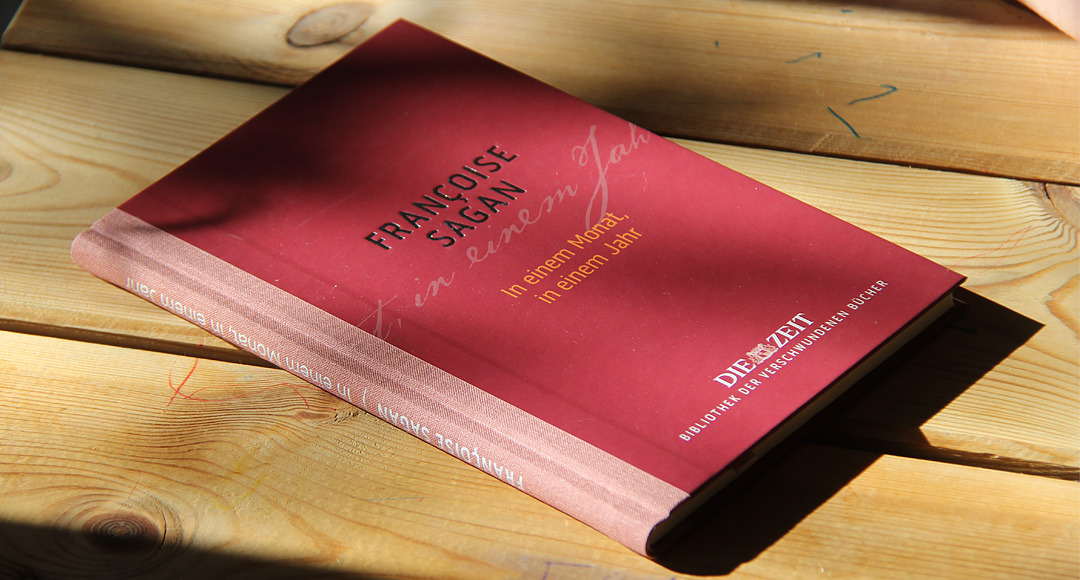
With “The Library of Vanished Books”, Die ZEIT is reissuing several forgotten classics. Somehow, it seems to be a current trend to unearth old treasures and present them again in an appealing form. Since I love beautiful books and classics, I hope this trend will continue and that more publishers will jump on this bandwagon.
In a Month, in a Year seemed the most interesting to me, even though its blurb is probably the shortest I have ever come across. However, since the book is only 112 pages long, anything more would have been a spoiler. Well, I’m exaggerating, but it really is more of a short story than a novel. So I was curious to see what could unfold in so few pages. I had neither read nor heard anything by Françoise Sagan before.
The writing style is clear and the sentences simple, yet still effective. You quickly sink into the story, and it’s easy to follow Sagan’s flow. Several characters are introduced early on, and the reader is given bits of relevant information here and there, forming at first a fragmented picture that soon fills with life. The style strongly reminded me of French films — that particular atmosphere that feels so typically French to me: with pauses where only the scene speaks, and with dialogues or inner monologues that linger, echoing subtly in the mind.
Here, Sagan depicts the fate of a few inhabitants of Paris in the 1950s. Although the plot moves forward through several deliberately chosen locations, Paris and its suburbs appear somewhat bleak and unwelcoming. All protagonists belong to the same social milieu and are connected in various ways, with desire, love, rejection, longing, and ambition standing close together — forming the central subject of the book. Hovering over the entire story is a sense of melancholy and, to me, a strange hopelessness. It’s a very distinct mood, the kind that often appears in French films, though I couldn’t quite name it precisely.
Somehow, the style also reminded me of Albert Camus, and when one looks at her characters, the central question of existentialism indeed clings to their fate. Out of complete freedom, each character constructs their own destiny and yet becomes a victim of themselves, as emotions like love or ambition emerge as dominant forces beyond human control. Without mincing words, Sagan states the facts and soaks her observations in a pale aftertaste of helplessness — or of being at the mercy of life itself.
[…]for life gives with one hand what it takes away with the other. (p. 59)
Conclusion: In a Month, in a Year is a book that, despite its brevity, deserves a recommendation. With its clear and unvarnished examination of human relationships and the pursuit of love, success, and contentment, Sagan touches on fundamental questions relevant to everyone. It’s fascinating to follow how her characters deal with their various situations, and her style — along with the subtle undertone of melancholy, hopelessness, and existentialism — makes this vanished book truly a classic well worth reading. Its weakness lies in its short length and a certain plainness that seems inherent to all works influenced by existentialism.
Book information: In einem Monat, in einem Jahr • Françoise Sagan • Eder und Bach Verlag • 112 pages • ISBN 9783945386118
Moin, lieber Tobi,
Sagan hat ihren ersten Bestseller in nur sieben Wochen schon mit 18 Jahren (1954) geschrieben: “Bonjour tristesse”. Und löste damals einen Skandal damit aus.
Mit 22 Jahren hatte sie einen Autounfall. Die Folge: eine lebenslange Drogensucht.
Liebe Anne,
über die Autorin hab ich auch ein wenig recherchiert. Petra hat ganz interessant darüber geschrieben:
https://phileablog.wordpress.com/2011/11/10/eine-alte-liebe-francoise-sagan/
“Bonjour Tristesse” als eine schicke Neuauflage wär schon was. Verstehe gar nicht, wieso das nicht ein Verlag schon für sich entdeckt hat.
Liebe Grüße
Tobi
Lieber Tobi, danke für die Erinnerung an Françoise Sagan. Dadurch habe ich unter meinen Schätzen soeben eine in Leinen gebundene und numerierte Ausgabe des Verlags René Julliard aus dem Jahr 1954 wiedergefunden! Ich liebe es, wenn an vergessene Bücher erinnert wird.
Viele Grüße!
Ist das eine französische Ausgabe? Das hat schon was, so ein Buch im Schrank stehen zu haben. Bücher mit Leineneinband und einer ordentlichen Fadenbindung, mit stimmiger Typographie bringen mich auch ins Schwärmen. Das hat einfach was, da macht das Lesen noch mehr Spaß. Besonders wenn das dann noch eine Autorin wie Sagan ist.
Liebe Grüße
Tobi
Ja, eine französische Ausgabe in Leinen mit Fadenheftung. Ein wenig stockfleckig, aber dadurch nicht weniger wertvoll. Ich liebe alte Bücher, die schon ein Leben hinter sich haben. Liebe Grüße zurück
ein wirklich interessantes Buch, sehr sympathische Rezension.
Wiedermal eine Erinnerung daran, dass ein Leben viel zu kurz ist, um alle tollen Bücher und Autoren dieser Welt zu entdecken :)
Liebe Jenni,
oh ja, das Leben ist definitiv zu kurz für alle guten Bücher. Ich glaube Sagan ist eine Autorin, die man recht leicht übersieht und daher passt das Buch hervorragend in diese Reihe der verschwundenen Bücher.
Liebe Grüße
Tobi
Lieber Tobi, wie schön, dass Sagans Stil dir auch zusagt. Wirst du noch mehr von ihr lesen?
Liebe Grüße
Petra
Liebe Petra,
also “Bonjour tristesse” ist auf der Liste, allerdings nicht mit höchster Prio. Fand ihren Stil ganz angenehm und schön, im Moment locken aber doch noch einige Bücher, die vielversprechender sind.
Liebe Grüße
Tobi