
Daphnis and Chloe • Longos
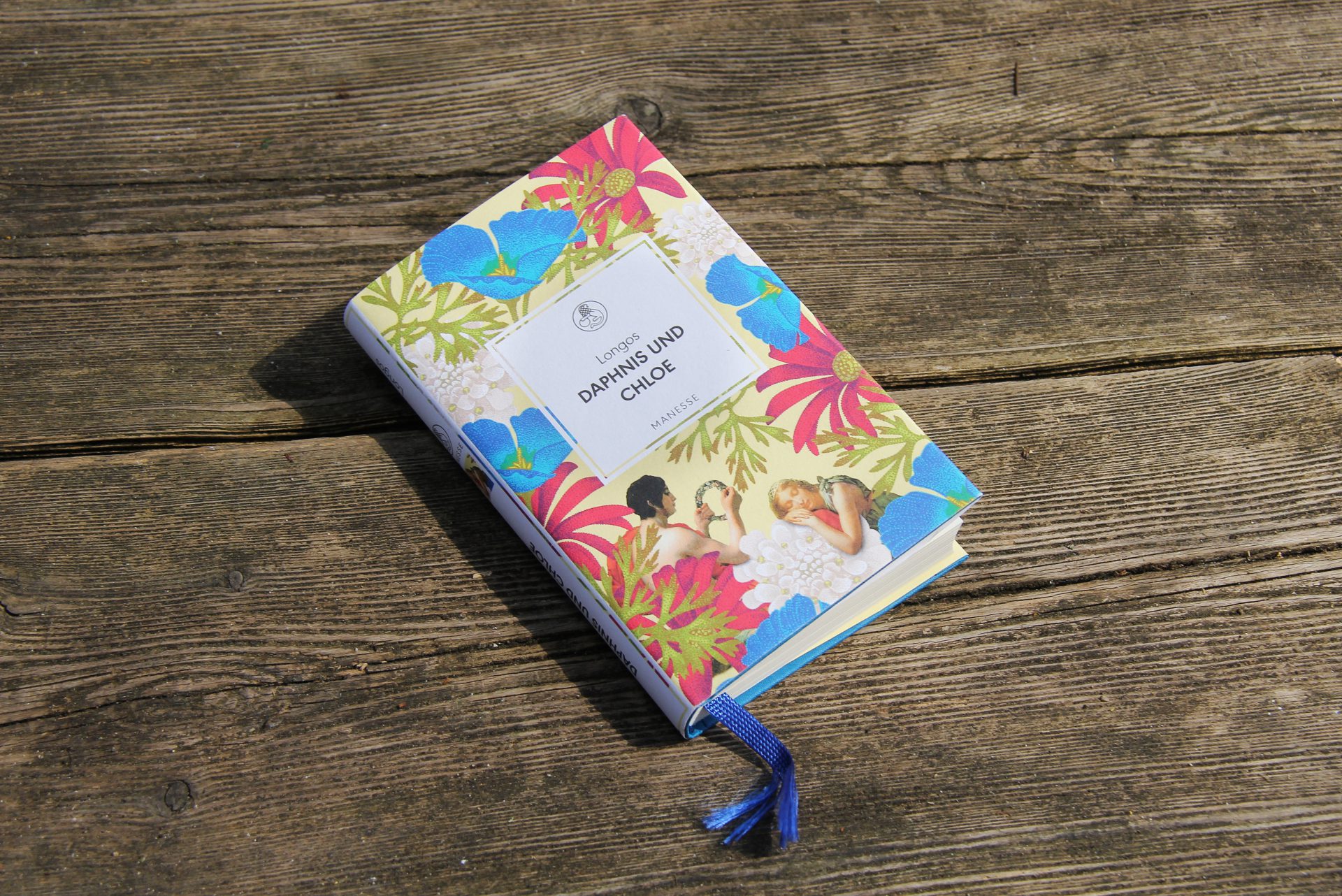
Looking back over the last few years, books from Manesse Verlag have made up a significant share of my reading pleasure. The traditional publisher’s selection is simply so broad, and the editions are usually so handsome, that I often give them preference. Daphnis and Chloe is one such little volume I spotted in the spring preview, and it won me over immediately—both in its presentation and in its content, which actually isn’t my usual fare. But what does that even mean? I like to try lots of things and read in all directions. Still, a novel that’s about 1,800 years old doesn’t land on my reading list very often. The fact that Daphnis and Chloe isn’t a stiff, antiquated text but reads with great ease, offers a wonderful setting, and feels like a mental vacation genuinely surprised me.

This love story is classed as “pastoral poetry,” a tale about shepherds—a theme that was apparently quite fashionable in the 2nd century. The title figures—fifteen-year-old Daphnis, a goatherd, and the two-years-younger Chloe, a shepherdess—graze their herds together every summer. Both are portrayed as very naïve, and over the course of the story they draw closer and fall in love. It’s in the spirit of a coming-of-age novel: the two young protagonists are making their first discoveries and are still a fairly blank slate. The plot spans roughly a year.
The whole thing takes place on the Greek island of Lesbos, and Longus describes this gorgeous setting wonderfully with just a few sentences. It’s like an old painting—Daphnis and Chloe seated together amid beautiful nature, falling in love; the wide blue sea in the distance; in the shade of ancient oaks; under the watchful eyes of the nymphs, of Pan, and of course of Eros, the Greek god of love, often depicted as Cupid. It all evokes the mood of warm summer nights and creates a densely atmospheric world. Goethe, too, raved about this lovely book and its marvelous mood—no doubt also in emotional recollection of his Italian journeys.

The novel reads very pleasantly. It’s not written in verse or in a lyrical form but in straightforward prose. The reading is effortless, and the simple sentences suit the naïve protagonists and the pure, innocent love Longus portrays.
“Eros, dear children, is a god—young, beautiful, and winged. That is why he delights in youth, pursues beauty, and gives souls wings. His power is greater than that of Zeus. He rules over the elements, he rules over the stars, he rules over his fellow gods; not even you have so much power over your goats and sheep.” (p. 48)
Manesse presents an entirely new translation here by the much-lauded translator Kurt Steinmann, who has already made a name for himself with his new German translations of Homer’s Odyssey and Iliad. There are quite a few German translations of this novel. According to the afterword, the original has a distinctive rhythm that only a few German versions have preserved. While reading, I wondered how close this comes to the ancient Greek. Considering the text’s age, this edition reads astonishingly well and smoothly. I asked myself whether that was thanks to Steinmann’s translation and compared it with the free Kindle edition translated by Friedrich Jacobs in 1832. Jacobs’s wording feels a bit more old-fashioned, but it’s just as easy to read. The ancient Greeks clearly had the knack for this 1,800 years ago—and with their frank, entertaining literature, they were far ahead of their time.

By contrast, almost nothing is known about the author Longus. Only the novel itself and its references—its style and the descriptions of Lesbos—allow a rough dating to the late 2nd century. Who Longus was, where he lived, and whether Longus was even his correct name are unknown. Apparently there are only two manuscript copies of his book.

The story and its theme were apparently beloved not only by Goethe and have inspired numerous adaptations. Maurice Ravel composed a ballet based on the novel. Rousseau turned the story into an opera (as did other composers). Naturally there are film versions—or at least works inspired by it. And the visual arts have embraced the book as well.
When Manesse announced a redesign of its Classics of World Literature series almost two years ago, I was of two minds (I wrote about it here). Since then the series has grown several times over, and some editions have truly impressed me with their design—for example, Home of the Gentry by Turgenev.
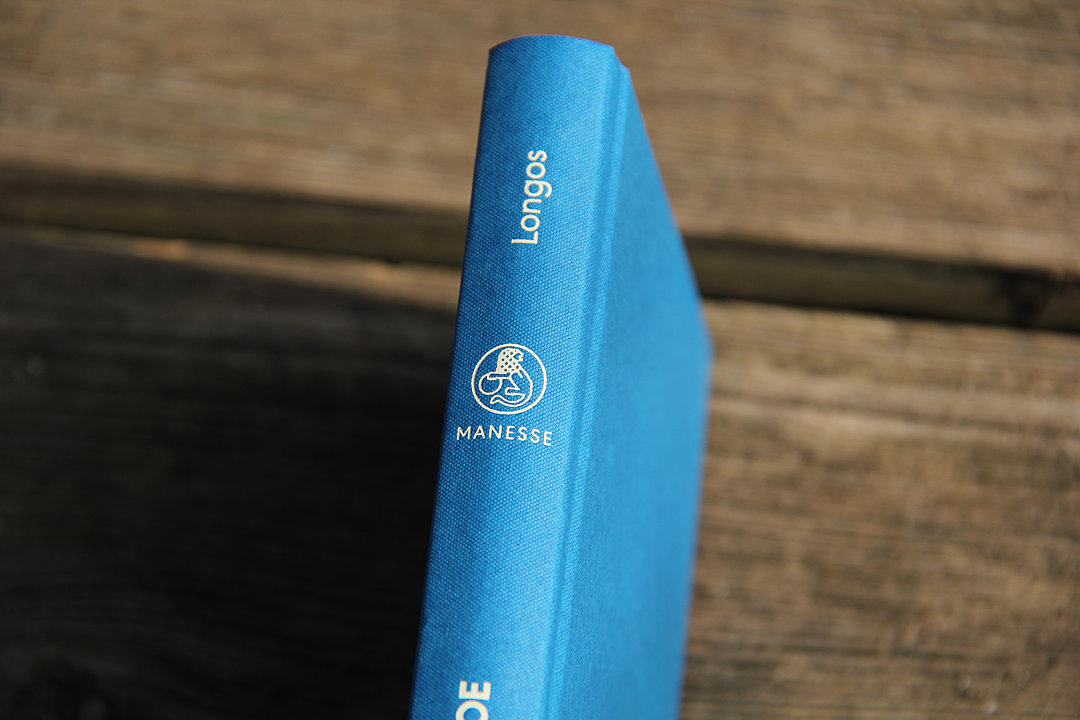
This edition is once again really well done. The color combination of blue and yellow harmonizes perfectly. Once more there’s sewn binding in the jacket’s blue, and I also like the dust jacket a lot. The entire book radiates that blend of love story and antiquity, to which the two drawn figures on the cover contribute greatly.

At 192 pages, it feels small and compact and is indeed a fairly quick read. I like its overall appearance very much. Since the Manesse relaunch, I still miss the cloth binding—but all in all, it’s a high-quality, excellently produced book that also makes a fine gift.
Conclusion: Although this love story is over 1,800 years old, the tale, the beautiful landscapes of Lesbos, and the simple, pleasant prose utterly won me over. A breath of antiquity hovers over the whole book—of balmy summer nights, the magic of ancient Greek myth, and of course naïve, pure first love. Set in unspoiled nature, it’s wonderful reading for switching off and immersing yourself in a picturesque world that recalls scenes from old paintings. The handsome design—with its splendid dust jacket and well-matched colors—contributes to that effect. A book I’ll certainly return to again.
Book information: Daphnis and Chloe • Longus • Manesse Verlag • 192 pages • ISBN 9783717524861
Ui, danke für die Empfehlung, lieber Tobi! Ich hab noch nie alte Manesse-Ausgabe in der alten Übersetzung hier … Da werde ich demnächst loslesen!
Liebe Grüße
Petra
Hallo Tobi,
für Romanzen bin ich ja sehr selten zu gewinnen, aber was du über die Stimmung und Landschaft in der Geschichte schreibst, hat mich nun doch neugierig gemacht. Da ich die alten griechischen Geschichten sowieso besser kennenlernen wollte, passt dieses Büchlein momentan auch gut.
Was die leichte Verständlichkeit betrifft, hatte ich den gleichen Eindruck auch bei Musaios’ “Hero und Leander”. Wie du dachte ich zunächst, dass das vor allem der Übersetzung zu verdanken wäre. Bei näherer Betrachtung wurde mir dann aber bewusst, dass es auch an der Art des Erzählens lag: die ganze Handlung ist aufs Wesentliche reduziert, es gibt keine langen Beschreibungen oder sonstige Ausschweifungen. Allerdings bleiben dadurch auch die Figuren recht oberflächlich gezeichnet.
Viele Grüße
Kathrin
Das Buch habe ich schon vor einiger Zeit mal auf meinem Kindle gelesen. Das ist natürlich nicht so schön wie diese Ausgabe hier. Aber ich fand die Geschichte damals auch sehr lesenswert und bin schon am Überlegen, ob mein Buchregal davon (demnächst) nicht vielleicht auch profitieren soll. :-)
Ich habe das Buch Anfang dieses Jahres im Rahmen einer Lehrveranstaltung gelesen. Passagen im Original, den Rest in einer etwas älteren deutschen Übersetzung (zweisprachiges Buch). Es ist sehr angenehmes Griechisch, die Kunst liegt in der Einfachheit und im Inhalt. Denn der Roman ist bei weitem nicht simpel, es wurde sehr viel literarisches adaptiert und mit dem Vorwissen der antiken Leser gespielt. So finden sich die Gegenüberstellungen Gott, Mensch und Tier, Stadt und Land, männlich und weiblich hier doch in recht komplizierten Beziehungen wieder. Man kann sich ein Bild von der damaligen Gesellschaft, vor allem aber von ihren Vorstellungen machen.
Ich werde Daphnis und Chloe mit Sicherheit auch wieder lesen und mir werden noch viel mehr Dinge auffallen, die mir beim ersten Lesen durchs Netz gerutscht sind.
Ein wirklich tolles Buch
Herzliche Grüße