
Schnell, dein Leben • Sylvie Schenk

As a book blogger, it happens from time to time that an unexpected book arrives — and if it’s one from Hanser Verlag, and not particularly thick, I’m easily tempted to give it a read. Even if it’s not exactly what I’d usually go for. I like to look beyond my literary comfort zone, and I’ve rarely regretted reading something entirely different. Schnell, dein Leben is such a book, and I’d like to share some of my impressions.
The title Schnell, dein Leben really says it all. This short novel of just 160 pages tells the life story of Louise, who grows up in a small mountain village in the French Alps, moves to Lyon to study, and eventually falls in love with a German man and follows him to his homeland. Schenk describes Louise’s thoughts, experiences, feelings, and impressions with a clear and precise language — quick, sharp, and evocative — managing to portray an entire life in just a few pages. That, to me, is an impressive artistic feat: to be so focused and at the same time give emotional depth to a life story, composing it as a coherent and linear portrait. Normally, a novel with this kind of subject matter would probably span around 400 pages. Yet I never felt anything was missing or insufficiently explored.
This precise clarity in Schenk’s language also creates vivid imagery — of the mountain village, her parents, the little bar, or her first physical experiences. Everything passes before the reader’s inner eye like scenes from a film. The scenes change quickly, and the book consists of many short chapters. Compared to the intricate, verbose style of the Romantics or the Realists, this book sits on the opposite end of the spectrum — it reads easily and swiftly.
In the end, the story revolves around the fate of a young woman of the post-war generation who, under the lingering shadow of World War II, as a Frenchwoman, takes a daring step by binding herself to a German man — the former enemy, whose people committed countless atrocities during the occupation. This is undoubtedly the central theme of the book. Questions of guilt, reconciliation, and the clash of worldviews and ideologies appear throughout. This becomes evident early on, when Schenk depicts the patriarchal family model of Louise’s parents — the mother receiving her household money daily from the authoritarian father — and how the children break free from this mold to live their lives according to a different spirit of the times. I found this very authentic, and it felt like Schenk captured well what both united and divided the generations. Naturally, the youthful search for identity — both Louise’s and that of her student circle — also plays a part. Schenk uses beautiful and well-crafted metaphors throughout.
“Parents live inside their children and can make them heavy and sad. If you’re lucky, they get smaller over time, like Russian matryoshka dolls, but they never disappear.” (p. 100)
Anyone glancing at the author’s biography on the jacket will notice the clear autobiographical elements of this book. Sylvie Schenk also grew up in a small town — Gap (Hautes-Alpes) in the French Alps — studied in Lyon, and likewise fell in love with a German chemistry student, moving with him to Germany. The thoughts, doubts, and desires she gives her protagonist are certainly not imagined; they feel authentic and grounded, and the way she describes cultural contrasts clearly draws from personal experience.
However, there were a few aspects of the book that didn’t appeal to me. One of them is the narrative perspective — the use of the second person singular, addressing the protagonist as “you.”
“As a little girl in the 1950s, you know your inferiority and wish you were a boy.” (p. 7)
This is how the novel begins, and the author maintains this form throughout. I found it somewhat disorienting — it creates a certain intimacy, more than an omniscient narrator would, yet less than the first-person perspective, which I would have preferred. It often felt as though someone was trying to impose thoughts on me that weren’t my own. In any case, novels written in this form are quite rare — for good reason, perhaps.
Even though the author has French roots, this book feels distinctly German to me. The mood is fundamentally somber; everyone is struggling with something — depression, death, dissatisfaction — all wrapped up with Nazis, Hitler, the persecution of Jews, questions of guilt, and so on. The whole Second World War theme, with its endless retellings and reexaminations, feels worn out — the thousandth repetition that doesn’t make it any better. Perhaps such stories broaden one’s intellectual horizon, offering an air of sophistication. But at the same time, these kinds of narratives are gloomy, cloud the sky, and feed into the so-called “German Angst.”
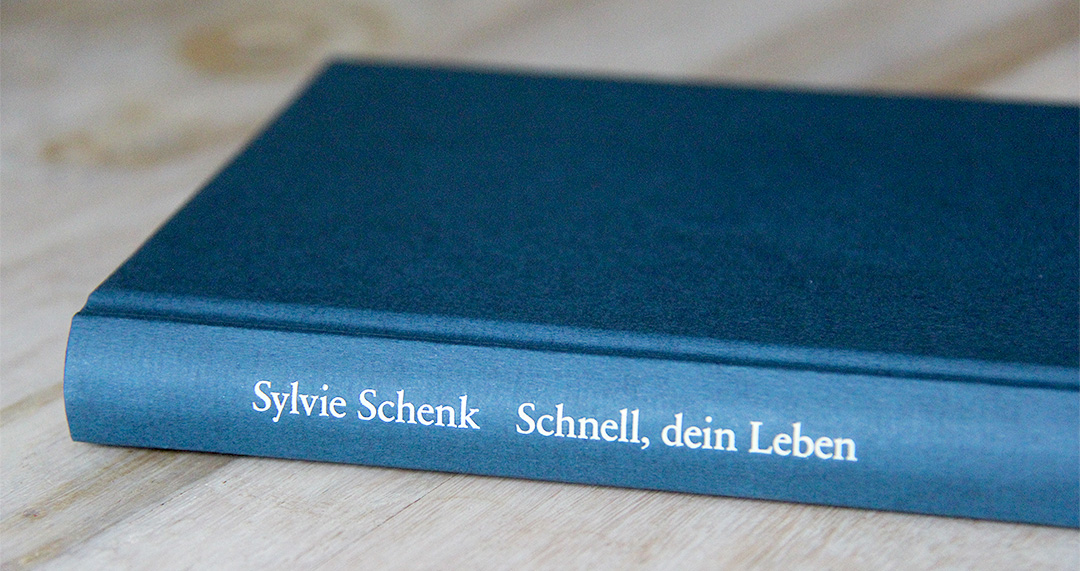
Conclusion: In just 160 pages, Sylvie Schenk portrays the life of a woman in clear and precise language, and it’s exactly this compressed form that makes the book so special. To convey so many thoughts, feelings, desires, and doubts — along with the lingering effects of World War II on a woman of the post-war generation — in such limited space is a remarkable achievement. At the same time, however, the narrative perspective, the generally negative tone, and the theme itself didn’t completely win me over. A book that is certainly worth reading — but one that needs to strike the right chord with the reader.
Book information: Schnell, dein Leben • Sylvie Schenk • Hanser Verlag • 160 pages • ISBN 9783442486069
Hallo Tobi,
Dieses Buch liegt auch noch auf meinem SUB. Eine Lesung der Autorin habe ich letzte Woche leider verpasst. Deine Rezension macht mich neugierig auf das Buch. Ich bin gespannt welche Wirkung die Erzählperspektive auf mich haben wird. Die von dir angesprochenen “ausgelutschten” Themen empfinde ich nicht als solche. Doch das ist Geschmackssache.
Deine Beschreibung erinnert mich Anfangs stark an “Ein ganzes Leben” von Seefelder. Auch hier wird das Leben eines Menschen auf vergleichsweise sehr wenigen Seiten aufgezeigt.
Eine Freundin von mir hat einen ähnlichen Lebensweg wie die hier beschriebene Protagonistin, nur ein paar Jahrzehnte später. Ich bin gespannt, ob sich hier Parallelen auftun werden.
Grüße
Silvia
Liebe Silvia,
ich habe das Buch schon als etwas ganz eigenes empfunden. Ein Stil, den man nicht an jeder Ecke antrifft und auch das starke komprimieren einer Lebensgeschichte macht es schon sehr lesenswert. Was natürlich das Thema angeht, da kann man sich über Geschmack streiten, was nur bedingt sinnvoll ist. Aber wenn natürlich ein nahestehender Mensch ein ähnliches Schicksal hat, ist es natürlich klar dass das Thema dann wesentlich interessanter für einen ist.
Ich bin auf jeden Fall auf deine Rezension dazu gespannt.
Herzliche Grüße
Tobi
“…Das ganze Thema zweiter Weltkrieg inklusive Nazis und Aufarbeitung ist einfach durch, das ist ausgelutscht, das ist die 1000te Wiederholung, die es auch nicht besser macht. …”
Das mag ein wenig flappsig formuliert sein und daher härter ankommen, als du es vielleicht meinst — aber selbstverständlich ist das Thema II. Weltkrieg inkl. Nazis nicht durch. Leider. Ebensowenig wie die Römer oder Etrusker jemals durch sein werden. Es ist schade, aber dieser Satz hat mir deine an sich interessant geschriebene Rezension verleidet.
Liebe Tania,
das habe ich natürlich bewusst provokant und mit political incorrectness formuliert. Den eigenen thematischen Fokus setzt man natürlich auf die Themen, die einen interessieren, faszinieren und gerade beschäftigen. Da hat jeder seine Vorzüge und ich nehme natürlich meine betreffend kein Blatt vor den Mund. Bei meiner Rezension lege ich großen Wert darauf hier aber zu differenzieren, was ich auch im Fazit ganz deutlich tue. Denn gut geschrieben ist das Buch, da kann man nichts sagen.
Liebe Grüße
Tobi
Es ist schon eine Meisterleistung eine ganze Biographie in nur 160 Seiten unterzubringen.
Klingt auf jeden Fall spannend, auch, dass zweite Person Singular als Erzählperspektive verwendet wird. Ich habe noch nie ein Buch mit dieser Erzählperspektive gelesen, oder ich kann mich zumindest nicht mehr daran erinnern. Hm, könnte was für mich sein, ich bin doch so geschichtlich interessiert:)
Liebe Grüße,
Valerie von MeerderWörter
Liebe Valerie,
da ging es mir ganz ähnlich, ich konnte mich auch nicht erinnern jemals ein Buch aus der Perspektive gelesen zu haben (mit Ausnahme von Abenteuerspielbücher, die immer in der Perspektive sind, aber das ist was anderes). Aber ich muss sagen, wenn man betrachtet, was die Autorin da in 160 Seiten packt, dann bekommt man selbst Lust so etwas zu schreiben. Und würde wahrscheinlich schnell frustriert aufgeben, denn ich bin mir sicher da steckt viel Denkarbeit dahinter das so zu komprimieren. Also wenn dich der geschichtliche Rahmen interessiert, kann ich dich nur dazu ermuntern das Buch zu lesen!
Liebe Grüße
Tobi
Lieber Tobi,
ich verstehe gut, was du meinst! Bücher über die NS Zeit kann ich absolut nicht mehr lesen, außerdem ist die Stimmung in solchen Büchern für meinen Geschmack viel zu trist. Schon in der Schule wurde ich dazu verdonnert solche Bücher zu lesen, dann ging es weiter auf der Uni mit der Pflichtlektüre. Irgendwann ist einfach Schluss!! Es ist auch sehr schade, dass wir Menschn im Deutschsprachigen Raum irgendwie auch gezwungen werden uns damit zu befassen, auch heute noch. Das wird wohl noch lange nachklingen. Aber ich finds toll, dass du auch mal Neuerschinungen eine Chance gibst, bei mir ist das ähnlich. Das müssen dann aber ausgewählte Bücher bei mir sein, die mich thematisch betrachtet interessieren. Ich mag Memoiren und Portäts sehr gerne. LG
Liebe Tinka,
irgendwie bekomm ich immer zwei Seiten mit. Einigen geht es wie uns, die wurden einfach in der Schule so zugepumpt mit diesen NS Themen, dass einfach irgendwann genug ist. Andere sind davon fasziniert und können einfach nicht genug davon bekommen. Ich für meinen Teil finde beispielsweise Bücher aus der Zeit und über die französische Revolution und die Jahre danach viel spannender. Weil sie die Republiken und das Demokratieverständnis maßgeblich geprägt haben und auch zeigen, wie wenig Bewusstsein für viele Dinge da sind. Wenn ich mir die politische Diskussionen so anschaue, glaube ich dass viele es wirklich bitter nötig hätten, mehr über diesen Ursprung der Demokratisierung Europas zu lesen. Und wie bewahrens- und schützenswert das ist. Dann in Schule und Studium das tausendste Buch über Hitler durchzukauen… ich weiß nicht.
Neuerscheinungen haben es bei mir momentan irgendwie echt schwer. Aber ab und zu mogelt sich doch noch eins in meinen SuB ;)
Liebe Grüße
Tobi