
Magic: The Gathering • An excellent game reimagined
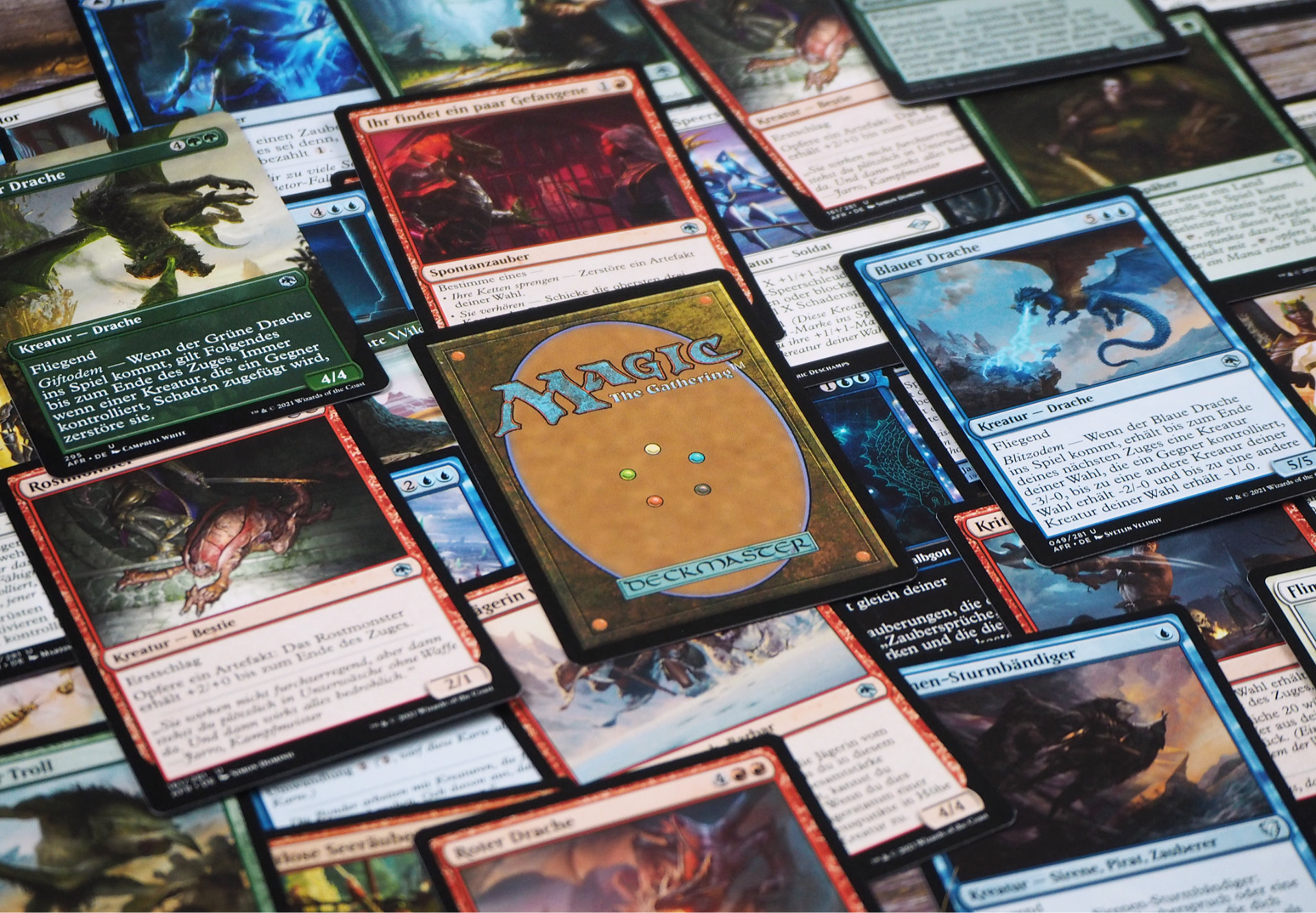
Today there’s no book review, but instead I’d like to introduce you to a wonderful game I rediscovered a few months ago: Magic: The Gathering. Featuring a game here on lesestunden.de is a first, but I think it’s a lovely idea—and delightfully nerdy. So please leave a comment or a like to let me know if you’d enjoy more posts like this. Introducing Magic: The Gathering here also fits this blog perfectly, because it’s something truly beautiful in its own right; with a few photos I’d like to rekindle your desire to play a game whose artwork is gorgeous. What special editions are to books, a few really lovely extras are to Magic for me.
Magic: The Gathering is a collectible card game set in a fantasy world with a complex rules engine. The combination of exquisitely designed cards and a rules system with tremendous depth makes the game a real pleasure. Magic has been around for almost 30 years, having been released in 1993. Even after all this time it remains popular and trendy, and I already loved playing it as a teenager. When school ended, I lost sight of it—and only rediscovered it a few months ago when I tried the online version, MTG Arena. That, however, only prompted me to pick up a few packs for the analog paper version again. In this longer post I want to introduce the game, whet your appetite for this beautiful card game, and share a bit about how, after such a long time, I explored Magic’s vast ecosystem. There are many ways to play Magic, and I want to show how I rediscovered the game for myself—without diving headlong into the nerd world and without breaking the bank.
What is Magic: The Gathering?
In Magic: The Gathering, each player takes on the role of a mage who uses spells from their library to try to reduce the opponent’s life total to zero. Your library is a selection of cards comprising various types: lands, which produce mana—the magical resource used to cast creatures, instants, enchantments, artifacts, and so on. That may sound fairly ordinary at first, but the game has a few special qualities that make it so appealing and successful.
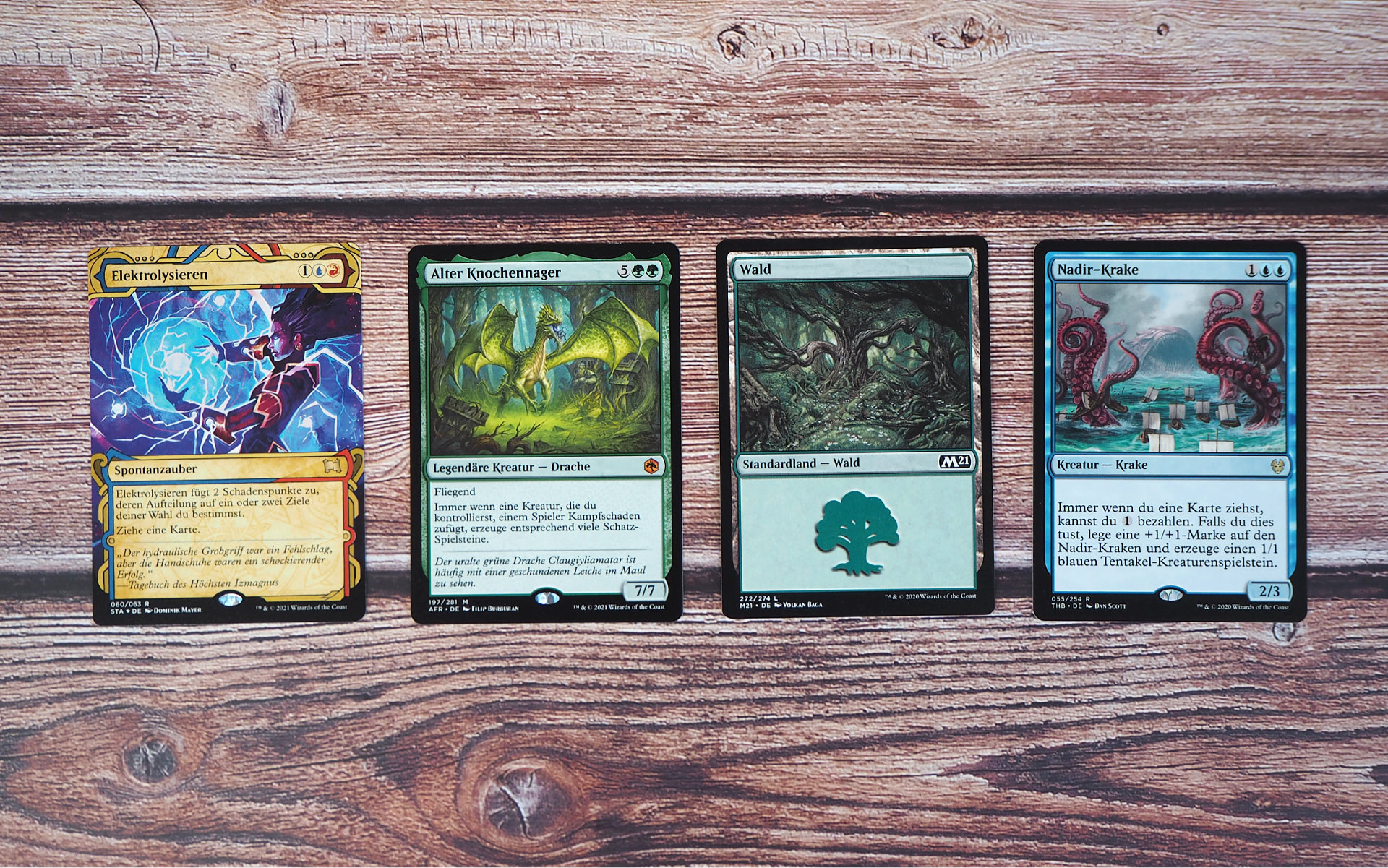
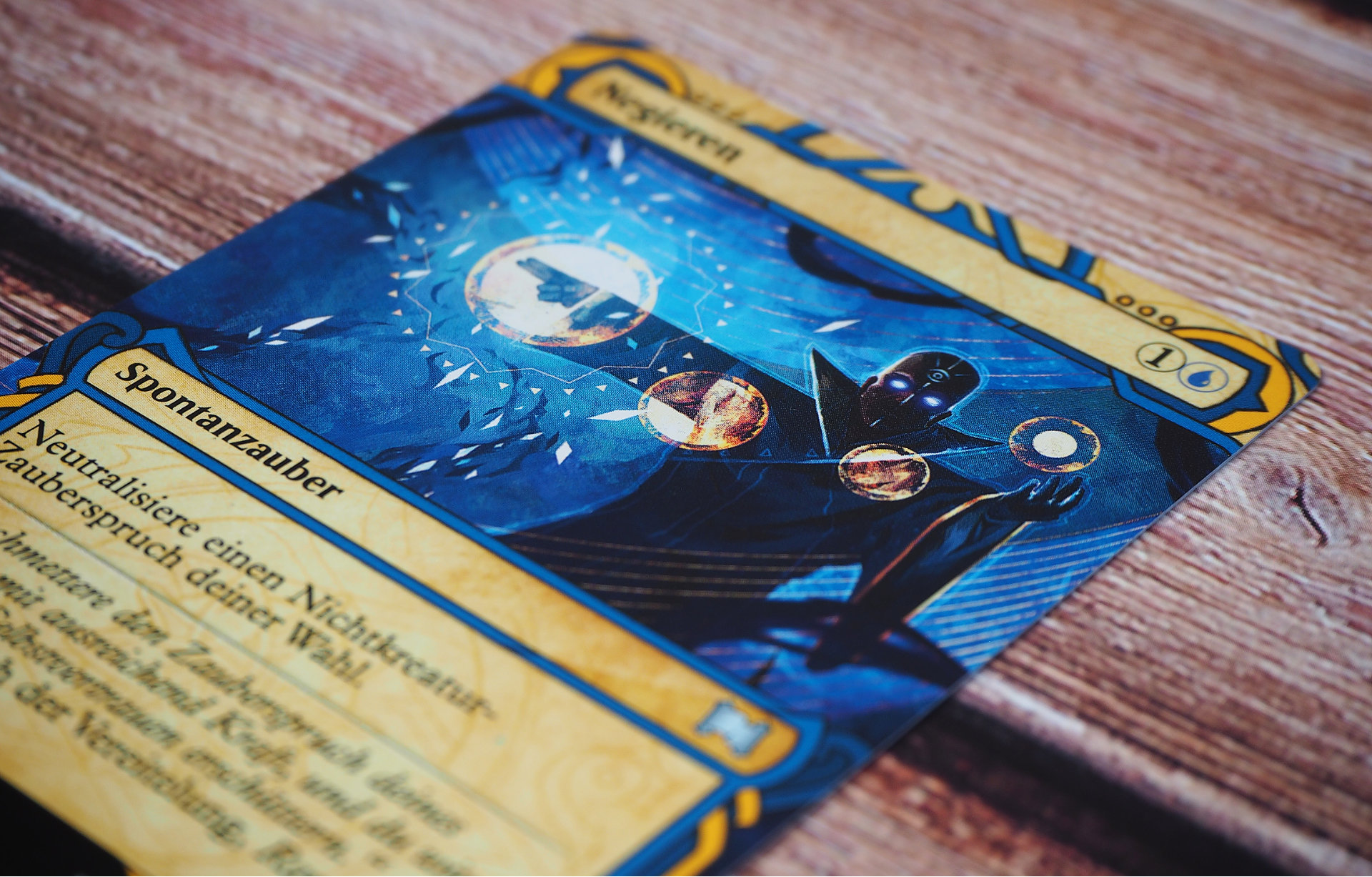
For one thing, there’s the beautiful design of the cards, each adorned with high-quality illustrations by renowned artists. Several sets with new cards are released each year, each with very different settings. The world of mythology, the icy realm of the Vikings, a wizarding school in the style of Harry Potter—these are just a few examples, and the creativity of the game’s makers, especially the talented artists, seems inexhaustible. I love beautiful fantasy illustrations, and these wonderful, very high-quality artworks are already an outstanding unique selling point of Magic: The Gathering.
Another special feature is that any given card can change the rules. The game continuously grows with new abilities—and with new cards that can alter and adapt the entire game state. Players build their library, also called a deck, of at least 60 cards from Magic’s enormous pool of cards. This leads to countless different deck variants that play and feel completely different. Depending on which cards you include in your library, the play experience changes dramatically.
The fascinating part of this multitude of combinations is the complexity that emerges. Magic: The Gathering is demonstrably the most complex game there is. The magazine Spektrum der Wissenschaft reported on this, and a study showed that Magic: The Gathering is even Turing-complete. The rules system is so powerful that, in theory, you could use it to develop complex software systems—for example, an Android operating system. Okay, that’s an exaggerated example and practically irrelevant, but it’s a fact that follows from theoretical computer science. Of course, as a player you’re not forced to open that huge barrel; you can enjoy the game without studying a rulebook for hours.

The learning curve is indeed steep at first, but overall it’s quite learnable, and the basic rules are manageable. For getting started, the free computer game MTG Arena is recommended; it introduces the rules very well. For me, though, a lot of the charm lies in the beautiful cards themselves—holding them in your hands and playing together with family and friends is far more enjoyable than sitting anonymously in front of a computer.
How do you play Magic: The Gathering?
Because there are so many cards, different formats have emerged over the years that define which cards can be in a deck. That matters especially for competitive play; in a casual circle you can relax and decide as a group what’s allowed and what’s not. In every larger city there are stores that sell Magic cards alongside fantasy and role-playing supplies, and every Friday there’s Friday Night Magic, where players meet regularly to play together. If you’re just starting out, you can try a premade deck to test the waters.
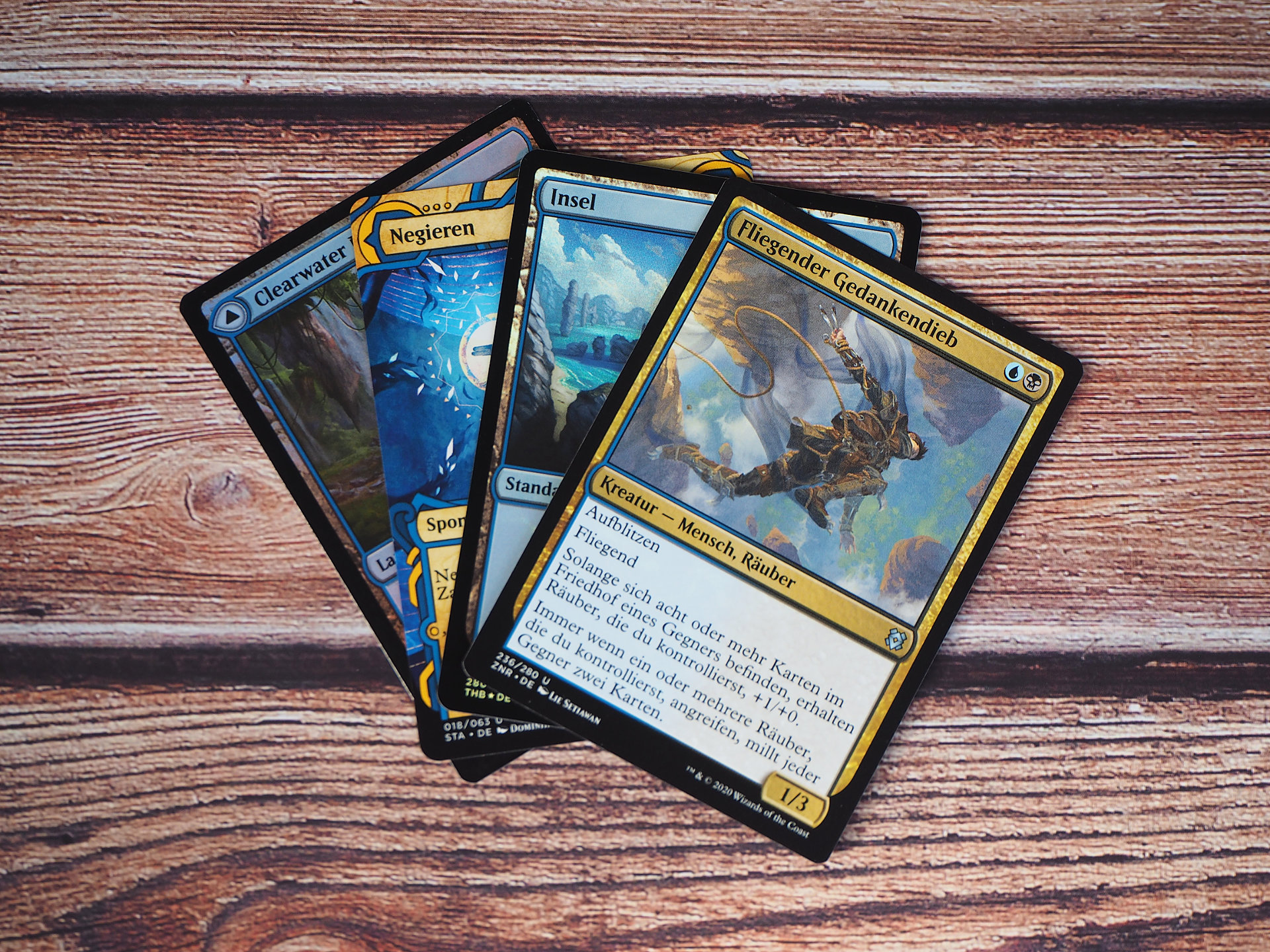
Once you play a bit more, formats become quite interesting because they set boundaries. In the Standard format, only cards from the most recent sets may be used, with a yearly rotation that removes the oldest sets from the pool while new sets are released. There are regular tournaments and competitions for Standard. In the Modern format, all cards from the Eighth Edition onward are legal—so quite a lot more. My absolute favorite format is Commander. Your deck must consist of a legendary creature and exactly 99 other cards, and each card may appear only once in the deck. Legacy and Vintage are the most expensive formats because the very old cards are allowed there. There’s also the Draft format, in which players open random boosters and build a deck from them. An overview of all formats can be found here.
Several sets are released each year, usually with around 300 cards. Depending on the format, you can put together your deck from all these sets—a proper variety. Online there are numerous sites with deck ideas and even very strong ready-made lists. The internet has changed Magic a lot compared to back then. If you want to play in tournaments, you can’t avoid studying what other players are running and which combinations are strong or weak. Deckbuilding is the great art in Magic.
What Magic products are there?
Magic cards are sold in many different ways. For newcomers, premade decks are definitely a very good way to try the game. The MTG Arena Starter Kit is available on Amazon for €5.99 and consists of two decks you can play with right away. There are also premade Planeswalker Decks, which aren’t very strong, but they also let you jump in immediately.
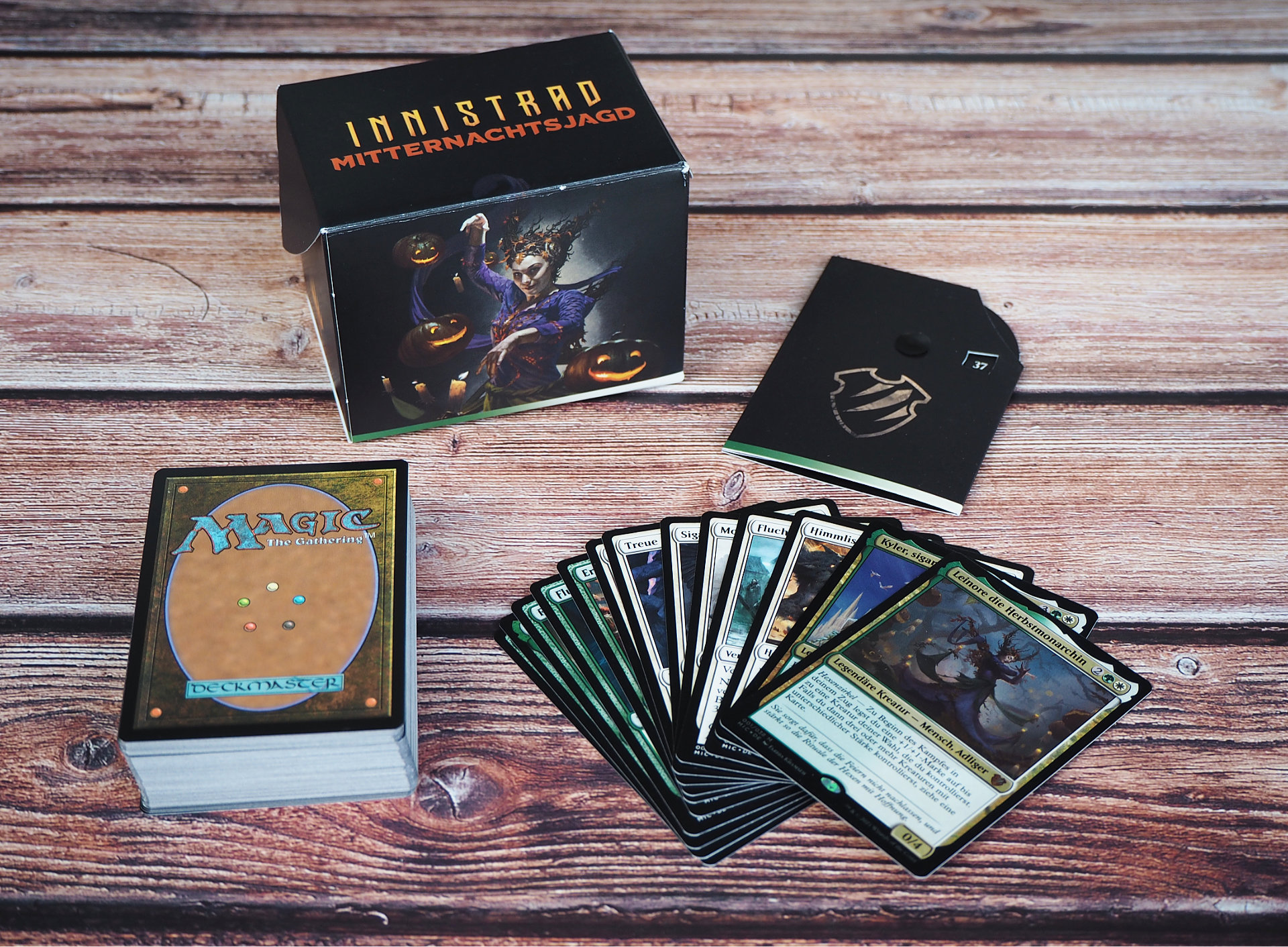
My absolute favorites are the preconstructed Commander decks, especially those from Strixhaven or Forgotten Realms. They’re already quite good power-wise, feature very different mechanics, and are nicely balanced against each other. Playing them against one another is a real pleasure, and in terms of price-performance I find them the fairest of all Magic products out there.
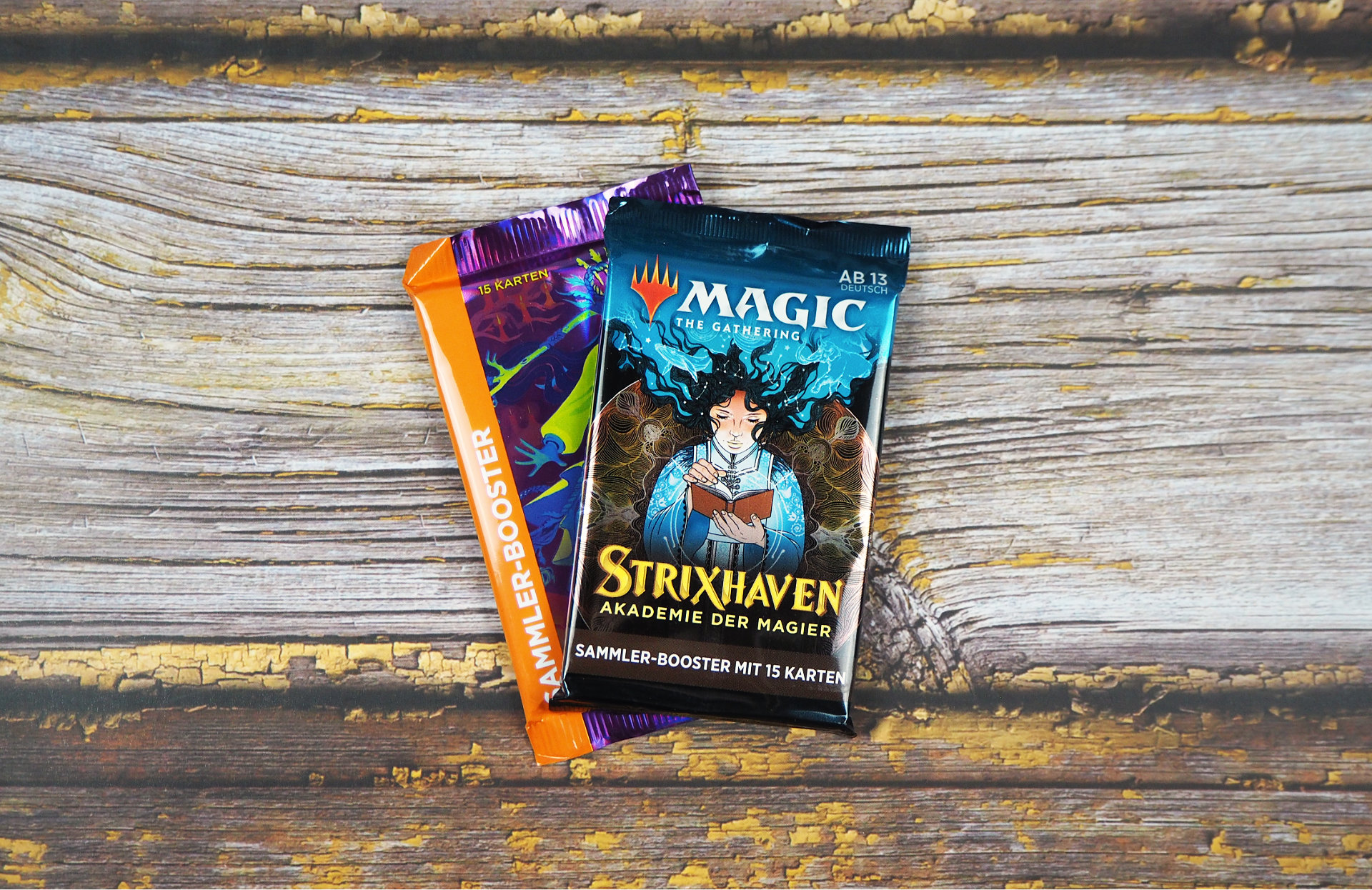
There are also boosters—the predecessors of loot boxes you know from video games. You get about 12 to 15 cards without knowing what’s inside. That could mean highly coveted rares, or unexciting commons. Every Magic card has a rarity: common, uncommon, rare, up to mythic rare. Generally speaking, the rarer a card, the stronger it tends to be. I find boosters largely uninteresting, because you’d need to buy a lot to assemble a strong, good deck out of them.
But you can also buy singles. If you want to build a specific deck, you can get individual cards online. Prices range from a few cents for commons to very high prices for highly sought-after cards. It even goes so far that there are investors who buy Magic cards, hold them for a while, and bet on rising prices to resell (often entire booster displays) at a profit. That’s pretty wild, but it does happen and seems to be quite lucrative for some.
Where I buy Magic cards
Like most things, I ordered my Magic cards online. With the exception of the Starter Kit, Amazon is too expensive—so forget it. There are numerous smaller online shops, but they’re often really pricey too, and I always wonder who orders there when the cards are significantly cheaper elsewhere. It’s easy to overspend—happens all the time.

The absolute top dog and largest marketplace for Magic cards is www.cardmarket.com. Cardmarket is a platform that lets sellers offer Magic as sealed product (boosters, premade decks, etc.) and as singles. For sealed product, it almost always pays to check Cardmarket first. And for singles, Cardmarket is basically unbeatable. Because of the direct competition there, single prices on Cardmarket are consistently much lower than in other shops.
I find Cardmarket brilliant. You can tell it’s been refined over a long time. You can create want lists to build a wish list. With singles, the problem is always shipping costs: if you buy a card for €0.02, you still have to factor in postage, which is often higher than the card itself (though cards ship well in an envelope). Cardmarket has a Shopping Wizard for that. Based on a wish list you’ve prepared, it tries to assemble the cheapest combination and bundle purchases from sellers so the total price is as low as possible. I suspect that, from an IT perspective, this is an optimization problem that’s too expensive to solve exactly, so the wizard’s result is often a bit off. I frequently had to tweak and double-check, but as a starting point Cardmarket really takes a lot of work off your plate.
As a central European marketplace for singles, Cardmarket is also a good source for estimating the value of your own cards. If you want to price multiple cards (for example, a deck), deckstats.net is recommended. You can store decks or your entire collection there and get the total price for all cards using Cardmarket data.

A second shop that feels like it’s been around for a hundred years is Miracle Games. Commander decks and boosters are available there at very good prices, and shipping is fast—with invoicing. In my view it’s a real insider tip: at first glance it looks rather unassuming, but it’s very well stocked with good prices.
The worst option is the toy store around the corner. I once checked the toy department at Müller and you pay hefty markups there. A Strixhaven Collector Booster costs nearly €30, instead of around €18 (incl. shipping) on Cardmarket. But that effect with brick-and-mortar retail is nothing new.
If you favor quantity over quality, you can get whole boxes of common and uncommon Magic cards on eBay for little money. That’s basically the chaff that collectors and competitive players pull from boosters in large quantities and don’t need. However, it’s not worth it, because to build a deck you need a good mix across all rarities. Of course, commons are necessary for a good deck—but not only those. From what I’ve read, eBay collections are a gamble. I suspect people regularly take each other for a ride, selling supposedly valuable collections that are mostly commons. Not an option for me.
Criticism of Magic: The Gathering
A game with this level of complexity, depth, and the sheer volume of sets also has its downsides, which I don’t want to gloss over. You should know that Magic: The Gathering is Hasbro’s big cash cow. It generates a lot of revenue, and the product portfolio is designed accordingly—to extract as much money from players as possible.
As mentioned above, there are many formats. Depending on the format you choose, costs for singles can be high if you want to play competitively (e.g., in tournaments or ambitious playgroups). Standard decks come to about €300, Modern decks around €800, and if you play the older Legacy or Vintage formats, you can easily spend €20,000 on a deck. The principle is basically buy-to-play: if you want to compete, you first have to shell out, or you’ll show up with a weaker deck, get stomped, and lose often. Someone clever and crafty can probably assemble a good deck with cheaper cards, but that’s quite an art—and rather unlikely.
If, like me, you don’t play tournaments and prefer family game nights, fair starting conditions are crucial. What you get “for free” in a game like Ludo (Mensch ärgere dich nicht) is hard to achieve in Magic: The Gathering. You can roughly orient yourself by the total card value in a deck, but as soon as everyone builds their own deck, imbalances arise quickly—which leads to frustration, because one deck will outclass another and someone will lose frequently. In my view, this is already the case when, for example, two teenagers play during a school break and one has a much higher card budget; that player will simply have far more rare or mythic rare cards. I’ve found a pretty nice solution to this problem, which many ambitious Magic players probably don’t think of when choosing products.
Another problem is the gambling aspect of boosters. They naturally entice purchases, because the chance of pulling good cards triggers the subconscious. There are studies on this, and even animals can develop addictive behavior when there’s a probability of reward rather than certainty. Especially with adolescents, I view this critically—just as with loot boxes in video games.
The online offshoot MTG Arena only convinced me to a limited extent. It’s beautifully implemented, but so focused on generating revenue that it’s right at the pain threshold of what players will tolerate. Wizards of the Coast publishes the probabilities, and based on those I ran the numbers. You’re looking at around €200–€300 for a good deck there as well—at least for the first two decks; after that it gets cheaper as your card pool grows. Still, for cards you only own virtually, that’s cheeky. In the last season I earned two good decks by playing, and for Standard 2022 I also built a nice deck—but only from the rewards you get for playing for free. Everything else is too expensive for me; it’s fine for a quick game now and then, but the real fun is with physical cards in hand and an old-school game night at the kitchen table.
How I play Magic: The Gathering
For me, as already mentioned, there are two major problems with Magic: The Gathering: the high costs if you want competitive decks, and the challenge of keeping decks evenly matched. That’s why I like preconstructed Commander decks best. For Strixhaven and the Forgotten Realms set there were several, and they’re simply great. For about €30 you get a 100-card deck whose singles are worth roughly as much as the whole deck costs. The decks are very well balanced, and it’s simply fun to play them against each other: the game swings back and forth, and each turn someone can turn the tide. That’s just fun, and we always end up laughing when someone already sees themselves as the winner and then the opponent wipes all creatures—or drops a super-strong creature that completely flips the board. Commander games also take a bit longer, making them perfect for an evening play session.



Beyond that, I also like the Challenger Decks. Like the Commander decks, they follow a specific game plan, are reasonably balanced against each other, and represent the archetypes played in the Magic scene—just not at top power levels, so you’d tend to lose outside a relaxed home session. Online you can find guides on how to upgrade these decks—but that usually involves expensive cards again, bringing you back to roughly €300 per Standard deck.
I built a few decks I had played in MTG Arena and that I simply found very well designed. However, that’s tricky again because they don’t match up with the Challenger Decks—they’re far too strong and basically win all the time. Not worth it overall, and I won’t do that again. Of course, the upside is that you can resell the strong, sought-after cards easily via cardmarket.com.
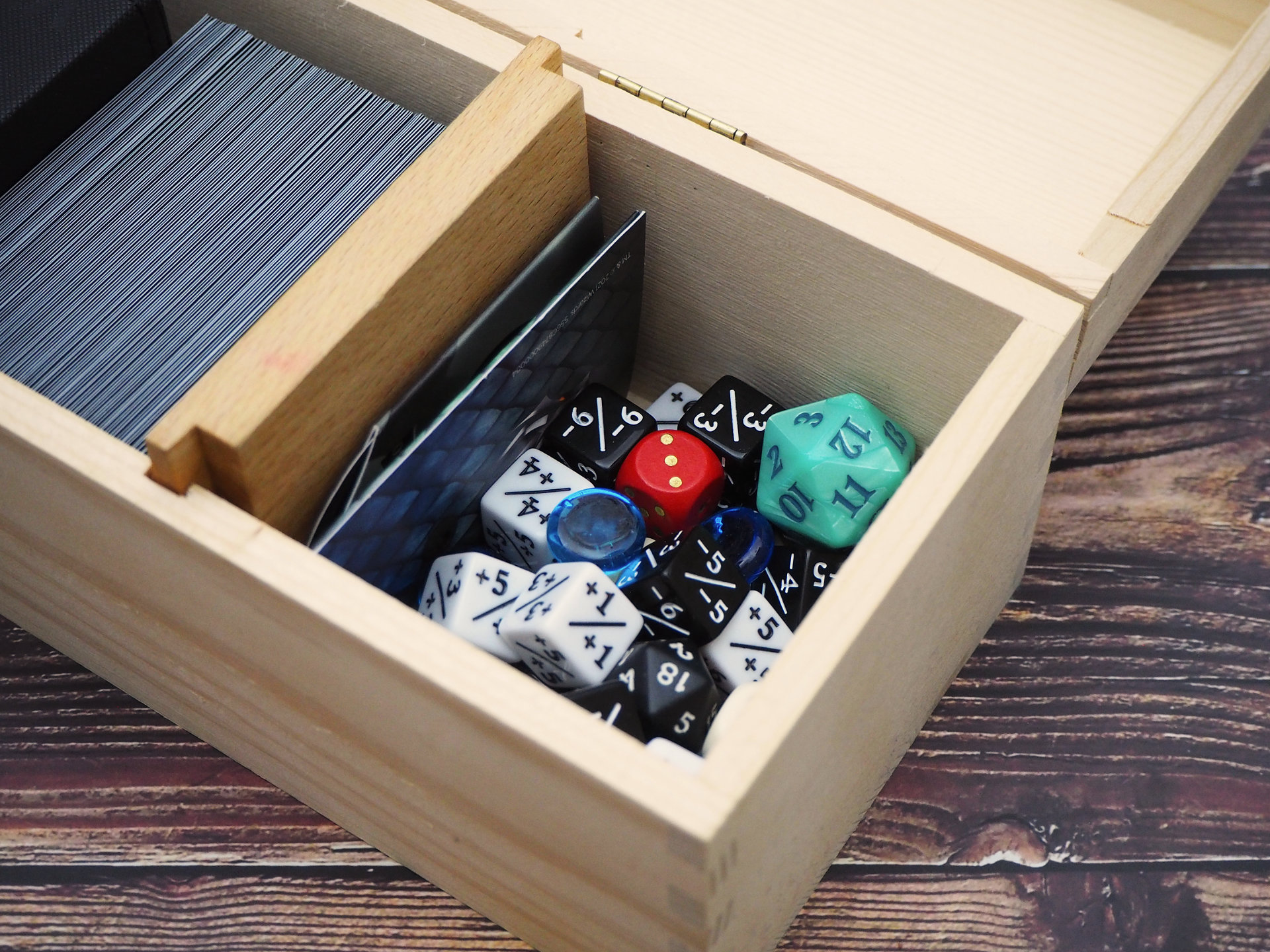

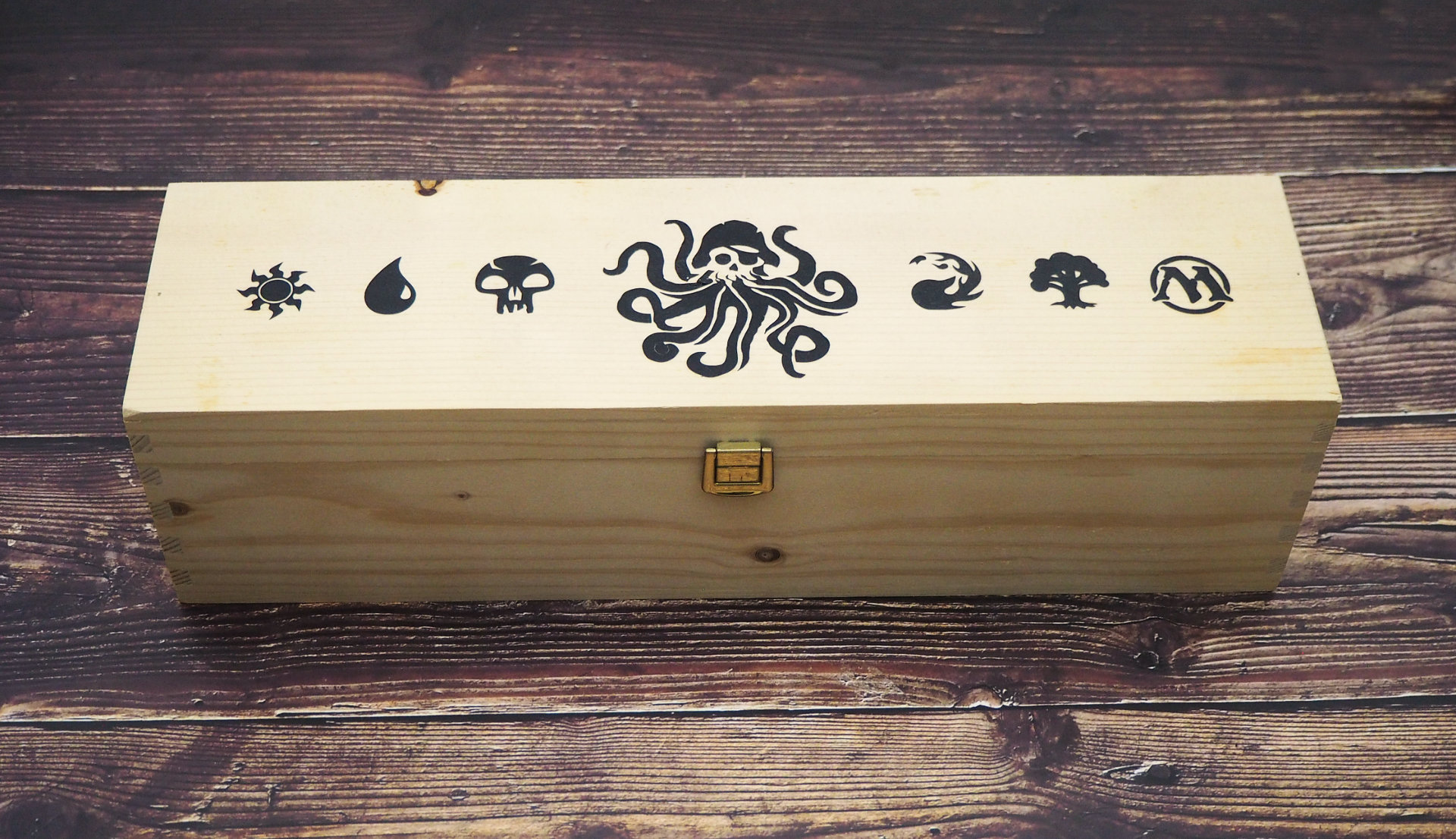
As with books or records, I like to make a ritual of Magic: The Gathering. I love the pirate setting and built my own Pirate Commander deck—or rather a box with many pirate cards from which I can assemble multiple decks. I treated myself to a really beautiful leather deck box engraved with pirate symbols, which is simply a joy to draw cards from. It instantly puts you in that fantasy game-night mood.
I also found an old wine crate and converted it into a Magic card game chest. I sanded off the winery print, and together with my better half—who happens to have a cutting plotter—we reprinted the lid, of course with a fitting pirate motif and the Magic symbols. The chest has room for the snazzy pirate deck box, extra cards, and also dice, tokens, and life counters. For me, the box falls into the “beautiful things” category, just like my fine books—it has style and sets the mood.
When I first got back into Magic: The Gathering a few months ago, I was surprised at how much had changed. There are lots of websites and online tools to build or discover decks. And there are even people who invest their money in Magic cards. They buy entire booster displays and singles to sell later at a higher price. Accordingly, there are websites where you can manage a Magic card investment portfolio—much like a stock portfolio at the bank. I found that pretty wild, but also kind of cool, because some folks apparently make nice profits. However, that should be approached with caution: the publisher reserves the right to take a slice. For example, Wizards of the Coast regularly releases so-called Secret Lair Superdrops—boxes with a few but valuable singles that otherwise fetch a lot on the secondary market. Reprinting these cards naturally pushes their prices down again. So overall, it’s not exactly a retirement plan.
Conclusion
Magic: The Gathering remains a very successful and worthwhile card game even after nearly 30 years. It’s a pleasure to play a few relaxed rounds in the evening, to hold the beautiful cards with their elaborate, atmospheric artwork, and to dive into the different settings. For me there’s always a hint of nostalgia and childhood mixed in. Even though the sheer number of cards, sets, and products may suggest otherwise at first glance, you can enjoy Magic without cashing out your savings—provided you know how and where to draw the line. If you play tournaments or want truly top-tier decks, you’ll of course have to dig deep. But if, like me, you simply want to play a relaxed game at home with your loved ones, preconstructed decks already deliver a lot of fun. It’s a card game I can warmly recommend—for yourself, as a gift, or to coax that lethargic teenager out from behind the monitor for an old-school round at the kitchen table.
How about you? Do you know Magic: The Gathering? Do you play it, or have you played it before? Or do you prefer another game of this kind? Or does this post automatically fall into the “random noise” category for you, and you’d rather reach for a beloved classic now?
Ich habe das Spiel früher gespielt. Magic Runden machen wirklich Spaß. Was ich allerdings mit zunhemendem Alter kritisch sehe ist der Sammelkartenvertrieb und die Gruppenpsychologischen Effekte, die derartige Spiele auslösen. Als Jugendlicher habe ich das Karten und Bundle Erwerben noch als Teil des Deck buildings bzw. des Spaßes gesehen, aber vom Prinzip her ist es total mies, wie das angelegt ist. Klar – man kann sagen: “betrifft mich nicht” und seinen Spaß haben. Man kann aber halt auch ein Mensch mit Prinzipien sein und sagen. Es sind Sammelkarten, ich rühre das nicht an. Es gibt tausende andere Tisch Spiele die Spaß machen.
Liebe Joana,
ich sehe das auch kritisch, wie hier die Hersteller ihre Spiele auf Gewinnoptimierung ausrichten. Bei Magic ist das schon auch echt extrem. Es wird auch klar, dass das Spiel sich primär an Erwachsene richtet. Welches Kind oder Jugendlicher kann sich das annähernd ein spielstarkes Deck leisten? Ich kann mir allerdings schwer vorstellen, dass es bei Jugendlichen zu sehr starken psychologischen Effekten kommt, weil einfach das Geld dafür nicht da ist. Welcher Jugendliche kann sich für 200 Euro Collector Booster Displays leisten? Oder Einzelkarten für 50 Euro? Die bekommen doch den Fuß schon gar nicht in die Tür. Kritischer ist es dann eher bei jungen Erwachsenen, die schon über ein Einkommen verfügen und dann damit nicht klar kommen. Als Erwachsener kann man das schon sehr gut kontrollieren und steuern, wie man das Spiel spielen möchte und was es einem Wert ist. Ich für meinen Teil hab da eine sehr gute Balance gefunden, so dass es ein Vergnügen ist. Den kapitalistischen Zirkus, den die Firma da so vorgeben möchte, den mache ich ganz sicher nicht mit. Insoweit kann ich gut verstehen, dass Du für Dich zu dem Entschluss gekommen bist, Magic nicht mehr zu spielen.
Liebe Grüße
Tobi