
Flaschenpost • Wolfgang Struck
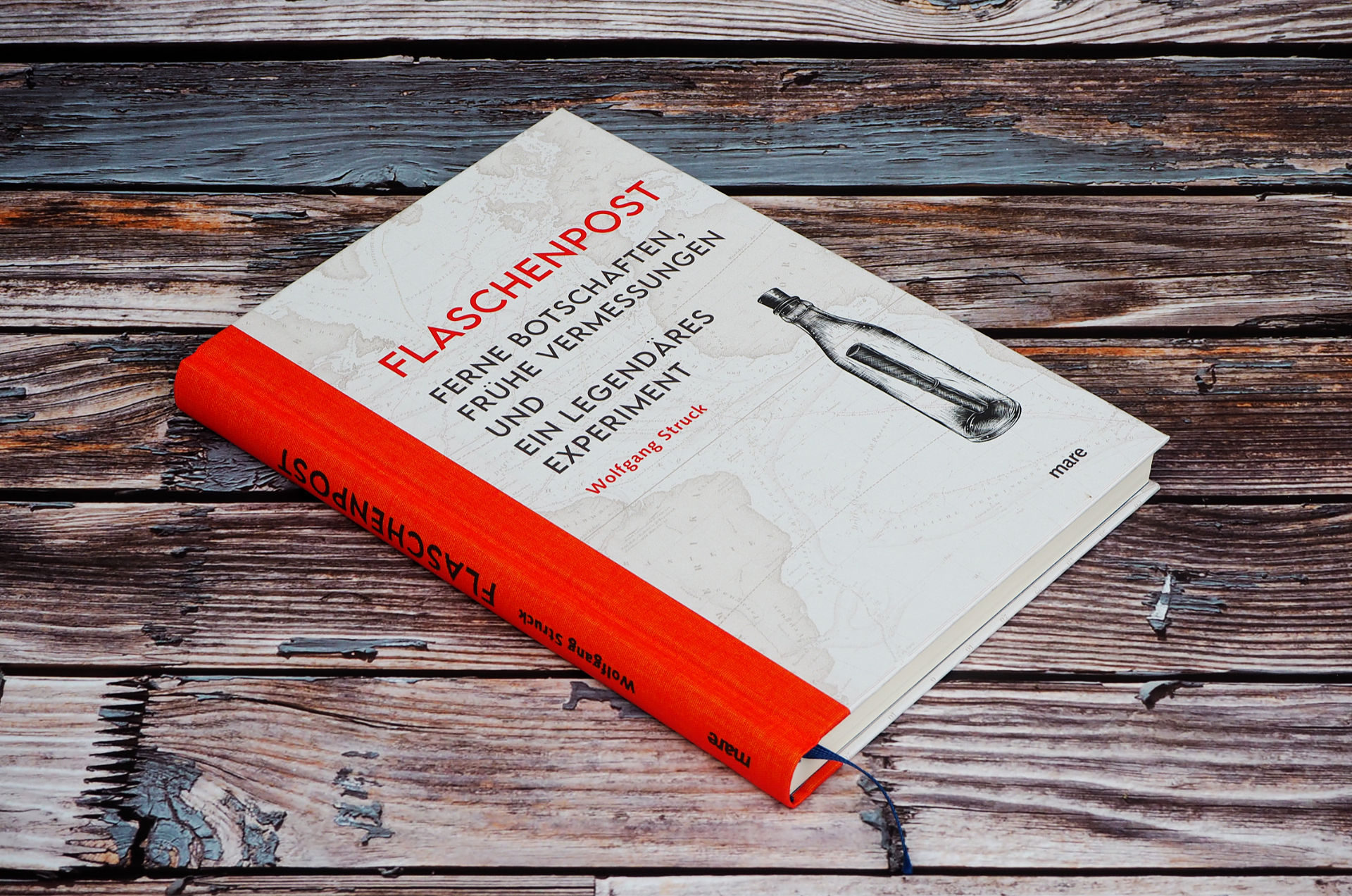
Very few books manage to spark positive associations in me just from their title and thus catch my attention. These are usually topics and things that are simply imbued with positivity from the outset because they call up a vague feeling from childhood and youth. For me, that definitely includes treehouses, pirates, and the message in a bottle. So it’s no surprise that I couldn’t resist Wolfgang Struck’s Flaschenpost. Not least because it carries that special whiff of adventure and, in its design, resembles the many pretty maritime books already on my shelves—foremost Judith Schalansky’s Atlas of Remote Islands, which for me has become the benchmark for beautiful, breezy, and entertaining books about the sea. Whether Flaschenpost also falls into that category, and whether it can awaken the romance behind the very idea of the message in a bottle in the reader, is what I’ll write about in the next lines.

The central subject of the book is an experiment initiated by Georg von Neumayer in the mid-19th century. Fascinated by the sea and hydrography—the study of bodies of water—he was interested in the vast oceans and conceived of them, with their currents, as a being in its own right that he wanted to understand better. To that end he set adrift (or had set adrift) more than 6,500 bottles at various points. Inside was a preprinted form to be returned to his institute, asking finders to record the coordinates and the time the bottle was found. About 10% of the bottles were found, and one by one the little slips reached Neumayer, who carefully collected them all and pasted them into an album. It often took well over a year before a reply reached him, and most bottles were lost for good. But from the data he gathered—supplemented by other observations—he was at least able to infer the ocean currents in broad strokes.
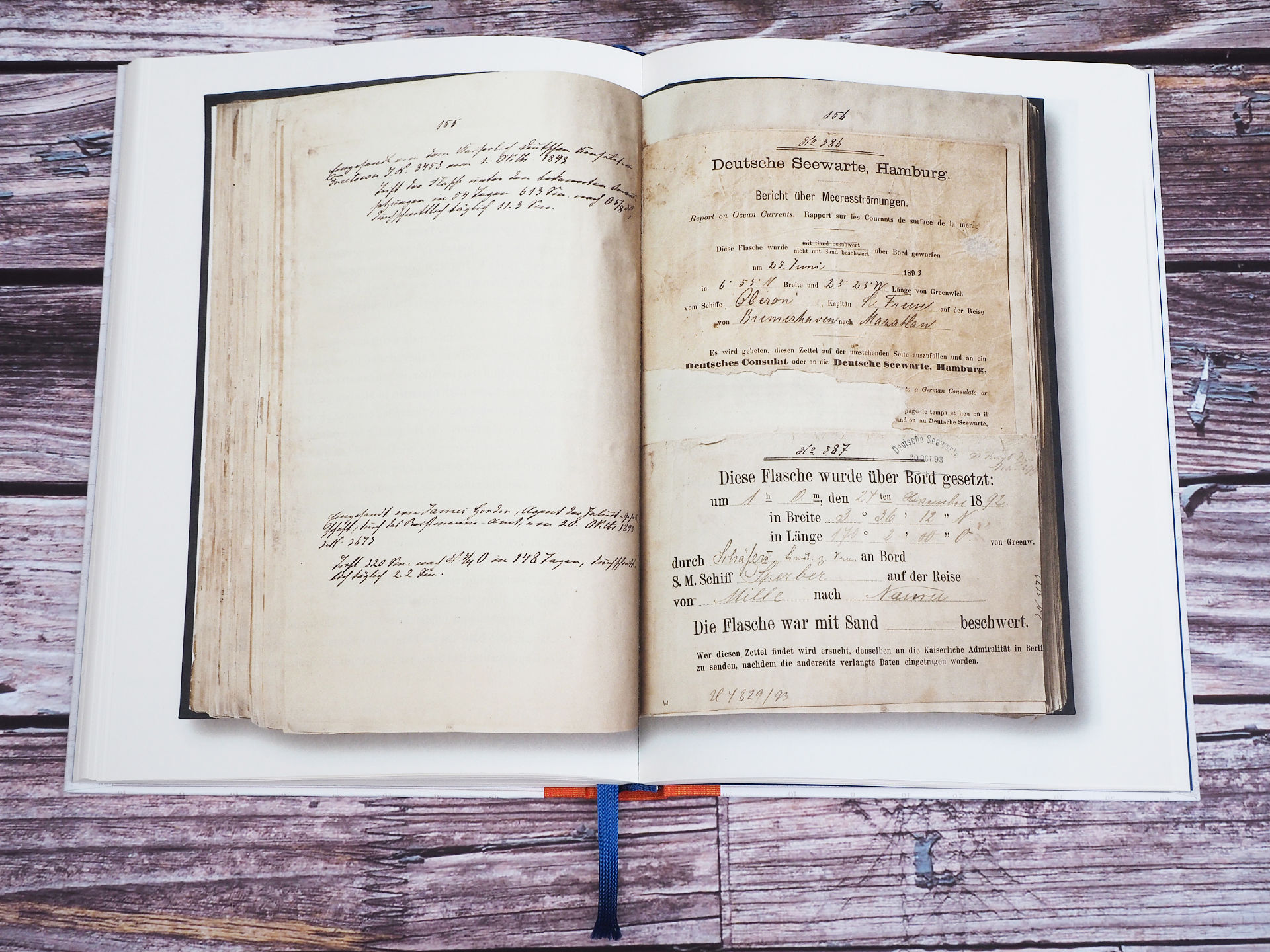
This experiment is presented through a selection of individual bottles that appear again and again as their own chapters. At the beginning of each chapter, Struck lists the distance traveled, the time, the geolocations, the people who set the bottle adrift, and the finder. On the following double-page spread there is a large reproduction of the entry in the album, showing the originally completed form and Neumayer’s notes. Listing them all would, of course, go beyond the scope of the book, so we get a selection.

Between these selected bottles are longer chapters devoted to a wide range of topics surrounding messages in bottles. These include a historical overview of the practice, Neumayer’s life and work, and a multitude of other anecdotes and stories related to it. There’s the role of the message in a bottle in science; there’s philosophizing about it, for instance by linking it to poems; and Struck recounts in one chapter how the ship London sank and how several letters had previously been sent out from it in different bottles. Elsewhere he connects two launched bottles to the history of slavery, discusses the Middle Passage, and shows how two bottles released at the very same spot drifted in completely different directions and finally landed on two different continents. In another chapter Struck describes a scene in which Neumayer, together with the painter Eugene Von Guérard and several others, climbs a mountain in the Australian Alps. Lastly, Struck turns to the message in a bottle in literature, retelling and interpreting in one chapter Jules Verne’s three-part novel In Search of the Castaways and in another Hans Christian Andersen’s fairy tale Flaskehalsen (The Bottle Neck).

Overall, the spectrum is quite broad. Struck attempts a panoramic view, considering the message in a bottle from every possible angle. While reading, however, I realized that the message in a bottle has a far less lively history than I had originally assumed. The book includes exciting anecdotes—for instance, of a mother who entrusted herself to a message in a bottle to process her grief. Or about Columbus’s first “message in a bottle,” a floating barrel that was to carry the news of the discovery of America should his ship sink on the return voyage. At the same time, there were many chapters in which the connection to messages in bottles felt very contrived to me—such as when a poem about a message in a bottle and its interpretation takes center stage. Or the mountain-climbing story, where the meanderings of a missing assistant were rather forcibly linked to the unknown paths of bottles adrift.

My expectation of finding stories with a certain wit, a twist, a hidden novella-like message was only partially met. That may be due to the interspersed chapters on Neumayer’s career path, but also to the fact that some of the anecdotes presented have only marginally to do with messages in bottles. It also has to do with the chatty style, which tends to philosophize, interpret, and speculate at length. In many places that was too much for me, and I caught myself reopening the author’s bio.
Wolfgang Struck is Professor of Modern German Literature at the University of Erfurt, with a focus primarily on the relationship between science and literature. I think this background accounts for the degree of philosophizing and interpreting. The many quotations and the extensive bibliography show, however, that the book is thoroughly and meticulously researched.
I found it particularly interesting to realize that messages in bottles could only really become common with the industrial production of bottles. In those days there weren’t many bottles aboard a ship; water and other drinks were stored in barrels, and at most the captain might have had a bottle or two in his cabin. The second intriguing insight is that a functioning message-in-a-bottle system depends on a globalized postal network. Neumayer’s experiment worked only because, for just a few decades by then, it had been possible to reliably send mail back to Germany even from other continents. The romantic notion of a pirate stranded on an island with his rum bottle, sending for rescue via a message in a bottle, probably never really occurred in that form—or was so unlikely that it’s scarcely worth mentioning.
I also found it interesting to read about Georg von Neumayer himself. I immediately associated the name Neumayer with the polar station in Antarctica, and indeed it was named after him. Neumayer’s own path was anything but linear: born in 1826 in the Palatinate, he applied to the navy in 1848 but was rejected, then sailed to Australia as a seaman, where he worked for a time in the goldfields and taught other German emigrants navigation. He studied geophysics and hydrography and became the first director of the German Naval Observatory he had proposed—an institution that would eventually become the Federal Maritime and Hydrographic Agency.

I’m very taken with the book’s partial-cloth binding and the drawing on the cover. It doesn’t have thread stitching, but it does have the pleasantly supple paper I appreciate so much in mare books. The illustrations are consistently of excellent quality, and the book includes a color-coordinated ribbon bookmark. I like it a lot, and it fits beautifully with the other sea-themed books on my shelf that are similarly designed.
Conclusion: Reading Flaschenpost once again stirred in me that familiar feeling of sea-borne adventure—the mood that clings to many maritime tales. The reader learns about Neumayer’s research project, in which he sought to analyze ocean currents more precisely by launching bottles. The book’s basic structure rests on selected bottles whose contents actually made their way back to Neumayer, along with the brief stories and key data the reader is given. I often found the interspersed anecdotes and stories about messages in bottles very interesting; at times, though, too chatty, and sometimes a bit contrived in their connection to the topic. It is certainly another very handsome book—pleasant for relaxed evenings and also well suited as a gift—but measured against the many books of sea stories and anecdotes, for me it sits more in the middle of the pack.
Book information: Flaschenpost • Wolfgang Struck • mare Verlag • 224 pages • ISBN 9783866486737
Vielen Dank für die schöne Rezension. Ich habe das Buch auch im neuen mare-Programm entdeckt und war neugierig geworden, aber nicht richtig überzeugt. Dank Deiner Rezension habe ich jetzt, denke ich, einen sehr guten Einblick gewonnen.