
Toplist of German book publishers: How successful are trade publishers?
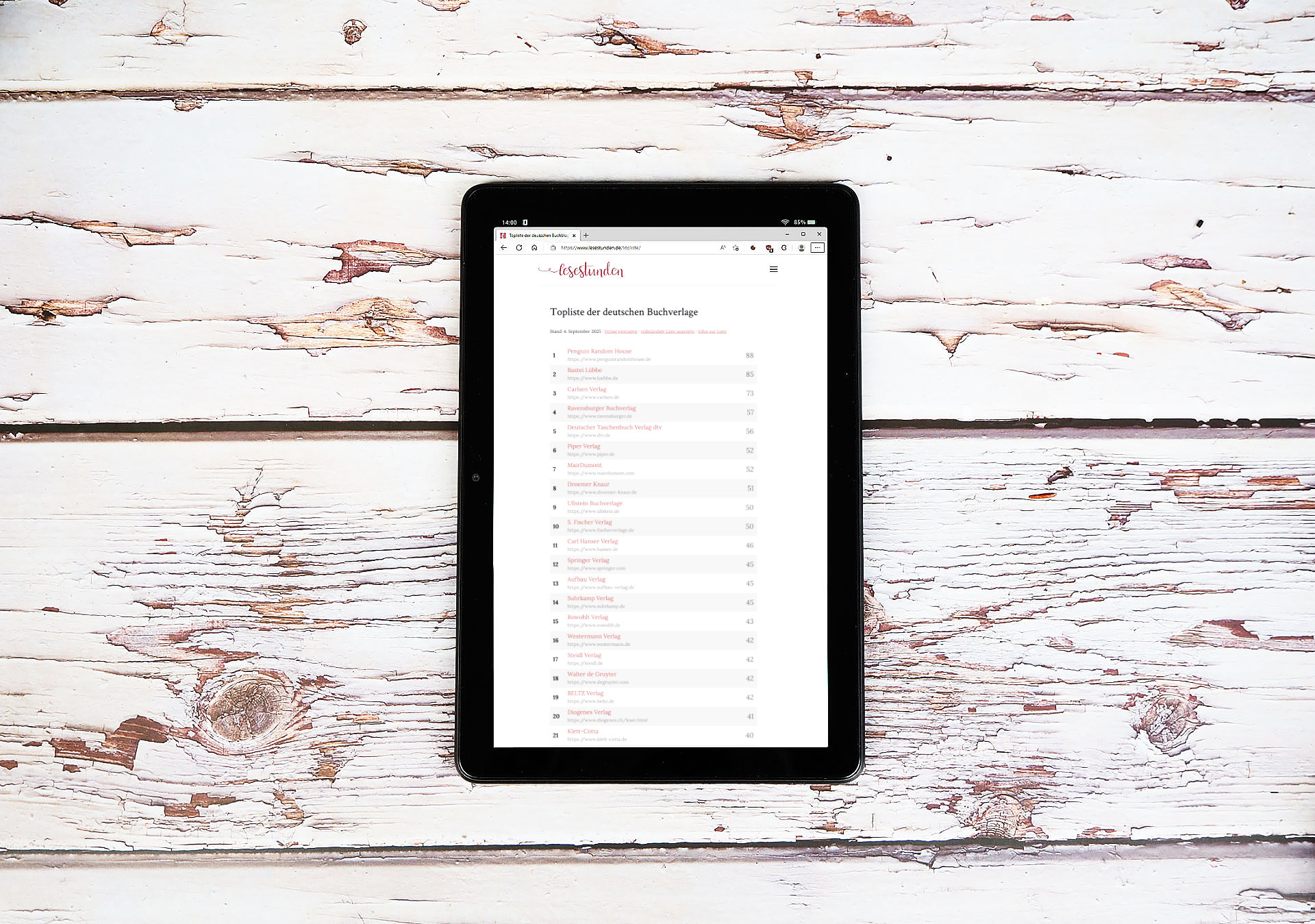
For quite some time, I’ve been toying with the idea of taking a closer look at publishers’ online activities. I’ve wondered which publishing houses are the most popular and successful online. We often read about how important social media and the internet are for publishers’ marketing strategies. “Bookstagram” has long been a buzzword, there are now “BookTok” bestseller lists, and a few years ago, book blogs were the focus of publishers’ public relations work. But how successful are publishers really with their online marketing activities? I combined various lists of all German publishers available online and created a toplist of German publishers. One of the results truly surprised me.
If you follow the literary world, you’ll notice that there are always new trends publishers use for their marketing activities. Ten years ago, it was book blogs that suddenly came into focus. Book bloggers were supplied with free review copies, invited to publisher events, and special blogger meet-ups were organized. At book fairs, bloggers were invited and networks were built. That hype then shifted toward Instagram. In recent years, TikTok has become the new go-to platform for publishers to promote their books. Large trade publishers targeting younger audiences can hardly afford to ignore it anymore.
Some publishers use social media very intensively, likely investing quite a bit of money, since all those channels must be filled with engaging content. Others, however, seem to rely more on their traditional sales channels. The question for me was: which publishers are the most visible and active online? What does the overall online presence of German publishers look like? To make sense of all this, I created a list to summarize the data and provide an overview.
Calculation of the Toplist
To assess online visibility and assign a ranking in my toplist, I used several metrics:
- PageRank: To measure the visibility of a publisher’s website, I used OpenPageRank. This numerical PageRank value, between 0 and 10, indicates the relative importance of a domain on the web.
- Instagram followers: This simple number shows how popular and established a publisher is on Instagram.
- TikTok followers: Likewise, this represents the followers a publisher has on TikTok — the latest trend in online marketing for publishers.
- Book blogs: This value shows how many blogs reference or write about a publisher or its imprints and subsidiaries.
I then calculated a single score from these four metrics, which determines the ranking in the toplist. Each metric was normalized between 0 and 1 and weighted: PageRank and followers each accounted for 40% of the total, and book blogs 20%. TikTok followers were given a 1.5x weighting factor.
This single score provides a good overall picture of how visible a publisher is. PageRank reflects visibility through search engines and across the web, Instagram and TikTok represent social media presence, and the book blog metric captures popularity somewhere between the classic web and social media.
You can view the results on the Toplist of German Publishers.
Evaluation of the Results
It’s unsurprising that the large publishing houses and groups top the list. Over the past decades, there has been strong consolidation, with many smaller publishers being acquired by large groups. As a result, the websites of these acquired publishers often merged into the parent company’s site. Some imprints or subsidiaries maintain their own social media accounts — but not all. Therefore, I listed these publishing groups as single entries, aggregating their subsidiaries. Separating them would make little sense, especially since marketing resources are likely shared within the group.
As expected, the list is led by the big publishing groups that bring many imprints under one roof. Bastei Lübbe surprised me — I hadn’t really had that publisher on my radar — but thanks to its popular Young Adult and youth fiction imprints, the group has gained strong visibility. That’s precisely the market segment that has grown rapidly in recent years. Penguin Random House taking first place is no surprise; the company has acquired numerous publishers over the years and invested heavily in marketing, which is feasible with such a broad base. It was also the first to launch its own blogger portal around ten years ago. On Instagram and TikTok, Penguin also has a huge following and high visibility. The Carlsen Verlag being near the top is also unsurprising — they’ve been very active in online marketing, something I’ve noticed myself, even if their program isn’t quite my focus. dtv Verlag stands out with a large number of followers on its non-YA Instagram account, which points to excellent marketing. I wouldn’t have guessed Ravensburger Verlag to be so prominent, but of course, with their famous children’s books, they’re highly popular in the book market. For Klett-Cotta Verlag, I expected a much higher ranking. With only about 35,000 Instagram followers, there’s definitely more potential given their well-known fantasy authors.
It’s obvious that publishers targeting a younger female audience tend to have much stronger social media presence and, consequently, higher online visibility. Imprints such as LYX Verlag, One Verlag, Cove Verlag, and Forever Verlag are particularly in demand online. Naturally, larger and more established publishers also tend to have more followers, which is no surprise. Overall, however, the follower numbers still seem rather modest. Established publishers average around 60,000 followers on Instagram — Hanser Verlag with about 65,000, Suhrkamp Verlag around 70,000, Rowohlt Verlag at 75,000, Droemer Knaur roughly 61,000, Kiepenheuer & Witsch around 60,000, and Diogenes Verlag also near 60,000. According to online sources, Germany has around 46 million monthly active Instagram users. On average, only about 0.1% of German Instagram users follow one of the larger publishers. That’s quite low — and the limited interest in books aligns with the figures on the book market. Considering that the 2019 “Bachelorette” has nearly a million followers, it’s clear where the focus lies in the land of poets and thinkers — and it’s not on reading. Okay, that’s not entirely fair, since 450,000 followers for Bastei Lübbe’s imprints, over 400,000 for Carlsen Verlag, and nearly 320,000 for the Penguin Group are still impressive numbers.
63% of publishers have at least one Instagram account. 12% have a TikTok account. That’s understandable, as creating TikTok content is probably more time-consuming, requiring short and appealing videos, whereas Instagram marketing can go a long way with good visuals. When publishers are on TikTok, their follower counts are usually much lower than on Instagram. Outside a young target audience, it’s likely not very cost-effective to advertise there. Still, I was quite surprised, since TikTok has often been called the marketing powerhouse for publishers. It’s likely that users discuss books among themselves on TikTok more than publishers actively participate. Nevertheless, I expected significantly higher numbers, closer to those seen on Instagram.
I was also surprised at how few publishers there actually are. 706 publishers and publishing groups are on the list. Yes, under umbrellas like Penguin Random House, many individual publishers are united. But overall, the diversity isn’t as large as I initially thought. The German Publishers and Booksellers Association reports around 3,000 publishers, though that likely includes specialized, academic, and magazine publishers. I’m a bit torn: yes, 700 publishers plus their imprints is quite a lot, but somehow, I expected even more — especially given 58,000 new releases last year and over 90,000 at peak a few years ago. Of course, that’s a subjective view: I love books — for me, there can never be too many publishers.
The Data Basis of the Toplist
Lists of all German publishers are usually found on websites for authors, who naturally want to identify potential publishers for their books. There’s also an extensive list on Wikipedia. I combined, consolidated, and enriched all the lists I could find.
I relied heavily on artificial intelligence in the process, so the data may contain errors. I manually reviewed and adjusted the list and cross-checked various sources. Especially the search for Instagram and TikTok accounts and for publisher imprints was automated using AI — otherwise, it would have been an enormous effort. Despite all diligence, some data might still be missing or incorrect. Please feel free to leave a comment or send me a message if you notice anything.
I excluded all publishers without a website and tried to filter out newspaper and magazine publishers. I had multiple language models review the list, add missing publishers, and remove irrelevant ones.
Deciding which entities to list as independent publishers and which as imprints or subsidiaries isn’t always clear-cut. There are also parent companies — for example, Carlsen Verlag belongs to the Swedish media group Bonnier AB. Some publishers are part of a holding and themselves have imprints and subsidiaries. So where do you draw the line? I think the solution in the list is pragmatic. It wouldn’t make sense to list Manesse Verlag separately if it belongs to Penguin Random House and doesn’t have its own website (even if it does have its own Instagram account). The level of abstraction isn’t fully consistent, but I think it’s appropriate for this purpose.
Conclusion
The toplist of German publishers largely meets expectations: publishing groups with imprints aimed at younger female readers (Young Adult, New Adult, romantasy, etc.) have much higher online visibility. Established publishers without that younger target group typically reach five-digit follower counts on Instagram, which, given Germany’s overall social media usage, is relatively low. 63% of publishers are on Instagram, while only 12% are on TikTok — a surprisingly small share, considering that “BookTok” has been a hot topic for some time. All major publishers have arrived in the social media world, and at the top of the list are the big publishing groups you’d expect to see there. The toplist also invites exploration — I found myself clicking through publishers and browsing for books. The book world, even online, remains a wonderful place.
Hi Tobi!
Du machst dir immer so unglaublich viel Arbeit mit solchen Beiträgen! Herzlichen Dank! Ich werde auf jeden Fall immer wieder mal in die Liste schauen, denn da sind so viele Verlage dabei, von denen ich noch nie gehört habe! ^^
Auch dieser Beitrag ist in meiner heutigen Stöberrunde gelandet ;)
Liebste Grüße, Aleshanee
Hallo Tobi,
was für eine tolle Idee von dir! Ich danke dir für deine Mühe und schaue mir die Liste gleich mal an. Mittlerweile kenne ich schon viele Verlage. Aber ich bin mir sicher, dass es immer noch ein paar kleine neue (und vielleicht auch alte) Verlage gibt, die man einfach noch nicht auf dem Schirm hat.
Danke für diesen Beitrag.
Liebe Grüße
Tanja