
The Handmaid's Tale • Margaret Atwood
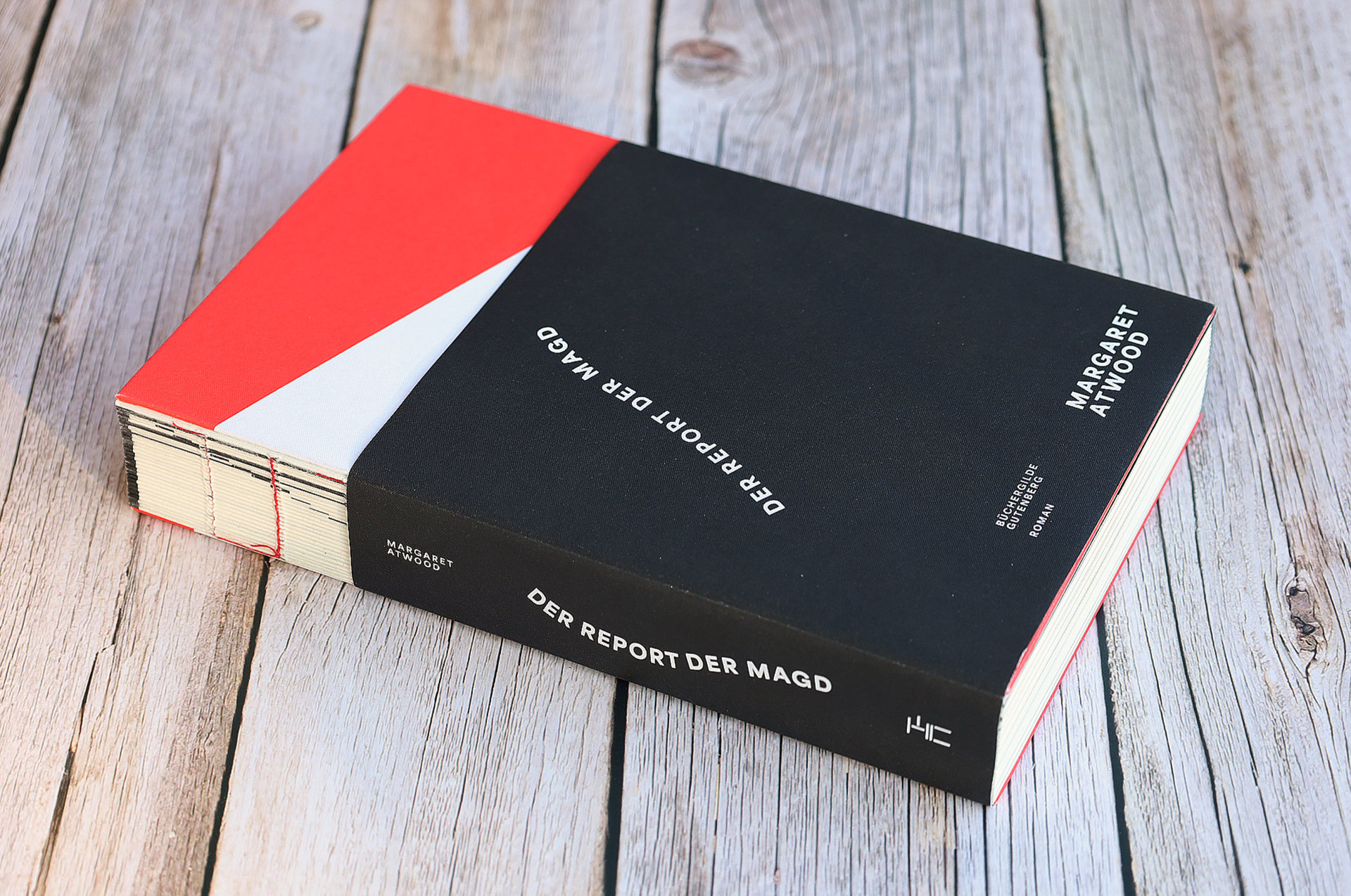
I’ve had this book on my list for a long time, but I never bought it because I couldn’t find a beautiful edition. All the more delighted I was when I discovered this gorgeous book at the Büchergilde. My expectations for The Handmaid’s Tale were also high in terms of content, as I anticipated a dark dystopian vision of the future with strong expressive power. A book very much in the tradition of Orwell’s 1984 or Huxley’s Brave New World. Read here why I would make this book required reading in schools and why everyone—especially every German citizen—should absolutely read it.
In a calm tone, the first‑person narrator recounts her life in a near‑future America that, after a coup, has been transformed into a religiously shaped totalitarian state. Her everyday life is strictly regulated, and her memories of the time before feel like forbidden fragments of a former self. As a Handmaid, she is assigned a single task: to bear children. From her perspective, the reader gains insight into a society defined by rigid roles, control, and an omnipresent sense of fear.
I found the reading experience emotionally exhausting, especially at the beginning. You dive deeply into the protagonist’s everyday life, which is marked by a lack of freedom, by external control, and by constant fear. As a Handmaid, she is responsible for giving birth, and the regime has turned the act of reproduction into a completely mechanical and loveless process. The society follows authoritarian structures and is under permanent surveillance. Women have no rights whatsoever, and this book pushes that to the extreme. The reader fully experiences the same sense of oppression and disgust one feels when reading 1984 or Brave New World. You feel completely with Offred, the narrator. After fifty pages of reading in the evening, I could already feel how it affected my mood. It’s simply a very oppressive atmosphere.
Atwood has arranged the book masterfully. You can sense how she approached it with great sensitivity and an eye for detail. The regime controls language, bodies, reproduction, access to knowledge, everyday life—it governs deeply into people’s lives. Offred’s body belongs to society, and her central purpose is to bear children. This is also expressed in her clothing, which is highly iconic for the book. She must always wear a kind of bonnet with white wings that function like blinkers. Her field of vision is restricted, and communication is significantly hindered by this attire. Her dress is red, striking and stigmatizing; it warns other citizens and functions like a uniform. Her appearance isolates her and makes it clear to everyone what her role is.

The transformation of society into this dictatorship—the structures, the constant exercise of power, the surveillance, and the massive restriction of free communication—can all be felt through the protagonist. This emotional experience is precisely what distinguishes the book. As a reader, you can feel what it is like to live in such a totalitarian state. Beyond that, Atwood has packed so many things into this book, mentioned, explained, hinted at, illustrated—things every person simply needs to know, because only then can freedom be preserved. For example, the story shows how important cash is and what happens when it is abolished. She mentions the experiment a behavioral researcher conducted with pigeons, demonstrating how strongly unpredictable rewards can influence behavior. The so‑called “variable ratio reinforcement,” which today is used massively and very successfully in social media, manipulating countless people. Atwood shows how harmful religiosity can be and how a utilitarian interpretation of the Bible can justify the worst crimes. A remarkable quote on this topic that expresses exactly that:
“Maybe it isn’t about who can own whom, who can do what to whom and get away with it, even as far as death. Maybe it isn’t about who can sit and who has to kneel or stand or lie down, with legs spread. Maybe it’s about who can do what to whom and be forgiven for it. Never tell me it amounts to the same thing.” (p. 183)
For her, it’s not only about a regime or a society exercising violence. Rather, it is the feeling of doing the right thing—of acting morally correct—that is truly devastating.
Alongside all these fine details and references, and all the pointed and wise thoughts Atwood has woven into the book, you also find strong quotes and passages that one can wholeheartedly agree with.
“Truly amazing, what people can get used to, as long as there are a few compensations.” (p. 361)
Atwood has crafted the book with great finesse. The various characters also represent different types of people and how they deal with a highly repressive system. Their fates are tragic and all understandable. In addition, the book contains numerous references to biblical passages, some of which find bizarre parallels in the societal system.

The protagonist’s name is Desfred in German, but that is not her real name. In the patriarchal system, Handmaids take the names of the household commanders to whom they belong. In this case, the commander is named Fred, and thus her name is Desfred—“she belongs to Fred.” In English, the name is Offred, which carries a double meaning. The English word “offered,” as in offering oneself, reflects what she is forced to do when she must offer her body to bear children for society. But it also sounds like “off red,” a reference to her red clothing, whose uniform nature erases all identity. Apparently, Atwood intended these two layers of meaning to further emphasize the dehumanization. In German, this nuance is unfortunately lost.
There has also been speculation among readers about Offred’s real name, which is never revealed. Some speculate that her name might be June, because in one passage it is described how the women in the re‑education center whispered their real names to each other. All the names mentioned there later appear as characters—except “June.” I’ve read that Atwood apparently did not intend this, but that it makes sense to her in retrospect.
The epilogue of the book is confusing at first. Only upon closer examination does its brilliance reveal itself. One simply has to say that. What I also find fascinating is the fact that nothing that happens in the book is invented. All mechanisms, rituals, forms of oppression, and ideas have historical precedents. The various forms of repression, the disenfranchisement of women, enslaved women, forced births, biblically legitimized polygamy, birth rituals, ritualized sexual violence, and much more have all existed in different societies throughout human history. The crown of creation.
“I have enough daily bread, so I don’t want to waste time on that. That’s not the main problem. The problem is getting it down without choking on it.” (p. 262)
Especially in Germany, this book has a relevance like never before. In my perception, extreme positions (in both directions) have gained visibility, and many people feel a noticeable decline in freedom of expression. This article summarizes it quite well. Critical thinking and the ability to inform oneself broadly and in a balanced way seem to be suffering greatly in times of fake news, social media, and AI. The Handmaid’s Tale is one of those books that shakes you awake, because it evokes emotions and conveys what it means to live in such a system.
Margaret Atwood, born on November 18, 1939, in Ottawa, is one of Canada’s most influential writers and has shaped international literature with more than fifty books. The list of awards she has received and the number of honorary degrees from various universities is impressive. Atwood wrote The Handmaid’s Tale between 1984 and 1985 (the year 1984 is quite fitting), and during that time she also lived in West Berlin. Definitely a premium author, and I want to read more of her books. Most recently, The Handmaid’s Tale was also adapted into a series. I would say this book has achieved cult status.

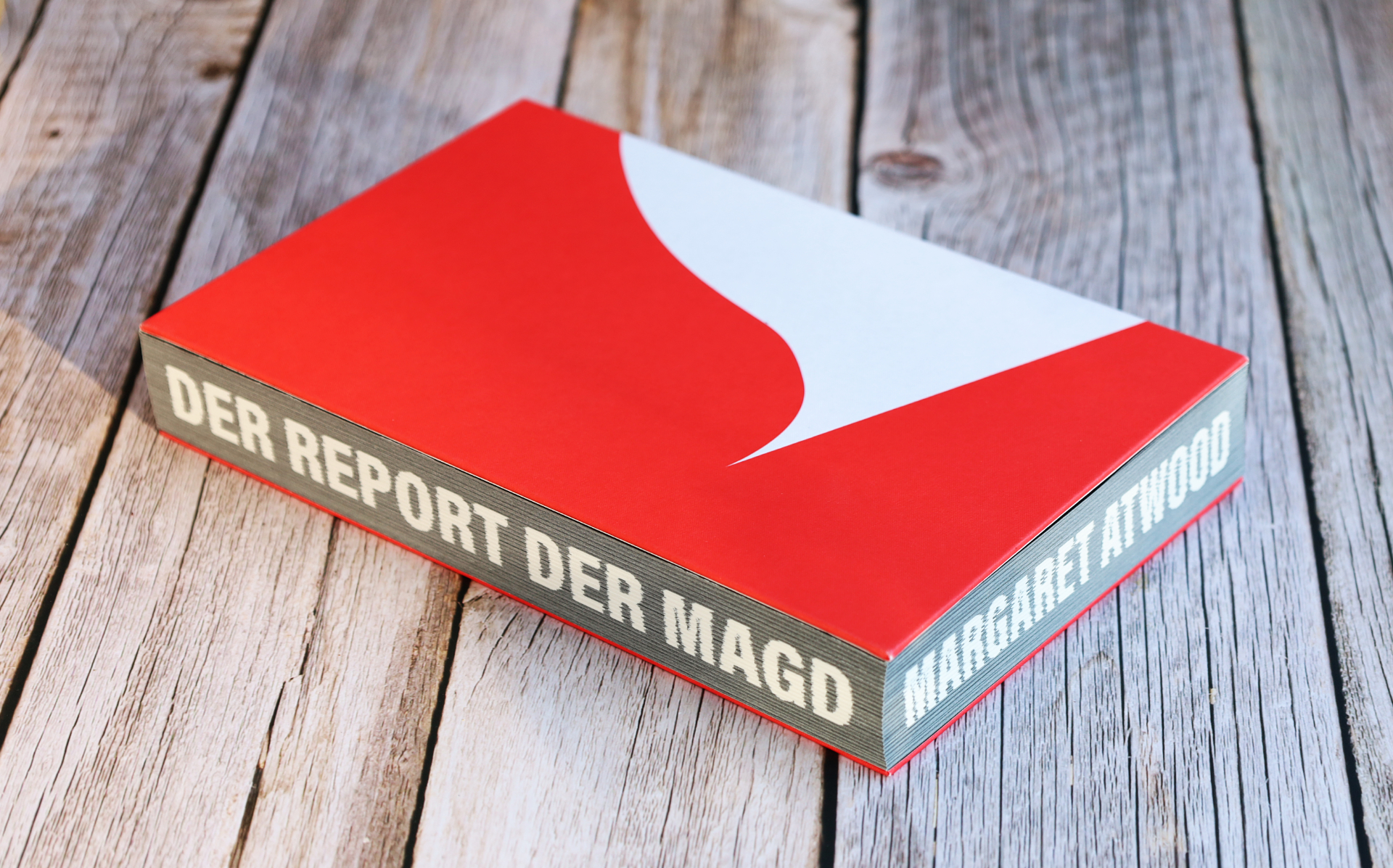
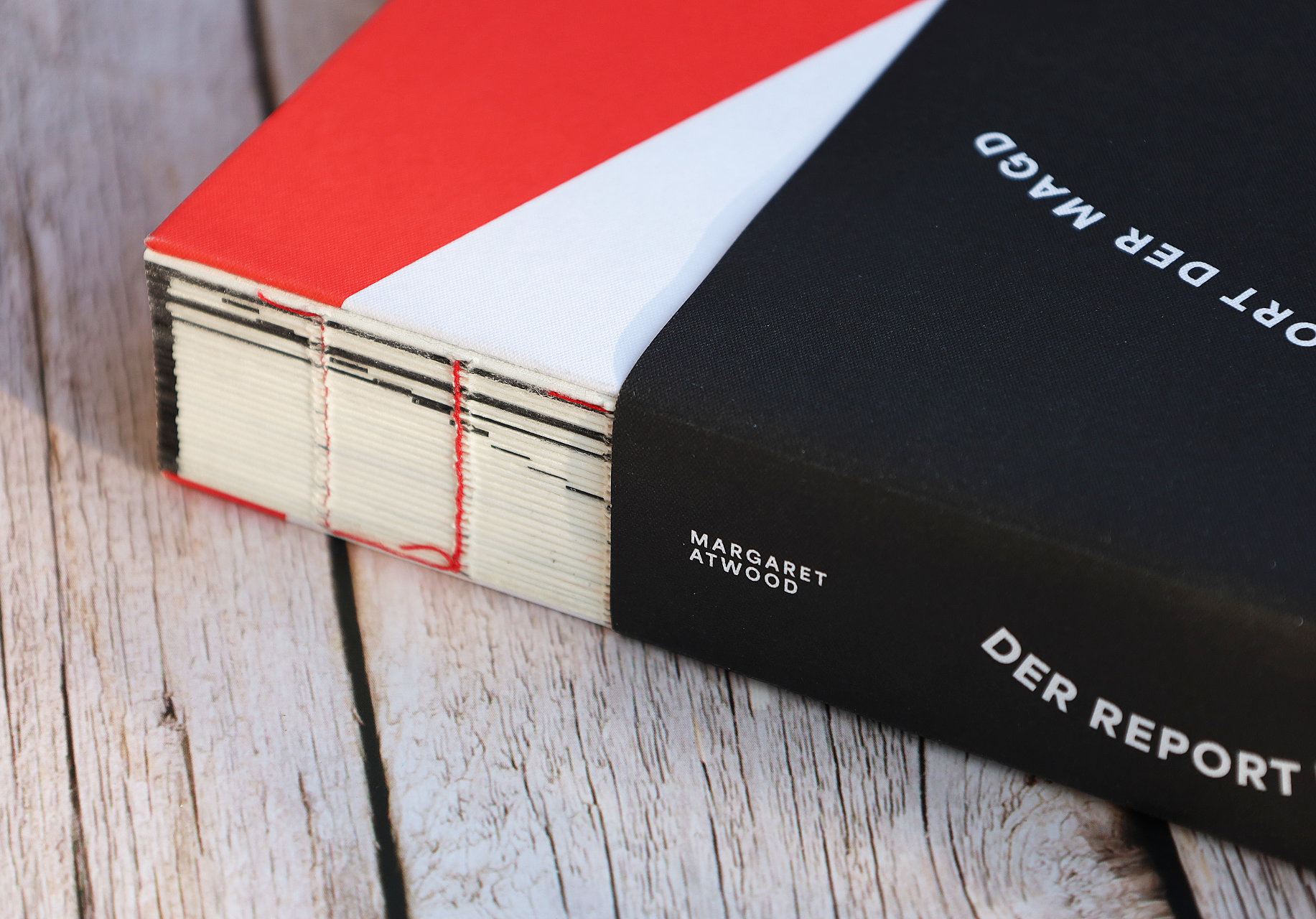
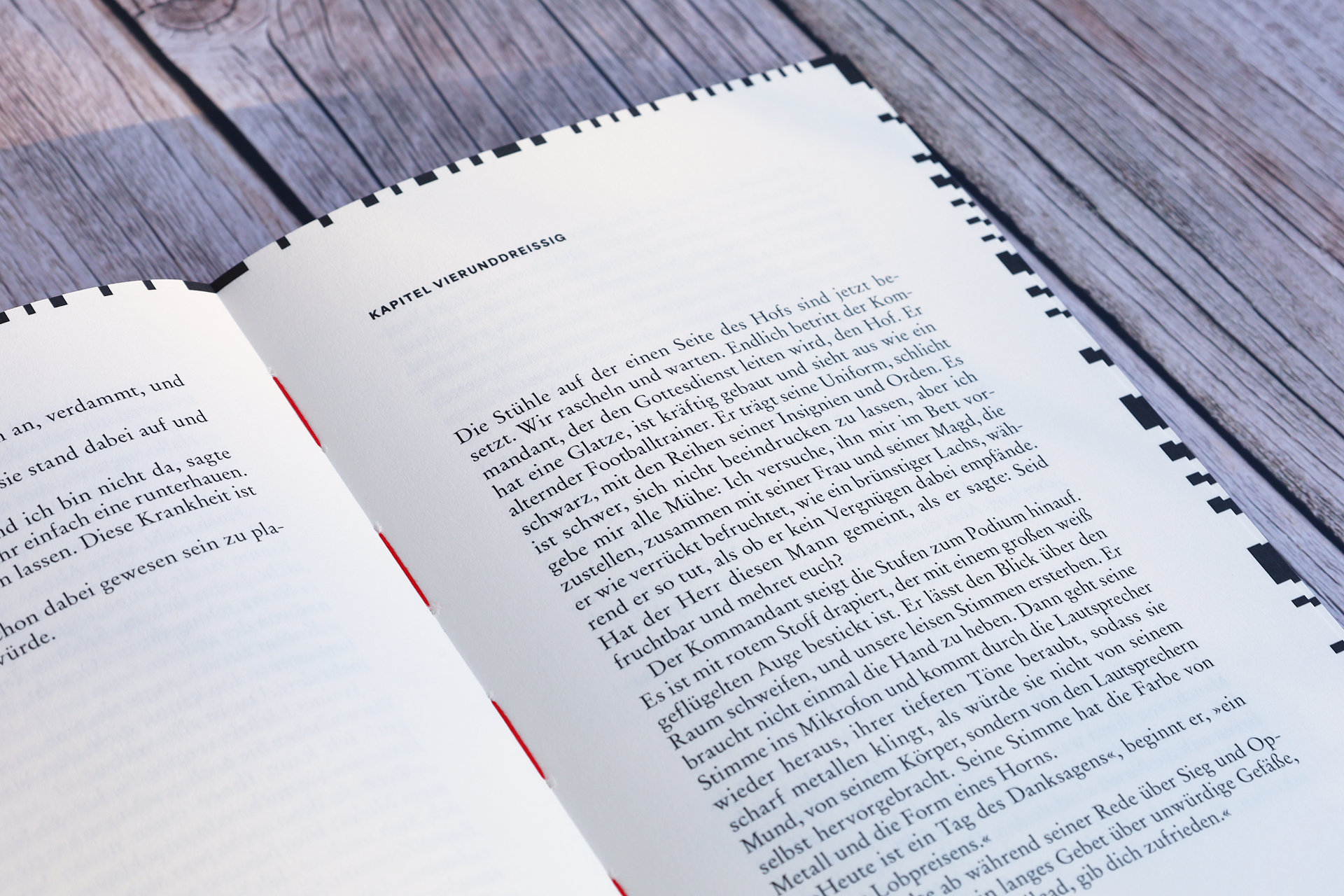
As I mentioned above, my edition is very bibliophilic. The book has an open thread binding, which is incredibly rare but looks fantastic. The cover features the shape of the white wings, which have become a recognizable symbol of the story. A black dust jacket made of sturdy material surrounds the book and carries the title, author, and a quote on the inside. The book itself, with its black pages and subtly decorated edges, is wonderfully aligned with the story. The red threads also look elegant. The book’s edge is printed with the title and author. All of this, with its sober design and clearly accentuated forms, reflects the coldness and emptiness of this repressive society. It is a report, and that is mirrored in the book’s visual expression. The production is very bibliophilic; only a ribbon marker is missing, though that is likely difficult to integrate with this type of binding. A truly well‑crafted, beautiful, and harmonious book.
Conclusion: The Handmaid’s Tale is a masterpiece. It fits seamlessly into the great dystopias 1984 and Brave New World and stands shoulder to shoulder with these classics. The reader experiences firsthand what it is like to live in a religious totalitarian state, how important freedom and equality are, and what can happen to a society that allows their loss. Atwood has woven many ideas into this book, crafted countless details perfectly, and in a pleasantly readable and refined language paints a very authentic emotional picture of what it is like to live in a totalitarian regime. For me, it is absolutely required reading, because freedom is not a given, and in our society awareness of this has declined significantly in recent years. Books like The Handmaid’s Tale are extremely important. Read this book.
Book information: The Handmaid’s Tale • Margaret Atwood • Büchergilde • 414 pages • ISBN 9783763276011