
Love and Saltwater • Ethel Wilson

This spring brings another slightly slimmer mare classic. Once again visually very appealing, and this time written by a Canadian author. I haven’t had many Canadian authors on my book stack yet. The book radiates something of a rediscovery of a classic. It is advertised as “Wise, sensitive, and still profoundly relevant today.” However, the promised relevance is not found in this book, but in another mare classic.
The novel tells the story of Ellen Cuppy, who grows up in Vancouver and, after the sudden death of her mother, goes on a sea voyage with her father. Around the 1930s, the young woman leads an independent life, does not marry—something that would have been more common at the time—and instead follows her own path. Eventually, she is put to a severe test once more, and while the sea, the saltwater, breaks into her life at a young age, it does so again later, with all its force.

Ethel Wilson’s writing style is clear and straightforward, much like the nature of Canada itself. She is an attentive observer and describes both the natural world—the sea, the bays of the Canadian coast—and equally the people, their thoughts and feelings, with a pleasant directness. The sentences are not simple, but neither are they overly poetic. And that fits the characters very well. At the center is Ellen, called Gypsy by everyone because she has a darker complexion and an untamed, freedom-loving character, just like a gypsy girl. Ellen knows what she wants; sometimes she wavers a little, but in the end she always finds her way back to herself. Both style and content work well together here.
I would say that the characterization of the figures is also the novel’s strength. Wilson contrasts the protagonist with her sister Nora. Nora is the opposite: she marries early, quickly adapts to sociocultural structures, but is far less sensitive than her younger sister. I found this contrast very beautiful. But Ellen’s father and numerous other characters also feel very real and lifelike.
Despite these finely drawn characters, the novel did not reach me. The plot lacks a clear line and breaks into three parts that seem arbitrarily connected and spread across Ellen’s life, making it difficult for me as a reader to form an emotional connection with her. Yes, one can understand her thoughts and motivations. But I simply didn’t get to know her well enough; the distance remains too great. In addition, the novel repeatedly loses itself. The landscape descriptions are beautiful and fit well, but some side characters or scenes are too detailed, move the story forward too little, and pull the reader out of the reading flow. I found a passage about the strawberry tree too artificially inserted. Likewise the description of an aunt who suddenly dies—this is simply not well composed. It just hangs there in the book and slows the story down rather than advancing it. Some general philosophical passages also felt too forced. Only in the last fifth of the book does it become interesting, and then, just when the reader finally experiences something together with Ellen, the book ends.
As one expects from the mare classics, the most important supporting character once again takes center stage: the sea. This is something that consistently succeeds in all the mare classics, and it is truly an art to select such books. Because it is not only the depiction of the sea, but also a feeling that resonates between the lines. When Wilson describes the freighters in the bays, or later spends time on Galiano Island and Mayne Island, she brings the landscape wonderfully to life. I always catch myself searching for images online to see it all, and anyone who does that cannot help but admire this beautiful landscape. In real life or in books—beautiful landscapes and islands always work for me.
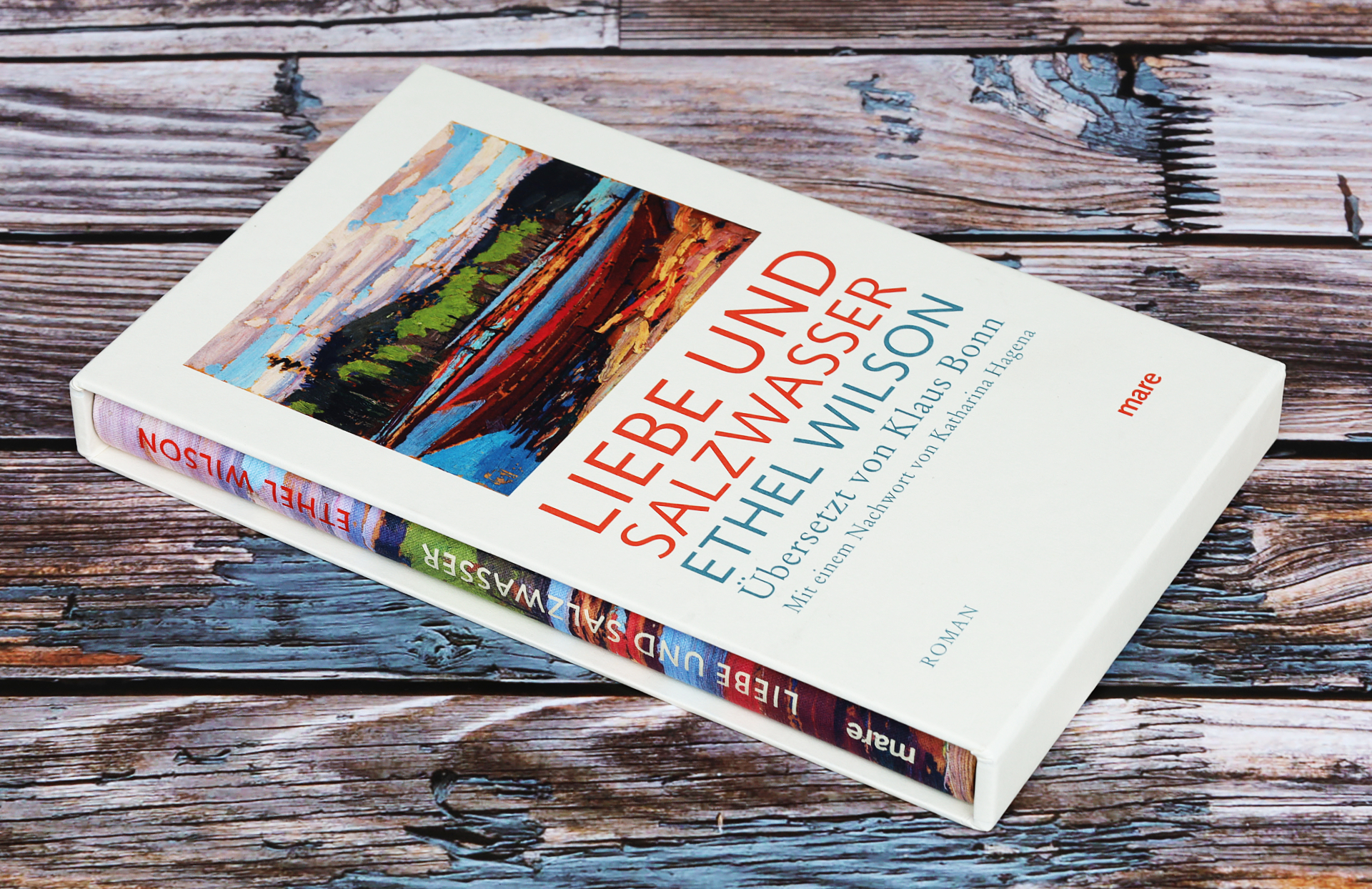
Visually, I really like the book. The printed linen cover is beautiful and colorful. The impressionistic painting of the Ontario landscape by Tom Thomson is perfectly chosen. With the clearly visible brushstrokes, it looks truly stunning on the high-quality print. The paper is also a delight. This is an absolute hallmark of the mare classics: this smooth, soft paper. It is a tactile pleasure every time. Thread stitching and slipcase are of the usual quality. Often months pass between two mare books, and when I hold one in my hands again, it is always a joy.

I also really liked the afterword by Katharina Hagena. When I finished the novel, I was already preparing to do my usual round on the internet and chat a bit with Claude about the meaning of certain elements, but that was no longer necessary. Hagena’s afterword is very well done and provides a pleasant all-around view. It briefly summarizes the story, interprets some of its meaning, tells about the author, and answers several things that had occurred to me while reading.
Ethel Wilson, born in 1888 in South Africa, came to an aunt in Vancouver at the age of eleven after the early death of her parents, where she was well cared for and lovingly received. In Vancouver she worked for many years as a teacher. She only began publishing novels at the age of 59. I found that very remarkable and it shows that it is never too early and never too late to start writing. (Unlike, for example, the great mathematicians, who made their major discoveries at a young age and rarely achieved much after their forties.) Numerous elements in the story are based on Wilson’s own experiences, and the absent mother, sudden events, sudden death or change are apparently elements in all five of her novels.
I found it fascinating that there were only two editions of Love and Saltwater: the first in 1956, when it was published, and a second in 1990. There were apparently no translations at all, making the book a rediscovery—which I find wonderful, because these are exactly the kinds of books I want to read. Even though the translation is of very high quality, in some places it might have been good to read the original. When Ellen wonders about the name “False Creek,” which is anything but a creek. Or when Ellen names a female dog “Bitch,” and her sister gets upset that she doesn’t say “Hündin.” Allusions that work better in the original.
What the book does not have, for me, is relevance. The story takes place in the 1930s and was published in the mid-1950s. The role of women at that time is no longer comparable to the situation today. Even if one is very sensitive regarding feminism, Ellen’s issues are simply not the ones we face these days. And that is where other books are significantly stronger. For all readers who want to experience a modern woman in a classic, I recommend The Adventures of Mrs. Mordaunt by Elinor Mordaunt. Why? Because here a woman simply does her own thing. She shakes everything off, travels, and just does. Men? They simply play no role for the protagonist. Yes, Ellen does this in her own way too, but Mordaunt carries it through to the end, and against a coherent and consistently beautiful backdrop, while Ellen’s world ultimately revolves around men. But perhaps I am wrong, and it is precisely this focus on men that gives the book relevance, because these days that is often the case, even if the opposite is claimed. Anyone who spends time on TikTok, Instagram, and the like knows I’m right.
Conclusion: Wilson leaves me with mixed feelings. You can see from this review how the book pulls me in different directions—how some things I liked, others I was less satisfied with, how I can recommend it and at the same time not recommend it. The landscapes, the sea, the Atlantic crossing at the beginning of the book, the last thirty pages—those were truly wonderful. The unsteady and mostly less exciting plot, the lack of emotional connection to Ellen, the dull interludes—those parts lost me. The design and quality of the book are once again masterful. Discovering this book is also a great achievement, as it has never been translated before and has had only two editions even in Canada. Read the mare classics and place this book toward the end of your reading list. But do put it on your book stack, because every mare classic is ultimately very much worth reading—and so is this one.
Book information: Liebe und Salzwasser • Ethel Wilson • mare Verlag • 222 pages • ISBN 9783866487512
Moin,
Ich muss sagen ich bin ziemlich vom mare Verlag enttäuscht. Ich hab ja nur noch wenig Platz und konsumiere dahrr vorwiegend eBooks. Ausgehend von deiner Buchbesprechung Der geträumte Norden von Kluyver zugelegt. Gekauft bei eBook.de. Ich schau ja immer in die ePubs rein und das sah schon recht merkwürdig aus. Also den epub checker drüberlaufen lassen und es kamen mehrere Dutzend Fehler, und zwar hefrige. So waren mehrere Illustrationen und Bilder zwaf vorhanden, aber nicht verlinkt. Das ist schon ein schwerer Bug. Ich hab mir dann die Mühe gemacht und die verfügbare Leseprobe hergenommen und gesehen dass manche Ilustrationen im Buch gar nicht in der epub Version vorhanden waren. Ich hab dann den mare Verlag kontaktiert. Gegen Vorlage der PDF Rechnung haben die mir dann eine neue Version geschickt. War natürlich der gleiche Murks. Nach zwei weiteren eMails ist der Ontakt dann abgebrochen. Enteeder hat man das Problem nicht verstanden oder schlicht kein Interesse. Auf den Vorschlag mir die Papierversion zukommen lassen weil das epub ja offensichtlich mangelhaft ist wurde gar nicht eingegangen. Ich mein, ich jab noch nie ein fehlerfreies epub gesehen, meistens sknd s jodoch Fehler die der (x)html viewer des readers mehr oder weniger gug ausbügelt. Ich lass es immer ein Pytjon script drüberlaufen was das meisstd ausbügelt bevor das Buch den Wev auf den Reader findet. Aber so ekne miese Qualität jnd Support ist mir noch nicht untergekommen. Werde wohl den mare Verlag meiden müssen, auch wenn es dort einige interessante Bücher gibt. SMein letztes Buch Die Nordsee von Tom Blass hatte kaum Fehler, nicht über das übliche Maß und Schwere hinaus. Das ist das Kreuz des ebook Benutzers, der Wert auf svhöne Ebooks legt und in 100% der Fälle sich erstmal selbst dran setzen muss. Das bin ich ja schon gewohnt. Die Bücher werden zumeist in InDesign erstellt und dann durch irgendwelche Konvertierungstools gejagt, was da raus kommt interessiert keinen. Warum auch, der Reader zeigt ja irgendwas an.
Jetzt hat dir das Buch nicht gefallen, also entsteht auch kein haben-wollen Reflex :)
//Huebi