
Surfaces and Essences: Analogy as the Fuel and Fire of Thinking • Douglas Hofstadter, Emmanuel Sander
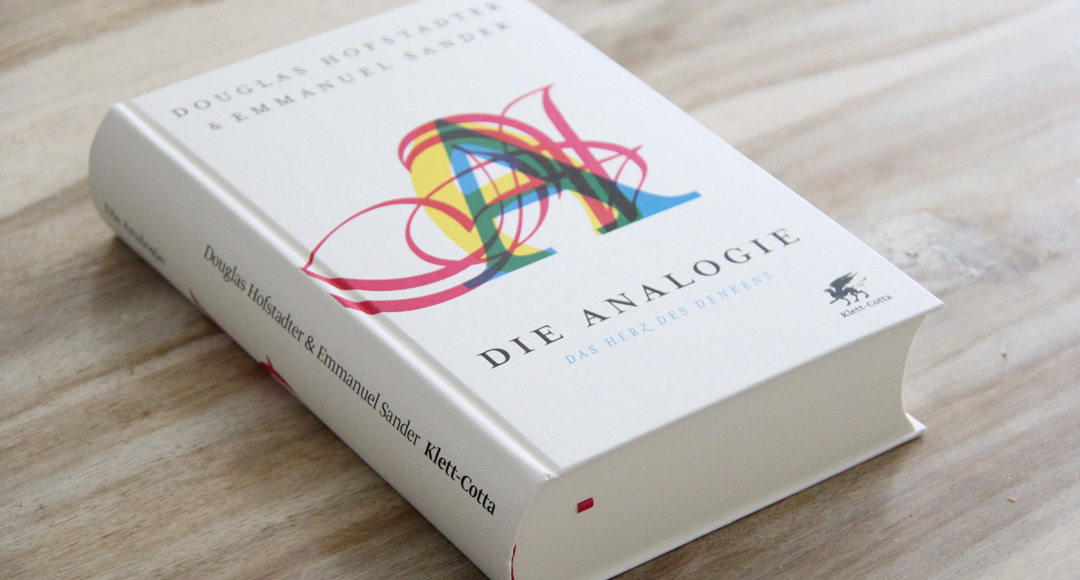
Since reading Gödel, Escher, Bach: An Eternal Golden Braid, Hofstadter has entered my personal hall of fame of authors. For this work, the cognitive scientist and PhD physicist received the Pulitzer Prize, weaving together Gödel’s incompleteness theorem, the drawings of M. C. Escher, and the music of Johann Sebastian Bach in a highly fascinating way. The book is a masterpiece without equal, and so I was naturally very curious when I came across Surfaces and Essences: Analogy as the Fuel and Fire of Thinking, his most recent work, which he co-authored with the psychologist Emmanuel Sander and published in the middle of last year. Emmanuel Sander, the second author — likewise a renowned scholar in psychology and cognitive science — was unfamiliar to me beforehand. When I write “Hofstadter” below, I of course mean Hofstadter and Sander; I certainly don’t wish to diminish Sander’s contribution. I’m doing so only for simplicity’s sake.
What’s exciting about the book is that it was written in both English and French. Hofstadter is American, Sander is French, and since the field of analogy is closely tied to language, this dual-track writing process yielded further insights. These flowed into Surfaces and Essences, which shows how different languages encode different analogies — and how each language has gaps that other languages fill.
As in Hofstadter’s famous book, Surfaces and Essences again concerns itself with human intelligence, thinking, and the self. Over nearly 800 pages, it explores a fundamental structure of thought: analogies. What are analogies, which are claimed to be the foundation of every human thought?
You’ll find the answer in this book in very extensive form, and it’s probably easiest to go chapter by chapter to gain an understanding of both the book and the concept. Before encountering the literature, I couldn’t really picture what lay behind it. It reminded me of the first time I heard about integral transforms — you have to delve into the topic to form even an abstract picture of it. So below I outline what each chapter is about and how analogies are considered from various angles.
In the first chapter, Hofstadter provides a detailed outline of what lies behind the term and uses numerous comparisons to convey how he and Sander understand it. An analogy is an abstract model for a relationship that is gradually built up and continually expanded in every human brain through experience. For a child, the term “mother” is initially very limited — it means their own mommy. As we grow up, the concept becomes more abstract and comprehensive. Analogies are identical to categories, but they don’t carve the world into disjoint elements. Instead, analogies help us orient ourselves in a constantly changing environment, where our organism is continually confronted with the unknown. In the concept “book,” for instance, there’s a wealth of information: it has pages; you read it; books aren’t super expensive; there are exciting books and boring schoolbooks… When we hear the word “book,” a chain of thoughts is automatically triggered that leads to a seemingly tangible idea of the object. Concepts thus define categories — and not only nouns, but also inconspicuous words like “and” or “but.” At this point it becomes clear that the two authors are very good at conveying their theses. Bit by bit, one builds an analogy of analogy itself. You grasp what it means for analogy to undergird thought — going beyond the model of a simple category or image — and how the human mind processes abstract images, categories, concepts, syntax, and semantics in an integrated process, continually modifying and expanding the underlying rules. Hofstadter’s comparisons are wonderfully vivid; they click for me instantly because he thinks in a way that’s so characteristically visual-computational. His image of languages as cloud-like clusters with cores that overlap only partially with other languages is masterfully explained.
The second chapter deals with analogies made up of multiple word parts. These include compound words (e.g., “living room”), but also abbreviations, idioms, and even fables. In places, the book becomes very detailed — at points too detailed for me. But again the explanations are vivid and pleasant to read. I found the resulting definition of intelligence compelling — an account that emerges from the picture of analogy and casts thinking in a new, yet graspable light:
The ceaseless activity of aligning freshly minted mental structures (new perceptions) with older mental structures (established concepts) — the activity that, in new situations, precisely identifies highly relevant concepts — constitutes the analogical fabric of thought, and the unending flurry of analogies we bring to bear is a mirror of our intelligence. (p. 178)
What matters is not the sheer number or inventory of analogies a human mind can form, but the skill of forging exceptional connections — that is, analogies — and recombining them in new ways.
The third chapter is, to my mind, even more exciting, because it concerns analogies that aren’t tied to named concepts — invisible analogies that nonetheless exist palpably in our minds. We constantly form new analogies from situations in our lives; even if they never receive a clear lexical label, they are made of the same substance as analogies that can be described with simple or compound words. Here the elemental importance of analogy is underscored with numerous examples. Analogies are the basis of our thinking, of empathy, of the ability to situate new circumstances, to evaluate them, and to respond appropriately — even in utterly trivial matters. And that’s true: even the simplest terms contain a great deal of implicit knowledge, evoked by analogies that run automatically in the mind. The formation of these analogies proceeds on its own, is continually extended, and arises from concrete situations that are abstracted and refined. These abstractions — together with emotion — are retained as memories and later drawn upon to form new analogies. I find these lines of thought fascinating. The concept that emerges here is compelling because of its simplicity and its universality. The book conveys it superbly and inevitably raises, for me, the question of how such thought processes might be confirmed neurobiologically. In any case, this mental landscape correlates with the way neurons are organized in the brain, supporting a hierarchy of rising abstraction — at least that’s the picture one can glean from well-known secondary literature on brains and consciousness, and it fits well.
The link between analogy and abstraction is obvious, so it’s no surprise that the fourth chapter is devoted precisely to this. It concerns how multiple levels of abstraction are formed in analogy-making and how thought moves fluidly among them. Sometimes these categories even share the same terms while denoting different things at different levels. These levels emerge gradually with growing experience; thus, experts in a domain possess many more levels of abstraction than novices. That’s an interesting definition of “expert,” and it’s something I’m taking away from the book. The ability to hold multiple analogies — i.e., categories — for a given subject area and to connect them more easily is something one can observe in oneself when one knows a field well. Fascinatingly, analogies of higher abstraction are formed for everything — even for people. This chapter, too, comes with a wealth of examples; for me, a few fewer would have sufficed to get the ideas across.
From the fifth chapter — “How Analogies Manipulate Us” — I expected a bit more practical payoff. It doesn’t yield many takeaways for practice; rather, it treats how, for example, slips of the tongue reveal competing analogies, or the role of empty and fleeting analogies. Most interesting to me was how analogies influence our opinions and how they sometimes cannot be suppressed, even when we’re aware of them. The chapter nevertheless reinforces the thesis that analogies govern our thinking and form its basis.
The sixth chapter is similar in spirit and examines how we handle analogies. It describes how we use comparable examples to clarify a standpoint or explain matters, but also how we deliberately generate analogies and categories for new problems. I found the “mixed scenarios” intriguing, in which our thinking produces analogies that aren’t cleanly separated but are tightly interwoven. Finally, through translation examples, the authors show that translating involves the extreme use of analogy — a homáge to professional translators.
A definite highlight was chapter seven. It deals with naïve analogies — those that spring to mind spontaneously but are often oversimplified and thus don’t fit a situation correctly. Strikingly, such naïve analogies persist even when we’ve developed a more detailed, fine-grained understanding of a relationship. Hofstadter shows, for example, how we interpret word problems in mathematics differently and how their solution becomes easier or harder depending on how strongly a problem aligns with a naïve understanding. Or how our grasp of division rests on a naïve analogy of “sharing,” even if math class has taught us otherwise. The beauty here is that one can readily observe these dynamics in oneself — and that even experts in a field, despite deep knowledge, work with naïve analogies.
Unconscious analogical processes thus dominate how we interact with our environment; they underlie how we understand the world and the situations we find ourselves in. (p. 519)
Chapter eight treats analogies that led to great discoveries. One case from mathematics traces a path from solving cubic equations to group theory — forged through analogies spanning different subfields. Another detailed case concerns Einstein’s breakthroughs and the key role analogies played there as well. In places it was too specialized and definitely too long for my taste, but the thesis — that analogy is central to scientific thinking — comes across very well. I would have happily cut the chapter to a third of its length.
The final chapter presents a fictional dialogue that makes clear that analogies and categories are the same (i.e., a category is an analogy and vice versa) — apparently a point of debate among cognitive scientists. The dialogue also serves as a sort of retrospective and rounds off the book nicely. It reminded me strongly of the dialogues in Gödel, Escher, Bach, which were aligned with a Bach fugue. This dialogue, however, isn’t as intricate — or perhaps I failed to perceive its full brilliance.
So what can one say in summary? Analogy itself is an analogy for thinking — a new perspective from which to view cognitive processes. As with any new vantage point, suddenly some things become clearer, and many connections in our thinking emerge more distinctly. For example, what language means for our thinking; how seemingly neutral words evoke analogies that manipulate us; how they trigger chains of emotionally tinged thoughts in us — thoughts we also consciously deploy to forge and use further analogies.
Even if you think you’re the one pulling the strings, you’re merely a marionette unaware of its strings. You think you’re consciously crafting an analogy to convey a particular standpoint, but in truth it’s the other way around: your standpoint rests on a myriad of hidden analogies that prescribe a particular view of things. (p. 512)
Throughout my reading, I kept wondering what lies behind this abstract model. A neural network geared toward abstraction and capable of extreme manifoldness? I do miss a discussion of where these analogies are to be found in neural structures — and of course that answer is anything but simple or even readily accessible.
Conclusion: This book presents a fascinating, fresh way to look at our thinking, offering a simple yet far-reaching concept and reflecting on itself through countless analogies. With many excellent examples, Hofstadter and Sander build the concept of analogy and illuminate this viewpoint on our cognitive processes from different angles. It’s a great book — highly worthwhile — and it expanded my view of thinking in an unexpected way. A book to reread, since you can’t absorb all the ideas and concepts at once, and many aspects invite long reflection.
Book information: Surfaces and Essences: Analogy as the Fuel and Fire of Thinking • Douglas Hofstadter, Emmanuel Sander • Klett-Cotta • 784 pages • ISBN 9783608946192
Wie schon auf einer Literaturkritik-Seite angesprochen ein Werk, das man auch auf einer Seite oder sogar in einem Satz zusammenfassen könnte: Unser Hirn gleicht ständig neuen input mit dem “Bestand” ab und das nicht nur in “Kategorien”, also “geordnet”, sondern auch mittels Analogien, die kulturell oder individuell, alt oder neu sein können. Wieso man das über 700 Seiten ausführen muß hat sich mir nicht erschlossen.
Teilweise dachte ich mir beim Lesen, was die Beiden wohl geraucht haben….
Für die blanke Behauptung, daß Analogien der Treibstoff des Denken seien finden sich, soweit ich mich erinnere, keine zitierten Experimente, die diese Hypothese stützen oder überprüfen – auch das hätte ich mir von Wissenschaftlern gewünscht…
Ich muß aber zugeben, daß ich nicht mehr alle Kapitel gelesen habe, da mir die ersten bereits derart redundant erschienen, daß mein Interesse weitgehend erloschen war
Lieber Rudi,
meine Lektüre des Buches liegt ja nun schon einige Jahre zurück. Das Grundkonzept ist mir schon noch in Erinnerung. Was ich faszinierend fand, ist die Einordnung bzw. Begrenzung auf die Kognitionswissenschaft. Also zu sagen, dass man sich nur Gedanken über die Denkprozesse macht, aber auf einer gewissen Abstraktionsstufe bleibt und sich um eine Abbildung dieser Vorgänge z.B. auf neurobiologischer Ebene so gar nicht kümmert. Ich glaub das geht auch nur, wenn man eine gewisse Zeit im akademischen Wissenschaftsbetrieb verbracht hat. Allerdings stand auch wiederum nichts im Widerspruch zu dem, was man so aus der Neurobiologie hört und insgesamt ergibt sich da schon ein stimmiges Bild. Auf der Abstraktionsebene der Kognitionswissenschaften sind Analogien wahrscheinlich tatsächlich der Treibstoff des Denkens. Es ist aber halt nur die halbe Wahrheit, das ist ungefähr so, wie wenn man sagen würde, dass Programmiersprachen der Treibstoff für Computer sind. Da kehrt man dann einen ganzen Haufen unter den Teppich, falsch ist es aber wohl auch nicht. Oder wie ein Professor bei uns immer gesagt hat: Man kann so viel emulieren wie man möchte, aber irgendwann braucht man halt doch eine Hardware.
Ja, inhaltlich ist das Buch schon aufgeblasen, das hätte man durchaus eindampfen können. Auch das erinnert ein bisschen an den Lehrbetrieb an Unis. Aber ich fand es okay. Das kommt immer darauf an, in was für einen Modus man ist und wie viel Zeit man hier widmen möchte. Hat man einen hohen Stapel ungelesener Bücher, deren Lektüre man kaum erwarten kann, dann ist das Buch hier wahrscheinlich schon stellenweise quälend lange. Das ist ähnlich wie mit Reiseberichten, am Stück empfinde ich sie immer langwierig und langweilig, in Häppchen sind sie perfekt.
Liebe Grüße und vielen Dank für das interessante Feedback.
Tobi