
Hotel Florida • Amanda Vaill
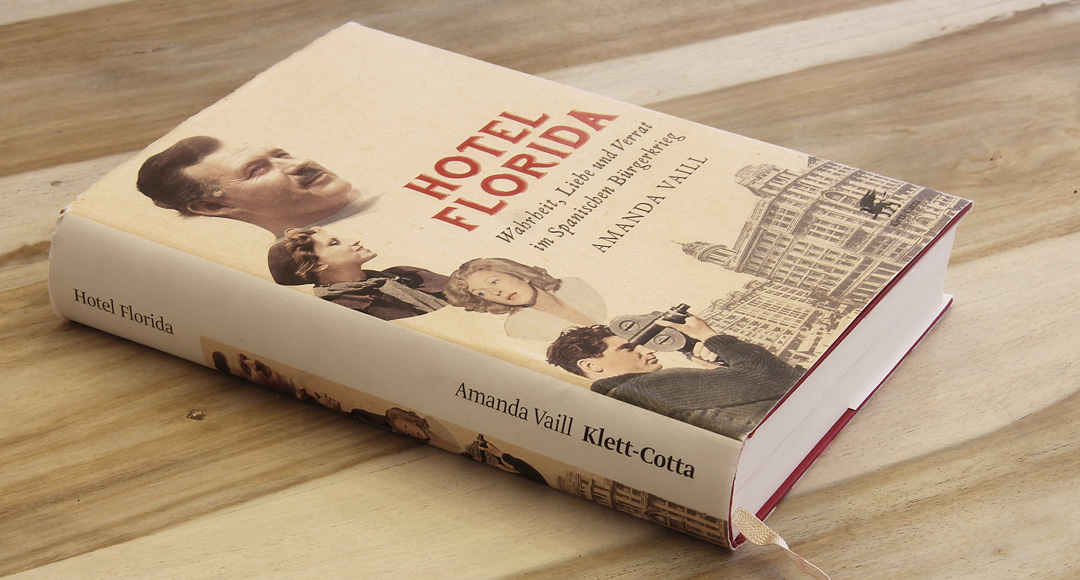
Some time ago, I asked on Twitter whether there was any kind of event for all those poor book bloggers who don’t attend the Frankfurt Book Fair. I expected many replies, but I certainly didn’t expect the publisher Klett-Cotta to hear my cry. Heiner Wittmann, a literary scholar, contacted me—which made me particularly happy, as he’s a true expert on 19th-century French literature. Practically my favorite genre (yes, for me, it has already become its own genre). However, I declined his suggestion for a thematically fitting book, because I had already set my eyes on another, very interesting title from Klett-Cotta: Hotel Florida by Amanda Vaill. Even though its background is set elsewhere, when I look back at the classics I’ve read recently, this book fits perfectly. Les Misérables by Victor Hugo was such a book, one that uses the struggle for the Republic at the beginning of the 19th century in France as a historical framework. But other works from that era, which I haven’t reviewed here, also reflect Europe’s transformation toward democratic states—and Hotel Florida fits wonderfully into that lineage.
The story takes place during the Spanish Civil War, which broke out between July 1936 and April 1939 and represented the climax of a conflict that gripped all of Europe—the clash between rising fascism and opposing communism. In this book, just as with many French authors, it becomes clear how societies caught between old, conservative, monarchic structures and emerging democratic movements experience a process of profound transformation. A process that began with the French Revolution and extends all the way into our present day.
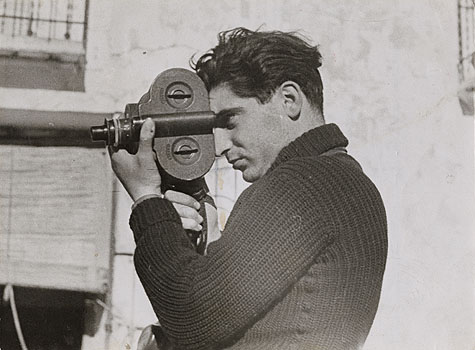
The book begins with a chronology of events from 1931 to 1939, condensing the key political developments in Spain and around the world during that period. This is followed by an overview of the main characters, which is helpful, though not absolutely necessary. The narrative then begins, gradually introducing all the prominent figures who, over the course of history, find themselves drawn into Spain’s civil war. The reader meets the photographers Robert Capa and Gerda Taro, the journalist Martha Gellhorn, the journalist Ilsa Kulcsar, the censorship officer Arturo Barea, and the author Ernest Hemingway. From various corners of the world, Vaill guides us through the background stories of these individuals.
Vaill depicts the political developments with precision, clarity, and a sense of order that I found surprisingly engaging. Surprising because she avoids the usual narrative techniques that create suspense. The reader doesn’t inhabit the characters; instead, everything is conveyed from a certain distance. Vaill compresses the characters’ backstories quite strongly at times, yet still provides glimpses into intimate details—for example, the relationship between Gerda and Capa’s mother. Overall, her style is highly factual, and the book is essentially a documentary account of the Spanish Civil War told from the perspective of internationally renowned intellectuals.
I found it especially fascinating to read about Robert Capa, whose photography I discovered years ago. One learns how his famous photo The Falling Soldier came to be—capturing a Spanish Republican soldier at the very moment of his death. Vaill also doesn’t shy away from mentioning that the photo’s authenticity has been questioned. The author frequently describes the photographs that Capa and his companion Gerda Taro took on their journeys to the war’s frontlines, and it’s nearly impossible not to look them up online. Some of the photographs are reproduced in the middle of the book.
Of course, Vaill also traces the lives of Martha Gellhorn, Ilsa Kulcsar, Arturo Barea, and Ernest Hemingway in great detail. Her documentary style packs an immense amount of information—names, events, and context—into the text. While I retained the overall narrative thread, I couldn’t keep all the many details in mind. It would take a very attentive reading to grasp every fact, and for that, the historical narrative isn’t quite gripping enough. The book is by no means boring—the places and events come vividly to life, and one can easily imagine wartime Madrid with its Hotel Florida. Vaill also conveys the personal development of each individual well, though the reader remains an observer rather than an emotional participant. The factual tone gives the descriptions of the war’s atrocities tremendous power—such as the scenes of refugees mercilessly hunted by Nationalists or of thousands of civilians executed after a city’s capture. The restrained narration makes these moments all the more haunting.
Finally, three squadrons of cumbersome Junkers 52 bombers reduced the city to rubble—with a technique the Condor Legion had first tested only weeks earlier on Republican positions around Oviedo, some three hundred kilometers west of Guernica, using deliberately lethal shrapnel and incendiary bombs. Cows and sheep ran panicked, burning through the streets; entire families were wiped out as their homes collapsed around them; people with severe burns staggered through the flames. By the next morning, Guernica was nothing but a charred shell. (p. 236)
The book clearly illustrates how, in a civil war, all sides reveal their true faces. While the Nationalists, supported by the fascist regimes of Germany and Italy, attacked the Republicans with brutal force, the democratic government was far from innocent. Propaganda, executions of alleged political opponents, and decisions made over the heads of the people—such as the transfer of Spain’s gold reserves to Moscow in exchange for military aid—show a long list of questionable acts. The Republicans’ enemies, who bombed entire villages with incendiary bombs (similar to those later used by the Allies against Dresden), were no less ruthless toward civilians.
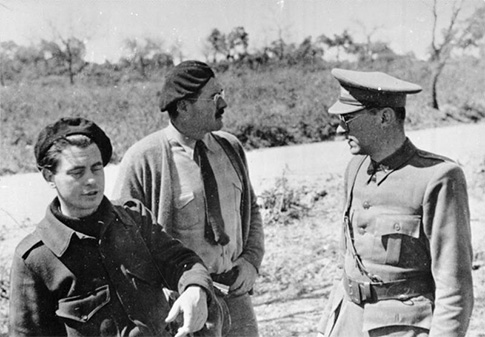
But even the main figures of the story don’t come across particularly well. Although Hemingway, as well as journalists Martha Gellhorn and Ilsa Kulcsar, and photographers Robert Capa and Gerda Taro, speak up for the Republic and democratic ideals—risking their lives to report from the front—they all act from strong personal motives. Each of these prominent individuals benefits from the war in some way, exposing themselves to danger not solely for noble reasons but also for ambition, fame, and career advancement. Hemingway, in particular, appears rather unsympathetic (at least to me). Martha, for instance, takes advantage of Madrid’s wartime bargains for a little luxury shopping spree before heading back safely to Paris. This multifaceted portrayal of the intellectual elite makes the book very credible—it shows that everyone bore their own burdens and that ambition always came at a price, just as it does in real life.
Hemingway is driven to Madrid by a documentary project; Capa and Gerda are in pursuit of powerful images; Ilsa strives to realize her ideological ideals; Martha wants to advance her journalistic career; and Barea is motivated by a patriotic desire to make a positive difference. The Hotel Florida serves as a key location—a hub in Madrid where the protagonists repeatedly meet, a refuge and a temporary home in the besieged city. There, people philosophize, debate, drink, and exchange ideas—intellectuals and journalists from the outside world who are nevertheless deeply immersed in the war, in the battle over political ideals, and in the search for a new Europe.
It becomes clear that, during this period, many ideologies competed and society underwent a transformation that was anything but linear. The conviction that one holds the political truth is as old as humankind itself, and here, it’s represented by all the protagonists. “It is not for man to decide what is just and what is unjust. Men have always erred and will always err, and never more than when they think they know what justice is.” These are the words of Andrei Bolkonsky near the end of War and Peace—a reflection that came to my mind more than once while reading this book.
Capa had come to Spain to record the truth—to make the truest, best pictures possible, images that would show how the Spanish people fought for their ideals, pictures for which he was willing to risk everything. (p. 90)
As factual as this book may appear at first glance, its mixture of love stories, emotional moments, and subtle criticism results in a surprisingly emotional overall portrait—of both the characters and the devastating consequences of war. A look into the past always offers a glimpse into the present and future, and so the reader is repeatedly confronted with the same pressing questions that still concern us today. Whether it’s democracy, freedom, truth, propaganda, or refugees—these themes have always been, and continue to be, part of societies worldwide.
The next day, France opened its border to Spanish refugees […] a trickle that would swell into a flood of 400,000 […]. (p. 430)
Conclusion: Amanda Vaill presents a fascinating book about the Spanish Civil War of the 1930s, written in a documentary style that captures the political developments and ideological conflicts of Europe through the eyes of internationally known intellectuals. Although she offers a nuanced portrayal of the strengths and weaknesses of these famous journalists, authors, and photographers, the book didn’t truly captivate me. It’s interesting, but not thrilling or emotionally gripping. Vaill provides a wealth of detail—from political developments to the artistic achievements of her protagonists—creating a realistic and tangible picture of the brutal war and the people moving through it. The research behind this book is immense, and one can sense how deeply the author engaged with her subject. Hotel Florida is a nonfiction work that could easily stand alongside one of ARTE’s outstanding historical documentaries. I learned a lot from reading it—about history, about Europe, and about a part of the past I previously knew nothing about.
Book information: Hotel Florida: Truth, Love, and Betrayal in the Spanish Civil War • Amanda Vaill • Klett-Cotta • 512 pages • ISBN 9783608949155
Hallo Tobias,
das klingt wirklich interessant; danke für die Vorstellung! Kennst Du “Das Narrenschiff“ von Porter?
https://notizhefte.wordpress.com/2015/06/01/eine-atlantikuberquerung-das-narrenschiff-von-katherine-anne-porter/
Könnte Dir gefallen. Liebe Grüße
Norman
Lieber Norman,
das Narrenschiff sagt mir nichts. Vom Inhalt hätte ich es eher mit Maupassants kritischen Blick auf die Gesellschaft in Verbindung gebracht. Hört sich ganz interessant an. Ich mag Bücher, wo kritisch und auch etwas zynisch auf die Gesellschaft geblickt wird.
Liebe Grüße
Tobi
Nein, nein Tobi , Du bist nicht am Geschmack Deiner Leser vorbei (Twitter-Vermutung), die sind nur faul und schreiben nicht immer was. Die lesen das aber schon. Gemessen an mir hast Du unendlich viele Kommentatoren, mach Dir keinen Kopf. Ich habe den Beitrag sehr aufmerksam gelesen und habe mir das Buch direkt für meine Mutter (zu Weihnachten) vorgemerkt. Meine Eltern gehör(t)en ja der Hemingway-Hype-Generation an, mein Gott, wenn ich mich da so an literarische Gespräche in meiner Kindheit erinnere….da ging nix über Hemingway. Ich denke, der Mann hat an seinem Image hart gearbeitet und hat es extremst gepflegt…umso schöner, wenn dieses Buch da evtl. so manches gerade rückt. Vielleicht lese ich es ja sogar selber mal. Danke fürs Vorstellen.
Liebe Devona,
vielen Dank für deine Worte und das Zerstreuen meiner Vermutung. Mir geht es da ähnlich, ich lese immer recht viel, aber kommentiere dann doch eher selten. Entweder, weil man nichts zu sagen hat, oder weil man sich nicht die Ruhe nimmt, was ich immer zu vermeiden versuche.
Von Hemingway habe ich nur “Der alte Mann und das Meer” gelesen, das fand ich aber sehr enttäuschend und damit ist Hemingway von meiner Liste komplett verschwunden. Der Darstellung in diesem Buch nach, gibt es aktuell auch irgendwie keinen Anlass was zu holen ;) Aber cool, dass es mal einen Hype um ihn gab. Du musst mir Bescheid geben, wie deine Eltern über das Buch urteilen und wie ihre Wahrnehmung dazu ist.
Liebe Grüße
Tobi