
Die Zukunft des Mars • Georg Klein
Lately I’ve been on the lookout for beautiful books. Of course, a handsome exterior isn’t decisive—what’s the point of reading something you don’t feel like reading just because the book looks chic? Let me reassure you right here: I won’t start showcasing fancy book covers; my focus remains squarely on what you find between the covers. Still, I appreciate the art of fine bookmaking, and there’s simply something special about holding a carefully designed book in your hands. If the content is appealing as well—or it’s even an outstanding classic—then there’s no stopping me.
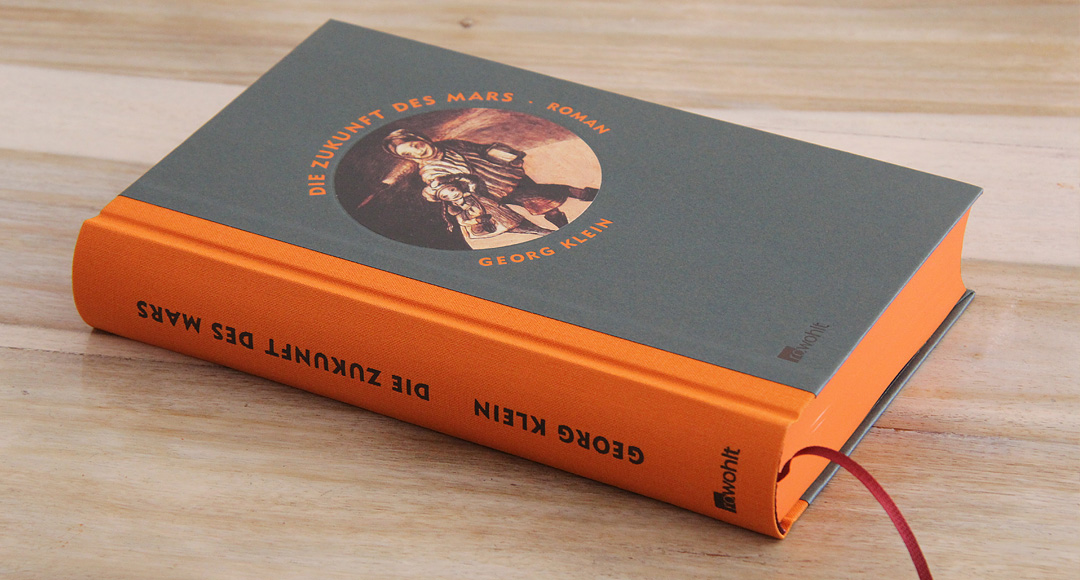
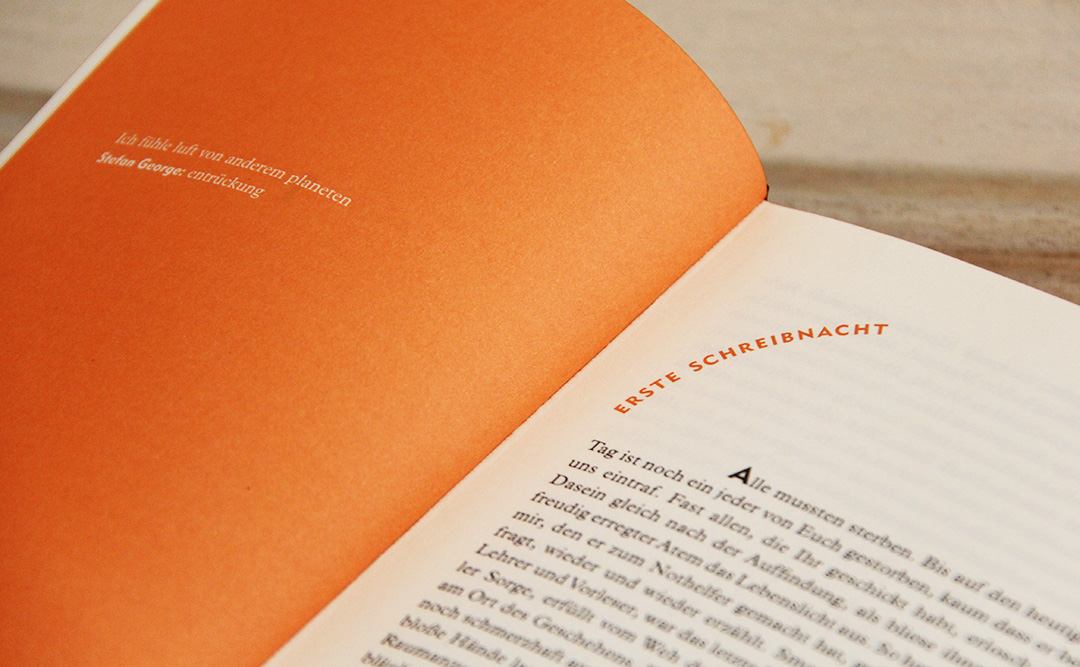
I came across Die Zukunft des Mars on the website of the Stiftung Buchkunst. There, books were honored in 2014 and 2015 for outstanding design. And indeed, this is a very beautiful volume, and once the content piqued my curiosity, I simply had to have it right away. It’s hard to find books that are exceptionally beautiful and also contain a gripping story. The photos I took of this lovely book show quite well why the presentation won me over.
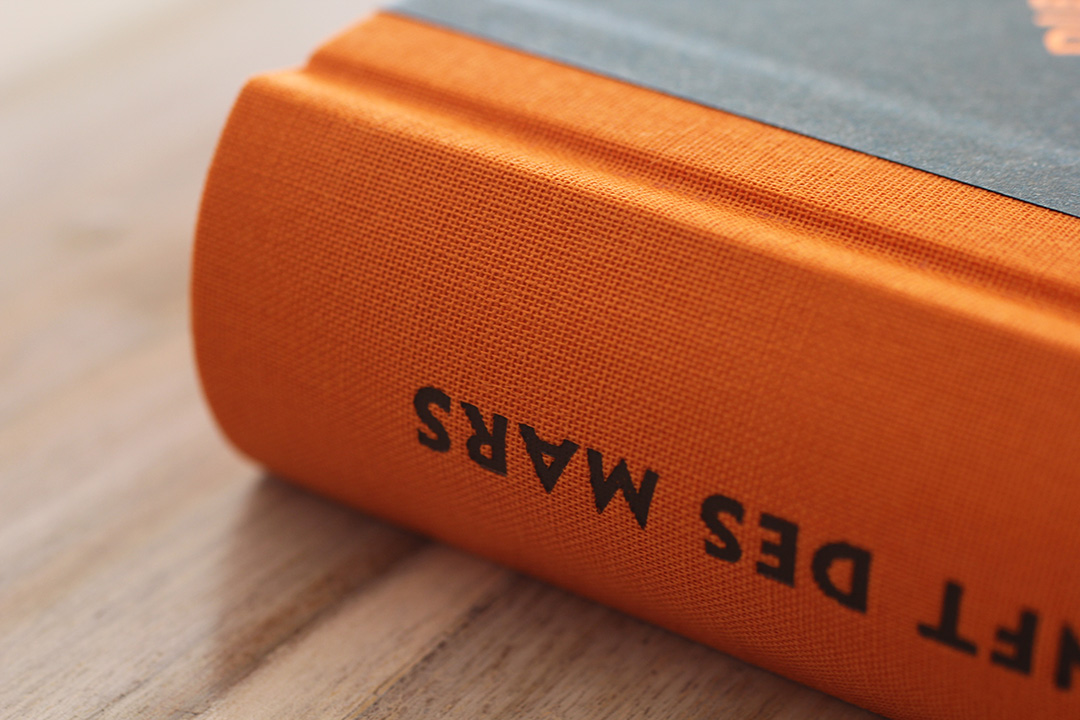
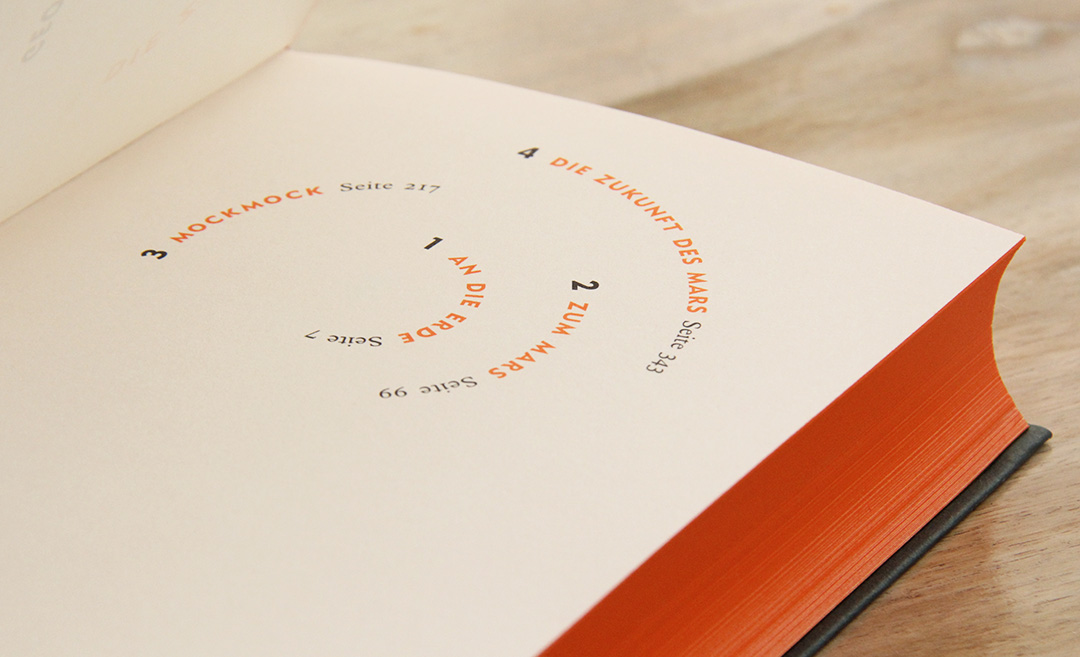
I find the book’s color scheme very appealing: it uses a fixed palette and carries the contrasting orange and the dark green of the cover and spine into the interior. The cover features a sketch meant to depict Elussa and her daughter. The curved, lightly debossed title on the cover is echoed inside the book through its radial arrangement.
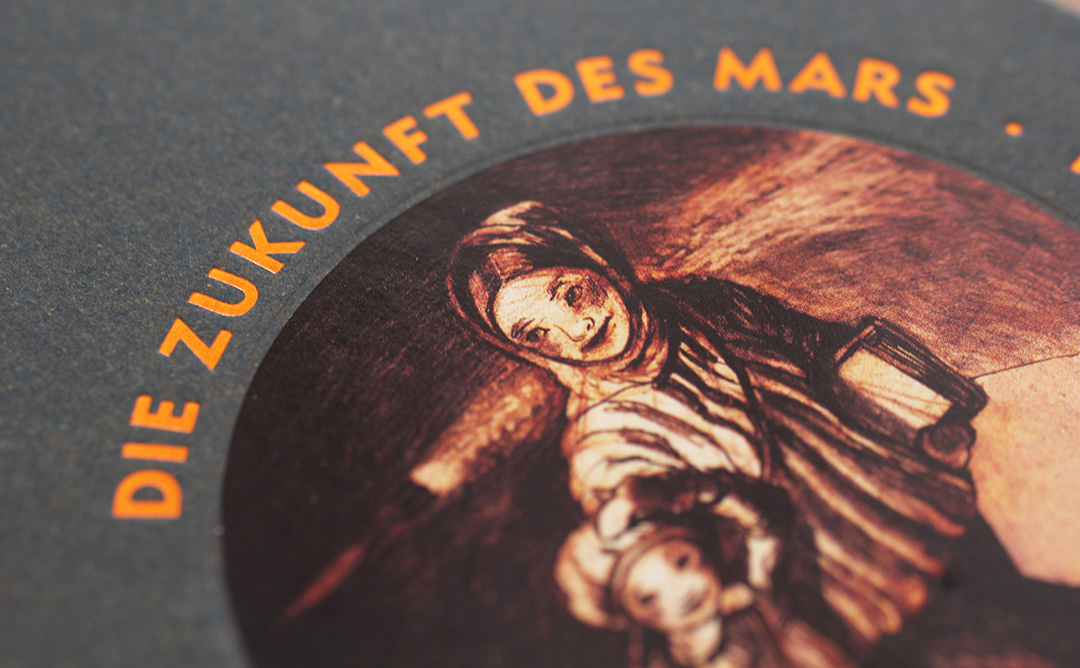
The typeface and colors also mirror the content nicely. The story is set in a fictitious future that is strangely backward and casts a shadow on a modern past. The headings and the orange fore-edge feel modern, while the text typeface, the green, and Anke Feuchtenberger’s cover sketch reflect a present that is somehow simple and impoverished. The colors orange and green also take on meaning within the story itself.
It’s not only the design that the content influences; a few blank pages at the end also pick up an element from the story. The protagonist’s notes are written on blank pages at the end of a book, and so this volume leaves space for that as well—an inventive detail I like very much.
From the blurb, I actually expected something along the lines of science fiction. What I then entered was a dystopia that, especially at the beginning, reminded me a little of Nineteen Eighty-Four by Orwell or Brave New World by Huxley. The story opens with the notes of one of the inhabitants of Mars, who describes various scenes from the life of the colony. As with Orwell, the reader sees the world through the limited gaze of someone within that environment and immerses into an alien culture. Accordingly, one’s understanding of the colony—its way of life and social structures—only expands gradually.
In the second chapter, the perspective shifts to Elussa and her daughter Alide, who live on Earth in the city of Germania. Although there, too, society and politics are shaped by new, patriarch-led structures, the entire world has a post-apocalyptic, impoverished cast. Here as well, the viewpoint is limited to Elussa and a few secondary figures, and it quickly becomes clear that Earth is quite backward. However, the overall setting feels only moderately threatening or extreme. Since the action on Earth takes place at Christmastime, and the central location—the “Electronic Hospital”—actually makes a rather old-fashioned and cozy impression, everything has a somewhat provincial, even slightly romantic air.
The narrative style is oddly intricate in many places. Klein jumps back and forth in time and between perspectives, illuminating a situation from several angles before finally getting to the point. At times I found this cumbersome and a bit long-winded. There’s no noteworthy arc of suspense; rather, the story proceeds quite steadily. I was never bored, though, and as a reader you constantly ask yourself where it’s all heading—how these separate strands come together and how the many small fragments he tells and hints at belong to one another.
The book has a mood all its own that struck me as somehow muted, a little oppressive, yet at the same time relaxed—an odd mixture that’s hard to capture in words. However inhospitable this world is, however saturated it may be with war and the aftershocks of an apocalypse, many small incidents and situations feel conciliatory. For me, this adds up to a story set in a world unto itself—one that ventures a glimpse of a fictitious future without telling it fully or yielding a detailed picture. I can’t find a “message” in the book—or at least it doesn’t force itself upon me. Some characters also seem superfluous; they may offer insights into the culture of the two societies, but they aren’t supporting, let alone necessary, pillars of the narrative.
Conclusion: This visually gorgeous book is a tour de force of book art. Design, color, typeface, and cover harmonize with the content and reflect it in an artful way. In terms of content, it offers a pleasantly readable dystopia with a mood all its own—somehow post-apocalyptic, cozy, inhospitable, threatening, and conciliatory. Klein’s narrative style is intricate and unhurried, and from a character-centered perspective it creates an improbable yet coherent vision of the future. Die Zukunft des Mars is certainly one of the most unusual books I’ve read this year. Even if a clear “point” and breathless suspense curves are absent, it’s an entertaining read that suits a relaxed winter season quite well.
Book information: Die Zukunft des Mars • Georg Klein • Rowohlt • 384 pages • ISBN 9783498035341
Endlich einmal eine Besprechung zu diesem Buch! Vielen Dank!
Ich bin letztes oder vorletztes Jahr – ebenfalls durch die einzigartige Optik – auf das Buch neugierig geworden. Der Klappentext sagte mir auch zu, aber beim Anlesen hat es mich noch nicht genug gebannt, um es zu kaufen. Seither warte ich auf eine Besprechung des Buches von einem Blogger, dessen Empfehlungen ich mehr oder weniger blind vertrauen kann. Dank dir habe ich nun endlich ein genaueres Bild vom Buch bekommen und festgestellt, dass “Die Zukunft des Mars” zwar ganz anders ist, als ich dachte (ich rechnete wie du mit SciFi), aber dennoch sehr außergewöhnlich und interessant zu sein scheint. Damit kommt der Titel nun endgültig auf die Wunschliste.
Liebe Kathrin,
du hast ja auch ein Faible für so schöne Bücher, was man deinem Blog auch sofort ansieht. Du solltest echt einmal einen Beitrag über deine schönsten Bücher machen, das würde mich echt interessieren. Glaub in deinem Schrank stehen auch so einige kleine Kunstwerke.
Was mir an “Die Zukunft des Mars” so gut gefällt, ist die Stimmigkeit zwischen Aufmachung und dem Inhalt des Buches. Die Story selbst ist nun nicht der Oberknaller, aber als Gesamtpaket fand ich das Buch durchaus überzeugend und eben ein wenig unkonventionell. Ich bin gespannt, was du dazu sagst. Also zögere nicht und rezensiere das gute Stück ;)
Liebe Grüße
Tobi
Ja, das Buch ist wirklich wunderschön und gehörte auch zu den besseren SF-Werken in 2013. Leider endete es genau an dem Punkt, wo man als SF-Leser das eigentlich Interessante erwartete.
Aber die Stimmung, besonders in der Mars-Handlungsebene, gefiel mir sehr gut.
Eigentlich ist SF ja gar nicht mein Genre. Bei dem Klappentext des Buches hat sich das aber nicht so wie ein klassischer SF Roman angehört und das ist er ja auch nicht. Die Story wäre sicher noch ausbaufähig gewesen und man hätte da noch eine umfangreiche Handlung und Story anhängen können. Aber dass genau das nicht passiert, bestätigt den doch eigenwilligen Charakter dieses Buches.
Liebe Grüße
Tobi
Hallo Tobi! :)
Ich muss gestehen, dass ich gerade zum ersten Mal von diesem Buch lese – was die Gestaltung betrifft, kann ich anhand deiner Fotografien nur allzu gut deine Begeisterung nachvollziehen. Inhaltlich klingt der Roman aber auch unglaublich interessant, weshalb ich gerade richtig froh bin, über deine Rezension gestolpert zu sein. Ich werde mir das Buch mal näher ansehen – als du Orwell und Huxley erwähnt hast, war’s um mich geschehen. :)
Schönen Abend und liebe Grüße,
Nana