
The Charterhouse of Parma • Stendhal
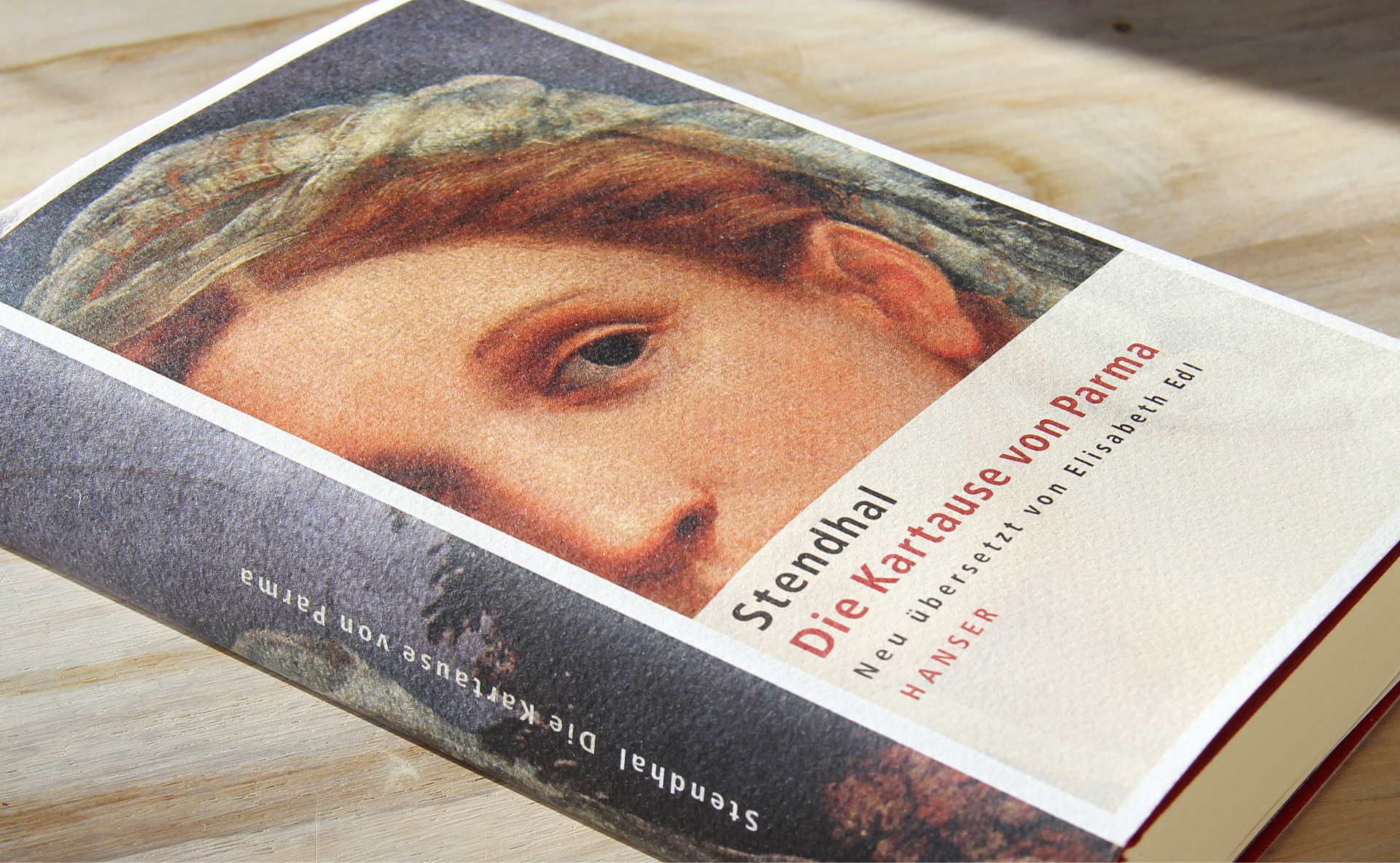
“The novel about the two things that mattered most in Stendhal’s life: Italy and love. Far from his adopted homeland, in Paris in 1839, he wrote in just 53 days the work that today counts among the greatest in world literature.” That’s as far as I got into the jacket copy before I ordered the thing. Sometimes that’s how it goes when the conditions are right. In this case it was the publisher—Hanser—and their series of classic reissues, which they regularly expand with wonderful works of world literature, newly translated and published as handsome hardcovers. Beyond that, Stendhal was a close associate of Honoré de Balzac. Well—“close” is an exaggeration, but the two were in contact, often met in salons, and Balzac praised Stendhal’s work highly in a review. Together with Balzac and Gustave Flaubert, Stendhal is counted among the great realists of his time. Balzac, Flaubert, Hugo, Zola, Maupassant, Dumas—books by these authors are simply a joy; it was clear I couldn’t go far wrong with Stendhal.
I wasn’t wrong, and although I’d read only the first sentence of the blurb, this book turned out to be a real stroke of luck. Stendhal—pen name of Marie-Henri Beyle, born in Grenoble, France—loved Italy all his life and spent three longer and shorter stays there. From 1830 to 1841 he served as consul in Civitavecchia, but spent a great deal of time traveling across Italy: Genoa, Naples, Rome, Florence, Bologna, Ferrara, Venice, and one of his favorite places, Lake Como. In any case, he was enthusiastic about Italy, which is palpable in The Charterhouse of Parma. It is his last completed novel, published in 1839, exactly three years before his death. The book was written during a longer sojourn in Paris—no surprise, since distance rekindled his love for the country.
On his travels he consulted many libraries and private archives. In 1833 he came across old manuscripts from the sixteenth and seventeenth centuries that fascinated him and inspired this book—stories full of intrigue, love, revenge, and passion. And that is exactly what The Charterhouse of Parma is. The book is a true adventure novel, with constant elements of suspense and everything that goes with it; in this it strongly reminded me of Alexandre Dumas’s The Three Musketeers.
Stendhal begins with a brief overview of the political situation in northern Italy. Fabrizio del Dongo, the story’s protagonist, is the second-born son of a noble family, and it’s a pleasure to read about the circumstances into which his family is entangled. His aunt, who champions and promotes him—and adores him—also plays a major role.
The book bears autobiographical traits, and Fabrizio’s adventure begins with the Napoleonic Wars and the French occupation of Milan. Fabrizio joins Napoleon, and here the novel offers a first, very exciting episode. He takes part in the Battle of Waterloo, but Stendhal tells it vividly, with a realistic look at war and the people who fight it. Beyle himself served in the army and was present at the occupation of Milan. His account of these war scenes earned him great admiration from Balzac as well as Tolstoy.
This first period also marks the initial step in Fabrizio’s development and ends with Italy, after the French withdrawal, becoming once again a patchwork of duchies. Most of the book is set between 1815 and 1830—that is, in Stendhal’s own era of the Restoration. The backdrop is the Duchy of Parma, but also the whole of northern Italy. It is, however, a fictional Parma, and Stendhal’s choice to use that name for his composite duchy—made up of many elements—drew some criticism from Balzac. Here the book becomes truly gripping, and the mixture of adventure, intrigue, court society, and of course the search for and struggle over true love is highly entertaining. It has everything: disguises, anonymous letters, revenge, salon society, prison, poisonings, tense skirmishes, despotic rulers, escapes, beautiful duchesses in opulent palazzi—practically everything you can imagine. Much like The Three Musketeers, the book is composed of multiple set pieces which, though they fit very well as stages of Fabrizio’s life, are also fairly distinct from one another. The thread is fairly loose, but it doesn’t diminish the pleasure of reading. The primary themes are love, court intrigue, and Italy—so much Italy. Everything is suffused with a whiff of old-fashioned monarchy and the sheen of bygone days.
In terms of style I found The Charterhouse of Parma surprisingly breezy and unpoetic. That, too, drew criticism from Balzac, who himself wrote in a truly beautiful prose. Stendhal dictated the book to a copyist in just 53 days, and you can sense that. It’s a loose, punchy, easy-to-read style—like spoken language or thoughts as they occur. Somehow spontaneous, unadorned, paired with a fast-moving story, the book is quite unlike what Balzac or especially Flaubert would write. The latter, for instance, labored for hours over his sentences to find the one perfect formulation. With Stendhal it’s entirely different, and the novel almost feels like a contemporary work, with little of the heaviness of a classic. I’m a bit torn here: on the one hand I found it very pleasant to read; on the other, I love the ornate, artful sentences you find in Balzac, Flaubert, or even Tolstoy.
Stendhal and Balzac had known each other personally since 1829; they met several times in salons but were more familiar with each other’s works than with each other. Although Balzac was the younger of the two, it was his well-known review that really made Stendhal famous and championed him—a curious thing, since you’d expect it to be the other way around, but Balzac was simply more famous and better established as a writer. Stendhal, however, was not only a writer but a genuine adventurer, devoted to women and the arts, with a great many interests. Writing was one of them.
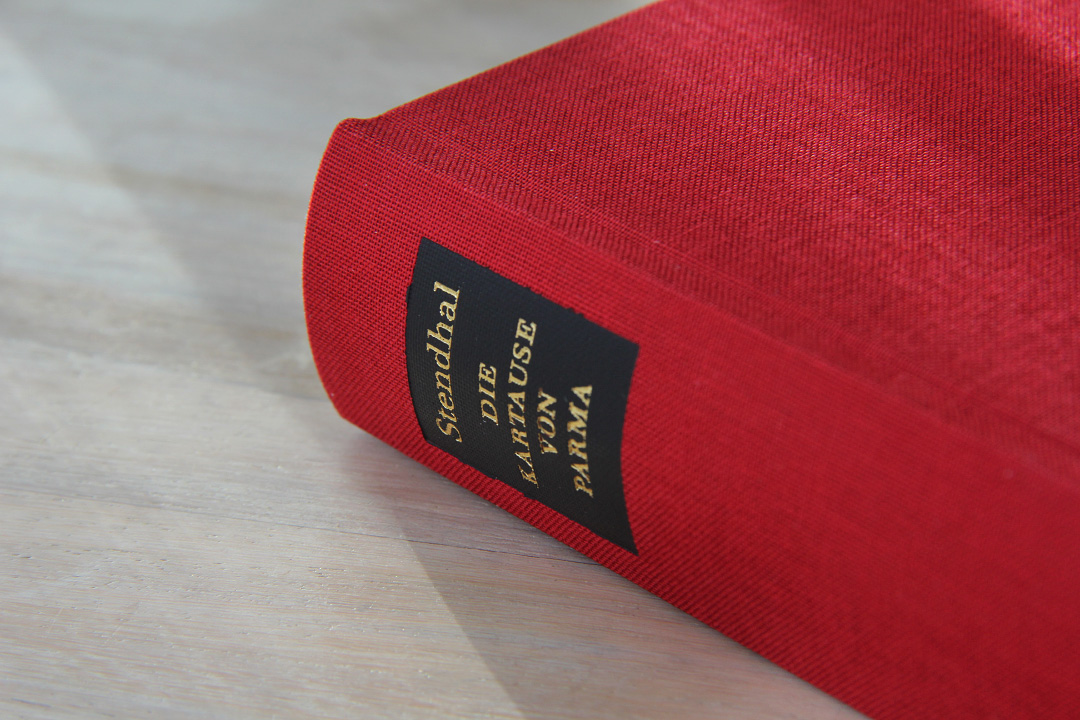
This Hanser edition is again of outstanding quality—truly generous in what it offers. Not only the usual high-quality production, but also the wealth of notes and supplements. Many of the details cited in this review are drawn from the very interesting, extensive afterword, which is well worth reading. There you learn, for example, that after publication Stendhal wanted to revise the book for a second edition. He had three author’s copies printed with blank interleaves, which he then filled with notes for the revision. The story of these three copies could fill a book in itself: they passed through many hands, were lost for a time, and were eventually all found again. This edition presents the 1839 text without those annotations, since they remain unfinished and were never approved by Stendhal—but the notes are included in translation. Also included are the letters between Stendhal and Balzac, as well as Balzac’s famous review. Finally, you also get the Italian manuscripts from the sixteenth and seventeenth centuries that inspired Stendhal’s story. Everything translated by Elisabeth Edl—about whom I need say little, since she is well known and essentially a seal of quality for the finest translations available today.
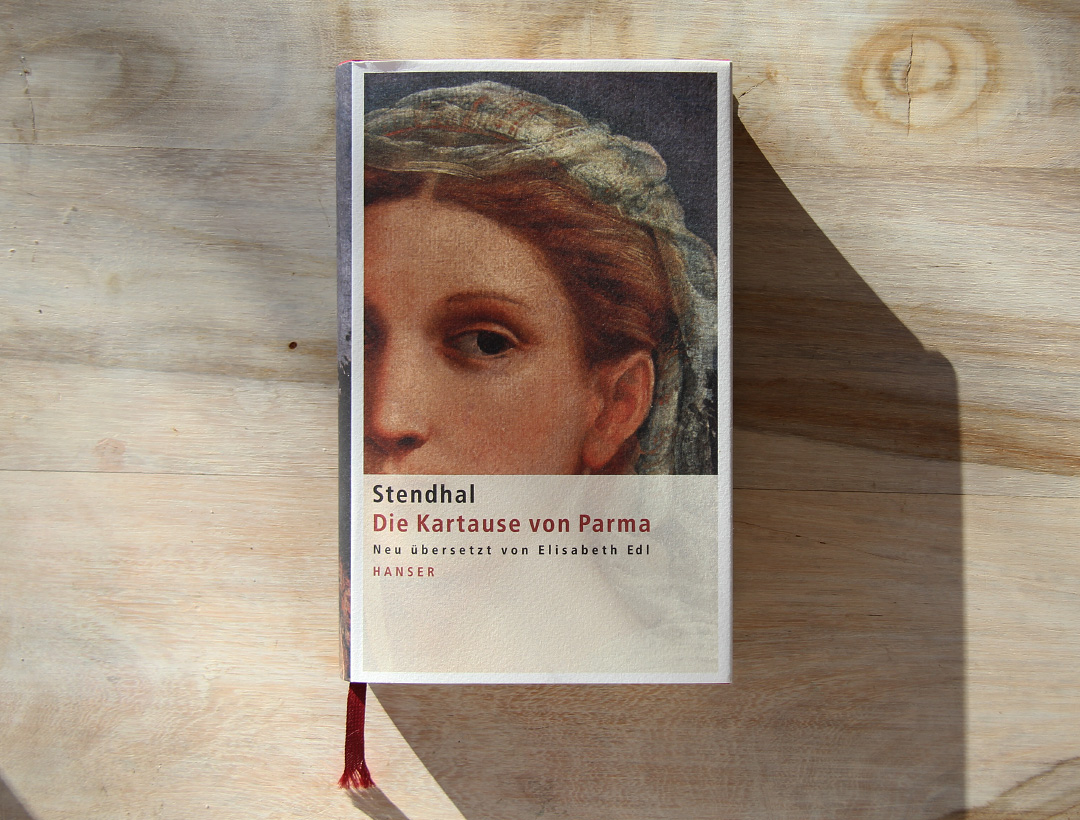
Conclusion: Conceived as a Bildungsroman, the novel beautifully traces Fabrizio’s development, and from the middle of the book the search for true love becomes a central theme. From that point on I truly fell in love with it. Here Stendhal hefts the big club of suspense with great skill. It has everything I want: thrilling fights, heaps of intrigue, lush love scenes, despotic rulers, beautiful duchesses in their palatial residences, disguises, escapes, murder—practically everything. Readers are dragged through every high and low. Stendhal keeps a pleasant pace and chooses a simple but highly readable style that supports the flow. There isn’t a dull stretch; a hundred pages pass as quickly as fifty elsewhere. At the same time, the characters suffer from the same weakness found in many of the authors named above: they are often exaggerated and heavily drawn. If someone is in love, they are completely headless and will-less; if someone is evil, then thoroughly so; if someone is a fawning courtier, then without a shred of backbone. It certainly drives the story and heightens the suspense, but you can’t always fully buy it. This Hanser edition comes with an excellent afterword and many supplements—letters, Balzac’s review, timelines, plans for a revised edition, and notes on the translation and terms. A book I can recommend to everyone—even to those who rarely read classics and prefer adventure novels.
Book information: The Charterhouse of Parma • Stendhal • Hanser Verlag • 1000 pages • ISBN 9783446209350
Hallo Tobi,
wieder eine tolle Buchvorstellung von dir. Das Buch steht auch schon lange auf meiner Wunschliste (wie fast alle Hanser-Klassiker). Im Herbst erscheint dort ja auch der 3. Tolstoi-Band “Auferstehung”, wird wohl auch ein Pflichtkauf. Hoffe, dass dann vielleicht nächstes Jahr endlich die Neuübersetzung der Fortsetzung von “Verlorene Illusionen” erscheint (Glanz und Elend der Kurtisanen). Die Lesung mit Elisabeth Edl hier bei uns in Duisburg vor ein paar Wochen ist leider geplatzt, hoffe, dass das bald nachgeholt wird. Bei mir steht als nächster Klassiker “Emma” von Jane Austen an (in der Lovelybooks Klassiker-Leserunde ab 10.5.), habe mir die Manesse-Ausgabe gegönnt.
Viele Grüße
Thomas
Hallo Thomas,
vielen Dank für dein Kommentar. Oh man, sehr genial. Das hab ich gar nicht mitbekommen, dass “Auferstehung” neu heraus kommt. Das bestell ich gleich vor, das ist ein absoluter Pflichtkauf. Klasse Neuigkeiten. Über die fehlende Ausgabe von “Glanz und Elend der Kurtisanen” war ich auch enttäuscht. Ich hab mich dann für die Ausgabe vom Diogenes Verlag entschieden und nicht bereut. Gebunden sieht die, jenseits des Umschlags, auch sehr schick aus und man spürt beim Lesen der beiden Bücher keinen groben Bruch hinsichtlich der Qualität der Übersetzung.
Emma ist auch eine schöne Geschichte, da wirst du bestimmt deine Freude haben. Und als Manesse Bändchen sowieso ;)
Herzliche Grüße
Tobi
Beruhigend zu wissen, dass es eine lesbare Ausgabe von “Glanz und Elend…” gibt, scheint aber nicht lieferbar zu sein, wenn man nicht gerade den ganzen Diogenes-Schuber möchte. Werde mich mal nach gebrauchten Ausgaben umgucken, danke für den Tipp.
Hallo, lese immer wieder gerne Ihre Rezensionen, auch wenn ich mich ein bißchen schäme, noch gar nicht so viele gelesen zu haben, aber die ich gelesen habe, waren gut.
Was Stendhal betrifft, habe ich ihn als Italienfreund in meine geistige Welt integriert, außerdem hat er eine sehr gute Rossini-Biografie geschrieben, die ziemlich vorne in meinem Buchregal steht.
Was seine Romane betrifft, hat der Autor ja nunmal eine sehr große Fantasie, was ja auch gut ist.
Zu “Rot und Schwarz” ist zu sagen, dass ich auch auf meinem eigenen Reise-Blog einen Kommentar dazu geschrieben habe, bedingt durch ein Erlebnis beim Carnevale di Venezia 2016, was man schon als Wink des Schicksals deuten kann (mit etwas Fantasie).
“Die Kartause von Parma” zieht sich ein bißchen hin, ich bin schon eine ganze Weile dran, liegt aber auch daran, dass ich nicht mehr so viel zum Lesen komme.
MfG
Thomas Roth
Lieber Thomas,
vielen Dank für das Lob. Es freut mich, wenn ich auch thematisch Deinen Geschmack treffe. Und wer Italien mag, der wird auch Stendhal lieben. Nach “Die Kartause von Parma” hätte ich schon auch echt Lust gehabt Urlaub am Comer See zu machen. Das wäre es überhaupt: Ein Urlaub und dort am See das Buch lesen. Es soll ja Stendhal Fans geben, die das machen und sich in den Hotel einquartieren, die Stendhal damals aufgesucht hat. Hab ich zumindest mal irgendwo gelesen und irgendwie würde das auch gut passen.
“Rot und Schwarz” fand ich irgendwie so ganz anders als die Kartause. Aber auch ein Meisterwerk, das zu lesen sich einfach lohnt.
Liebe Grüße
Tobi
Hallo, eine gute Idee mit dem Comer See.
Als ich 2014 in Florenz war, konnte ich das nach Stendhal sogenannte “Stendhal-Syndrom” nachvollziehen,
aber eher dahingehend, dass mir nicht schwindelig wurde von der ganzen Kunst dort, sondern von den Preisen, die dort herrschen…
Die “Kartause” vor ein paar Tagen beendet, man muss schon etwas Geduld haben, kommt mir manchmal auch etwas
langweilig vor (Gefängnishaft des Protagonisten).
Das “Italien-Buch” Stendhals habe ich zweimal gelesen und ich schätze eher seine Fantasie, und wie er manche Dinge erfindet, so z.B ein
fiktives Treffen mit Rossini und Reisen in gewisse Teile Italiens, wo er nie war…
Aber Fantasie ist immer wichtiger als Wissen, denn Wissen ist begrenzt…
Gruß
herrrothwandertwieder
Noch ein Zusatz:
Es hieß ja immer, dass es ein reale Kartause in Parma gar nicht geben würde.
Vielleicht ist es einzelnen bekannt, aber nach meinen Erforschungen gibt es wirklich eine Kartause (Certosa di Parma), die
an der Strecke kurz vor Parma von Osten kommend, oberhalb (nördlich) der Bahn- und Autostrecke von Reggio Emilia nach Parma
liegt. 2011 bin ich dort mit der Bahn auf dem Weg von Bologna nach Parma vorbeigekommen, nur zu dem Zeitpunkt hatte ich
das Buch noch nicht gelesen.
Einst Kaserne, Tabakfabrik, jetzt Schule für Gefängsniswärter mit Kaserne, aber zu besichtigen!
Roth
Hallo,
nochmal etwas zu Stendhal. Die Stendhal-Biografie von Willms bestätigt wieder meine Meinung zu Biografien – eine Biografie ist immer die Meinung des Herausgebers und kann nie neutral sein, es kommt immer wieder eine Wort zum Tragen: …enttäuscht, enttäuscht, enttäuscht.
Wenn man natürlich wie Stendhal nur hinter Frauen her rennt, dass man dann enttäuscht ist, ergibt sich ja von selbst.
Also, besser die Romane von Stendhal lesen (und geniessen) und nicht irgendeine Biografie, dann ist man auch nicht enttäuscht.
Roth