
Fanny • Ernest Feydeau
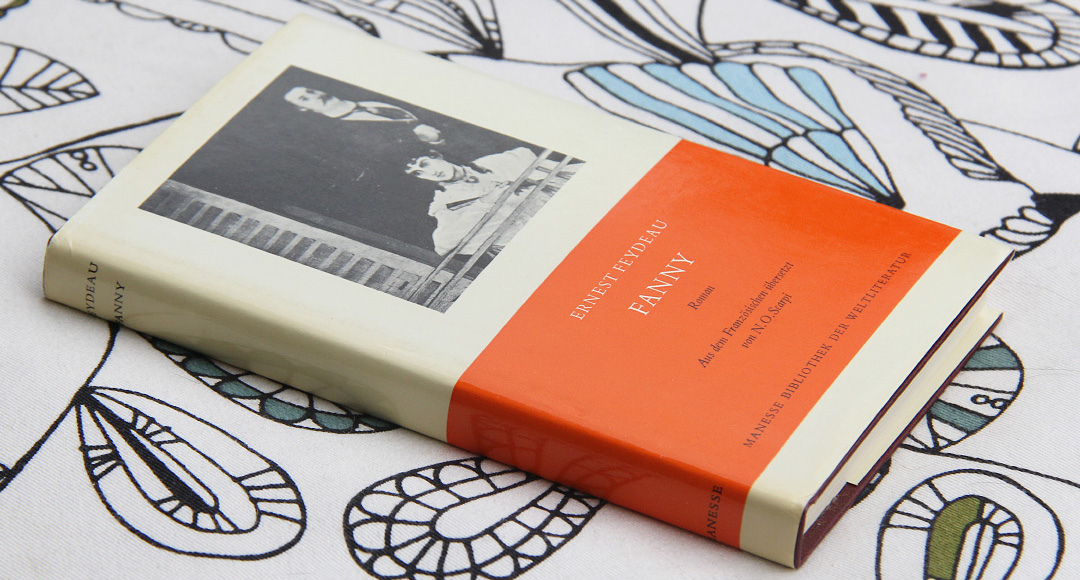
I discovered this book on Petra’s blog, and for me, it’s a perfect example of how book blogs are a great place to find good recommendations. I would never have found this book on my own, since it’s out of print and has never been reissued. At this point, a heartfelt thank you to Petra for her excellent posts — like me, she has a soft spot for 19th-century French literature. And just like her, I’ve also grown fond of the Manesse editions. However, it wasn’t easy to get hold of this little out-of-print gem.
The edition I finally managed to get hold of for a reasonable price is from 1974, and it looks exactly like that. Don’t be fooled by the picture — it’s yellowed, musty, and anything but attractive. I’ve had it lying out on the terrace for a few hours, but it still smells. What can I say: I just don’t like shabby old books, and I’ve grown spoiled by the beautiful new editions, especially of classics. Why no one has yet rediscovered this book, retranslated it, and published a fine new edition is a mystery to me. But curiosity won out, and better a worn-out book in hand than to have a promising work not at all.
The story is told from the perspective of Roger, the lover of Fanny, a woman about ten years his senior and married. Both are well-off, meeting once a week for tender hours together — yet their love is not one of happiness. Roger is dissatisfied, and the central focus of the story lies in the emotional world of the lover. Jealousy of the husband and the desire to possess Fanny entirely torment the young man. The conflicts with Fanny, but also with himself, and his struggle with these feelings, create an adultery novel that is quite unlike most others I have read. Instead of describing events or social conflicts, everything is built upon Roger’s inner life — how he feels, how he yearns for consummated love, how he worships Fanny, and how she, in turn, torn between domestic happiness, material security, and thoughts of her children on one side, and her lover for moments of leisure on the other, cannot be swept away in the storm of passion. It is an unequal, disharmonious couple, and so the story has nothing of a beautified, tempestuous, romantic love story.
The central theme is thus the lover’s jealousy — his suffering, not that of the betrayed husband. It is the struggle the lover wages with himself and his beloved, the lack of claims, and the abundance of love he feels for Fanny. Feydeau employs a very direct style, holding nothing back, capturing emotions sharply and clearly, rendering the protagonist’s inner world comprehensible. He often finds very beautiful words for it.
“Often in my dreams, I imagine that we voluntarily exile ourselves to the infinity of solitude, where, under an ever-blue sky, in the shade of ever-green trees, on the shore of an ever-peaceful sea, upon the ever-blooming moss, we delight in each other as though our doubled existence were nothing more than a tangible memory.” (p. 88)
What’s interesting about the book is that there are really only three characters, and the husband is little more than a shadow. This strong limitation to Roger’s emotional world felt a bit oppressive to me, making the emotional turbulence all the more pronounced. The few dialogues become livelier and more expressive as a result.
“Love — it has never occurred to you — thinks of nothing and reserves nothing for itself that is not itself.” (p. 193)
Ernest Feydeau, like his friend Flaubert, was born in 1821 and published Fanny shortly after Flaubert had won his trial for offending public morals (because of his novel Madame Bovary). Although the comparison seems obvious, I wouldn’t associate Feydeau with Flaubert — neither in style nor in structure. The two were friends, and Flaubert advised him on his novel project. And of course, one can see parallels in the theme of adultery and a then-daring scene. However, the book reminded me more of Strong as Death by Guy de Maupassant. It, too, is told from the perspective of the lover, who is only moderately content with his situation, and of a wife unwilling to give up her social and financial security. Feydeau cannot match Maupassant’s style — his sentences, his refinement, his deliberate and skillful construction — for the latter simply plays in another league. Still, the perspective is similar: the struggles of a lover who wishes to possess the woman he loves entirely.
Anyone who searches for Feydeau will first come across his son Georges, a playwright and far better known than his father. Ernest Feydeau, who worked as a bank clerk and stockbroker and had interests in Egyptology and antiquities, was primarily known for this novel, Fanny. He wrote a few other books, but when he died in 1873, he was already half forgotten. At least that’s what the afterword says, and it fits the lack of popularity Feydeau still suffers from today.
Conclusion: Fanny is a worthwhile read — it offers a captivating story, though not one that is extraordinary or profoundly moving or fascinating, as in the works of his contemporaries such as Flaubert or Maupassant. From the lover’s perspective, Feydeau beautifully portrays pain and jealousy, depicting adultery from a different angle. With a direct and pleasant language, he describes a situation that feels real and authentic, even though the story is fictional. This book is definitely a small hidden gem, and it’s lovely to read something a bit off the beaten path — to pick up a now rather forgotten book from that era.
Book information: Fanny • Ernest Feydeau • Manesse Verlag • 256 pages • ISBN 9783717514787
Endlich mal ein Buch mit Seele auf diesem Blog! ;)
Nein, Spaß beseite: Tolle Rezension, wie immer. Weder Autor noch Buch sagen mir etwas aber das klingt alles sehr interessant. Bei Booklooker ist noch das eine oder andere Exemplar zu finden (in der eher schlichten DTV-Ausgabe) und da werde ich wohl bald zuschlagen.
Du hast ganz offensichtlich ein Faible für französische Autoren aus dieser Zeit, vielleicht kann ich dich auch für andere Autoren erwärmen? Oscar Wilde, James Joyce usw? Von Joyce gibt es glaube ich auch die eine oder andere schicke Ausgabe. Vielleicht würde dir sogar Yeats gefallen? ;)
Du meinst endlich mal keine Chicklit Neuerscheinung, die ich hier bespreche ;)
Feydeau ist ein echter Geheimtipp und nun kein Buch, das der super Knaller ist, aber sehr interessant, einmal etwas aus dieser Zeit zu lesen, das weniger bekannt ist. Französische Autoren des 19. Jahrhunderts haben einfach die besten Bücher geschrieben. Da können andere Autoren dieser Zeit aus anderen Ecken, wie beispielsweise Mark Twain, Oscar Wilde oder auch Henry James, nicht mithalten. Aber das ist persönliches Gusto, denn ich mag den Stil und die oft rasante Art zu erzählen sehr und kann mich im Gegenzug mit den dagegen oft spartanisch anmutenden Büchern Anfang des 20. Jahrhunderts weniger begeistern (beispielsweise Hemmingway oder Camus). James Joyce habe ich in einer schicken Ausgabe auf dem SuB, da bin ich schon gespannt, was mich erwartet.
Herzlichen Dank auf jeden Fall für deine Worte und die Empfehlungen!
Oh, ich gönne dir deine Luxuswälzer gerne aber mein Fall sind sie nicht. ;)
Wilde finde ich immer wieder köstlich, seine süffisante Art blitzt in seinen Werken auf jeder Seite durch und es macht einen Heidenspaß sie zu lesen.
Joyce ist immer wieder ein Erlebnis auch wenn er es einem oft nicht einfach macht. Am sinnvollsten ist es wenn man bei ihm chronologisch vorgeht also mit “Dubliners” anfängt.
Wie gut, lieber Tobi, dass du noch eine Ausgabe gefunden hast. Meine ist ja auch aus 2. Hand, doch aus gepflegtem Haushalt, sodass sie trotz ihres Alters kein bisschen müffelt. Ich mag alte Bücher sehr gern, aber wirklich schlimmes Gemüffel kann dem Lesegenuss durchaus etwas abträglich sein …
Als ich den Beitrag zu “Fanny” damals schrieb, dachte ich mir gleich, dass dir das Buch zusagen könnte. Das denke ich oft bei manchen älteren Werken, weil ich weiß, dass du gern jenseits der Neuerscheinungen liest. Demnächst kommen zwei Beiträge, die dir eventuell wieder zusagen könnten (also die Bücher), allerdings sind es diesmal keine Franzosen, aber das macht ja nichts ; )
Liebe Grüße
Petra
Liebe Petra,
ich bin ja noch gut versorgt, was die großen Titel und dicken Fische im Klassiker-Teich betrifft. Aber so kleine Geheimtipps finde ich immer wieder klasse und ein positive Rezension in deinem Blog ist für mich schon ein Kaufgrund. So auch wieder bei der neuen Ausgabe von Irène Némirovsky beim Manesse Verlag. Aber Franzosen müssen es nicht immer sein. Auf meinem SuB sind sie aktuell auch in der Minderheit. Es gibt einfach zu viel noch zu entdecken, als dass man sich da zu stark einschränken sollte ;)
Liebe Grüße
Tobi
Da hast du vollkommen Recht, einschränken lassen wollen wir uns ja auf keinen Fall!
(Ui, fühle mich gerade extremst geehrt, dass eine positive Besprechung bei mir für dich schon ein Kaufgrund ist *-*)