
Sehnsucht: Das geheime Tagebuch der Contessa Livia • Camillo Boito
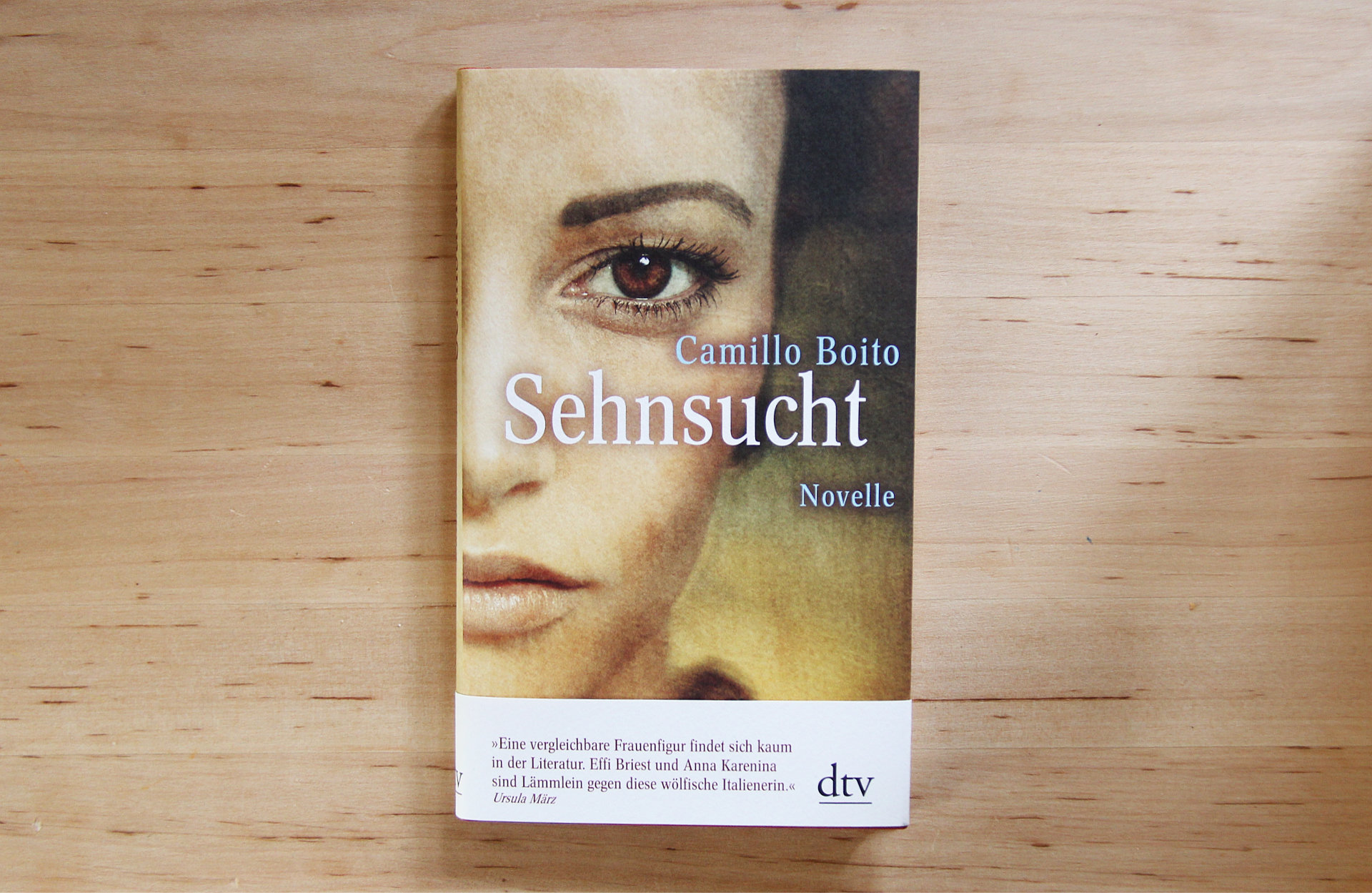
Actually, I usually enjoy reading publishers’ previews as soon as they come out, but somehow this book slipped past me. Neither the title nor the author rang a bell, though this classic from 1883 intrigued me once I read the blurb:
“A comparable female character can hardly be found in literature. Effi Briest and Anna Karenina are lambs compared to this wolfish Italian woman.”
Of course, I had to get and read this short novella—after all, the adulteress novels of the 19th century are premium fare. So I was quite curious to see whether this brief work could hold its own. Whether it truly does, you’ll find out in the following lines.
This little book contains a single novella of about 80 pages, and those pages aren’t particularly densely printed. A short piece, one that takes no more than 45 minutes to read—perfect as a quick interlude during a train ride. I quite like such brief novellas. My reading choices are usually more extensive, so a small book like this is a pleasant diversion.
The story itself is quickly summarized. The beautiful Livia marries an old man, primarily for his position and wealth, thus rising to the rank of a Contessa (comparable to a Countess). Stunning as she is, she’s also a self-assured and haughty aristocrat who, out of boredom, takes a lover. She really turns it up a notch and competes quite well with Emma Bovary. Her chosen lover, however, turns out to be far from ideal, and things escalate dramatically—surpassing even the outcomes that befall Emma, Anna, or Effi. The Italians really take it one step further.
The novella is written in an entertaining and fluent style, with simple sentences. No artistic prose like Flaubert, no hefty tome like Tolstoy, and none of the interpretative openness of Fontane. It’s actually quite straightforward. The story is told in the first person, though it doesn’t read like a diary but rather like a normal narrative. We gain a clear insight into Livia’s thoughts and emotions, and much like Flaubert’s Emma, it’s easy to understand her yearning for romance and her boredom with her elderly husband. But when you look at Anna, Emma, or Effi, their actions as adulterous women were always driven by powerful emotions—feelings that swept them away. I didn’t sense that in Livia. Although she’s passionate, you always feel that, despite her emotionality, calculation plays a role. And that takes away some of the story’s appeal and the realism that defines those other famous novels.
Overall, it’s a pleasant story that’s easy to read, though it didn’t quite captivate me. It’s simply too short. In 80 pages, it’s impossible to unfold the rich complexity of human thought and feeling. Tolstoy and Flaubert did that masterfully—Boito doesn’t come close. Still, this book is something of a hidden gem, as it serves as a nice teaser for what awaits in the great adultery novels.
I also find the historical context quite fascinating. The great adultery novels of the second half of the 19th century were well-known bestsellers that deeply moved society. The fact that an Italian author also explored this central theme is noteworthy—it shows that this concern with emancipation, and thus with progress through Enlightenment and the great social changes after the Revolution, was a truly European process that touched nearly every country on the continent. And if there has been one truly significant advance in the two centuries since the French Revolution, it’s the emancipation of women, which for me—alongside the understanding of a society built on individual freedom—is one of the greatest (albeit regionally limited) achievements in human history.

Camillo Boito was previously unknown to me, and apparently literature wasn’t his main focus. He published two collections of novellas. In the second, Nuove storielle vane, this novella Senso is included. Boito was actually an architect, and his most famous building is the Casa di Riposo per Musicisti in Milan—a retirement home for musicians founded by the famous composer Verdi.
The political context in which this novella takes place is also noteworthy. Set during the Risorgimento—the Italian War of Independence and the formation of the nation-state—the story unfolds in turbulent and warlike times that also influence the course of the love affair. Livia clearly takes the Austrian side, and neither she nor her lover comes off well. The protagonists show little interest in the political maneuvers of the great powers; the focus is, of course, on the relationship between the two. Still, this backdrop gives the book a lively and authentic atmosphere.
Conclusion: This novella offers an enjoyable and entertaining story that, unfortunately, is far too short and thus fails to fully capture the emotional and psychological depth of a woman in love. Stylistically, it reads smoothly, and a fast-paced story about an adulteress from the pen of a 19th-century Italian author is certainly a hidden gem among the famous novels of the time. So—not a masterpiece, but I liked it and found it thoroughly entertaining.
Book information: Sehnsucht: Das geheime Tagebuch der Contessa Livia • Camillo Boito • dtv Verlag • 104 pages • ISBN 9783423281201
Danke fuer den Beitrag, klingt spanned.
x finja | http://www.effcaa.com
Moin,
dein neuer Blogeintrag wirft jetzt aber Fragen auf :)
Ist eine kurze Novelle nicht ein Pleonasmus?
Wieso gibt es zwei so unterschiedliche Bilder?
Oder ist die rote Hardcoverversion einfach nur ohne Schutzumschlag?
Und wenn dem so ist, seit wann macht der dtv Verlag Hardcover?
//Huebi
Lieber Huebi,
eine kurze Novelle ist sozusagen doppelt gemoppelt, lässt aber keine Zweifel zu: Das Buch ist zu kurz ;)
Das Buch ist tatsächlich Hardcover und das zweite Foto ist das Buch ohne Umschlag. Ich dachte auch immer, dass es im dtv Verlag nur Taschenbücher gibt, was ja der Name schon nahe legt. Ein paar Hardcover Bücher haben Sie aber schon im Angebot. Wenn du dir die Vorschau für den Herbst anschaust, dann sind da einige Hardcover zu finden.
Herzliche Grüße
Tobi