
Daisy Miller • Henry James
Ever since I read my first book by Henry James, The Ambassadors, I’ve kept coming back to the American-British author, and without even noticing it at first, I’ve continued to read him ever since that first book. It’s probably his style—unruffled and composed. A Balzac novel hits you like a bomb going off. Henry James, by contrast, is restrained, polished, utterly relaxed, and gets by without a steep dramatic arc. And yet I love his books, because in the subtle observations and wonderful dialogues there are so many delicate, all-too-human nuances that reading them is a true delight. His novella Daisy Miller predates The Ambassadors by 25 years, and since I’d stumbled across it several times—and as it’s among his better-known works—I was curious to see what it would be like.
Not long ago I introduced Four Meetings by Henry James. I especially liked the story Pandora, because his female characters are particularly fascinating. Daisy Miller is very similar to Pandora in structure and theme and likewise centers on a young American woman. Daisy Miller is traveling through Europe with her mother and little brother. The American Frederick Winterbourne, who has been living in Switzerland for some time, meets her at a spa town and strikes up an acquaintance. Once again the book explores the cultural contrasts between the new America and the old Europe. And again, the protagonist Winterbourne lacks the insight to grasp Daisy Miller’s true nature and cannot see the situation clearly. The reader comes to know Daisy gradually through Winterbourne’s subjective impressions and must piece together an image from their encounters and his descriptions.
What I wrote about Pandora there applies fully to this novella as well. This is pure Henry James and sheer reading pleasure. I love the dialogues, always engaging and full of subtext. He depicts situations so you clearly feel that much more is being exchanged between the protagonists than what’s said aloud. It’s quite an achievement to distill that into a novella. His manner is relaxed, with a certain refinement. His figures move in polite, well-bred society—reserved, courteous, cultivated. Yet that very cultivatedness often gets in their way, for the American temperament and the social structures of old Europe in James always create a latent but palpable rift. Here too, the unpredictable Daisy Miller—her willful manner, and the social reactions to her—are elements that stoke the reader’s curiosity. I kept wondering how the story would end—what would ultimately come of it all.
Unfortunately, Daisy Miller is once again only a very short novella. I feel I could go on reading endlessly. The characters feel vivid and realistic, and together with those fine descriptions, the even, orderly prose, and that refined society, the book exerts a pull that’s hard to resist. James is known for his psychologically delicate portraits of women, and like Pandora, this novella is a showcase of his art.

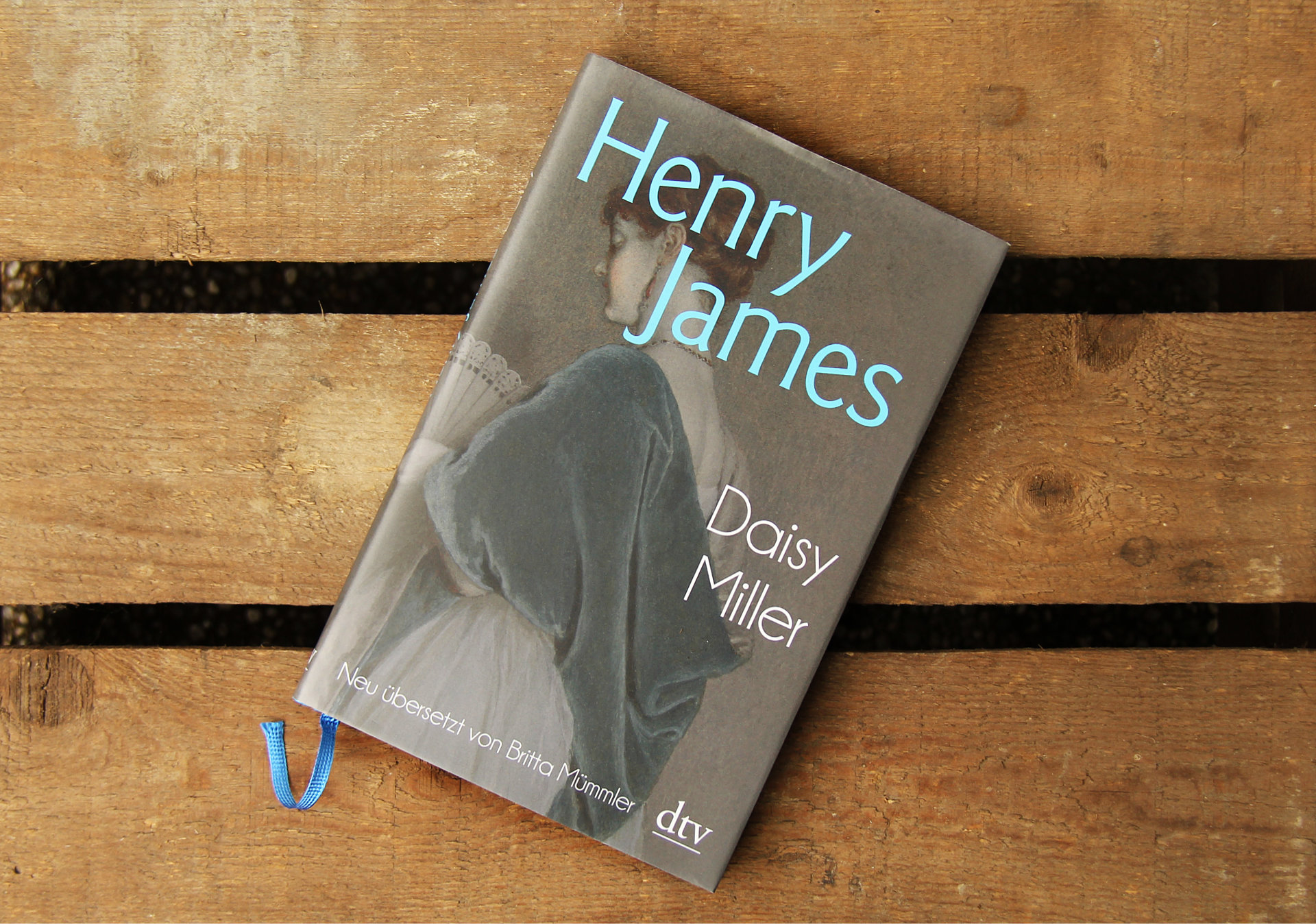
Last year, to mark the 100th anniversary of Henry James’s death, dtv reissued several of his books. Daisy Miller is the only hardcover in the series (as far as I’ve seen). The slim volume is well produced, though not a bibliophile masterpiece. But the colors are nicely balanced, it includes a ribbon bookmark, and the cover is quite attractive. I really like the look of it. I also found the notes very helpful—they explain certain terms and are an excellent addition. The translation made a solid impression, too. Overall, I liked the package very much.
Conclusion: The novella Daisy Miller is wonderfully written—pure Henry James—and it delighted me once again. It strongly resembles his novella Pandora, once more offering a finely drawn portrait of an American woman, delivered in his usual calm, composed, and matter-of-fact style that I find so pleasant I could read it forever. The cultural divide between the new America and old, conservative Europe is again central, made tangible through the characters and rendered in all its nuances. Even though the book doesn’t build conventional suspense and the plot flows gently along, I couldn’t put it down and was very curious to see how the story would end. I find the dialogues brilliant, and the way James describes reactions and encounters is superb. A recommendation for anyone wanting to try Henry James for the first time—and definitely for those who already enjoy his other novels.
Book information: Daisy Miller • Henry James • dtv Verlag • 128 pages • ISBN 9783423146531
Hallo,
eine sehr gute Rezension, die mich daran erinnert, dass ich mir vorgenommen hatte, mal wieder ein Buch von Henry James zu lesen… “What Maisie Knew” liegt dahinten auf dem Lesestapel – das aber schon länger. “Daisy Miller” wandert auf der mentalen Leseliste mal ein paar Plätze weiter nach oben.
Ich habe diesen Beitrag HIER für meine Kreuzfahrt durchs Meer der Buchblogs verlinkt.
LG,
Mikka
Liebe Mikka,
“What Maisie Knew” habe ich auch noch nicht gelesen oder auf dem Stapel. Mein nächstes Buch von Henry James wird “Porträt einer jungen Dame”, das hat sich vom Klappentext auch hervorragend angehört. “Daisy Miller” kann ich dir nur empfehlen, nimm es lieber auf deine richtige Leseliste ;)
Herzlichen Dank fürs Verlinken von meiner Rezension!
Liebe Grüße
Tobi