
Victor Hugo: Im Exil • Laurent Paturaud und Esther Gil
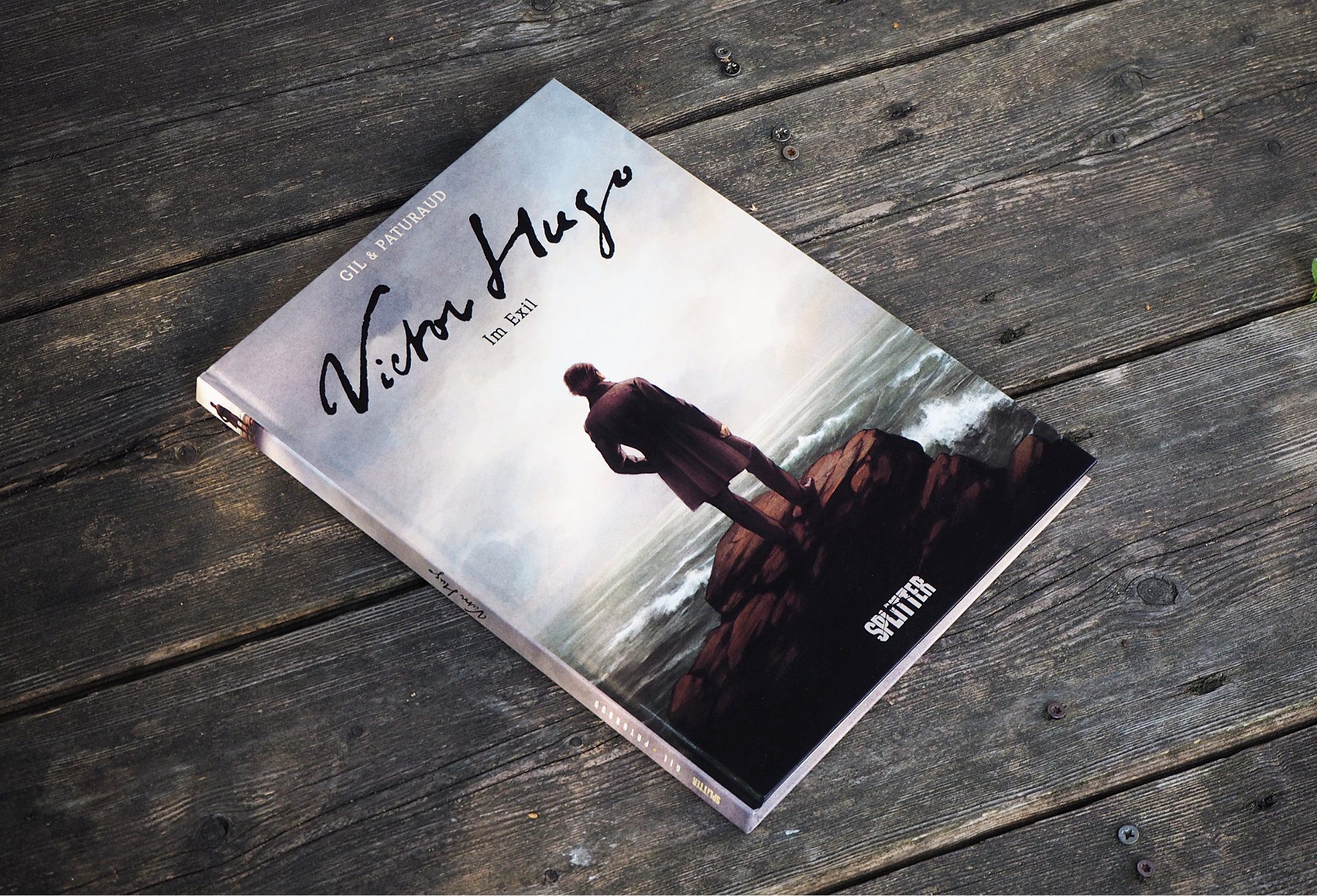
I love the great novels of the world-famous French authors, above all the literary heavyweight Victor Hugo, who will forever remain in my memory for Les Misérables (which I reviewed here). For political reasons, Victor Hugo had to flee France and chose the Channel Island of Jersey as his first place of exile, later moving to the neighboring island of Guernsey. It was there that the wonderful book Toilers of the Sea was written, which is set on Guernsey, and which I really enjoyed and also reviewed on lesestunden. When I discovered the graphic novel Victor Hugo: Im Exil in the Splitter Verlag catalogue, it was immediately clear that I had to read it. In this post, you can see what awaits you with this graphic novel.
In 1843, shortly after her marriage, Victor Hugo’s daughter Léopoldine drowned together with her husband when their boat capsized on the Seine. A tragedy that stands at the center of this graphic novel, whose story begins ten years later on the island of Jersey. During a séance, Victor Hugo’s deceased daughter appears to him, urging him to uncover the truth behind her death. Despite the dangers, Victor Hugo returns to France to confront his past. While the drama surrounding his daughter’s death is true, the search for an explanation for this tragedy is purely fictional.
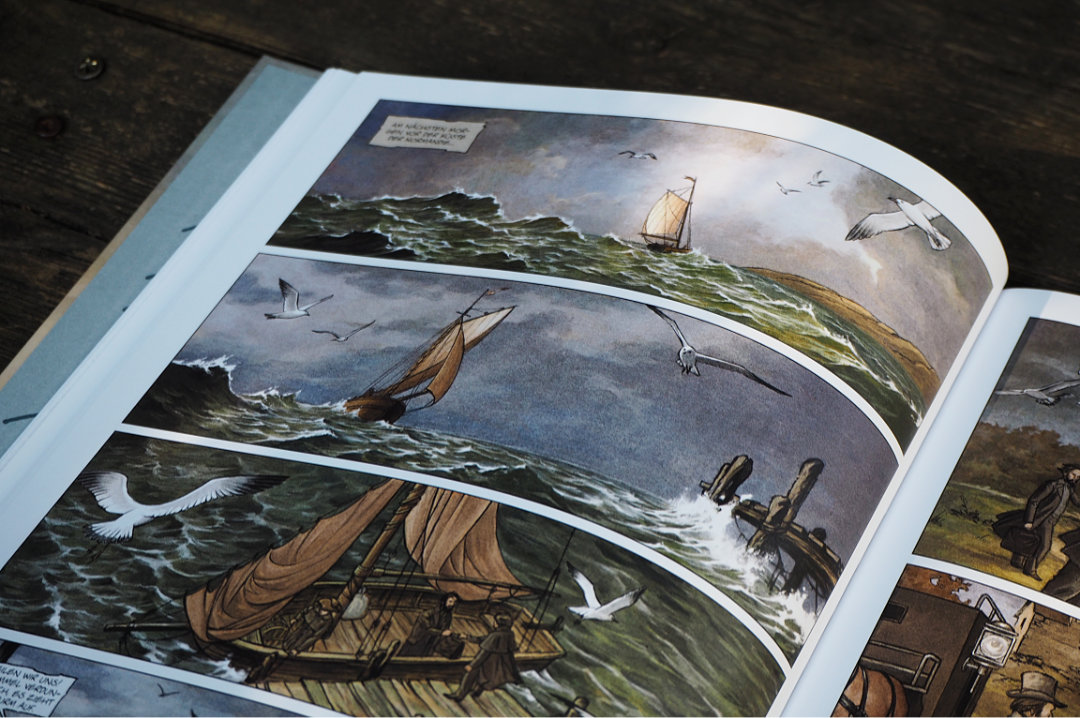
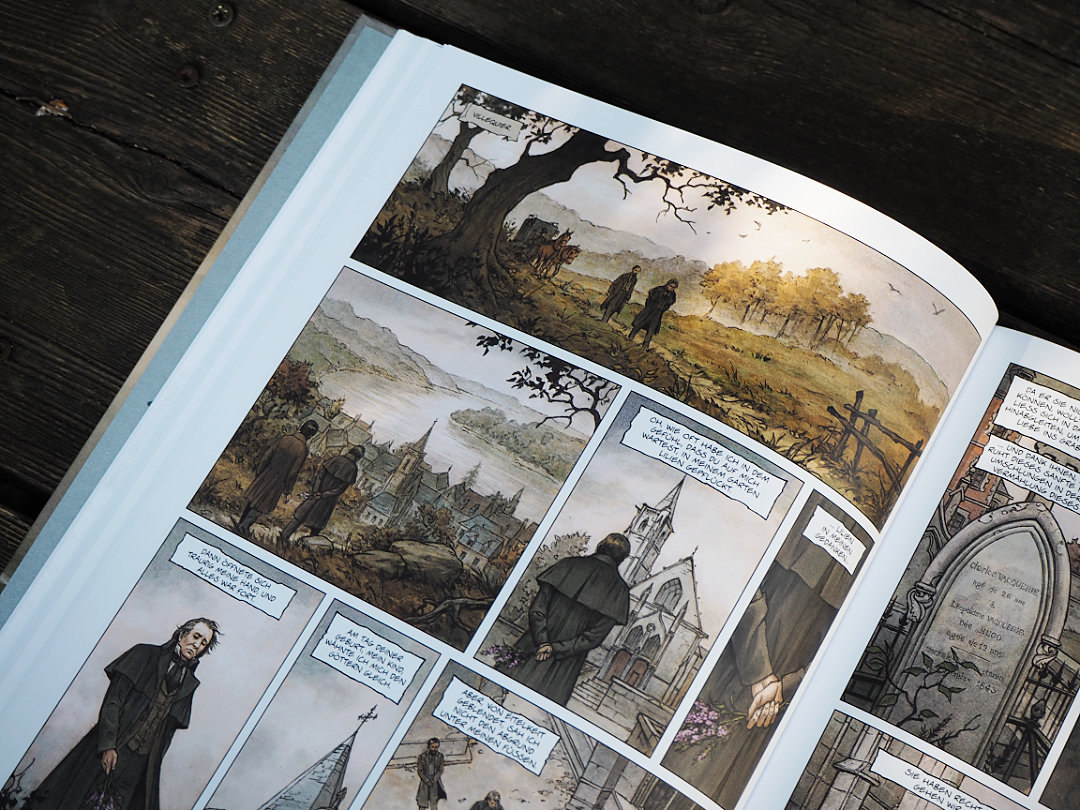
The whole setting—Paris, the Channel Islands, 19th-century France—is very familiar to me from numerous novels, so I was very curious to experience these places visually. The mostly dark but clear and expressive illustrations really matched my imagination, especially of Paris, with its old houses and narrow streets. I found the drawings of the Channel Islands and the sea particularly beautiful—conveyed very authentically and atmospherically powerful. That’s exactly how I imagine the rough sea, but also the vastness of the ocean, as Victor Hugo stands on the coast gazing into the distance—this is depicted repeatedly and effectively throughout.
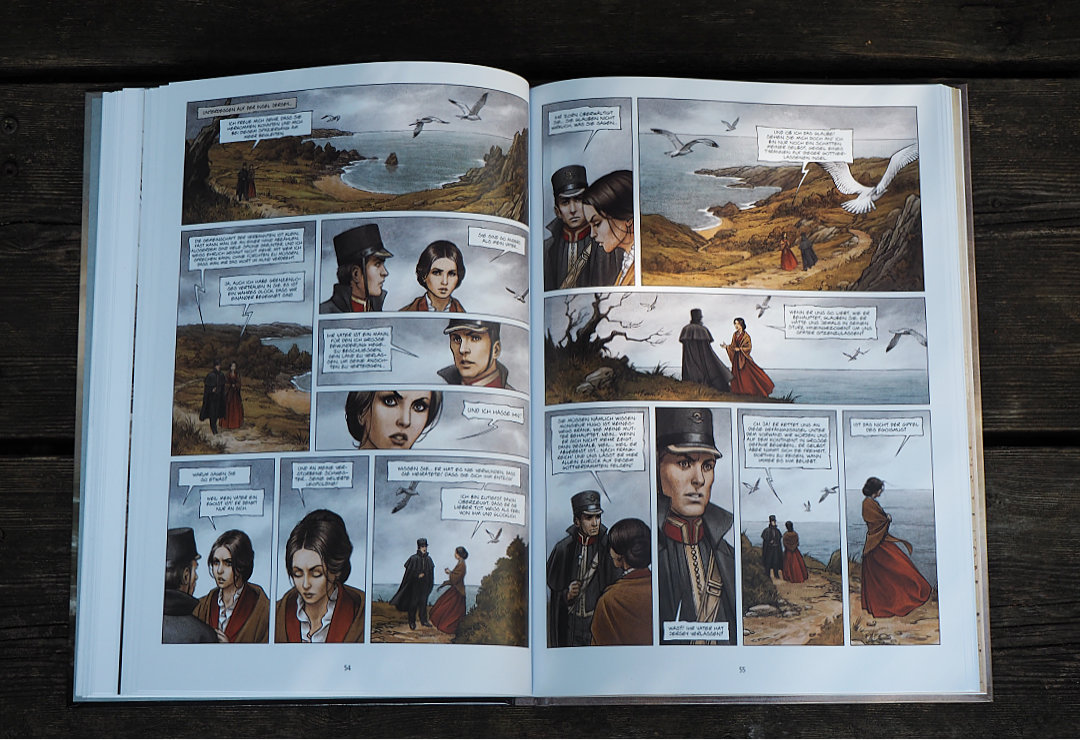
The story itself moves at a rather moderate pace and doesn’t really have any action scenes. But I had expected that—the plot isn’t designed for it. There are, of course, moments with a bit more movement, but what I especially liked were the dialogues and the delicate drawings of the various locations, as well as of Victor Hugo’s beautiful lover. After all, he was said to have had quite a few affairs.
The political situation of that time under the rule of Napoleon III is beautifully depicted (that was the little Napoleon, not the real Napoleon Bonaparte), who, after the February Revolution of 1848, seized power, declared himself president for life, and was a declared opponent of Victor Hugo. There’s also a subplot that illustrates the morals of the time through an example and provides a look at how ruthless the country’s political elite was. I especially enjoyed this political aspect of the graphic novel, as these were very turbulent times for France—and for all of Europe—because much of what defines modern democracies today finds its roots in the French Revolution and the years that followed.
Laurent Paturaud is a French illustrator who also drew the comic series Succubus, which was also published by Splitter Verlag. I really liked his illustrations and felt that he stayed very true to the historical references in his characters and settings, which lends the book a strong sense of authenticity. In a detailed appendix, the reader learns more about the creation of the book and can also view numerous concept sketches—an extra that I always love in comics and graphic novels, as it provides an insight into the creative process, and in the end, each book is truly a small work of art in itself.
Conclusion: This graphic novel tells a fictional story set during Victor Hugo’s time in exile and portrays his search for the causes of his daughter’s death. Embedded in a historical context, the story entertains the reader well and tells a narrative that, while not emotionally overwhelming, finds its strength particularly in the beautifully and authentically drawn settings and characters. I especially liked Jersey as the backdrop and the political references to this turbulent era in which France found its path to democracy and, in doing so, swept all of Europe along with it. This graphic novel is a must-read for anyone who, like me, has devoured the great novels of that time and wants to take a visual journey into post-revolutionary France.
Book Information: Victor Hugo: Im Exil • Laurent Paturaud and Esther Gil • Splitter Verlag • 120 pages • ISBN 9783962193003
Hallo Tobi,
danke für den Tipp, liebe Werke der französischen Autoren wie Hugo, Dumas oder De Maupassant.
Habe übrigens in der Süddeutschen Zeitung dein Interview gelesen ;-)
Beste Grüße
Daniela
Lieber Tobi,
bei mir steht der Titel seit Ankündigung auf der Merkliste und daher bin ich dir dankbar für deine Eindrücke. Der Zeichenstil entspricht jetzt auf dem ersten Blick nicht ganz meinem Geschmack, aber mir geht es wie dir: Ich habe eine Schwäche für Hugo und darum werde ich den Comic sicherlich schon aus reiner Neugier lesen (trotz der Fiktion).
Liebe Grüße
Kathrin