
Schwarze Schwäne • Gaito Gasdanow
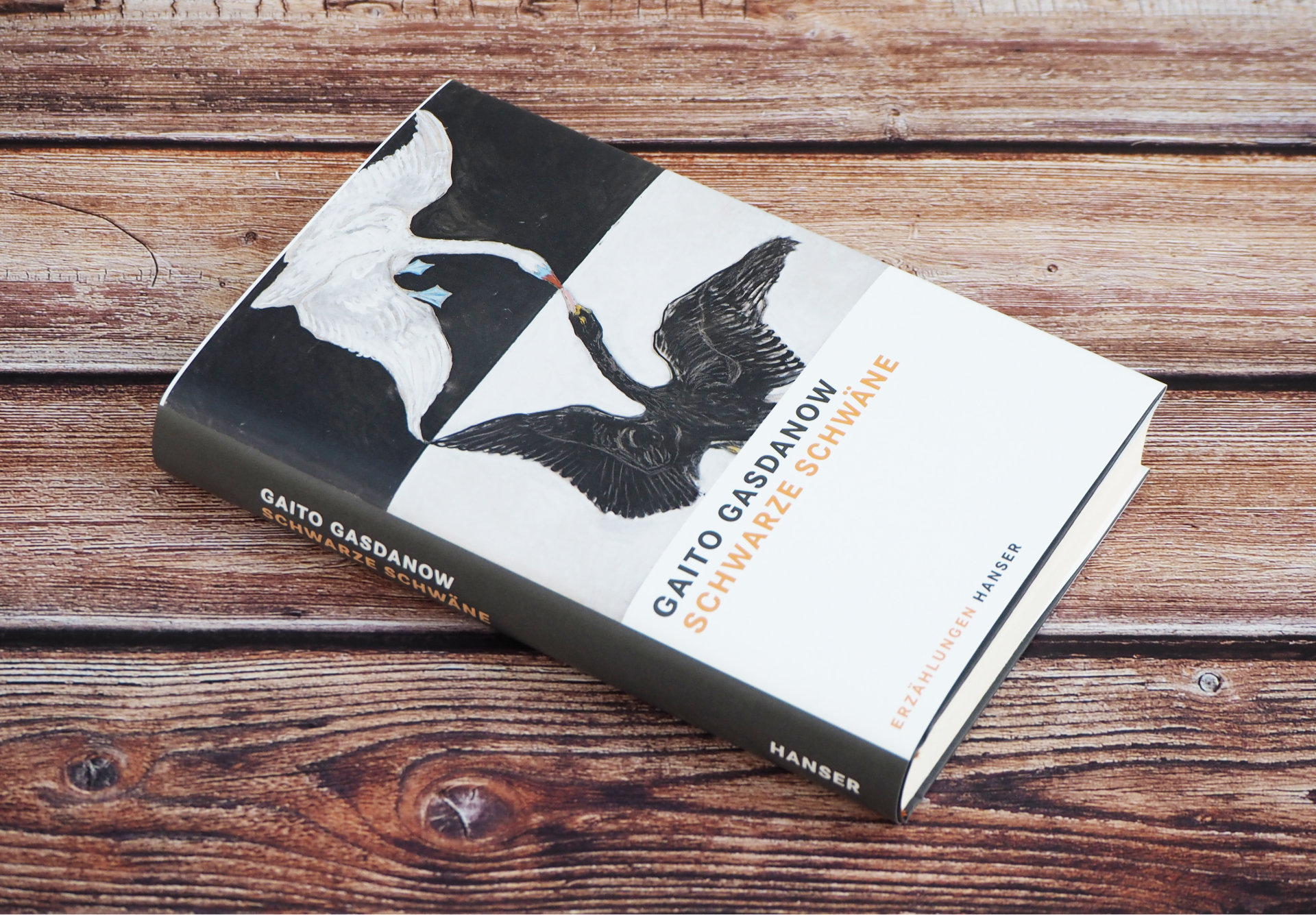
This review is something of a novelty, as I have never before discussed books by the same author one after another. This time I’m making an exception, because it’s about one of my absolute favorite authors, and I was lucky that two of his books were published this year. I was especially delighted by the announcement of Schwarze Schwäne, since I hadn’t expected another new translation from Hanser Verlag. After two of his novels (The Pilgrims and Awakening) were published without the involvement of a traditional publisher, I assumed that his work was commercially exhausted. I was very curious what a collection of Gasdanov’s short stories would be like, since his previous publications were all novels. That it would be a special reading pleasure was clear to me from the beginning. However, as I continued reading, I was still surprised by it.
The well-known Hanser translator Rosemarie Tietze has translated nine stories into German. They were originally published between 1927 and 1960 and are arranged chronologically. They are set in Russia and Paris and cover a wide range of themes. These range from the characterization of a revolutionary (Comrade Brack) or extraordinary people (Martin Raskolinos or Schwarze Schwäne), to love stories (Hannah), and brief snapshots (Hawaiian Guitars). Some of the stories have a novella-like precision, others do not at all. The spectrum of these stories is therefore quite broad.

What do all these stories have in common? They often contain memories, and one repeatedly senses that they are autobiographically influenced. When Gasdanov writes in Hannah about the childhood days of his protagonist, it’s clearly audible. Some stories carry that feeling of alienation and displacement that characterizes Gasdanov’s early novels—where one can distinctly sense how he processes his involuntary exile in Paris. Especially in Hawaiian Guitars, I once again felt what I already sensed in his novel An Evening with Claire or in The Phantom of Alexander Wolf. With these stories, one gets the full Gasdanov style, as found in his well-known and acclaimed novels.
I found the first two stories, Comrade Brack and Martin Raskolinos, entertaining. They again had Gasdanov’s beautiful, subtle language and that special atmosphere—especially when the setting is Russia. From my perspective, however, there was still room for improvement, as they lacked a clear direction and read more like exercises. In other words: I expected a little more and thought that this was how it would continue. Then Hawaiian Guitars hit me like a bucket of ice water and became a turning point in my reading. It is just so well written—with Gasdanov’s fine and precise language—completely tangible, deeply felt, filled with a contemplative gaze and an acute sense for detail, far from what one would expect. I found Hawaiian Guitars very confusing, and I don’t think it has a clear line—it lives in the moment. Again and again, Gasdanov drifts off or begins broadly, like a funnel starting with many impressions that gradually narrow until a clear plot suddenly emerges. He does this in several stories, and each time it creates a dense atmosphere.

The next time I was absolutely blown away was by Schwarze Schwäne. He describes a highly gifted Russian exile whose biography strikingly resembles his own. I was thrilled by the way he characterizes this man. It’s simply good—simply wonderful—and never boring. Gasdanov writes vividly, convincingly, and when he gives examples as if he had experienced everything himself, you believe him; it feels entirely plausible. He weaves in beautiful sentences and profound thoughts.
“How slowly the fog drifted away! I would not have been surprised if, at that moment, everything had disappeared before my eyes and hidden itself, just as, imperceptibly to my consciousness, an image slips from my memory when I begin to think of something else.” (Hawaiian Guitars, p. 76)
For Gasdanov, social differences and money were also recurring themes, which becomes particularly clear in The Liberation and The Nocturnal Companion. In fact, The Liberation is the story with the most pronounced punchline. Regarding his reflections on money and its influence on people, Gasdanov seems somewhat ordinary here and could reach me only to a limited extent. The stories were well written again, but for me they felt more like an interlude.
The stories that completely blew me away were the love stories—especially Hannah. I don’t know how one can write such a story. Or to put it more intellectually and cultivatedly: it’s simply breathtaking. The way he describes Hannah, his childhood in Russia, her character with just a few sentences yet so full of emotion. And what later unfolds—how his protagonist feels, how Gasdanov captures those emotions in wonderful sentences, using such precise, melodious words that flow so naturally. The blurb says, “people […] for whose landscapes of the soul no reliable maps exist,” which captures it exactly. With this story, he does justice to the complexity of the human mind, resonating in the many small moments that make up the stream of consciousness flowing through each day. This story, Hannah, is my absolute favorite, and this story alone makes the book worth buying. The Iron Lord and The Nocturnal Companion also contain love stories, though they only emerge later and less clearly.
“After he had experienced the most terrible thing imaginable, whose occurrence destroyed everything and rendered even the best he had known in life meaningless and hollow, he understood—not with his mind, but with something infinitely more sensitive—a dreadful and insurmountable truth, one that could not be put into words and that plunged the entire pointlessly existing world into unceasing, deadly sadness.” (The Liberation, p.149f)
People and their thoughts in Gasdanov’s work always seem unusual—often completely different from one’s own thinking—yet still understandable. They often appear harsh and uncompromising, yet the characters have heart and feeling, carrying within them something delicate that doesn’t fit their life plans or daily actions.
Gasdanov lived from 1903 to 1971. At sixteen, he joined the White Army in the Russian Civil War, and after its defeat, fled via the Crimean Peninsula, Turkey, and Bulgaria, arriving in Paris in 1923 along with many other Russian émigrés. There, he worked in simple jobs as a porter and mechanic, and for many years, he drove a taxi at night while studying at the Sorbonne during the day. All of these experiences appear in his stories and find their place there. Despite his literary success, his financial situation remained difficult, and he continued to drive a taxi until 1952 to make a living.
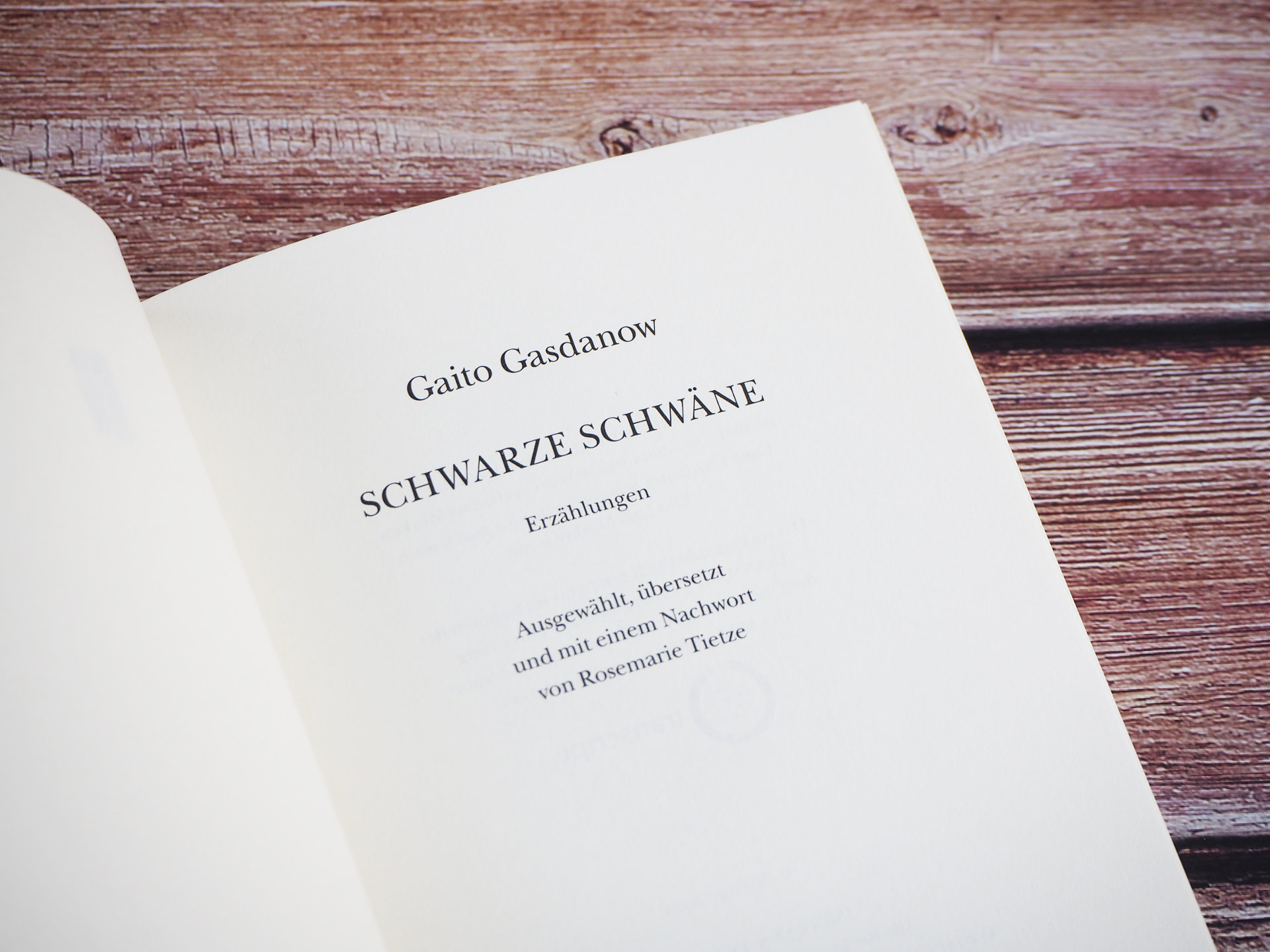
The translation by Rosemarie Tietze is, as usual, of high quality and very pleasant to read. Gasdanov’s unique style is clearly recognizable. The afterword is brief but offers some interesting information, as do the notes, though unfortunately not as extensive as in the Hanser Classics series. Unfortunately, like Gasdanov’s other books, this one has neither a ribbon marker nor a linen cover. However, it is not part of the well-known, higher-priced classics series. The dust jacket design fits well with the other Gasdanov books published by Hanser Verlag. The most beautiful one was the cover of Night Roads; compared to that, this book looks more modest—but tidy and solid.
Conclusion: Schwarze Schwäne is a collection of short stories that is highly enjoyable and written at an exceptional level. Individual stories such as Hannah, Schwarze Schwäne, or Hawaiian Guitars deeply impressed and moved me. Gasdanov’s fine and precise language is simply melodious and very pleasant to read. His characterizations are masterful, and their unusual ways of thinking are fascinating, profound, and full of ideas worth following. Here we find Gasdanov stranded in Paris, lost in exile—the same one readers know from his early novels—with everything that entails: his memories of Russia, the uncertain feelings of a contemplative mind, and his compassionate, empathetic view of others. Gasdanov is one of the most fascinating and best authors I know, and none of his books have disappointed me so far. Schwarze Schwäne is a wonderful book that should not be missing from any bookshelf—and one I will definitely read again.
Book information: Schwarze Schwäne • Gaito Gasdanov • Hanser Verlag • 272 pages • ISBN 9783446267510
Hallo Tobi,
ich muss zugeben, ich habe von Gasdanow noch gar nichts gelesen… “Nächtliche Wege” wartet hier aber schon seit längerem, und deine Rezension hier erinnert mich daran!
Hoffentlich komme ich bald endlich mal dazu, was du über den Autor schreibst, macht mich sehr neugierig auf seinen Stil!
LG,
Mikka