
Die Pilger • Gaito Gasdanow
There are authors whose language is so polished and fluid that reading their books sounds like music to my ears. At many points I truly feel as if I’m listening to a melody rather than reading written words. I couldn’t say exactly why that is—on closer inspection, the sentence structures don’t seem particularly unusual or intricate enough to explain the effect. Nor does the content have a structure that would justify it. Perhaps it’s the overall composition, the way the author reveals his world of thought to the reader, and his unique way of thinking and expressing those thoughts. And perhaps it also depends on the reader, whose own thought patterns must resonate with the author’s so that these inner strings begin to vibrate. One author who manages to do this for me with every one of his books is Gaito Gazdanov. He wrote nine novels, four of which have been newly translated and published by Hanser Verlag. Since then, I’ve been keeping an eye out for new Gazdanov translations. Just last week I checked again—and indeed, a new book of his appeared. But from a completely unexpected corner, one where I never would have expected a book by him.
The publisher for The Pilgrims turned out to be Books on Demand, or BoD for short. I actually only know BoD from the self-publishing scene, where anyone can publish their book with little effort and cost, complete with ISBN and full availability in bookstores. That’s where The Pilgrims by Gaito Gazdanov appeared, advertised as a newly translated late work. The book was translated and annotated by Jürgen Barck, who seems to be a newcomer, as there’s virtually no trace of him online or in literary databases. So I wondered whether Barck himself had uploaded the book to BoD. To find out more, I contacted BoD directly, and they quickly replied—confirming that yes, Jürgen Barck had published the book himself via BoD.
I was able to get in touch with Jürgen Barck, and he kindly answered a few of my questions. A publication of Gazdanov’s novel Awakening is planned for mid-year. While Awakening also belongs to his late works, next year will see Gazdanov’s second novel, The Story of a Journey (1934/35), appear. When Barck discovered The Return of the Buddha in its German translation a few years ago, he was so enthralled after just a few pages that he continued reading it in the original Russian. Unfortunately, Hanser Verlag did not translate any more of Gazdanov’s novels, likely for business reasons—his last translated work, Night Roads, apparently didn’t sell as well as expected. So Barck decided to fill that gap himself by translating the novel. A demanding task requiring deep knowledge of Russian, and Barck, true to the standards of modern translators, aimed for a highly faithful rendering. In my view, the result holds up well and is definitely on par with the quality one expects from established publishing houses.
The novel originally appeared in the 1950s and tells the story of Robert, the wealthy son of a factory owner who, though educated and well-read, suffers from aimlessness and ennui amid his wealth. In Paris’s red-light district he meets the young Jeanine and falls in love with her. But her feared pimp, Fred, regards her as his property, and conflict ensues. So the novel begins like a crime story, but then takes a rather unexpected turn.
The narrative style is typically Gazdanov. His works available in German are usually a blend of autobiography and fiction. Gazdanov, who fought in the Russian Civil War on the White side during his youth, fled Russia after the Bolshevik victory and, after several stops, settled in Paris. There he lived in involuntary exile, and his novels radiate that atmosphere—depicting Russian émigrés stranded abroad, always somehow lonely and lost. People at odds with themselves, gazing deeply at the world around them, trying to abstract, cultured yet perpetually outsiders. None of that is present in this book. Here, Gazdanov seems truly to have arrived in Parisian society. All the characters are of French origin and firmly rooted in their environment. He creates a range of figures, described with nuance yet representing familiar archetypes: the rich industrialist’s son, the poor young woman on the brink of prostitution, the petty criminal from a similarly harsh background. Every character follows a typical life trajectory, and Gazdanov raises the question of whether this must be so—whether people’s lives are predetermined by their circumstances, or whether one can break free and shape one’s own fate.
Within this framework, the question of life’s meaning arises again and again, giving the novel a distinctly existentialist tone, very much in keeping with the modern spirit of its time—and reminiscent of Camus, who explored similar philosophy in The Stranger. Gazdanov, too, arrives at a conclusion: his characters find meaning through caring for others, through compassion, and only in that do they perceive a purpose in their lives. I found that a bit simplistic and one-dimensional, even if the sentiment itself is beautiful.
Gazdanov’s prose is, once again, magnificent, and I love following the thoughts of his characters—seeing how they wrestle with the questions that eventually confront everyone, how they reflect on life and existence. No other author, in my opinion, conveys so well how fruitless such pondering can be, and yet how vital it remains to ask what it’s all about—to watch how answers dissolve in thought, because it’s far more important to ask than to find a clear response. He wraps all this in beautifully crafted sentences.
“Only now and then would a translucent sadness suddenly come over him—precisely because everything was so wonderful. Then he would reflect on how vast the distance was between all the tragic and negative notions that once shaped his view of the world and human life, and what he now felt—a distance that had somehow been overcome and fit no theory.” (p. 140)
As with all his novels, the story itself entertained me, but it’s just one facet among many. Taken on its own, it’s rather unspectacular; yet within the whole composition, it works beautifully. I devoured the book again. The tension curve is uneven, but I was always captivated—sometimes by the characters and their introductions, sometimes by a suspenseful plot element, and at other times by the philosophical musings. Gazdanov simply could write, and if someone asked me why, I couldn’t answer. Perhaps because his way of thinking and seeing the world resonates so well with my own.
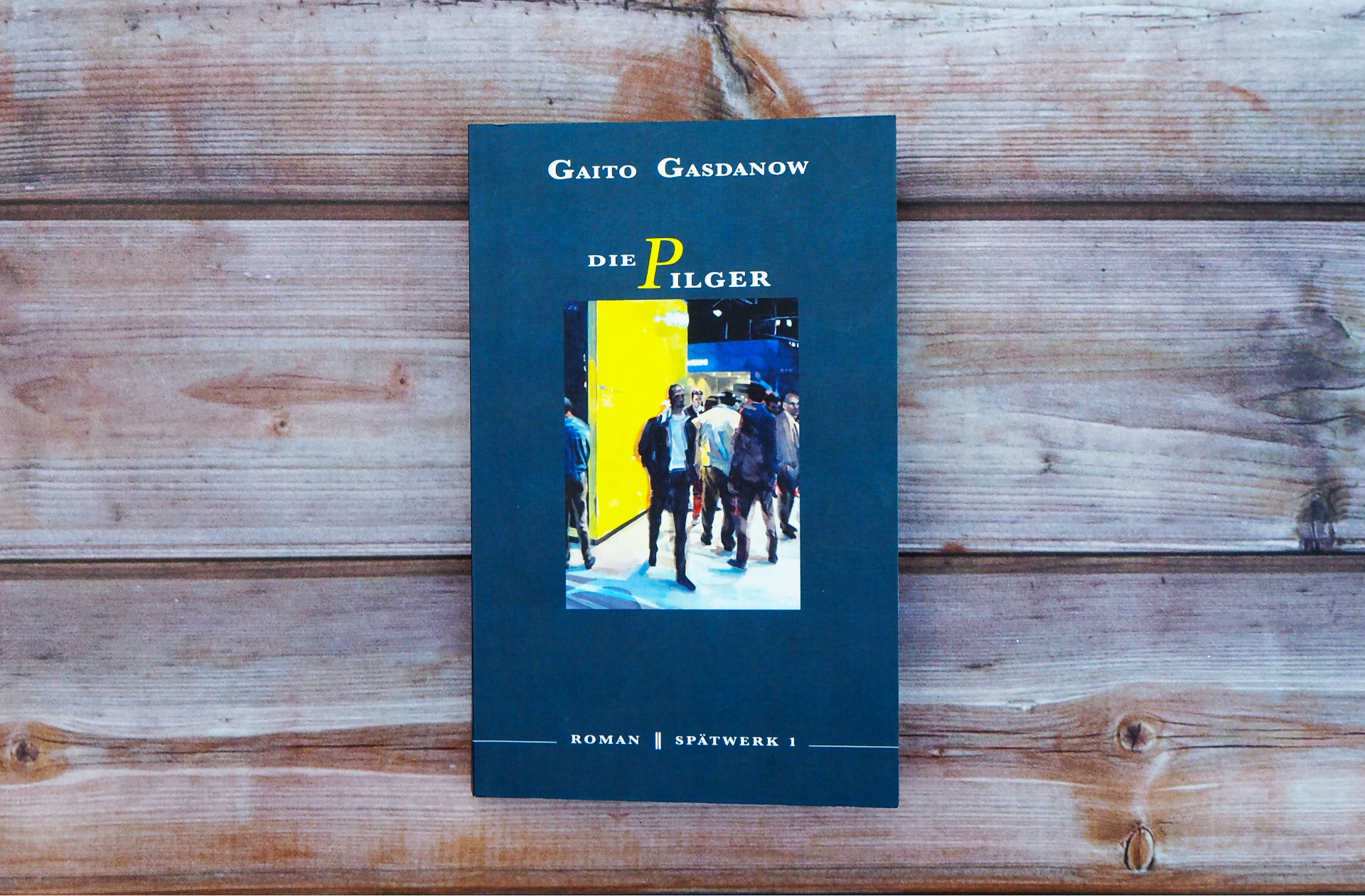
The book’s production quality isn’t impressive—a cheap glued binding, average print, type, and cover design. Still, the price is fair, and in the end, content is what counts. The translation and text quality are excellent, easily matching what one would expect from major publishers. I also really liked the notes and afterword: Barck doesn’t ramble, but clearly and concisely highlights the differences between Gazdanov’s late work and his more famous novels.
Conclusion: With this unexpectedly released first translation of Gazdanov’s The Pilgrims, I’m presenting a real hidden gem. I love Gazdanov’s books, and although this one doesn’t quite reach the level of his greatest works, I found it beautifully written, engaging, pleasantly philosophical, and still full of tension. Readers shouldn’t expect an extraordinary plot, but rather a well-rounded composition that asks what defines a human life, where meaning might lie, and what role culture plays for the individual. The book itself isn’t particularly elegant in design, but it’s reasonably priced and worth every cent. It bears the subtitle “Late Work I,” so I’m already looking forward to the continuation—and I’ll definitely buy every new Gazdanov translation. I simply love his style and the melody of his words.
Book Information: Die Pilger • Gaito Gasdanow • BoD • 236 pages • ISBN 9783753422183
Spannende Hintergrundgeschichte was die Übersetzung angeht. Finde ich ziemlich cool, dass Herr Barck dieses Projekt vorgenommen hat.
Von Gasdanow selbst kenne ich bisher nur den Namen. Der Alexander Wolf liegt hier immerhin seit kurzem ungelesen im Regal. Aber so wie du schreibst, scheint es sich ja zu lohnen. Ich bin gespannt drauf, wenn ich denn mal dazu komme.
Lieber Florian,
also ich kann dir nur empfehlen rasch zu dem Buch zu greifen, denn “Das Phantom des Alexander Wolf” fand ich das beste von Gasdanow. Die Geschichte und seine Figuren, besonders aber auch sein philosophischer Blick auf die Welt, da ist einfach alles perfekt. Und das Buch ist schnell gelesen, seine Bücher sind ja alle ziemlich dünn.
Ich finde das auch sehr genial, dass Herr Barck das so komplett in Eigenregie macht und die Bücher überhaupt einem deutschen Publikum so zugänglich macht.
Herzliche Grüße
Tobi
Ich mag deine Artikel sehr gerne lesen. So wie du in Gasdanows Text abgetaucht bist, bin ich es gerade in deinem. Danke!
Lieber Moritz,
vielen lieben Dank für Deine netten Worte, das freut mich natürlich sehr, dass meine Rezension angenehm zu lesen ist.
Herzliche Grüße
Tobi
Ich werde nächste Woche gleich zu Thalia gehen und mir das Buch besorgen!
Danke für den Tipp!
Liebe Anneli,
herzlichen Dank für Deinen Kommentar, das ist ja klasse, dass ich Dich von dem Buch überzeugen konnte. Allerdings gibt es das Buch dann auch bei Thalia nur zu bestellen, das ist ja BoD, also wird dann erst gedruckt, wenn es jemand bestellt. Aber es lohnt sich, und natürlich auch die Bücher, die bereits bei Hanser erschienen sind.
Liebe Grüße
Tobi
Hat Hanser neben “Die Rückkehr des Buddha” und “Nächtliche Wege” nicht auch noch “Ein Abend bei Claire” und “Das Phantom des Alexander Wolf” übersetzt? Die ersten 3 Romane (2012 bis 2016) wurden von Rosemarie Tietze übersetzt, “Nächtliche Wege” in 2018 dann von Christiane Körner. Wenn sich dieser Roman nicht so gut verkauft haben sollte – kann das an der neuen Übersetzerin liegen? Ich habe das auch nur im Kopf, weil ich diesen Herbst den Abend bei Claire lesen will und vorrangig wegen Tietze zugeschlagen habe. Sowas spielt ja auch ne Rolle beim Kauf. Kannte Tietze noch von Karenina.
Tietze hat für Hanser auch noch “Glück” übersetzt, welches allerdings nur als ebook verfügbar ist.
Ich sehe gerade, dass du oben die vier Hanser-Übersetzungen anführst. Hatte ich überlesen.
Ich bin mir nicht sicher, ob der wohl eher mangelnde Erfolg von “Nächtliche Wege” auf die Übersetzerin zurückzuführen ist. Gasdanow ist glaub ich nicht für jeden etwas und vielleicht konnten die vorhergehenden Romane nicht so überzeugen, so dass der letzte dann nicht mehr gekauft wurde. Ist das tatsächlich so, dass Du aufgrund des Übersetzers ein Buch kaufst? Wobei Tietze natürlich hervorragend ist, soweit ich das beurteilen kann. Ich habe damals auch die Anna Karenina Ausgabe von ihr gelesen und das ist schon perfekt.
“Glück” gab es einmal auch als Printversion, als exklusive 5plus Edition, auch von Tietze übersetzt. Die hatte ich mir damals natürlich geholt. Aber die Geschichte fand ich nicht so gut, die war dann mit etwas mehr als 50 Seiten einfach zu kurz.
Liebe Grüße und herzlichen Dank für Dein Feedback
Tobi