
Five weeks in a balloon • Jules Verne
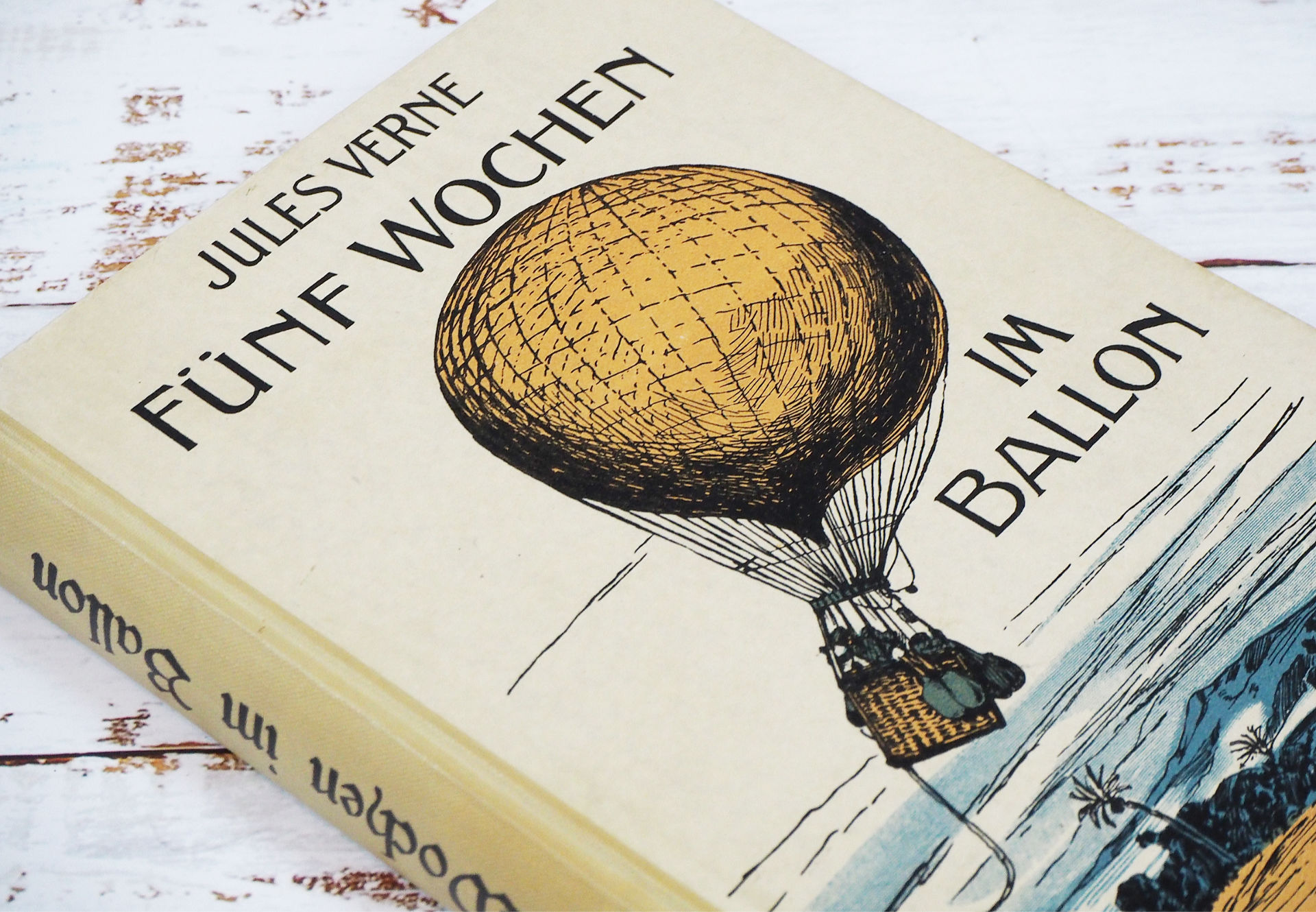
Jules Verne’s novels keep sending me into a loop, and I suspect I’ll only break out of it once I’ve read everything he wrote. Every time I finish one of his books, I’m so thrilled that I immediately order the next one. In the meantime, I start some other reading, and eventually the new book arrives and wanders onto my shelf of unread books. There it waits until I’m once again in the mood for an adventure novel and, at first a bit half-heartedly, reach for Verne. With every line, my enthusiasm grows again, and I’m fully captured once more by his exciting, gripping adventures. This time I read Five Weeks in a Balloon, and I want to share my impressions—and maybe get one or two of you excited about these wonderful old adventure novels as well.
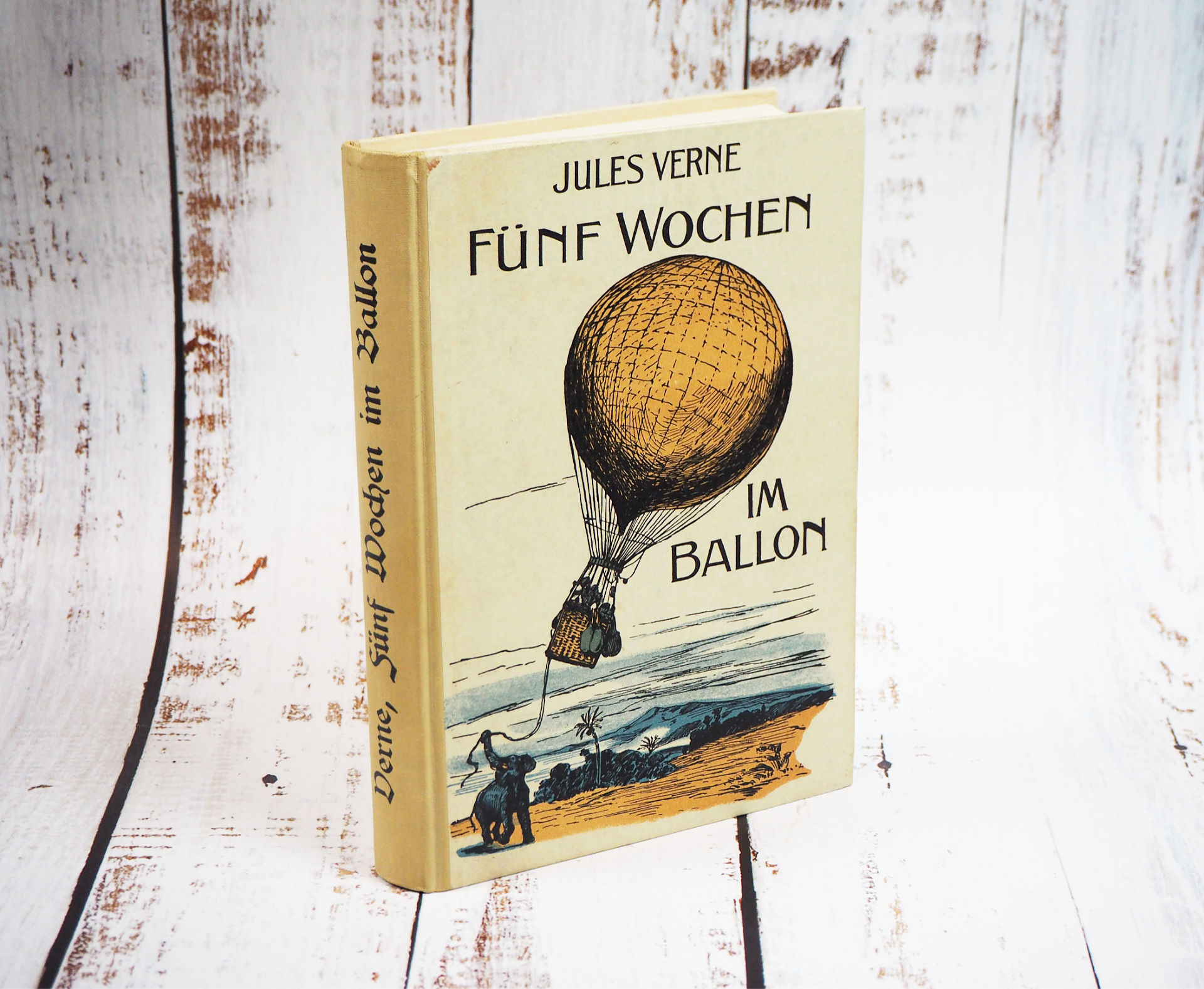
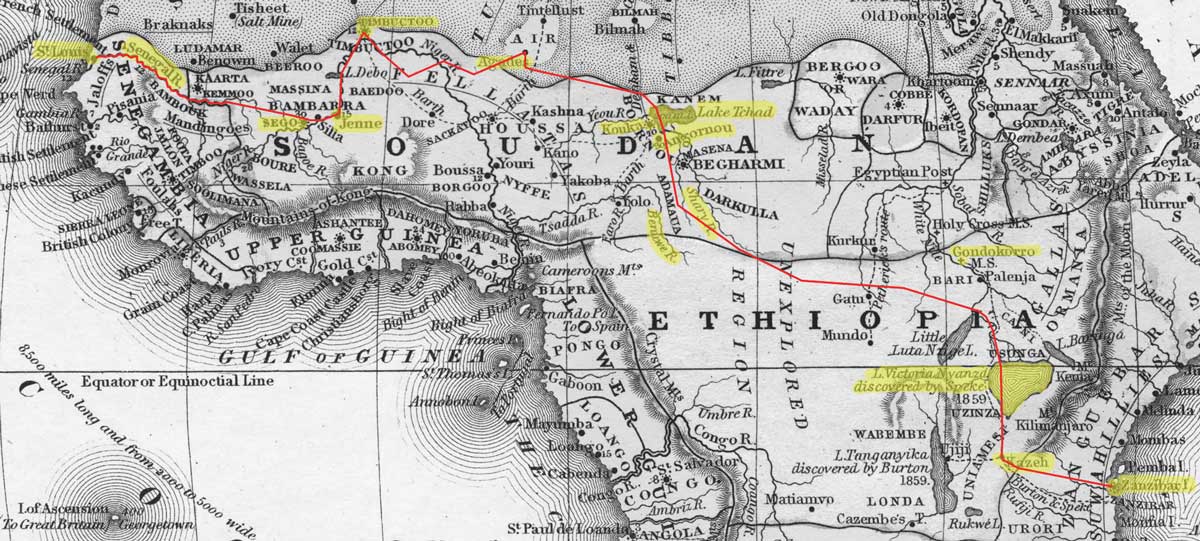
Five Weeks in a Balloon follows Dr. Samuel Fergusson, who, together with his friend Dick Kennedy and his servant Joe, aims to cross Africa from the east to the west coast in a gas balloon in order to find the sources of the Nile. Thanks to an additional device, he can heat the gas in the balloon and thus control the airship’s altitude, allowing him to find air currents at different heights to steer the balloon in the desired direction. He also uses the trade winds to drift from the island of Zanzibar to the Atlantic. Naturally, the three friends experience numerous adventures above and on the then not yet fully explored African continent.

At the beginning, Verne introduces the gas balloon Victoria and how it works, but he also provides an overview of the various research expeditions already undertaken into Central Africa. In the 19th century, these were associated with great hardships and dangers, and the question of where the Nile actually springs was still unresolved. Samuel Fergusson manages to convince the Royal Geographical Society in London of his plan and quickly raises funds for such a daring project. As usual, readers are offered many facts and technical details, naturally mixed with fiction. When Verne wrote the novel, the Englishmen John Hanning Speke and James Augustus Grant actually set out from Zanzibar to explore the source of the Nile—only by land. Speke is also mentioned in the novel, but only in connection with an earlier journey, and Verne omits the new attempt to identify the Nile sources. As in the novel, the origin is found in a lake, and Speke proudly declares by telegram that with Lake Victoria he has found the source. Later it turned out that the actual source lies in Burundi and Rwanda. For the novel, however, this question isn’t all that crucial and simply provides motivation for the expedition. The fascination lies in the balloon voyage and in crossing entirely unknown regions.
Verne once again brings out all the elements for which his novels are known: furious animals, dangerous natives, daring maneuvers, and numerous narrow escapes that demand everything from the heroes. I found the descriptions of the landscape and nature particularly delightful—I could picture them vividly, and they were again a real pleasure. The high point in that regard is a thunderstorm that Fergusson and his friends observe from above, which Verne describes with great atmosphere. Overall, Verne strikes a balanced relationship between these nature descriptions and the exciting scenes that drive his story forward. Whenever I thought something ought to happen now, a gripping episode began, and I couldn’t put the book down.
A map of the exact route can be found quite quickly on the internet and gives a good overview of the path the protagonists traveled. Looking at satellite images on Google Maps in parallel is quite feasible—though, unfortunately, there’s no Street View in that region.

The book first appeared in 1863 and was Verne’s first published novel. He hadn’t been able to convince the publisher Hetzel with his first two books, but Five Weeks in a Balloon became his first great success. It wasn’t an immediate blockbuster but sold steadily well over time. As far as I can glean from his biography, Verne hadn’t visited Africa at that point, although he would undertake many journeys in later years. For his novel Eight Hundred Leagues on the Amazon, too, he drew on travel accounts by other authors, and as readers, we find the details convincing in Five Weeks in a Balloon as well.
Verne was inspired to write the novel by his friend, the photographer Nadar, who wanted to make commercial balloon flights possible. Verne himself probably went up in a balloon only once, and quite briefly. Nevertheless, he was familiar enough with the technicalities: for example, his description of how gas for the balloon was produced in Zanzibar from iron, sulfuric acid, and water matched the actual methods of the time. The problem of steering a balloon hadn’t been solved then—and even today it isn’t. Verne’s protagonist Fergusson devises a device by which he regulates the balloon’s altitude by heating the hermetically enclosed gas inside. That reads quite plausibly, but it doesn’t quite match reality. In describing the balloon’s construction, Verne goes into considerable detail, and based on his data, a physicist once ran the numbers (read here); apparently, given current nickel–cadmium battery capacities, the energy would run out after about 18 hours. A pity, really—but to be expected; otherwise, anyone could book a balloon crossing of Africa with Jochen Schweizer.
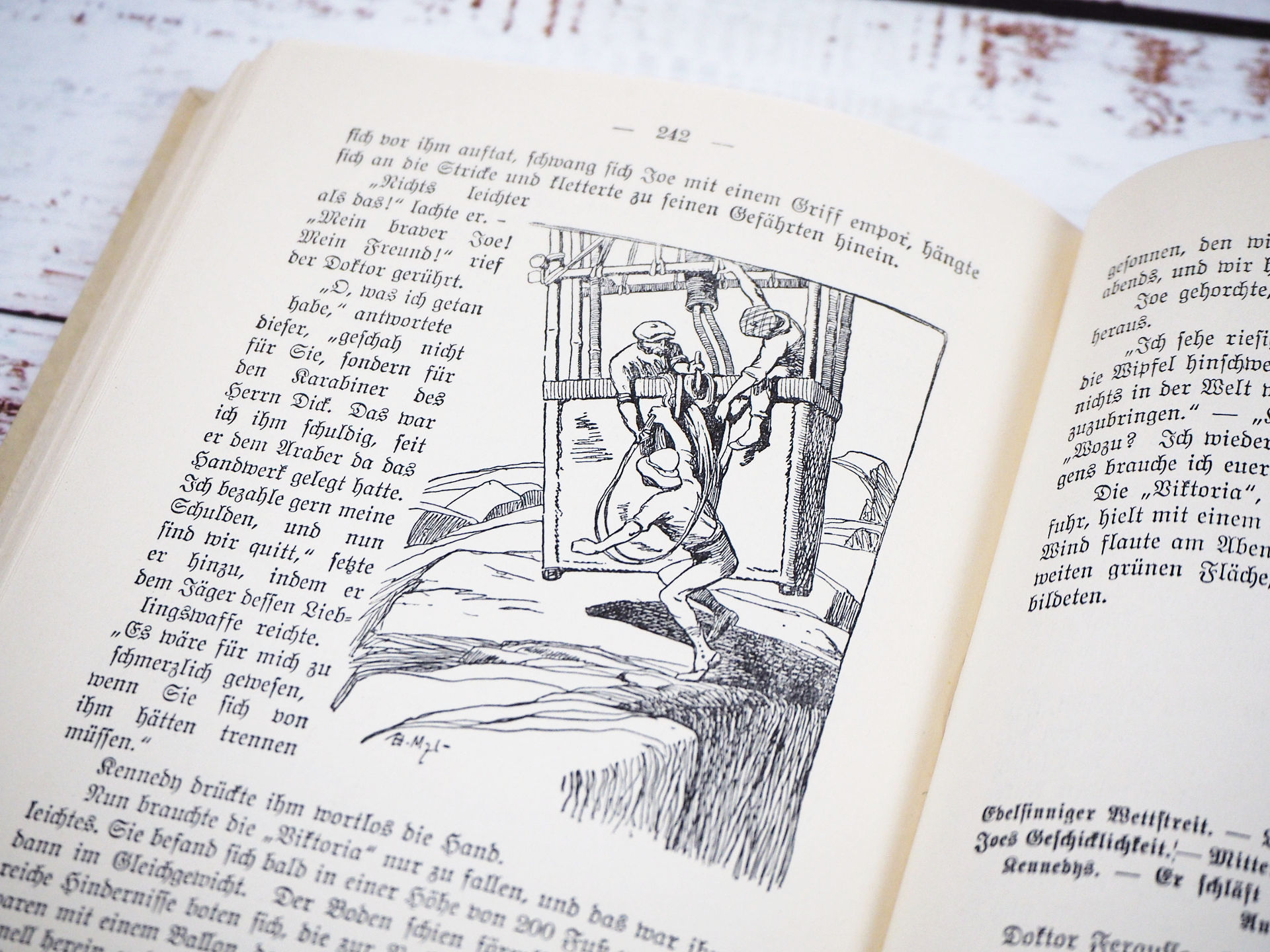
What I once again loved about this adventure is the balloon Victoria as a safe vessel. Much like the Nautilus—a cozily furnished Victorian submarine—or the jangada, a small, comfortable village on a raft, the balloon with its gondola is a kind of secure home base for the adventurers. It’s a pleasant idea to gaze down from safe heights at a land full of dangers and yet feel secure. Accordingly, the gondola has a tent, provisions, and ample space. What goes unmentioned, however, are the sanitary facilities—but never mind, these are three men; they won’t be squeamish. Of course, there are some fuzzier points, and when Verne cranks up the tension with adventurous events, chance is once again stretched beyond all measure—which I’ve come to expect from 19th-century French writers and can never hold against them when it makes the story even more gripping.
While reading, I wondered whether the book is still politically correct today. After all, my edition is from 1936. Once again—apart from Kennedy’s elderly housekeeper at the very beginning—there isn’t a single woman. That seems to happen fairly often with Verne. In looking at African indigenous peoples, Verne also takes swipes at Europeans, and when he describes the gruesome warfare between tribes, he draws parallels to the no less horrific doings of so-called civilization in Europe. The focus, though, is on adventure and science fiction, and to my mind Verne remains pleasantly neutral here.
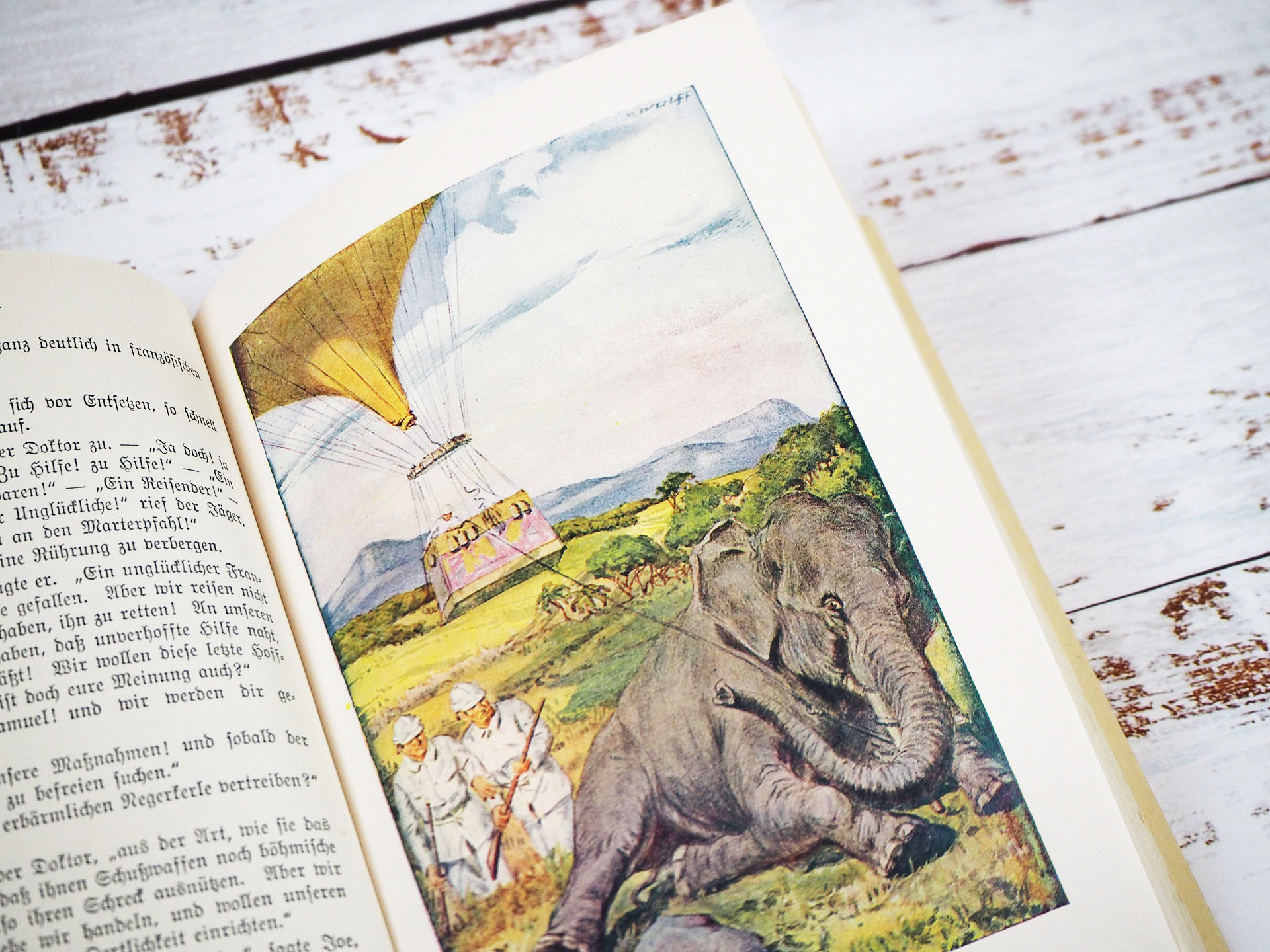
For my copy, I found an old book from 1937 published by A. Wichert Verlag. I liked the cover and the design quite a bit. I simply love these old adventure novels with their blackletter type and illustrations. I think the drawings in the original edition are more beautiful than the simple sketches in this book; all in all, though, I found it wonderfully atmospheric to hold such a pretty old volume in my hands. The book also includes two color plates that feel charmingly old-fashioned and are pleasant to look at. The translation’s language is antiquated—and that’s exactly what I really enjoy in old adventure novels.

Conclusion: If you like old adventure novels, you’ll love this book too. You get everything you expect from Jules Verne: a thrilling adventure, a fascinating vehicle, likable protagonists who must endure all manner of hardships and adversities but are rewarded with magnificent, extraordinary landscapes—and, of course, that special feeling of a gripping journey through foreign, pristine, and undiscovered realms. I once again thoroughly enjoyed the read and took great pleasure in my old A. Weichert Verlag edition. A superb book that I can recommend without reservation.
Book information: Five Weeks in a Balloon • Jules Verne • A. Weichert Verlag Berlin, 1937 edition • 256 pages
Das gehört in die Top 3 meiner Lieblingsromane von Jules Verne! Schöne alte Ausgabe. Und gut recherchiert bzw. gewusst, denn gewöhnlich liest man, mit diesem Buch sei Verne “über Nacht” berühmt geworden.
Wie herrlich (und lehrreich) ein Abenteuer zu lesen, das in einer Zeit spielt, in der es in Afrika noch weiße Flecken auf der Landkarte gab und man noch debattierte, was die Quelle(n) des Nils betraf.
Die Illustrationen in dieser Ausgabe sind schön, aber ich würde nie auf die Originalillustrationen verzichten wollen (siehe z.B. Diogenes 1972). Die schaffen immer eine ganz besondere “historische” Atmosphäre.
Lieber Lucien,
es ist einfach schön zu sehen, dass es doch ein paar wenige Liebhaber dieser wunderbaren Abenteuerklassiker noch gibt. Da gebe ich Dir recht, die Originalillustrationen wären schon um einiges schöner und stimmungsvoller gewesen. Dafür gefällt mir die Aufmachung von dem Buch richtig gut, mit der schönen Zeichnung auf dem Cover. Überhaupt finde ich es schwer, schöne Ausgaben von Verne zu finden. Die bekannte Variante mit dem roten Leineneinband vom Hartleben Verlag ist zwar hochwertig, zieht bei mir aber irgendwie nicht so richtig. Am schönsten finde ich die ganz alten Verne Gesamtausgaben in Leder, aber die sind echt unbezahlbar.
Liebe Grüße und herzlichen Dank für Deinen Kommentar!
Tobi
Lieber Tobi,
was für eine prächtige Ausgabe! Solche Schmuckstücke von Vernes Büchern findet man heute leider selten.
Und ein Kompliment auch an dich für den spannenden, informativen Artikel – ich würde jetzt am liebsten selbst zu so einer Spurensuche aufbrechen (zur Ballonfahrt allerdings nicht – dafür ist meine Höhenangst zu groß ;) ).
Die Frage der sanitären Anlagen habe ich mir auch schon bei so manchen Abenteuergeschichten und Science Fiction gestellt, u.a. auch bei kürzeren Texten von Verne. Sowas wird wohl doch einfach zu gern ausgeblendet.
Viele Grüße
Kathrin
Oh, was für eine schöne Ausgabe!
Als Jugendliche habe ich Jules Verne verschlungen und heute noch unterliege ich seiner Faszination :)
Gute, bebilderte und gebundene Ausgaben sind sehr teuer – und auch rar geworden.
Ballon bin ich auch schon gefahren – ein unvergessliches Erlebnis!
LG Charis <3