
Reeds in the Wind • Grazia Deledda
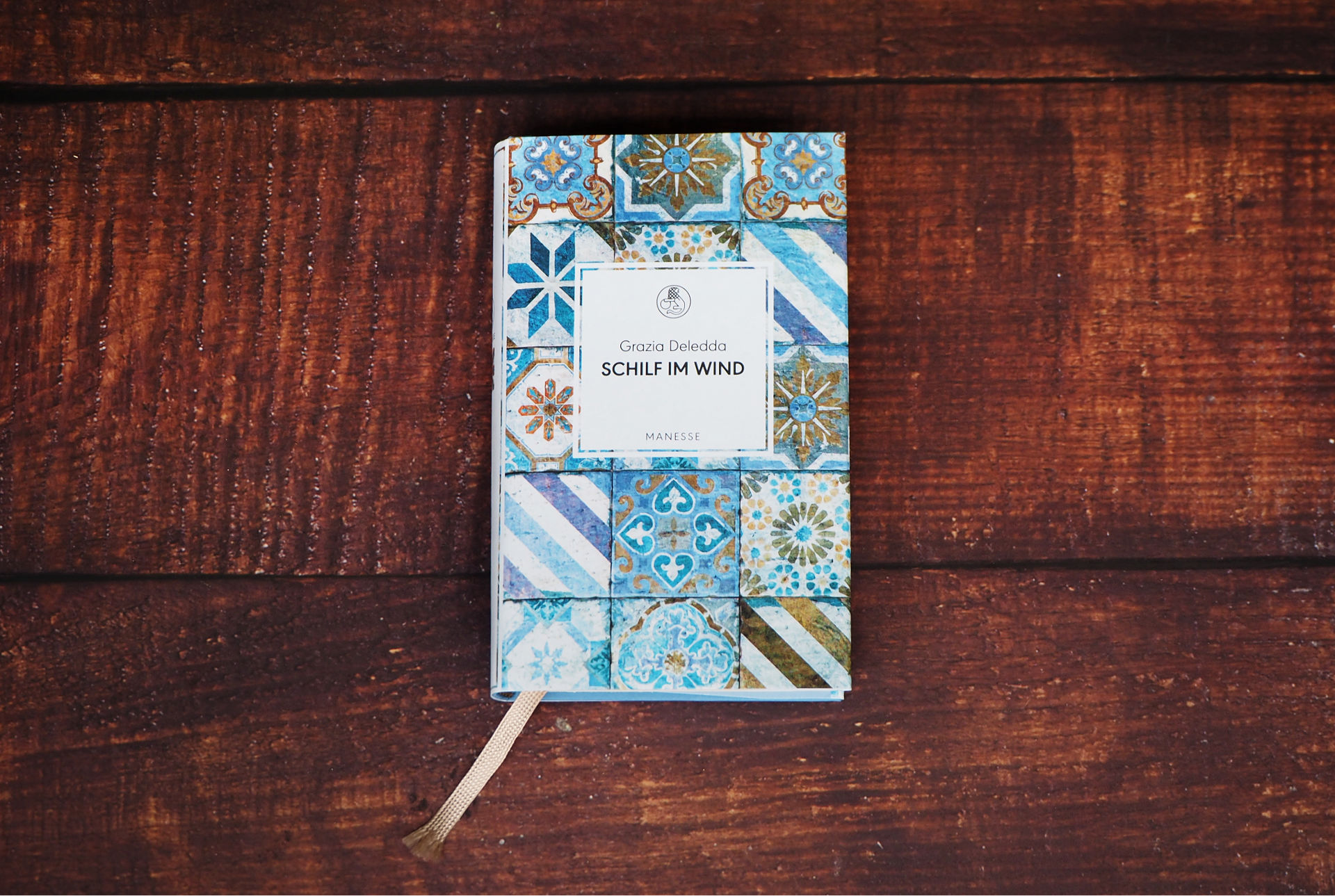
There are countless well-known classics offered on every corner in various editions, which I read with pleasure and which are usually very good. And then there are the unknown books that fly under the radar, whose authors I’ve never heard of, that are only briefly displayed in bookstores (if at all), appearing inconspicuously somewhere on the tenth page of search results before quickly disappearing again. Finding good books of this kind — that is the true art. And that is the achievement of a good publisher: discovering such hidden gems and reissuing them in high quality. Reeds in the Wind is one of those books, in my opinion. I had never heard of the author or the book before, but both the blurb and the overall presentation immediately appealed to me. Whether this book really is a hidden gem, or whether it will end up gathering dust in the depths of my bookshelf in complete obscurity, you’ll find out in this article.
Reeds in the Wind is set in Sardinia and tells the story of the servant Efix and an impoverished noble family. All that remains of the once-wealthy household are the three adult daughters, who lead a simple life in their old and dilapidated estate. Gradually, the reader learns about a tragedy that occurred years ago, one that brought about the family’s downfall and continues to haunt them in the present. When the aunts’ nephew returns from the mainland, all those involved must confront this past.

Grazia Deledda, born in 1871 in Sardinia, came from a wealthy family and grew up on the Mediterranean island. A classic by an Italian woman author is not something I come across often — in fact, I haven’t read a classic written by a woman in quite some time. That alone made this book intriguing. The blurb also promises outstanding descriptions of nature, which is exactly my kind of thing. Indeed, the reader is treated to some beautiful depictions of the Sardinian landscape, which Deledda weaves into the narrative with her clear style and her keen eye for color, flora, weather, and the island’s unique charm. These descriptions, as frequent as they are, form an essential part of both the characters and the culture of Sardinia. This lush island, with all its colors and nuances, is deeply connected to the people Deledda portrays and reflects their nature on another level.
The world stretched wide before him like the valley after a storm wind, when the mist rises and fades again. The castle against the blue sky, the ruins where the grass quivered with dewdrops, the plain below with the rust-colored patches of rushes — everything was filled with the sweetness of childhood memories, of things long lost, longed for, wept over, and then forgotten, but rediscovered in the end when one no longer thinks of them or mourns their loss. (p. 253)
I found the people in this novel particularly fascinating. Deledda portrays a society that seems almost archaic, shaped by pagan superstition and a folk Christianity permeated with numerous festivals and rituals. In the afterword, Federico Hindermann notes that the story feels timeless. While there are many clues suggesting that the novel takes place in the early 20th century, while reading, one might rather think it is set in the late Middle Ages. The characters are constantly attending Christian festivals, but these events are so deeply infused with superstition that one gets the sense of encountering a culture still intellectually simple and steeped in tradition. The inhabitants of the small, village-like communities are depicted as typical rural islanders — self-centered, withdrawn, concerned primarily with their own interests, and living simple lives. This is particularly evident in the protagonist, Efix. Early in the book, there is a festival scene that vividly demonstrates how deeply rooted these people are in their ancient cultural patterns.

I could only partially empathize with the characters. Deledda gives them realistic depth, yet they remain trapped in their faith built entirely on tradition and superstition, a mindset that determines their actions and their lives. This is also the book’s strength: it provides a glimpse into the cultural reality of the Sardinian islanders of that time — a literary rarity and one that earned Deledda the Nobel Prize in Literature in 1926. Such a window into the thinking of a past culture is something I find quite fascinating from time to time, and it reminded me of the Pellisquadre in Horcynus Orca.
The language is neither overly simple, as is often the case with novels written in the early 20th century, nor are the sentences complex or cumbersome. The book reads smoothly, and there are occasional beautifully phrased sentences that make for a pleasant reading experience. The nature descriptions have a certain roughness — not as flowery or poetic as in some other works — but they still hold their charm. Vivid landscapes formed in my mind as I read, though only a few passages truly captivated me.
It took me a while to really get into the story. The author takes her time introducing the characters and the society, and especially at the beginning, the pace is very slow. This is actually necessary, because the individual characters and their ways of thinking become important as the story progresses. In the middle of the book, I was completely absorbed, wondering where it would all lead and how the story would unfold — that was exciting. Toward the end, however, the pacing slowed down again, and I found it a bit too sluggish.
The annotations are truly excellent, providing detailed explanations of the festivals, rituals, and settings. They clearly demonstrate how profoundly the old folk beliefs influence the plot and the characters’ thinking. This adds great value to the book and is another success for Manesse Verlag. I found the afterword quite good — informative, though it could have been a bit more extensive. After finishing the book, I was left with a few questions about the story, and some interpretative commentary would have been interesting.
I also found the editorial note fascinating, which explains the textual foundation of this edition in detail. The book was first published in 1913, with the initial Manesse edition appearing in 1951, and thus the translation by Bruno Goetz is quite old. Instead of commissioning a new translation, Jochen Reichel reworked the text, comparing it with the 1913 original. This included linguistic sharpening for clarity, the reconstruction of deliberate tense shifts from imperfect to present during perspective changes, and standardization of place and character names (for instance, Noëmi became Noemi). Additional annotations were added, along with numerous other revisions detailed in the editorial note. In line with current translation practices, the goal was clearly to stay as close as possible to the original and to recreate the same linguistic effect on the reader as found in the Italian text. I have read a few of Manesse’s Maupassant translations from the 1950s, and even without later revisions, they were of remarkably high quality.
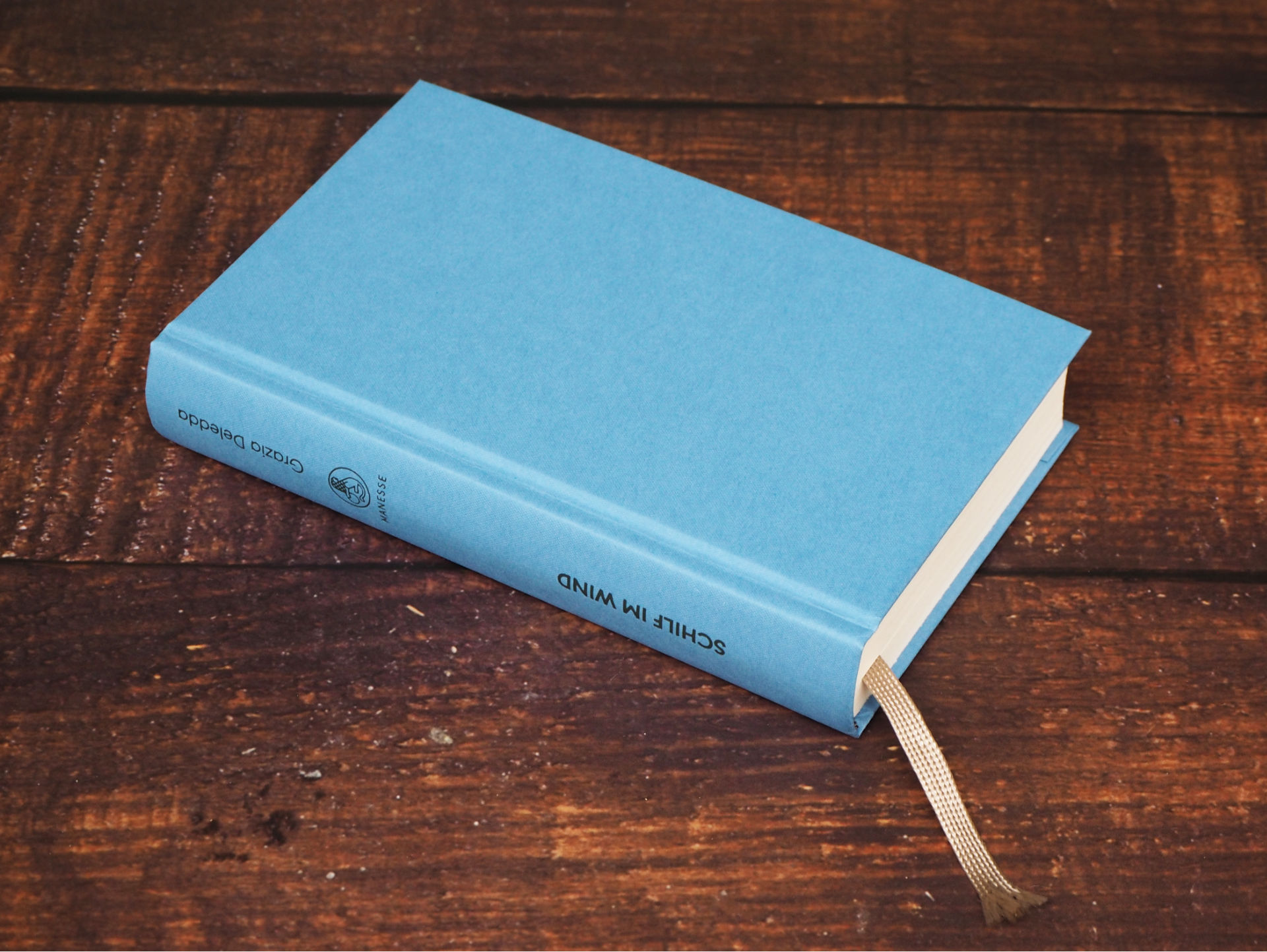
In terms of design, the book meets the usual high standard of the new Manesse classics. The dust jacket is made of pleasantly sturdy paper and is beautifully designed. I love the pattern reminiscent of ceramic tiles — it reminds me of the Azores, where similar tile-making traditions exist. It has a wonderfully Southern and slightly old-fashioned charm. The book itself features the colorful thread stitching typical of the series, matching the board cover, which I also find delightful. It comes, of course, with a ribbon bookmark. Typographically, it follows the clean and modern design of the new Manesse classics line. The one major drawback, however, is the lack of a cloth cover. Without the dust jacket, the book suddenly looks quite plain, and I really miss the beautifully colored linen bindings of the older Manesse world literature editions.
Conclusion: Reeds in the Wind will stay with me primarily because of its characters, who are deeply shaped by pagan superstition and a strong Christian faith. The story, along with the characters’ decisions and thoughts, and the depictions of festivals and rituals, offers a vivid insight into the mindset and culture of the Sardinian people at the beginning of the 20th century. The nature descriptions harmonize beautifully with the narrative and embed the protagonists in a distinctive landscape. Linguistically, the reader gets a solid novel — not exceptional or particularly poetic, but written with a simplicity that suits the story and portrays the characters authentically. The novel is entertaining and at times gripping, though the beginning and end are quite slow and somewhat drawn out. The dust jacket design, ribbon bookmark, thread stitching, and typography are again very well done, and the revised translation also convinced me. The missing cloth binding, as with other books in Manesse’s new classics series, remains a minor disappointment. Overall, this is a beautiful and worthwhile book — not a masterpiece, but one that I thoroughly enjoyed.
Book information: Reeds in the Wind • Grazia Deledda • Manesse Verlag • 448 pages • ISBN 9783717525240
Das klingt ziemlich gut. Werde ich mir mal bestellen. Habe bereits die Erfahrung gemacht, dass aus Sizilien viel gute Literatur kommt.
Und ja, irgendwie sind italienische Klassiker in Deutschland recht unbekannt, angesichts der beinahe-Nachbarschaft…
Dass Deledda den Nobelpreis überhaupt bekommen hat war wohl mehr eine Konsensentscheidung. Insgesamt wurde sie 13 Mal nominiert, 1926 zum 12ten Male. Nur wurde der Nobelpreis für Literatur im Jahr 1926 überhaupt nicht vergeben, da keiner der Nominierten die Kriterien aus Nobels Testament erfüllte. Der Literatur-Nobelpreis für 1926 wurde Deledda erst 1927 verliehen. Ich weiß nicht, was der Preis in einem solchen Fall wirklich wert ist. Deine Rezension hat mich auch nicht neugierig gemacht. Zudem ist auffallend, dass von Deleddas unzähligen Romanen nur eben dieser eine noch im Handel erhältlich ist. Ich fürchte, hier wird einfach nur mit dem Titel “Nobelpreis 1926” geworben. Für Sammler von Nobelpreis-gekrönten Werken sicherlich schön, für mich aber kein Thema.
…war wohl mehr eine Konzessionsentscheidung…meinte ich.
Interessant, das mit den vielen Nominierungen wusste ich nicht und dass der Nobelpreis erst später vergeben wurde. Wobei ich von den ganzen Auszeichnungen grundsätzlich nicht viel halte. Für mich ist das ganz sicher kein Kaufanreiz, aber möglicherweise ist das bei anderen Lesern anders.
Hast Du bereits ein anderes Buch von Deledda gelesen, so dass es zu der eher ablehnenden Haltung gegenüber der Autorin kommt? Wie im Fazit geschrieben fand ich das Buch kein Meisterwerk, es war aber sicherlich nicht schlecht und ist schon lesenswert.
Liebe Grüße und herzlichen Dank für Deinen interessanten Kommentar
Tobi
P.S.: Sehr schöner Nickname, ich stell mir da gerade vor, wie dieser Kommentar von einem auf einem Diwan hingestreckten trägen Russen in einem weichen Chalat geschrieben wurde ;)
Nee, ich habe Deledda nicht mal vom Namen her gekannt. Meine Ablehnung beruht zum einen auf eigenen Leseerfahrungen und zum anderen auf deiner Rezension. Ich habe einfach keinen Zugang zu Romanen, die in ein strenges biblisches Korsett gepackt werden. In diese Richtung bin ich nicht gebildet, das läuft dann komplett unter mir durch. So ist Efix z.B. einer der Schutzheiligen der Stadt Cagliari. Ich bin mir sicher, dass die sardischen Leser in den 1920er Jahren das wussten und alleine von den Namen und bestimmten Handlungen der Charaktere her weitere Rückschlüsse auf die Geschichte ziehen konnten. Die heutige Bildung ist einfach eine andere. Ich bin kein Anhänger davon, während des Lesens die Suchmaschine als ständigen Begleiter zu haben.
Vor einigen Jahren erschien im Hanser “Das erste Gewand” von Donataschwili, hat sich ganz interessant gelesen. Nur fühlte ich mich durch Passivität des Domenico provoziert. Erst nach der Lektüre habe ich dann erfahren, dass auch diesem Roman eine biblische Sequenz zu Grunde lag. Ich konnte den Roman in seiner Gänze also gar nicht verstehen. Ich habe ihn ausschließlich als politische Ansprache im damaligen Sowjetrussland gelesen – besonders der Teil Canudos war sehr informativ (wobei ich da auch im Netz nach weiteren Informationen gesucht habe, da mich die lateinamerikanischen Namen der Akteure irritiert hatten) . Doch bei Schilf im Wind sehe ich diese Möglichkeit nicht. Dass die Süditaliener bzw Insulaner lange Zeit und in Teilen auch heute noch sehr rückständig leben ist nichts, was ich mir neu erlesen muss.
Wenn ich dann noch lese, dass weder Anfang noch Ende des Romanes überzeugen können, dass die Personen dich nicht erreicht haben, dass selbst die Naturbeschreibungen nicht lobend hervorgehoben werden, dann weiß ich, dass das nichts für mich ist.
In einem Nachruf auf Deledda stand geschrieben, dass sie vor allem dafür geachtet wurde, dass sie an ihrer Schreibkunst arbeitete. Da stand nicht, dass sie eine gute Autorin gewesen sei. Das passt dann wieder dazu, dass von ihren ca vierzig Romanen lediglich drei “überlebt” haben (Die Mutter, Schilf im Wind und den dritten habe ich schon wieder vergessen). Nee, die 450 Seiten spare ich mir.
Übrigens gefällt mir, dass du nichts hochlobst, was dir nicht zu loben wert ist. Eine Rezension, die mir eine enttäuschende Lektüre erspart ist mir mindestens so wertvoll wie eine, die mich zum Lesen auffordert. Dafür danke.
Das ist ein sehr schöner Kommentar und ich kann das, was Du schreibst voll nachvollziehen. Aus Deinen Worten spricht auch echt Erfahrung, was die Wahl passender Lektüre betrifft.
Was den Kontext der Zeit betrifft, da hat der Manesse Verlag mit den Anmerkungen echt gute Arbeit geleistet. Die Bedeutung des Namens Efix beispielsweise findet darin tatsächlich Erwähnung, was ich auch nicht gewusst hätte. Ich wäge immer ab, bei manchen Romanen habe ich das Bedürfnis mehr zu erfahren und gehe dann auf Recherche, bei Schilf im Wind war es tatsächlich dann eher so, dass mich eher visuelle Eindrücke interessiert haben. Wie es wirklich dort aussieht und wie die Ortschaften auf Bilder so sind. Die Figuren an sich hatten zusammen mit den Landschaftsbildern schon etwas Schönes, auch wenn sie rückständig sind und ihren veralteten Glauben verhaftet sind. Man muss aber auch immer in der Stimmung zu so etwas sein und da bin ich sehr wankelmütig. Die Kunst ist es eben immer auch, das richtige Buch zur richtigen Zeit zu finden.
Es freut mich sehr, dass meine Rezension einen so guten Einblick in das Buch geben konnte. Deine Eindrücke und Schlussfolgerungen sind durchaus korrekt und dann mit einer Rezension Leser von einer Lektüre abzubringen, die frustrierend oder langweilig gewesen wäre, halte ich für genauso wertvoll, wie jemand für ein Buch zu gewinnen, das dann auch Vergnügen bereitet.
Herzliche Grüße und nochmal vielen Dank für das wertvolle Feedback
Tobi
Der Roman ist wunderschön geschrieben, gemächlich, aber doch ohne sich zu verlieren erzählt, und ob er sich christlicher Symbolik bedient, tut der Qualität keinen Abbruch. Unter all den lächerlichen Nobelpreisen, u.a. an Premierminister, die nie ein literarisches Werk verfasst haben, an Musiker und an die Julia Engelmann des 20. Jhdts, Hermann Hesse, ausgerechnet diesen anzuzweifeln, scheint mir da eher anmaßend. Von Deledda ist auch nicht nur dieser Roman im Handel erhältlich, sondern allein auf Deutsch mindestens 5 weitere. Das Angebot auf Italienisch ist natürlich deutlich breiter, und auf Englisch gibt es nicht nur mehrere Romane, sondern auch die Kurzgeschichten bzw. Erzählungen.
@Soeren
Aufgrund deines Beitrages bin ich nochmal im Netz auf die Suche gegangen und habe eine Leserunde zu dem Buch entdeckt. In dieser Runde wurde “Schilf im Wind” von mehreren Lesern als eher für Spezialisten geeignet ausgewiesen – Literaturstudierende oder am Literaturbetrieb teilnehmende etwa. Bin ich beides nicht. Auch wird in der Runde mehrfach geschrieben, dass sich den Lesenden nicht alles der Handlung erschlossen habe – mit dem Nachsatz: ist ja auch egal. Am Ende wird “Schilf im Winde” dann unter “Bildung” verbucht. Das ist doch mein Kritikansatz: “Schilf im Wind” wäre für mich nicht in Gänze zu verstehen. Geeignet für Menschen, die sich beruflich mit Literatur beschäftigen, die schon eine Beziehung zur italienischen Literatur oder zu Sardinien im allgemeinen aufgebaut haben. Für den Rest dürfte dieses Werk eher anstrengend sein.
Ich habe mir Deledda auch nicht speziell herausgesucht, um ihr den Nobelpreis streitig zu machen. Ich habe zu anderen Nobelpreisträgern gar keinen Bezug genommen. Lediglich habe ich geschaut, was zur Entscheidungsfindung in 1926 zu finden war. Und da ging bei mir eben die rote Lampe an.
Herzlichen Dank für den Beitrag und die Anregung. Das Buch steht bei mir (noch) ungelesen im Regal in der ganz besonderen Ausgabe des Coron-Verlages zum Literaturnobelpreis, in dem neben einem Werk auch eine kurze Biografie, die Antrittsrede und Hintergründe zur Auswahl des Preisträgers / der Preisträgerin enthalten sind. Bisher habe ich von Grazia Deledda nur “La Madre” gelesen, in dem es um Religiosität und Zölibat geht. “Schilf im Wind” werde ich dann demnächst lesen.
Mich wundert es auch, dass italienische Literatur bei uns gar nicht so sehr verbreitet ist. Meine Mutter kommt gebürtig aus Italien und daher haben wir einiges hier.
Vorher viel mir das gar nicht so auf, da ich damit groß wurde. Aber in den Buchhandlungen ist davon nicht so viel zu sehen!