
Deephaven • Sarah Orne Jewett
It’s been some time since I last held one of Mare’s beautiful classics in my hands. I was very much looking forward to Deephaven, especially because I knew for certain it would carry that particular sea breeze that clings to all the Mare Classics—and which, these days, is a more than welcome way to escape the real world. The blurb promised a somewhat run-down, quiet 19th-century harbor town, and that announcement only heightened my anticipation for the book.
Deephaven is a small, fictional, sleepy coastal town on the East Coast of the United States. Helen and her best friend Kate, both 24 and from well-to-do families, want to escape bustling Boston for a summer and agree to look after the house of Kate’s late great-aunt. Together they explore this slightly shabby seaside place and come to know the local landscape and its somewhat idiosyncratic inhabitants. The story is set in 1877 on Maine’s beautiful—and at times rugged—coast.
The novel opens with Helen as she plans the summer with Kate and then quickly sets off for the little town of Deephaven. The individual chapters recount the two young women’s experiences in an episodic way, and through them the reader primarily gets to know the place via its very singular and authentic residents. At first I found the characters rather ordinary, and their often arduous lives noteworthy but not exceptional. As the book went on, however, several very entertaining episodes appeared that I enjoyed a great deal—for example, a story about a sailor with a cat; or how the protagonists encounter a very large woman exhibited by a traveling circus. I also found their meeting with a very eccentric woman, living out her final years in complete seclusion, quite entertaining. But Jewett also portrays poverty here; I especially remember a funeral procession that she describes beautifully, with an atmospherically dense mood in which this coastal landscape intensifies the scene:
The minister and several other guests joined, and the procession moved slowly down the slope; a strange shadow had fallen over everything. It was like a November day, for the air felt cold and raw. Some large seabirds wheeled high in the sky, struggling against the wind to reach the sea, and now and then uttered a wild, far-carrying cry. We heard the dull roar of the ocean, and not far from the shore the waves rose high and broke into white foam upon the scattered rocks. (p. 171)
Each of the thirteen chapters collects the two women’s noteworthy experiences. There is, for instance, a chapter about the old seamen, one about going out fishing, and one about an old, mad woman. The book is arranged so that it reads as if Helen is telling everything herself—reporting to the reader in summary, much as one would describe one’s experiences in a letter.
All the episodes radiate a certain youthful lightness that the two carefree and cheerful protagonists bring with them. And it is precisely this light, open-minded, and positive outlook that gives the book such a pleasant tone. The lovely nature, the sea, the old sailors, the dilapidated houses that speak of long-gone times when Deephaven was a thriving and prosperous place, and not least the elderly residents who have often fallen on hard times but still carry that old life within them—all this makes the book a small and entertaining voyage of discovery.
Jewett’s sentences read smoothly; her language is neither too simple nor overly convoluted. It’s just right—very fitting to the character of the two young women, who wander through the world with the relaxed, curious gaze of the well-to-do, yet remain decent and empathetic thanks to their good upbringing. I found some passages sonorous and pleasing to read; overall it’s solidly written, if not, on the whole, exceptionally outstanding.

I hadn’t heard of Sarah Orne Jewett before. She lived from 1849 to 1909, the daughter of a successful physician and the granddaughter of a wealthy merchant. Deephaven was her first book publication in 1877 and a great success. Her most famous novel is The Country of the Pointed Firs, considered a masterpiece of American literature. But it was precisely Deephaven that opened the doors of the literary salons of her time to her. Deephaven originally appeared in several issues of Atlantic Monthly and was only gathered and published as a book two years later. She drew inspiration from the coastal towns of Wells, York, Portsmouth, and Kittery, as well as from her grandfather’s tales.
The editor and translator is once again Alexander Pechmann, who has already rendered numerous titles in the Mare Classics series and, as always, delivers an impeccable translation. His afterword is very informative, just the right length, and provides exactly the information I wanted after finishing the book. The notes are comparatively few due to the book’s brevity, but nothing remains unclear in the text. I also particularly liked the compilation of the books the two women took with them, with explanations of what kinds of novels they are. These are listed in the final chapter, though they are mostly unremarkable contemporary works. Still, I found the compilation an excellent idea.

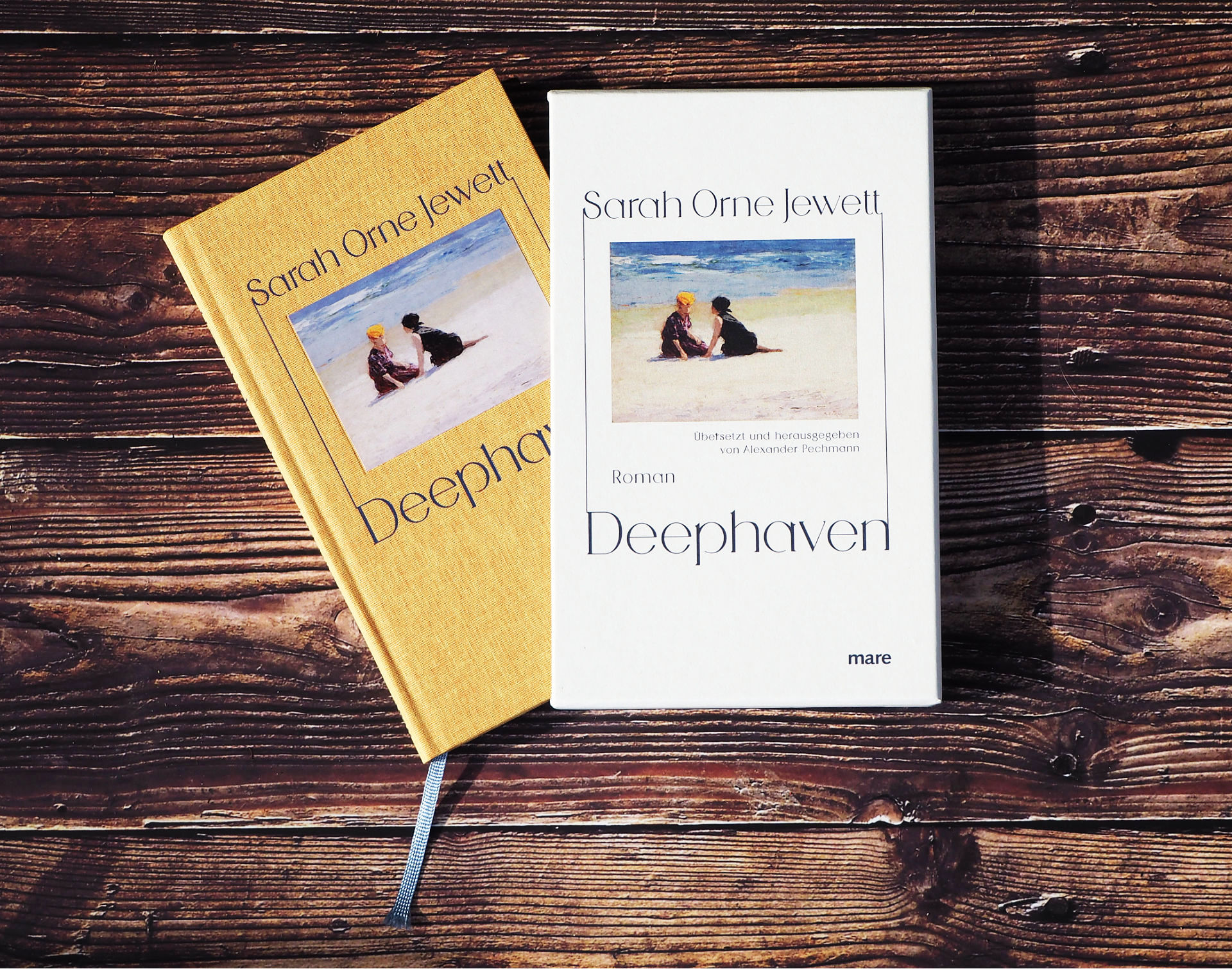
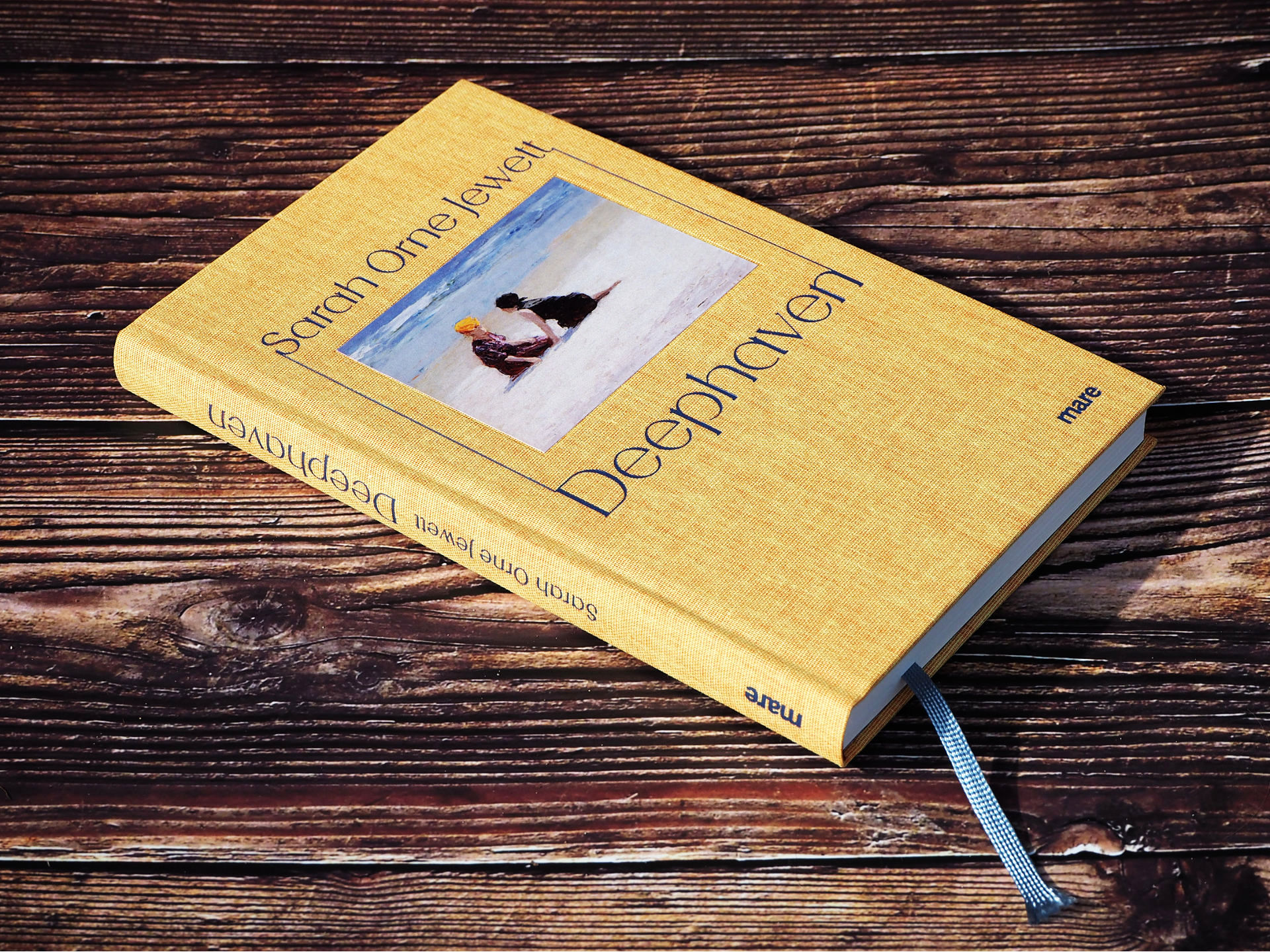
Right now I’m holding the book in my hands, running my fingers over the high-quality cloth binding, leafing through pages that feel so pleasantly supple, and looking at the small painting Confidences by Edward Henry Potthast, meant to mirror Helen and Kate, who sit together on the beach, turned toward one another in a familiar, private conversation. What can I say—it’s a Mare Classic, with the wonderful quality and bibliophile production that, even in the details, is once again perfectly executed. There’s sewn binding, the endpapers are brown to match the cover, and the pale blue ribbon marker and the slipcase round it off perfectly. There are volumes in the series whose design I like even more, but when I take this book in my hands, it simply feels wonderful. For several years now I’ve been regularly getting all the Mare Classics, and they’re among the most beautiful books on my shelves.

Conclusion: The tale Deephaven is a lovely collection of anecdotes and experiences that carries the reader off to an old harbor town and introduces them to its very particular inhabitants. The way the two young friends discover this sleepy little coastal place—how, with their open and unburdened manner, they describe the landscape, the sea, and the people—is simply a pleasure to read. Jewett transports the reader to a world composed of many lives, thereby giving this place a face. The book reads pleasantly and offers several fine descriptions, though in many spots it also struck me as rather ordinary. Nevertheless, precisely because of the lightness with which Jewett has Helen recount things, I was very happy to dive into the book. The sea is always present, and the story once again fits perfectly into the Mare Classics series. All in all, this beautifully produced book is well worth the literary journey—I have to say—and I greatly enjoyed the read.
Book information: Deephaven • Sarah Orne Jewett • mare Verlag • 208 pages • ISBN 9783866486669
Tolle Rezension! Ich habe vor ein paar Tagen die Leseprobe gelesen, mich dann aber doch dagegen entschieden das Buch zu kaufen, weil es mir als zu leicht erschien. Aber Deine Besprechung lässt mich jetzt doch noch mal überlegen.