
Yellowface • Rebecca F. Kuang

Yellowface landed quite unexpectedly in my mailbox. Packaged in a beautifully designed box, it arrived at just the right time, as I was going through a phase of rather erratic reading habits. I had already read Babel by Kuang, which for me wasn’t exactly a masterpiece of the century, but I did find it entertaining and worth reading. I wouldn’t have picked up Yellowface based on the blurb, since the way it’s marketed clearly targets a specific audience to which I certainly don’t belong. Nevertheless, I decided to give it a try—sometimes it’s refreshing to break one’s habits and experiment a bit with literature. What is Yellowface about, and was this unexpected read worth it? You’ll find out here.

The protagonist, June Hayward, is loosely acquainted with Athena, a former classmate from an elite university. Both aspire to become successful authors, and while Athena enjoys growing acclaim, June looks at her with a mix of envy and admiration. Although their connection is rather casual, they spend some time together—and during an accident, Athena dies right before June’s eyes. In the shock of the moment, June takes Athena’s newly completed manuscript, edits it, and eventually publishes it under her own name. Naturally, things unfold as one might expect: June becomes entangled in a whirlwind of events surrounding this book that is both hers and, at the same time, stolen from Athena.
Why wouldn’t I have picked up the book at first glance? It deals with cancel culture, racism, cultural appropriation, diversity, and all those topics that currently feel excessively omnipresent. These are not subjects I feel the need to engage with in literary form—especially when, in this country, they are discussed only polemically and without any nuance. The plot also seemed trite to me: an author steals someone else’s work, publishes it under her own name, and the only real tension lies in whether she’ll get caught. A third argument against the book: novels about books, the publishing world, cozy bookstores, or writing itself are usually trash. That’s because, in my view, authors who write about their own daily business can hardly achieve creative distance.
Yellowface confirmed many of my initial reservations. The plot is rather dull, lacking imagination, and the overall story—including the ending—is nothing I’ll remember for long. It lacks any real substance. That said, the book is undeniably entertaining and fun to read—though only at the level of a light TV series you might watch in the evening to relax.
Kuang portrays the publishing world in an exaggerated way, clearly for dramatic effect. Everything is excessively commercial, and literary success is depicted as something akin to pop stardom—though in reality, the book industry moves at a much slower pace. Still, this adds excitement and momentum to the story. I found it quite engaging to read how June achieves success, how she follows her rise on Twitter, and how commercial the publishing industry is portrayed to be. From the start, her publisher positions the book—about the mistreated Chinese migrant workers of World War I—as a guaranteed bestseller. The entire literary scene is depicted as driven solely by short-term success, money, and shallow ambition: greedy literary agents, rooftop cocktail parties with editors and marketing teams, and a constant rush to chase trends. While such commercial motives certainly exist, the novel exaggerates them far beyond reality—even in the U.S., where the business is far too sluggish for such extremes. That said, Kuang’s critique isn’t entirely misplaced: when you look at what kinds of books are published, it’s often just as she describes. Publishers chase trends relentlessly, and in Germany especially, certain moral topics—whether genuinely significant or utterly trivial—are relentlessly exploited. As long as there’s a market, there will be books to fill it. This exaggerated depiction of the publishing world is, of course, also part of the book’s entertainment value.
The second major protagonist in the story is Twitter. June’s main gauge of public opinion—whether she is currently in favor or disgrace—comes from people’s tweets. There are ups and downs; she reads both praise and scathing criticism. Unsurprisingly, her fiercest critics are found on social media—blogs, Instagram, and most notably Twitter. But it’s undeniably gripping to experience the next Twitter scandal alongside the protagonist. The level of book-related popularity described on Twitter is exaggerated, but it’s clear that the author is deeply familiar with social media herself—unsurprising given that she has nearly 100,000 followers on Twitter/X. I imagine she has experienced some highs and lows there herself. The way June behaves in the novel mirrors exactly the well-known behavioral patterns and pitfalls of social media use. This doesn’t add much depth to the novel, but Kuang captures the dynamics of online spaces very effectively.
Linguistically, the book is a complete disappointment. There are no poetic or beautifully crafted sentences. Everything is written in plain, everyday language, with words that simply don’t belong in literature. Here’s an example:
“Shit, shit, shit, shit. Athena kept all her ideas in those stupid Moleskine notebooks.” (p. 63)
The simple, conversational tone reads like a long social media post—something you might find on Facebook. This straightforward style does create a certain intimacy with the protagonist, and if you spend a lot of time on social media, you’ll likely find it authentic and relatable. Which brings us full circle: who finds stories about cancel culture, cultural appropriation, racism, and diversity compelling? The people who constantly debate these topics online—social media users, especially those on Twitter/X.
If you wade through this plain, colloquial prose, you’ll find an additional challenge: the entire text is written in gender-inclusive language, which makes it quite tiresome to read. This clearly caters to a particular, socially aware target audience. It’s the first gendered novel I’ve ever read, and I nearly put it down at the very first “*innen”. There are browser extensions to remove gendered language online, but unfortunately that doesn’t work with a printed book. I also noticed that gendering creates an imbalance in the opposite direction—since every gendered word ends with “-innen,” you end up reading mostly the feminine form. A fairer approach would be to alternate between masculine and feminine terms instead.
Are the themes of cultural appropriation or “canceling” explored or analyzed in any meaningful way? In my view, no. The book merely rehearses familiar arguments and counterarguments, offering no new insights or depth on the subject.
I also found the book too long. The story is overly detailed, and it could easily have been shortened by a quarter—or even a third—without losing anything of real significance.
Up to this point, it may sound like I’m completely trashing the book, but I do want to emphasize that it was genuinely entertaining. I wanted to know how things would turn out (though the ending was disappointingly flat and meaningless). Kuang did a great job with the pacing and suspense elements. The exaggerated publishing world, the effect of social media on June, the reader’s feeling of watching her live through each new storm, the colloquial style that mirrors online communication, the haters whose identities she tries to uncover—all these elements keep you engaged. It’s clear that Kuang has studied the craft of storytelling carefully. Around the middle, when the book starts to drag a bit, she ends chapters with cliffhangers, giving it a distinctly TV-series-like rhythm—which I found quite fitting.
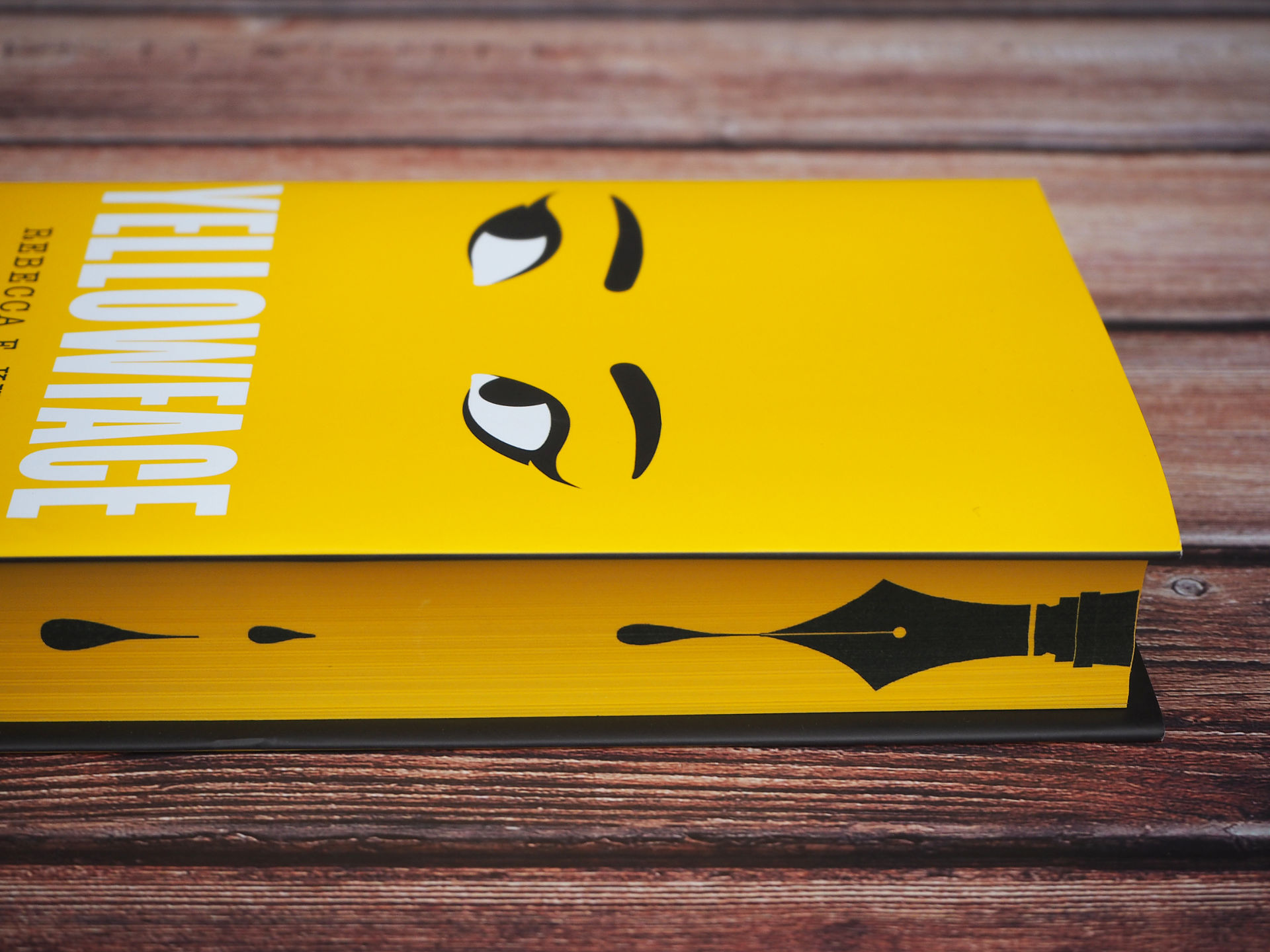
Kuang, who was born in China and moved to the U.S. at age four, has already written several books and recently achieved great success with Babel. Comparing Yellowface to Babel, the latter was far more original and had much greater depth. Yellowface feels more like a commercially motivated publication. The marketing is also very polished: the bright yellow cover design, the topical themes, the printed page edges (currently trendy among younger readers), and of course Kuang’s existing fame after the international success of Babel—all of it feels highly optimized.

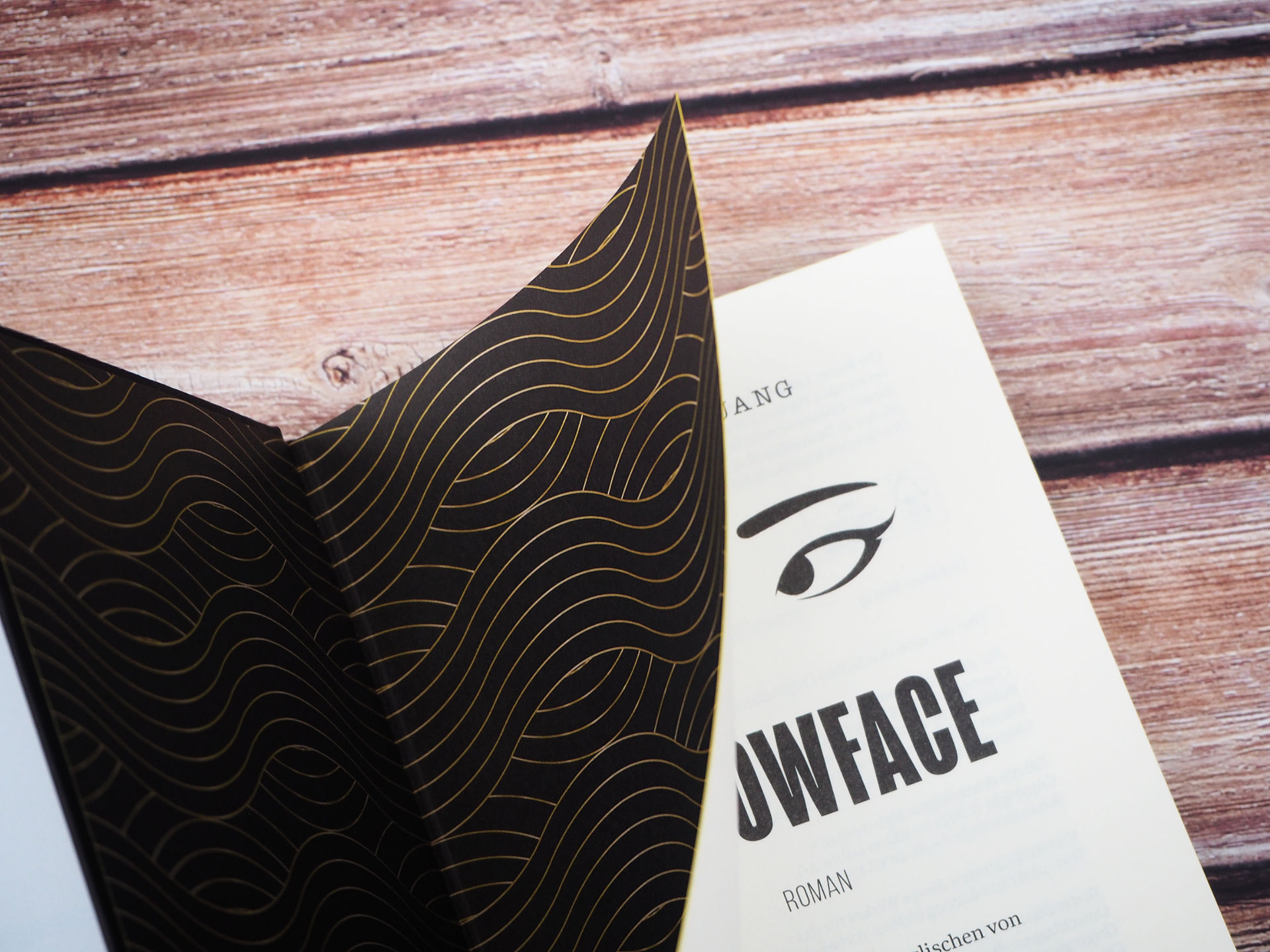
I quite like the physical design of the book. The yellow dust jacket is simple but appealing, and together with the printed page edges, the color scheme, the black ribbon bookmark, and the endpapers, it’s a nicely produced edition. I particularly appreciate the book cover, which features the title of June’s novel, with Athena’s name crossed out and replaced by June’s pseudonym—an excellent design choice that reflects the story itself. Overall, Eichborn Verlag does a great job with their book designs, as I also noticed with Washington Black and Babel.
Conclusion: Yellowface is a book that only moderately convinced me. The plot is fairly ordinary, the language simple and unpoetic, and the central themes—publishing, cancel culture, cultural appropriation, and racism—feel overused and overly present. The story is suspenseful and engaging, and I did enjoy reading it, mainly because it keeps you hooked with constant tension, while still being an easy, undemanding read. I did want to know how it ended, though the finale left me rather disappointed. If you want to read a good book by Kuang, you’re better off picking up Babel. If you just want to relax, switch off, and enjoy a light summer read—or get an exaggerated glimpse into the world of social media—this book is a solid choice.
Book information: Yellowface • Rebecca F. Kuang • Eichborn Verlag • 274 pages • ISBN 9783847901624
Guten Morgen Tobias
Mit großem Interesse habe ich deine Rezension gelesen. Da ich deinen Lesegeschmack schon länger verfolge, wundert es mich nicht, dass dich die Geschichte nicht komplett (bis gar nicht) überzeugen konnte. Ich selbst bin dem Hype um das Buch aufgesessen und habe es mir gekauft. Da Babel auch noch ungelesen bei mir im Regal steht, freue ich mich nun darauf. Trotz deiner Kritikpunkte freue ich mich jedoch nun auf Yellowface. Das Thema ist genau meins. Die Sprache ohne poetische Sätze mal richtig erholsam. Diesbezüglich habe ich manchmal das Gefühl, in einigen Büchern versucht man krampfhaft poetische Sätze hinzuknallen. Das kommerzielle in der Geschichte von Kuang klingt für mich überzeugend. Der Buchhandel und die Verlage kämpfen um gute Verkäufe. Für mich nachvollziehbar. Wer kämpft heutzutage nicht? Ausgefallene Buchschnitte und Cover sollen den Kaufanreiz erhöhen. Schade ist nur, dass die Individualität auf weiten Strecken damit verloren geht. Wobei ich dir zustimme. Das ist bei diesem Buch sehr gut gelungen.
Danke für die differenzierte Besprechung.
Einen schönen Sonntag,
Gisela
Lieber Tobi, danke für Deine Rezension.
Bei dem Hype, der um dieses Buch entfacht wurde, bin ich automatisch skeptisch geworden. Deine Rezension hat nun meine Vermutungen bestätigt. Ein weiteres Buch, viel zu schade, um damit Lebenszeit zu vergeuden. Herzlichen Dank für den damit möglichen Zeitgewinn.
Michael