
The Masque of the Red Death • Edgar Allan Poe
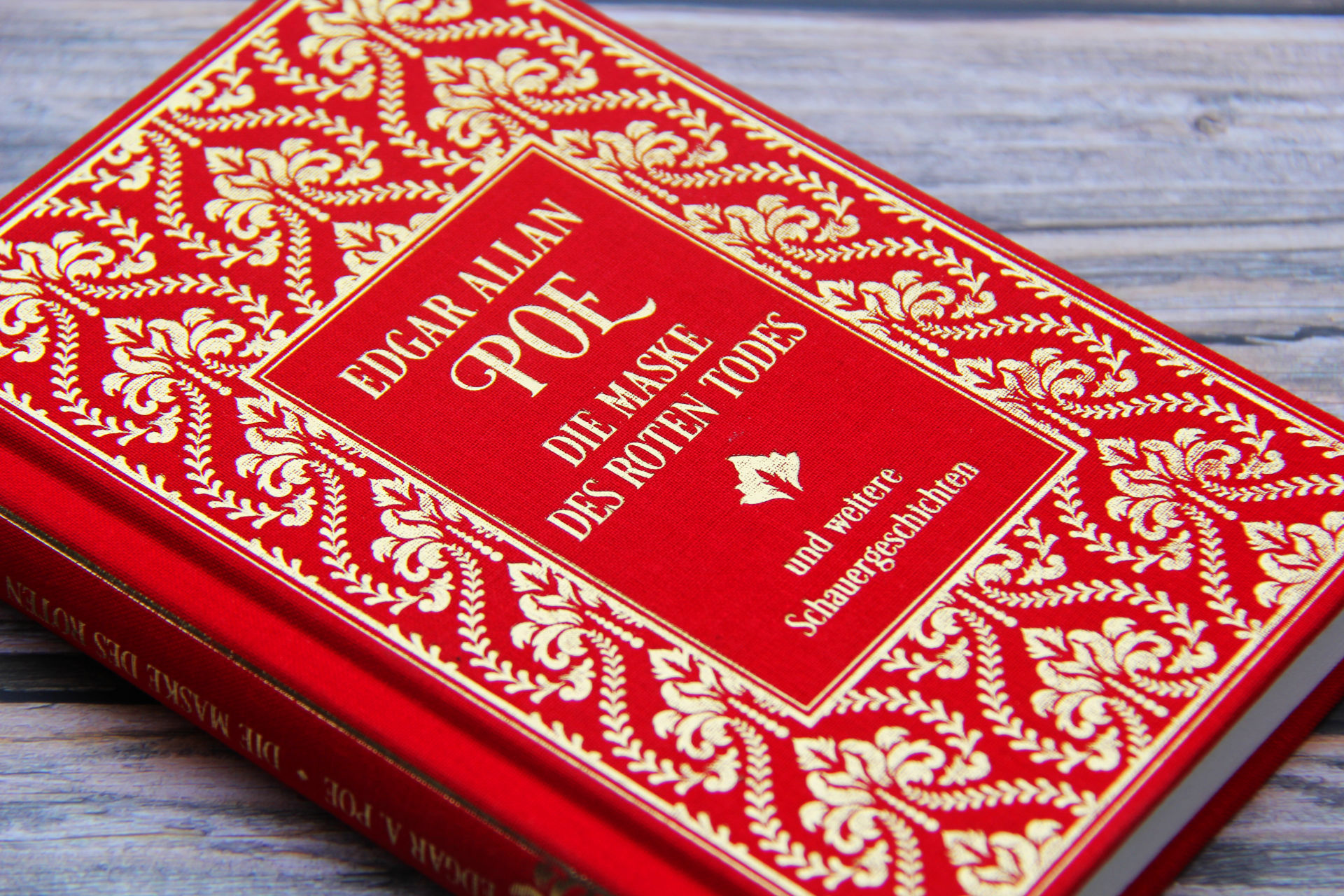
Anyone who regularly browses the classics section inevitably comes across books by Edgar Allan Poe. His stories were also personally recommended to me again, so I decided to pick up one of the pretty editions from Nikol Verlag featuring his tales of the macabre. Seemingly a safe bet—when a writer is still read 175 years later, you can hardly go wrong. In the following lines you’ll find out just how much I was spooked.
Edgar Allan Poe is known for his tales of the macabre, and this collection from Nikol Verlag contains eleven of them. It begins with The Masque of the Red Death, about a prince who withdraws to his luxurious estate with his court during an epidemic. The Fall of the House of Usher is one of the better-known stories, in which the narrator visits the last two members of a sinister family. It’s wonderfully atmospheric, because the setting is so classically Gothic. It brings to mind Dracula, with the Gothic horror backdrop of an old family mansion. The Oblong Box recounts a brief episode at sea with an unexpected twist. The Premature Burial has precisely that as its theme. MS. Found in a Bottle is another short tale set aboard a ship. In William Wilson, we follow a young man whose fate reminded me a little of The Picture of Dorian Gray. Metzengerstein is a short story about a scion of an old family, which I found middling in its execution. The System of Doctor Tarr and Professor Fether is set in an asylum—again with that typical Gothic vibe, a pleasure to read and with a neat punchline. A Descent into the Maelström tells of a great tidal current in the Lofoten that becomes a huge whirlpool, swallowing ships and people in an instant. That one is highly atmospheric and reminded me a bit of Jules Verne. Of course I immediately googled the Maelström, and the pictures and videos are unfortunately nowhere near as spectacular as the deadly vortex in the story. Hop-Frog takes place at a royal court, deals with revenge, and is full of symbolism. The Facts in the Case of M. Valdemar is a superb finale to the book: the narrator hypnotizes a dying man to discover what happens next—truly gripping to the last line.

I liked every single story exceptionally well. What’s remarkable is the constant second layer of meaning—the depth and complexity inherent in these tales. On the surface, they are horror stories that tap into fundamental human fears: being buried alive, death itself, mysterious diseases, and again and again the supernatural. Yet each story is also designed to allow wide interpretive scope, so alongside the Gothic element there’s always something deeper to discover. For example, that fear can become a kind of self-fulfilling prophecy. Or that it is simply impossible to hide from a pandemic—something that resonates strikingly with our experience of COVID.
Poe writes with suspense, and thanks to the frequent first-person perspective the reader is always very close to the narrator. You empathize and can readily follow the narrator’s thoughts, which lends the stories even more authenticity. You’re taken into confidence, handed an experience, and you can’t help but want to know where it leads. I constantly felt the curiosity to find out how each story would end—and that pulled me through the collection.
On top of that, Poe’s language is simply wonderful. The style is consistently refined, with beautiful sentences and a polished diction that’s just a pleasure to read—the kind you really only find in truly great classics. In contemporary books, that high level is extremely rare. I really savored it. You can tell you’re dealing with an educated and very alert mind, and it’s all the nicer to be taken into his confidence.

I love the combination of a book and an Arte documentary, and luckily there was an excellent one for Edgar Allan Poe again. I read the book and then watched the documentary “Edgar Allan Poe – Amerikas abgründiger Pop-Poet.” (If the video is no longer available because our Stone Age public broadcasters have deleted it, I recommend searching the title on YouTube—sometimes other users reupload it and it’s still accessible.)
I found it very interesting to learn more about Poe’s life. He was born in Boston in 1809 and lived only to the age of forty. His mother died very young at twenty-three of tuberculosis, and the orphaned Edgar, not yet three, went to live with a foster family. They cared for him well and enabled him to study, but he began gambling and drinking. After a falling-out with his foster father, he left home and enlisted in the military. The strict discipline didn’t suit him either, and after a few years he moved to Baltimore, where he lived with his aunt and cousin. At twenty-seven he married his thirteen-year-old cousin—which would have been scandalous even then, which is why her age was adjusted upward. A love letter Poe wrote to her shows he was a complex personality and certainly not a balanced man. Professionally he was quite successful over the course of his life, but his alcoholism repeatedly threw his life off course. When his wife, like his mother, died young of tuberculosis, he processed his grief in poems. Only two years later he died under mysterious circumstances. Acquaintances found him, drunk or ill, outside a tavern and brought him to a hospital, where he died a few days later.
Although some of his publications gained recognition during his lifetime, his fame truly took off only after his death, and in the nineteenth and early twentieth centuries he inspired numerous writers. According to the Arte documentary, he’s now a pop star in America, complete with merchandising and various adaptations—though I think that’s a bit exaggerated. He did lead a dramatic life, and together with his work, the daguerreotype portrait, and his timeless, extraordinary texts, it’s entirely understandable that he still enjoys a certain cult status.

My edition is from Nikol Verlag and comes with a cloth binding, gold embossing, and pretty endpapers. For a small price you get a truly beautiful book that also makes a fine gift. In general, I really like books from Nikol Verlag. For those who prefer to read the stories in the original, I recommend the lovely Penguin Classics edition, a small clothbound volume that’s also quite handsome.
Conclusion: Poe’s tales of the macabre are definitely recommended. His stories are profound, rich in symbolism, atmospherically dense, elegantly written, and always boast an additional layer of meaning that lingers with the reader long after finishing. I wasn’t exactly terrified, but I devoured the stories—they’re simply gripping, with a consistently pleasant pace and a well-shaped arc of suspense. Edgar Allan Poe was also a very interesting figure, and the Arte documentary greatly enriches the reading experience. I’ll definitely be getting the beautiful Coppenrath edition as well; while it includes some of the same tales as the Nikol volume, there are several others too—all in a splendid gift edition. You really can’t go wrong with Poe—this is top quality once again. I can only recommend this short-story collection.
Book information: The Masque of the Red Death and Other Tales of Horror • Edgar Allan Poe • Nikol Verlag • 192 pages • ISBN 9783868206296
Grüß Gott!
Wie immer verfolge ich Ihre Rezensionen mit Interesse aber beim besten Willen, mit Poe kann man mich nicht hinterm Ofen hervorlocken. Ich werde bei Gelegenheit meine Ausgabe in einen Bücherschrank stellen.
LG Rezipient Mst
Sehr geehrter Herr Doktor Stähr,
da sollten sie aber schnell mal den Poe in unseren Bücherschrank stellen, damit ich das Buch abgreifen kann ;) Zugegeben, Poe ist nun mal nicht der neueste heiße Scheiß, aber verglichen mit dem zeitgenössischen Bullshit noch immer eine andere Liga. Ich empfehle Ihnen sich ein Bild zu machen, mit “Poe kurz angerissen, die Gesammelten Werke in nur 9000 Seiten als handliche Taschenbuchausgabe”. ;)
Liebe Grüße
Jenosse Tobi
Guten Morgen!
Ich bin schon seit meiner Jugend ein großer Poe-Fan. Aber ich suche seitdem vergeblich nach einer Geschichte, die uns im Unterricht in der Mittelstufe vorgelesen wurde und von der ich bis heute vermute, sie müsste von Poe gewesen sein.
Darin geht es um eine Person, die lebendig in einem Zimmer eingemauert wird. Sagt Dir das was?
Danke für die tolle Rezension und den Tipp mit der Dokumentation. Ich werde sie mir die Tage auf jeden Fall ansehen.
Liebe Barbara,
vielen lieben Dank für Deinen Kommentar. Tatsächlich wird die von Dir gesuchte Geschichte auch in der Dokumentation erwähnt. Die Geschichte ist von Poe und heißt “The Cask of Amontillado” bzw. in deutsch “Das Fass Amontillado”. Bei solchen Fragen hilft ChatGPT super. Das findet das auch sofort. Ich hatte auch schon ein Zitat, an das ich mich nur noch sinngemäß erinnern konnte und auch nicht den Autoren mehr wusste und ChatGPT konnte das echt sofort sagen. Die Geschichte ist aber nicht in dieser Ausgabe enthalten. Aber in der schönen Ausgabe vom Coppenrath Verlag (https://www.amazon.de/Untergang-Hauses-Usher-Dark-Romance-Klassiker-Schmuckausgabe/dp/3649648652/), da ist sie drinnen und das Buch hole ich mir noch.
Herzlichen Dank nochmal für Dein Feedback.
Liebe Grüße
Tobi