
How computer games influence my use of books
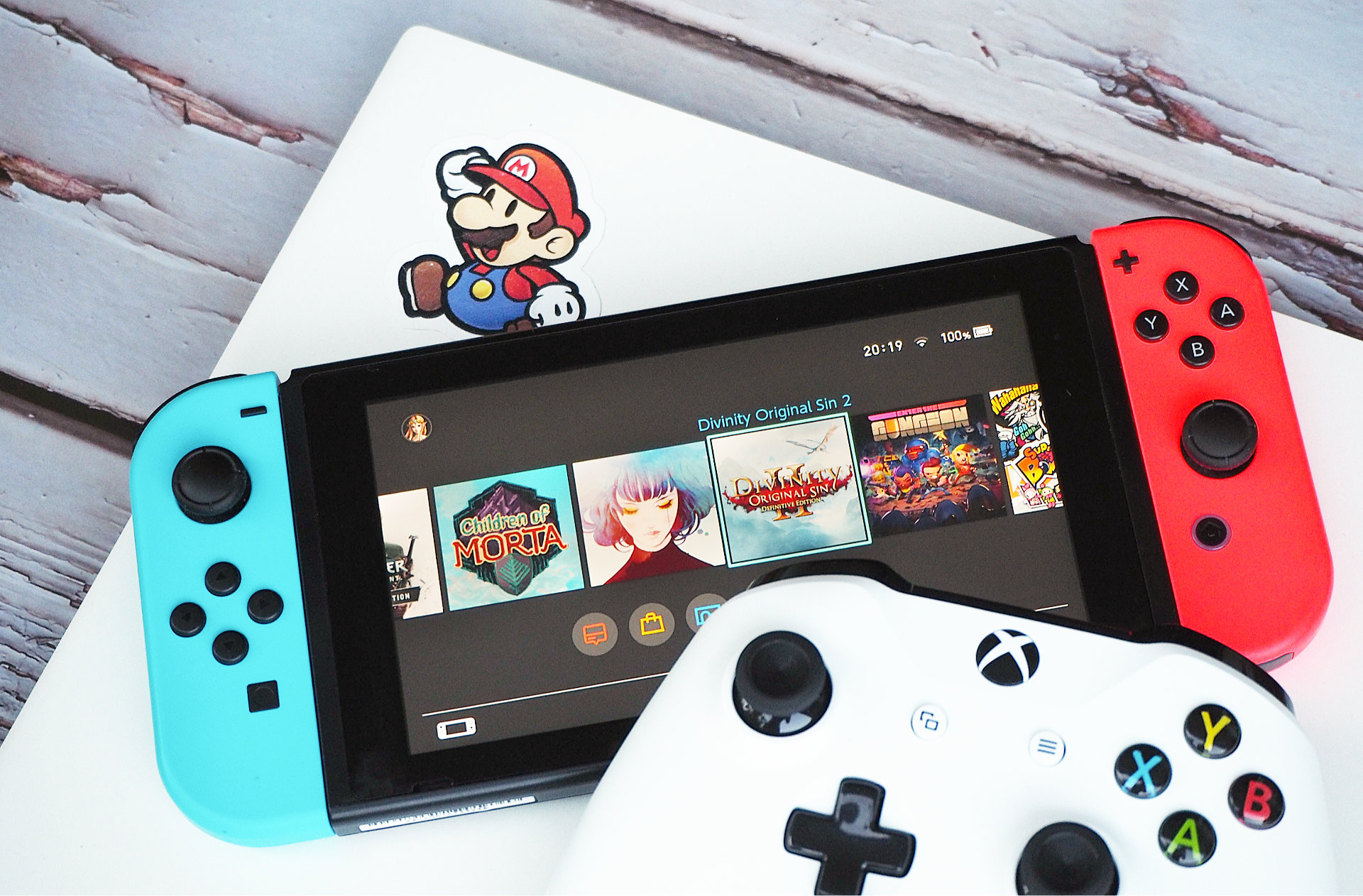
At the moment, books are taking a serious back seat in my life. That’s partly because I’m still working entirely from home, which means my lovely reading time on the train has completely vanished, and partly because I got myself a new gaming PC at the beginning of the year, opening a portal to the world of modern video games. On top of that, I bought a VR headset, and there’s just so much to explore that books have had to take a backseat for now. At the same time, I’ve been wondering how these two things fit together: reading old classics, immersing myself in stories written centuries ago, and at the same time playing the latest games. What’s happening here that both these ancient texts from before or at the dawn of industrialization completely captivate me, while entertainment from the far opposite end of that process also absorbs me so completely? I want to dig a little deeper into that.
I think it’s a mistake to directly compare books and games. Just as films have their own cultural framework, so do books and games, and any comparison between them inevitably has gaps—it’s like comparing apples and oranges. Even though video games have deeply permeated society, they still carry a somewhat dubious reputation. When you tell someone you enjoy reading, that’s almost always met with approval. Even if it’s just some trashy paperback, reading is always “okay.” With games, it’s different—they still have that whiff of childish time-wasting. Video games are packed with visual elements, while books come across as so utterly unspectacular—just text, quiet and unassuming. Are there any commonalities at all? Can something as different as video games even influence the reading experience?
The most obvious impact is already felt in the world of literature: video games eat up time. And that’s something I’ve definitely noticed myself in recent weeks as I’ve given preference to virtual worlds. It’s not a permanent thing for me, because eventually the various game mechanics wear thin—which is not the case with books. “Even the best game becomes too much eventually” is a pretty solid rule. Still, beautifully crafted and engaging games do lure me away from books from time to time.
Everyone looks for something different in games, but I notice that the same basic principles appeal to me. I value a good story and a well-crafted world. So, in these virtual worlds, I’m automatically seeking what I also find most important in books. And there are some really great games that can hold their own against books in terms of narrative structure and depth. Bioshock Infinite, for example, has a brilliant story that stayed with me long after I finished playing. Video games follow their own path, of course. I particularly loved the indie title Firewatch, where you communicate with the second main character exclusively via a walkie-talkie, gradually forming an emotional bond influenced by your earlier choices. Or Xenoblade Chronicles 2 for the Nintendo Switch, which creates a wonderfully detailed world over many hours of play—its inventiveness keeps players hooked for a long time. I also found Hellblade: Senua’s Sacrifice incredibly gripping; you play as a Celtic woman suffering from psychosis, and throughout the game you hear multiple voices trying to influence you. As the story progresses, it becomes increasingly unclear what is real and what stems from the protagonist’s unstable mind. These are just a few examples showing that, just like books, games can tell an extraordinary story.
In many contemporary books, I notice how strongly the impressions of video games influence the authors. There are often elements that feel very visual, reminiscent of games. Maybe it’s just me and the authors have nothing to do with games—but for instance, I found Ophelia’s monocle in Christelle Dabos’ The Mirror Visitor series very telling. While the world around her is an illusion, the monocle temporarily lifts that illusion, shining through it like a flashlight beam and revealing the true nature of things. Or the various powers of the family clans in the same series—those remind me very much of character classes in online role-playing games. I’ve noticed similar elements in Tad Williams’ more recent novels, too. The imagery that forms in my mind is clearly shaped by video games and gives books a distinct structure, influencing how I imagine them. Whether that’s good or bad—I’m not entirely sure.
Video games also often inspire me to read about certain topics. After playing Bioshock Infinite, for example, I absolutely had to read a book about multiverses. Since I adore the Monkey Island series, I couldn’t resist reading Tim Powers’ novel On Stranger Tides, which was a major inspiration for lead developer Ron Gilbert. And after playing beautifully designed RPGs, I can’t help but reach for some really great fantasy novels. There aren’t that many truly fantastic and immersive games, though—so when I crave an epic adventure, I often turn to books. In sum, video games often lead me back to reading.
I’ve spent countless hours in beautifully designed open-world games like The Witcher 3, Horizon Zero Dawn, and The Legend of Zelda: Breath of the Wild. Many of these games feature exceptional storytelling that pulls you deep into their worlds and narratives. The emotional depth of their characters is often conveyed impressively well. Yet, what’s still missing is the inner perspective—the deep insight into the characters’ minds. That, for me, is on another level entirely in books. When I think of novels by Gaito Gazdanov or the characters Henry James brings to life, there are so many subtle nuances and shades that I’ve never experienced in a game—not even remotely. The longing for precisely that kind of deep, intellectual exploration of character always drives me back to books. I haven’t found that anywhere else.
Since my time is limited between family and work, I have to budget it carefully. For me to invest in a game, it has to be a truly exceptional title. Casual gaming just to kill time isn’t an option. When you set high quality standards, there are inevitably long stretches where you’re “on dry land” in gaming terms. And that’s actually a good thing—because it makes much more sense to pick up a great book instead. In the world of literature, that “dry spell” doesn’t exist; there’s always a gem waiting on the to-be-read pile that’s calling out to you.
When you play a game, you’re not passive—you have to interact, you can influence how you experience the story, how you explore the world. And even if it’s often just an illusion, that feeling of freedom is essential. The act of play and the sensations that come with it—rooted, perhaps, in childhood—have their own special appeal. In that sense, games have an advantage over books. Conversely, there are moments when I want the exact opposite, when the apparent simplicity and calm of books feels incredibly pleasant. No glowing screen, no driver updates, no battery to charge—books are often an oasis of media serenity. And that’s where the circle closes: when reading classics, you realize it’s not the big effects that matter, but the subtle nuances and small details. What fascinates me most are the descriptions of reactions, thoughts, and everything that isn’t obvious—the wild jumps in time and setting, and the vast space of the unspoken, which the reader’s imagination fills to create entire worlds. This contrast strikes me again and again when reading, and I’ve come to savor it consciously—especially because of my experiences with video games.
If you browse the fantasy shelves, you’ll also find books based on some video games. Especially for the big, well-known AAA titles, there seems to be a certain demand. I tried one of those “game novelizations” once, and it was so terribly bad that I’ve never picked one up again. For me, the two just don’t belong together. They’re separate worlds. I even find it boring to play a game set in the world of The Lord of the Rings. So in that respect, games don’t influence my book choices at all.
Conclusion: Video games subtly but perceptibly influence my reading experience. The contrast between the sensory overload of gaming and the calm of reading makes me appreciate both more consciously. Games inspire me to read more about different topics. At the same time, it’s also wonderful to experience a familiar setting visually, with all the graphical finesse a game can offer. For example, Assassin’s Creed Unity provides a somewhat limited but atmospherically rich glimpse into revolutionary Paris—a city that has become deeply familiar to me after reading thousands of pages of French classics. The most obvious influence, of course, is time: books and games have to share it, and every now and then, a beautifully made game tempts me away from literature for a few hours. Ultimately, I enjoy in both media what I find most essential: immersing myself in another world and experiencing a captivating story.
What about you? Do you enjoy playing games too? How do these different types of media influence your reading habits?
Ich zocke sehr gerne, am liebsten (Open World) RPGs, aber auch spiele mit begrenzten Welten. Darunter Assassin’s Creed, Greed Fall, WoW, Skyrim, Kingsdoms of Amalur….
Und ja, wenn ich zocke, leser ich sehr viel weniger. Aber ich schätze den Kontrast: bei dem einen kann ich interaktiv Dinge entdecken, aber vieles ist visuell vorgeben, bei dem anderen hat meine Fantasie mehr zu tun, dafür ist es ruhiger und gelenkter.
Aber am Ende geht es auch für mich bei beiden Medien um das Abtauchen in andere Welten und Erleben von Geschichten.
Liebe Jasmin,
also wenn ich Deine Bücherauswahl auf deinem Blog so ansehe, dann bist Du ja gut in der Fantasy-Welt unterwegs, da passen ja die von Dir beschriebenen Games ja hervorragend. Aber sehr cool, also das ist sehr sympathisch, das ist eine Auswahl, die ich schon auch echt gut finde. Und ich sehe das ganz ähnlich wie Du das beschreibst, Games sind angenehm interaktiv und visuell ein Vergnügen, Bücher sind ruhiger und entspannter.
Liebe Grüße
Tobi
Ach lieber Tobi,
in deinen Zeilen erkenne ich mich ganz gut wieder. :) Ich sehe mich eher als Gelegenheitsspieler, aber mir geht es im Großen und Ganzen ähnlich. Die komplexen Welten und v.A. die Möglichkeit die frei zu erforschen und in das Geschehen einzugreifen kriegen mich immer wieder. Einige der Spiele, die du hier erwähnst oder die ich oben auf dem Foto gesehen habe, spiele ich auch oder habe sie zumindest gespielt. GRIS, Firewatch, Breath of the Wild – Dear Esther kann ich auch sehr empfehlen. An BioShock 2 bin ich gerade dran. Aber du nennst auch mein “Hauptproblem” mit Computerspielen, nämlich dass häufig der narrative Unterbau fehlt, die Charaktere und Motive flach bleiben. Durch die Ressourcenschlacht (in technischer Hinsicht) scheinen dort andere Aspekte manchmal etwas zu kurz zu kommen. Deswegen treibt es mich doch immer noch öfter zu den Büchern als zu den Spielen. Aber in jedem Fall ist beides Eskapismus, der in diesem Jahr auch besonders gelegen kommt …
Viele Grüße