
The Parrot Book
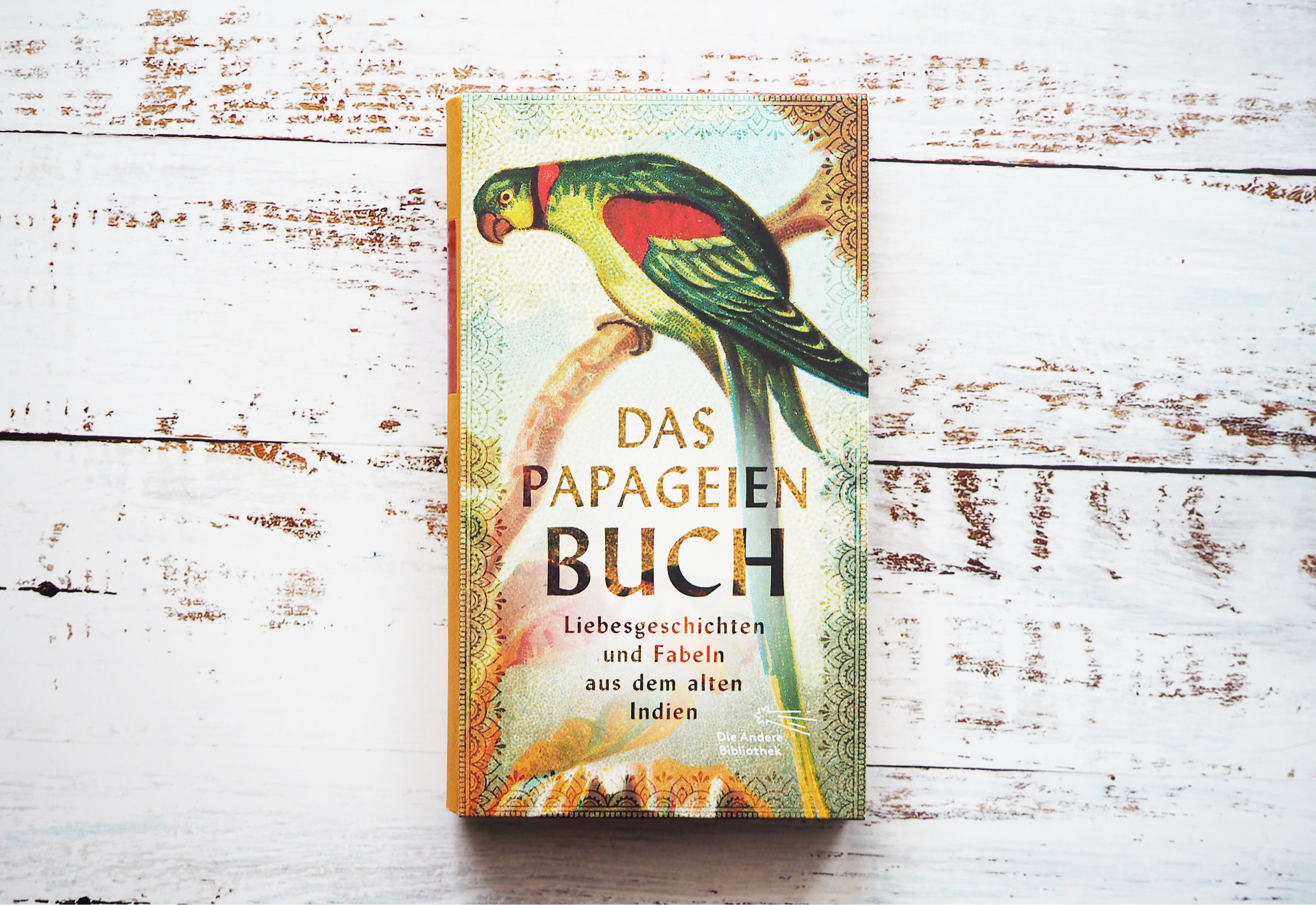
Love stories from ancient India, written in the first millennium, compiled in full for the first time and newly published in a beautiful edition. Of course, a book like this is hard for me to resist. The Other Library has newly translated this collection of tales, whose author is unknown and whose originals have been lost, and it’s simply curiosity that draws me to such a book. How often do you get to read a text that’s so old and yet feels so accessible? What was life like in ancient India, and what kind of love stories are these? I’ll tell you in this article.
Madanasena, the son of a wealthy family, marries the beautiful Prabhawati and devotes his life entirely to his love for his beautiful wife. His father is troubled and urges him to pursue the three goals of life—righteousness, wealth, and love. He insists particularly on the pursuit of wealth, and so Madanasena decides to leave home for a long time to serve his father’s wish and go into trade. Before leaving, he entrusts his wife Prabhawati to a talking parrot—no ordinary bird, but a bewitched being from the heavenly realms—to keep an eye on the lonely wife. Prabhawati soon finds a new admirer, the son of a prince, and plans to visit him and give herself to him. Every evening, before she can leave, the parrot stops her and tells her a story whose twist she must guess. But she becomes so absorbed in the tale that the night passes, and she never manages to carry out her plan of betrayal. These seventy short love stories are collected in the book, and the reader, together with Prabhawati, listens to the parrot’s tales.
Most of the stories are very short, often only two pages long. Only the fifth tale is significantly longer, but it too is divided into numerous sub-stories, so that it again matches the overall style. The plots often involve women deceiving their husbands, almost getting caught, and barely escaping exposure. There are also Brahmins who trick their way into amorous favors, humble craftsmen betrayed by their shameless wives, or clever thieves caught red-handed who talk their way out of punishment. Some fables feature animals that outwit stronger beasts through cunning. I would say that wives wriggling out of tricky situations form the most common theme. That makes sense, since the parrot’s role is to admonish Prabhawati and prevent her from committing adultery—though it’s perhaps not the most effective method to do so by recounting numerous successful acts of deception.
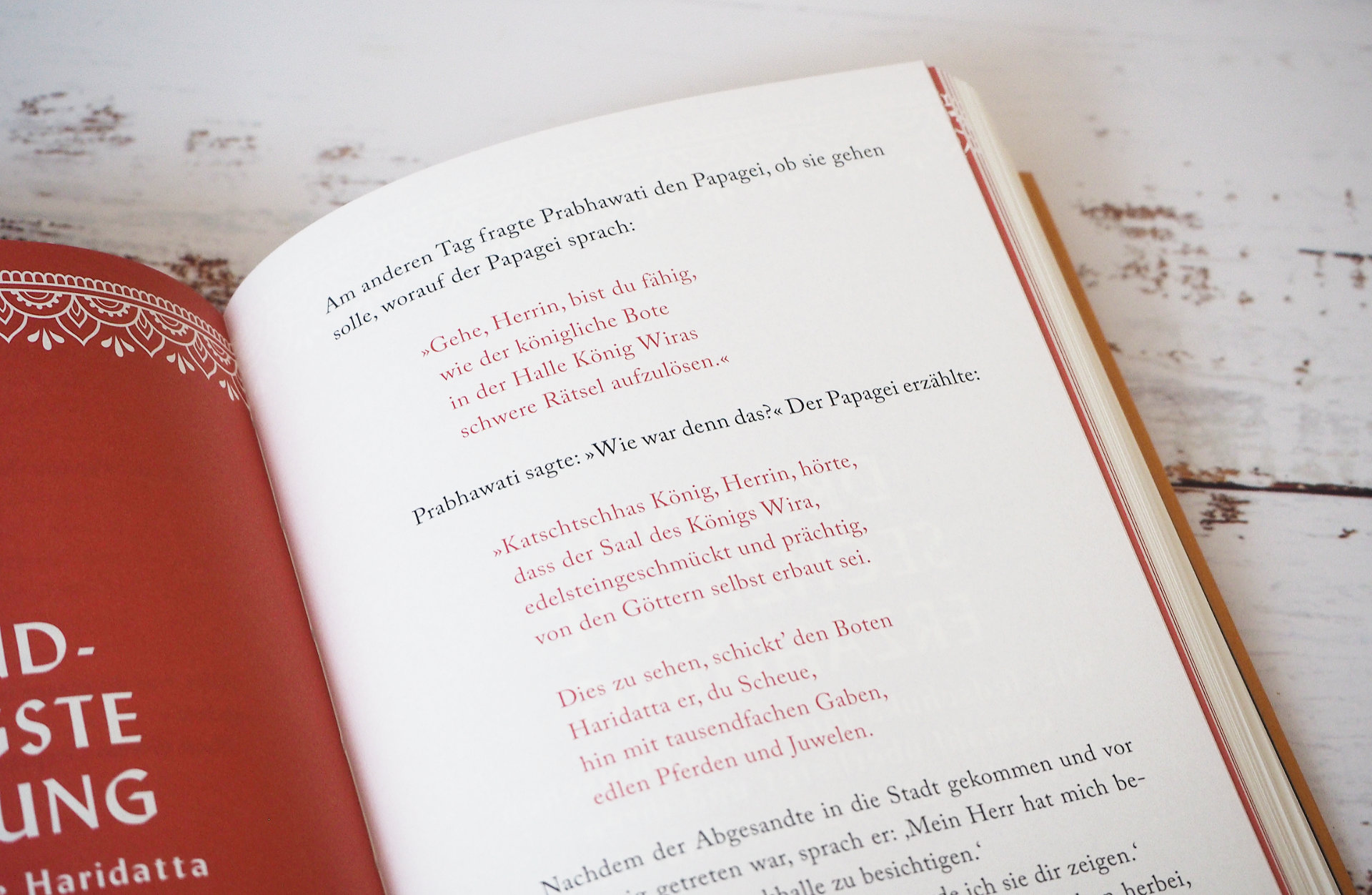
I found many of the tales entertaining, and as often happens with short stories, I eventually got into a flow and wanted to keep reading the next one. Each story ends with a punchline, though it’s rarely sophisticated, moral, or profound. Sometimes superstition helps the women; sometimes ingenuity makes a tale stand out. You won’t find deep moral lessons here, nor lofty wisdom. Throughout the text, there are red-highlighted passages containing aphorisms. Most have an archaic character, especially concerning the role of women. But it doesn’t seem the book’s intent was to create a moral guide. Here’s one example of these sayings that I found rather appealing:
One must always think through the teaching,
Page 204
even if a wise man conceived it;
One must always mistrust a prince,
even if he’s on your side;
One must always guard the young wife,
even when she sits upon your lap;
Otherwise how could they obey us—
the teaching, the prince, and the women?
Because of their brevity, the stories contain no real descriptions of landscape, art, or culture. Yet the reader still learns quite a bit from the scenes and events. At the time, there were four social classes: kings, Brahmins (priests), merchants, and craftsmen. Each of these groups appears in the tales. Through the narratives one gains insight into daily life, the worship of the gods, spiritual rituals, and the strong presence of superstition. The notes are extensive, adding much background about the mythology and religion of the era. So, the book indeed conveys the spirit of its time, with its ancient culture. Yet the stories remain very approachable, pleasantly readable, and fluid in style.
In its structure, the book is reminiscent of One Thousand and One Nights. Here too we have a female protagonist, and the many stories prevent her from doing something foolish. Scheherazade stays alive through her countless tales, and Prabhawati is kept from adultery. The nesting of stories—where a storyteller recounts a tale, within which another tells yet another story—also appears repeatedly in The Parrot Book, though not as excessively as in One Thousand and One Nights.
I also found it fascinating how unpuritanical the book is. The characters openly embrace lovemaking, and it doesn’t seem to be a social taboo. The unfaithful wives are viewed with a wink, and since they’re often cleverer than their cuckolded husbands, the author seems to side with the women. Of course, women had no rights in that era, but as in many 19th-century novels, it shines through that in many families, women still wore the pants.
Very interesting is the afterword by editor and translator Wolfgang Morgenroth, which is excellent and provides the reader with much information about the origin of the text. Over the centuries, there have been numerous versions and editions of The Parrot Book in different languages and countries. The original has been lost—likely due to India’s humid climate—and the author remains unknown. Based on its content, it is assumed that The Parrot Book originated only toward the end of the first millennium. This edition is based on the two oldest surviving versions: one very short, one somewhat more detailed. They overlap but are also incomplete. Combined, they probably come closest to the original, though given the uncertain foundation, it can only be considered an approximation.
The book also notes that The Parrot Book served as an inspiration for The Decameron. And if we recall that The Decameron in turn inspired Balzac’s Droll Stories, it’s fascinating to see how this book has left traces across so many centuries.
I found the foreword rather useless. Aside from pointing out the parallels between The Parrot Book and One Thousand and One Nights, it was mostly unnecessary fluff, and I wondered why it was included at all.
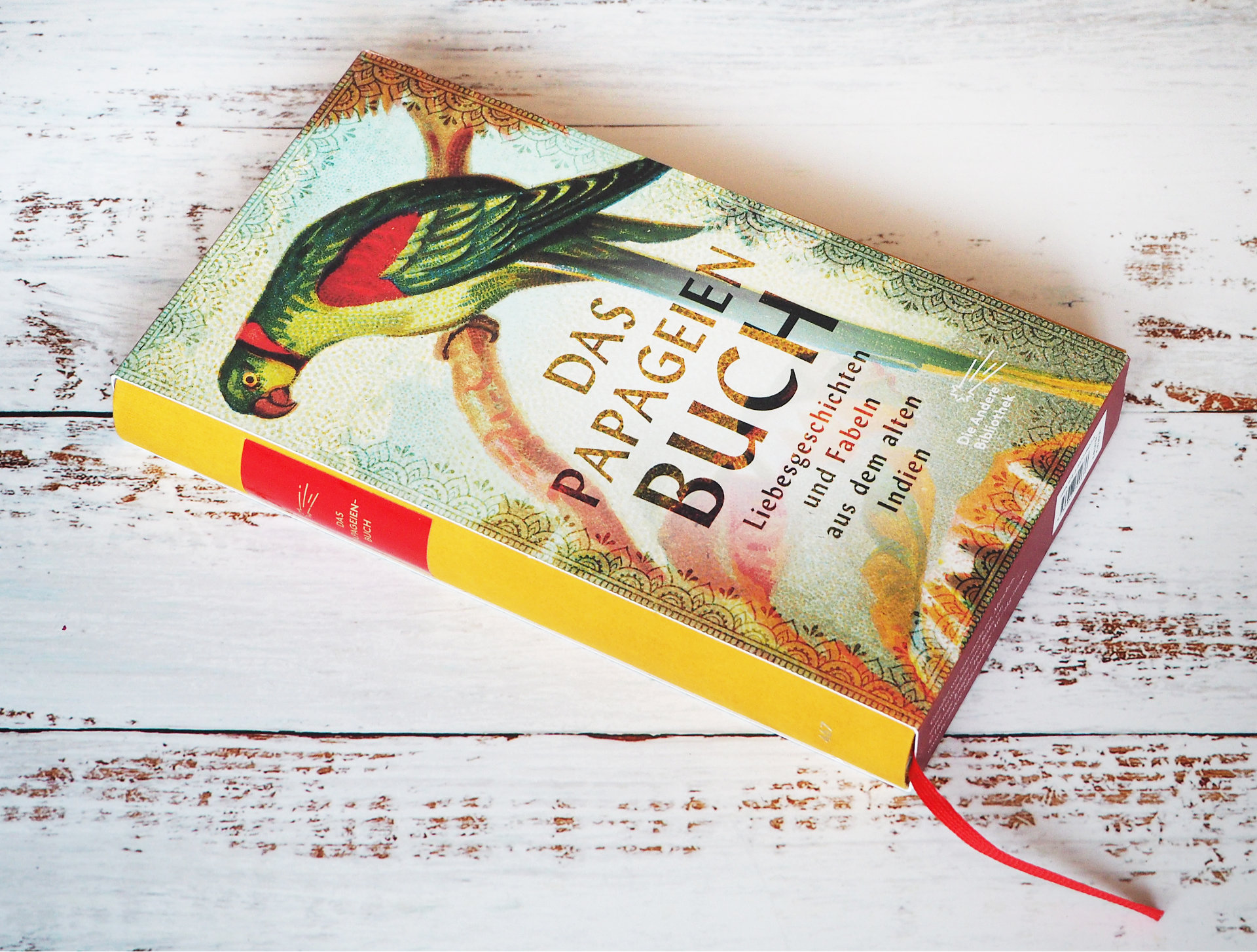
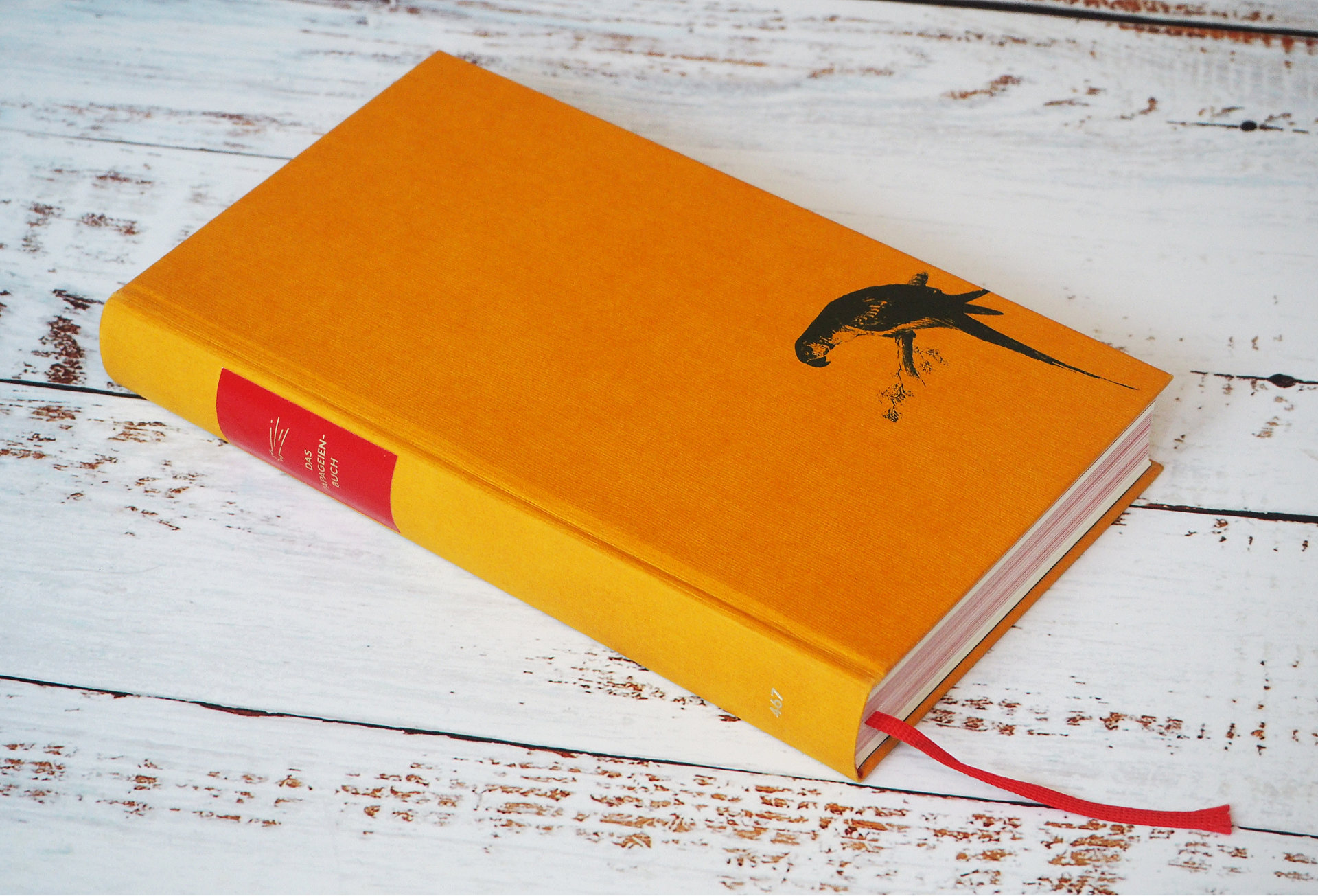
The design follows the typical style of The Other Library and I like it very much. The colors are beautifully chosen. The slipcase with the parrot looks vivid and elegant, reflecting the tone of the stories. On the yellow hardcover, the parrot is printed again—though it’s a simple cardboard binding; other editions from The Other Library have had more refined designs (for example, the elegantly shimmering blue of *Sister Carrie*).
I also really like the clear and fine typography, which feels neat and well-balanced. Some of the aphorisms are printed in red, adding structure and visual appeal. I’m a sucker for such details. However, near the end of the book, some red-highlighted passages seemed to be just ordinary sentences, which I didn’t quite understand.
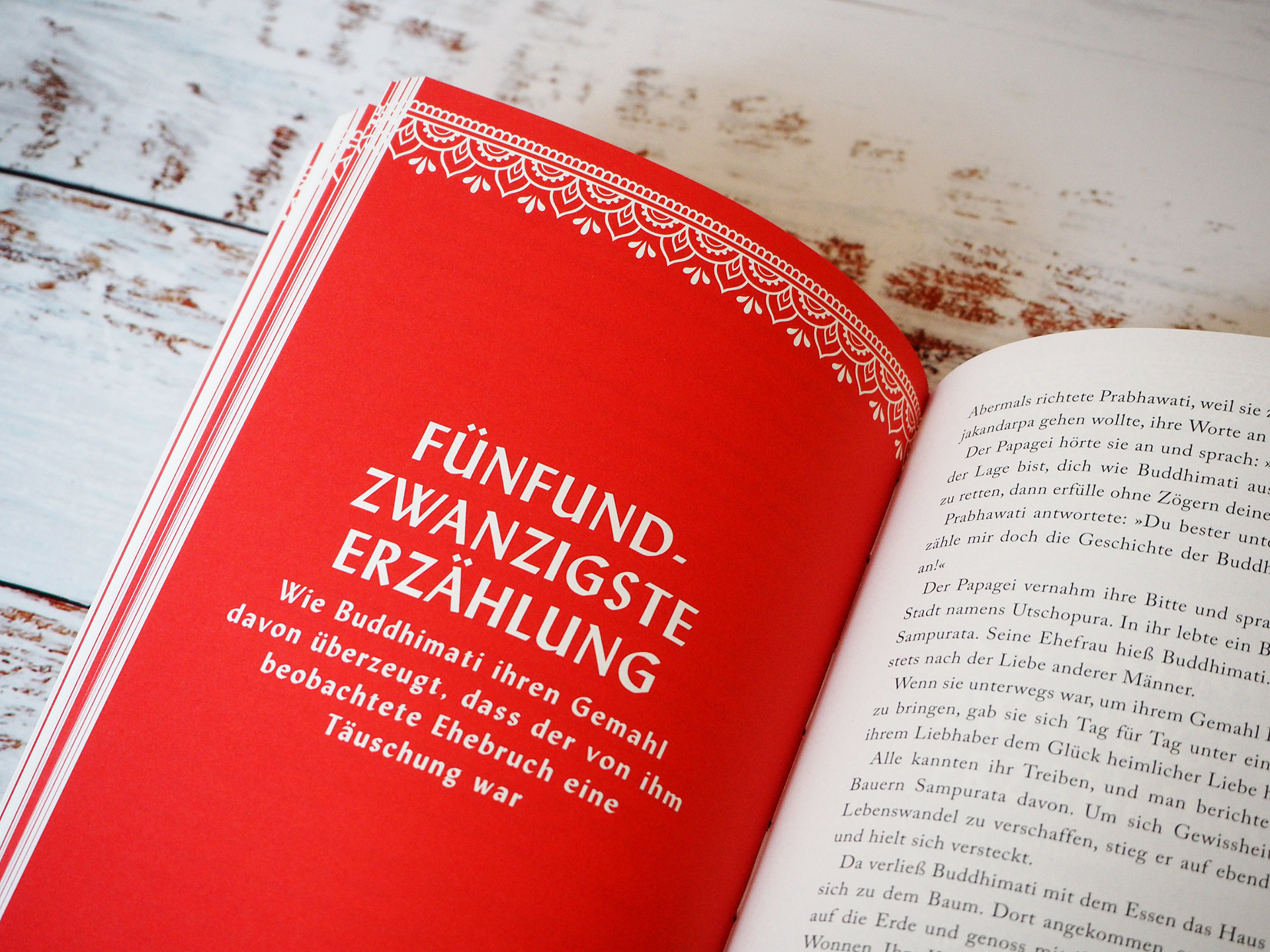
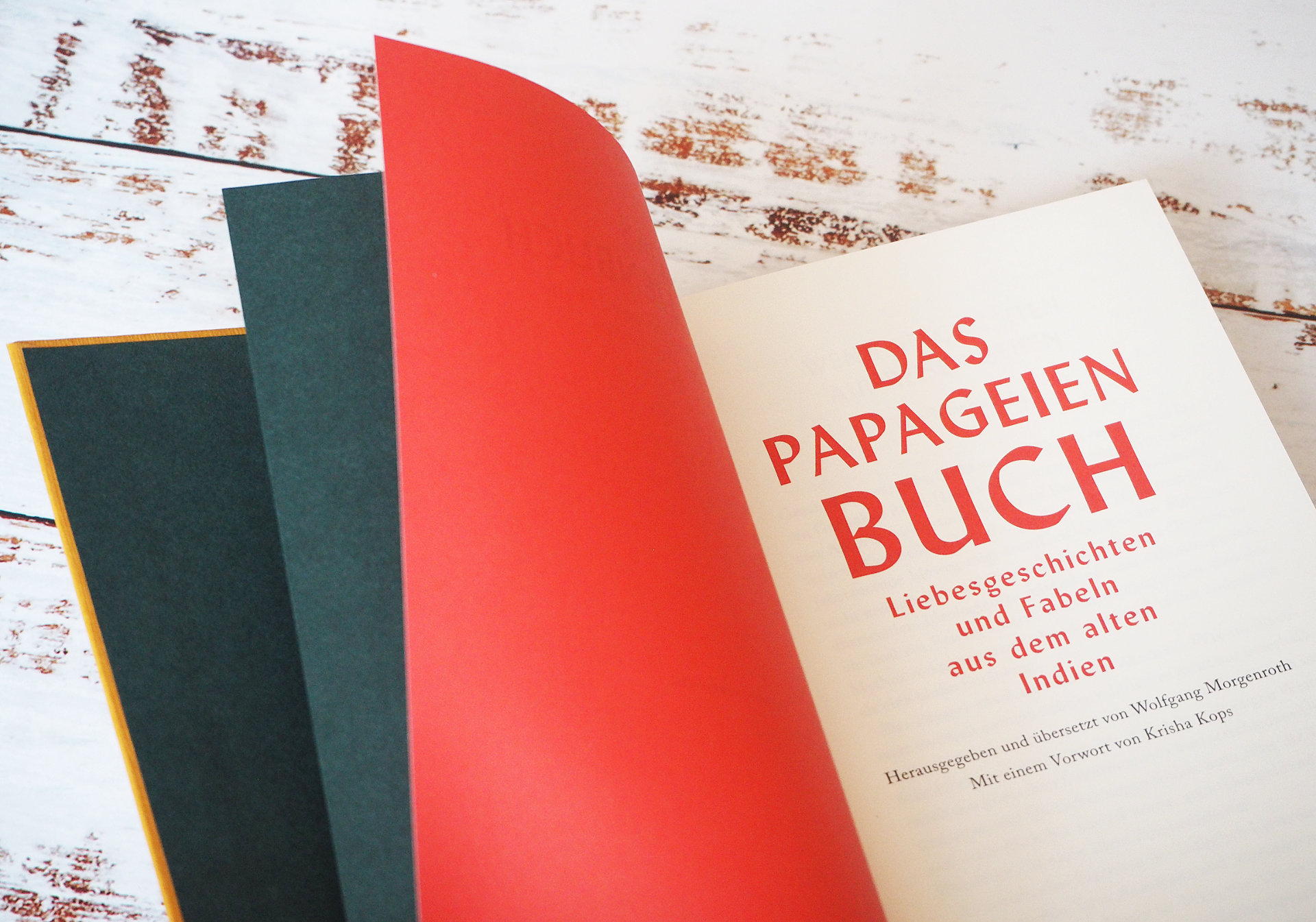
Each story begins with a red page showing its title and a single summarizing sentence. It looks elegant, especially with the ornamentation and fine font choice. Of course, this makes the book thicker than it really is. Because of the many chapter breaks, some pages are only partly filled. So the reader gets less content than it first appears. The book reads quickly, though I didn’t find that a disadvantage. This brisk pace makes the reading light and lively—something rare in texts of such age.
Once again, the thread binding is lovely, the paper smells fine, and of course, the ribbon bookmark isn’t missing. The book may be pricey, but it meets every bibliophile expectation.
Conclusion: The Parrot Book is a truly unusual read. Its ancient textual foundation, its focus on over–a-thousand-year-old Indian love stories, and its glimpse into the culture of that time make it a unique work. I found it very entertaining to read these many short, pointed tales and to discover an India with surprisingly modern moral undertones—something I hadn’t expected. The reader won’t find intricate plots or deep content here. With a gentle smile, the narrator observes the characters’ excesses, giving wit and love their due. It’s a pleasant, light journey through ancient India that ends far too soon. The edition itself is beautiful, bibliophilic, and—with its fine typography and elegant design—wonderfully produced. A book I can warmly recommend as both a read and a gift, for its content and its craftsmanship alike.
Book information: The Parrot Book • Edited and translated by Wolfgang Morgenroth • The Other Library • 372 pages • ISBN 9783847704676
Lieber Tobi,
danke für Deine anspruchsvollen Buchempfehlungen, man findet selten ein entsprechendes Forum.
Zwar habe ich mich in der Vergangenheit auch hier nicht immer verstanden gefühlt; dann etwa, wenn ich die Würdigung von Fakten reklamierte und diese vor polemisierende Schubladen-Vorurteile zu stellen versuchte, doch lese ich gerne nach wie vor Deine Empfehlungen.
Irgendwie verstehe ich Dich immer wieder so, dass Du Bücher vordergründig liest, um Dich in wohlverdienter Freizeit zu zerstreuen, Dich von Politik und unangenehmem aktuellen Weltgeschehen abzulenken; dass Lesen für Dich allein das Wohlgefühl in einer Art Komfortzone bedeutet und bitteschön von Krisen allerart abstrahieren möge. Ähnlich verstehe ich auch den vorstehenden Beitrag: Wichtig sind Romantik, Leichtigkeit, das Ausblenden von Historie, auch Gegenwart, sobald sie dann doch zu martialisch wirkt, und womöglich die Rolle der eigenen Nation verantwortlich in Frage stellt; kurz: Aufgabe der Lektüre soll das Vermeiden jeglicher “Problemdiskussion” sein.
Auch wenn ich gerne – zugegebenermaßen – häufig aus genau denselben entspannenden Gründen “unaufgeregt” lese, sehe ich die Aufgabe von Literatur (auch belletristischer) in etwas weiteren Grenzen, etwa nach Franz Kafkas Motto “Ein Buch muss die Axt sein für das gefrorene Meer in uns”.
Und zufällig habe ich genau zu dieser Thematik einen aktuellen Beitrag im “nd Die Woche” vom 9./19.12.23, S. 9, gefunden. Hier ging es um den 80. Geburtstag des Dichters und Hanser-Verlegers Michael Krüger und dessen aktuell erschienenes Buch beim Suhrkamp-Verlag: Verabredung mit Dichtern. Erinnerungen und Begegnungen.
Hier heißt es (für mein Gefühl sowas von zutreffend):
“Je mehr ich las, desto komplizierter wurde mein Leben.”
Und Hans-Dieter Schütt rezensiert a.a.O. mindestens ebenso berührend: “Literatur kräftigt nicht, Literatur macht porös; Poesie härtet nicht, Poesie erweicht, ja verwirrt den Menschen. Der Sensible ist der Angreifbare.” (Fast ist man/frau versucht, hier zu gendern, unterlässt dies aber angesichts des anstehenden Verbots u.a. in Bayern, fragt sich aber dennoch, wer hier eigentlich “cancel-cultured” ;-) )
Und weiter heißt es: “Poesie ist Aufstörung – gegen das ideologisch dröge Geschwätz vom Gewusst-wie und Gewusst-wo. Kindheit, Jugend, wunderbares Altern. Viel Erfahrung und viel Wissen werden angehäuft für die wertvollste aller Erfahrungen: Leben wird schöner, je mehr uns das Einverständnis mit der Unbegreiflichkeit der Dinge gelingt.”
Liebe Sandra,
vielen Dank für Deine Worte und es freut mich sehr, dass Dir die Buchbesprechungen gefallen, das freut mich sehr!
Das Spektrum von Literatur ist sehr weit und ich schöpfe dabei durchaus einen weiten Teil davon aus, was alleine schon der Neugierde geschuldet ist, die mich immer wieder packt und mich auch immer wieder auf neuen Pfaden wandeln lässt. Über einen Teil davon schreibe ich hier. Ich achte darauf, diesen Blog weitgehend von politischen Themen frei zu halten (was nicht immer gelingt, beispielsweise wenn es um Themen wie Zensur geht). Das liegt auch daran, dass in dieser Gesellschaft und besonders in sozialen Netzwerken (an die dieser Blog dann doch sehr eng angebunden ist) sich eine Kultur etabliert hat, die einen sachlichen und respektvollen Diskurs nahezu unmöglich macht. Das ist nicht das, was ich mit diesem Blog suche. Es gibt viele gelesene Bücher, die hier also unerwähnt bleiben, einige davon, weil sie das Thema Religion, Philosophie, Glaube betreffen. Andere die politisch völlig unkorrekt sind und mir sofort einen Shitstorm einbringen würden, da die Zensur und der gesellschaftliche Zwang in den Köpfen einfach zu stark sind. Das bedeutet nicht, dass ich einem politisch extremen Spektrum angehöre, sondern es ist wieder diese Neugierde, die mich dazu treibt, hin und wieder auch Dinge zu lesen, die gesellschaftlich nicht akzeptiert sind. Erschwerend kommt hinzu, dass hierzulande die feste Überzeugung einer moralischen Überlegenheit etabliert ist, die ich als wenig zielführend, ja sogar sehr schädlich empfinde und die dieser Gesellschaft derzeit sehr viel kostet und noch kosten wird. Die Erfahrung zeigt, dass es absolut sinnlos ist, gegen diesen Zeitgeist anzukämpfen, womit ich auch sehr gut leben kann und was ich akzeptiert habe.
Hinzu kommt, dass jeder, hinsichtlich der Bedeutung einzelner Themen, für sich zu völlig anderen Schlüssen kommt. Beispielsweise das Thema Depression. Es hat für viele Menschen eine sehr hohe Relevanz, es gibt viele Bücher die sich im engen und auch weiteren Sinne damit befassen, für mich ist es allerdings gar nicht von Interesse. Jetzt könnte ich natürlich anfangen auch Bücher darüber zu lesen, um die Problematik darin eingehend zu verstehen, aber macht es Sinn, sich alle gesellschaftlichen Probleme zu eigen zu machen?
Tatsächlich liegt in zahlreichen Klassikern sehr viel von dem, was im Kern der Krisen dieser Tage steckt. Ich halte es, für ein besseres Verständnis des aktuellen Zeitgeschehens, für sehr lehrreich Klassiker zu lesen. Und davon tauchen hier im Blog sehr viele Bücher auf. Beispielsweise “Die Welt von Gestern” von Stefan Zweig. Wenn es ein Buch gibt das einen massiven Bezug zur aktuellen politischen Situation hat, dann das. Oder “Das Bett mit dem goldenen Bein”, das einen Blick auf die politische Entwicklung Lettlands öffnet, einem Land, dass immer wieder zwischen zwei Großmächten zerrieben wurde.
Zu der Frage, wieso hier auf dem Blog nicht alle von mir gelesenen Bücher zu finden sind, schreibe ich auch in diesem Beitrag..
Liebe Grüße
Tobi