
Dunkelsprung • Leonie Swann
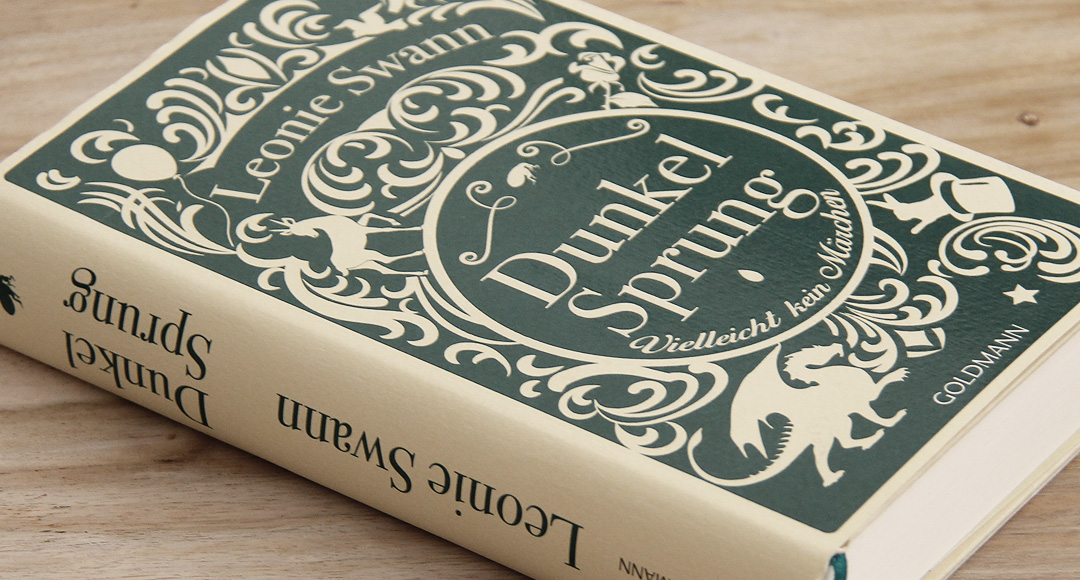
Lately, I’ve really had a knack for picking the right books. Dunkelsprung has a blurb that could have gone either way—from absolute rubbish to a truly successful story. Fortunately, it’s the latter, and I’d like to explain why here.
For me, one of the clearest differences between classics and contemporary literature is the image that forms in the mind’s eye—and the process by which it’s created. In classics, this happens in a different way, more through the protagonists’ thoughts and actions and usually less through painstakingly detailed scene description. With contemporary literature, it’s often the opposite, especially in books from the fantasy genre (which I wouldn’t count Dunkelsprung as—more on that below). I think this is due to the influence of film and television, which leaves a strong imprint here, and so Dunkelsprung also uses a very colorful, highly descriptive language rich in adjectives. As a reader, you see the whole scene before you; you’re not confronted with an abstract image—rather, the story plays out like a film in your mind. Leonie Swann does this masterfully, and reading such a book is a real pleasure.
The story moves at a very high pace, with numerous scene and location changes—something that, in my experience, usually signals poor quality. Here, that’s absolutely not the case; it fits the plot and, linguistically, suits the author’s style very well. The prose employs wonderfully vivid, atmospheric comparisons, and the author pulls out all the stops, parading a host of emotionally charged—at times seemingly clichéd—settings through the narrative: a magical theatrical performance in a mysterious courtyard, a houseboat moored in London fog on a canal, or a private detective agency in the style of the 1930s, to name just a few.
All this framing strongly reminded me of Babayaga by Toby Barlow (German title: Baba Jaga). I can’t assign the story to a single genre; it contains a wide range of elements. There are beings drawn from fable (in Babayaga, the witches), enriched with suspense and gangster motifs (also present in Babayaga), sprinkled with a dash of humor and comedy, and set in an atmospheric environment such as London (in Dunkelsprung) or 1950s Paris (in Babayaga). The heroes aren’t heroes at all and find themselves in bizarre situations and confronted with supernatural phenomena. A mix of seemingly contradictory elements—but it works. I love books that defy conventions, brim with imagination, try new things, and pull the reader into a current, a spell, from which you can’t—and don’t want to—escape.
The two main characters, Julius Birdwell and Frank Green, are both somewhat bewildered antiheroes with a strongly distorted view of reality. I often wondered whether the author herself doesn’t shine through here, because the book is also linguistically a bit twisted. At the center is Julius, a flea-circus ringmaster—something that, when I first read the blurb, put me off. But within the story, his perspective and profession are woven in beautifully; Julius feels authentic and is anything but a stereotype. That said, due to the slightly quirky nature of the main figures, I did find myself feeling a bit less empathy for Julius and Green.
What stands out most is the book’s language. It’s highly individual and, as mentioned above, dazzles with numerous, very vivid adjectives that sometimes appear in lists. The words used aren’t directly linked to the thing being described, but are connected through associations—or the emotions they evoke. The following quote is representative of many such passages:
A sound could be heard, gentle as wind in the reeds, the flight of swans, moon on water. Elizabeth whispered, not words, rather a melody of raindrops.
Here the author describes a sound, a breath of wind in the reeds, and combines it with the flight of swans and the shimmer of moonlight on water—creating a mood without indulging in lengthy descriptions, using only a few keywords. Swann often begins a sentence with colorful descriptions, combines long and short sentences, and even inserts single words. For me, that occasionally disrupted the reading flow and felt somewhat mannered. I also found the rhetorical questions—sometimes directed at the reader—odd; they’re meant to be amusing but end up being more distracting. The following quote nicely shows how the author mixes long and short sentences, ends in single words, and plays with language in a highly figurative way.
Fog danced across the afternoon parquet of the Thames, perhaps a waltz, or possibly a lazy foxtrot. Willows stretched in the somewhat half-hearted sunbeams, moist air nestled around things—the walls and boats and street lamps—and softened them; even the light seemed unable to decide and dissolved between yellowish gray and blue smoke.
Everything moved, gently but steadily, like a sleeper just before waking. Almost everything. Near the bank, sheltered by a rusty boat, stood a heron, drawn in watercolors, swathed in fog, wings shaped into a bell. Stood. Still.
Places and people aren’t comprehensively characterized but often only in selective strokes, focusing on features and qualities that match the observing protagonists’ perceptions. Sometimes crazy connections and sentences arise that border on nonsensical in the immediate context, but later gain meaning through the story and thus often acquire a philosophical value for the characters (a good example of this is the content of Green’s notebook). Through these stylistic devices—and the wild story with its colorful genre mix—a mood emerges that feels magical and fairy-tale-like, though it isn’t a fairy tale. Swann doesn’t shy away from neologisms either, and they lend the book a generous dose of humor. At any rate, it’s the first—and probably the last—time I’ve read the word “Fabelwesenfeldwebelmanier” in a book:
Elizabeth marched up and down beside the sofa in finest Fabelwesenfeldwebelmanier. (p. 219)
Also excellent: “Totenvogelhaftes” (p. 235).
The book bursts with ideas and creativity. There’s a therapist for forgetting, wonderful mythical creatures described so beautifully they invite you to dream, mystical mazes in the form of forests, gemstones with sinister karma, and imaginary stockings that become a gift—very helpful in the right situation.
The author Leonie Swann writes under a pseudonym, and there’s little publicly known about the person behind the novel. She is said to be from Dachau near Munich and to have studied philosophy, psychology, and English literature in Munich. Otherwise, she keeps a low profile and chose a pseudonym to keep work and private life separate. She supposedly spent some time in Paris and London and now lives in Berlin.
Conclusion: With Dunkelsprung, Leonie Swann has produced a linguistically outstanding book that also convinces with a thrilling, fast-paced story. The characters are anything but stereotypes or off-the-shelf heroes; the setting is as colorful as Swann’s distinctive style. A reading pleasure that’s definitely worth recommending, especially to anyone who wants something outside the norm. The story stands on its own; in my view, it doesn’t have literary depth or broader references, and in some places the sentences felt affected—hence a deduction of one star. Nevertheless, I can unreservedly recommend reading Dunkelsprung.
Book information: Dunkelsprung • Leonie Swann • Goldmann Verlag • 384 pages • ISBN 9783442313877
Hallo Tobi!
Ich freue mich sehr, dass du dieses Buch rezensiert hast! Ich hatte es schon so oft in der Hand, bin im Buchladen darum geschlichen, habe es bei Amazon angeklickt… Und dann doch nie in irgendeiner Form mitgenommen, weil ich mir nicht sicher war.
Dein Eintrag bestätigt mich aber in der Auffassung,dass es doch ein gutes Buch ist und so wird es mit Sicherheit schneller als gedacht den Weg zu mir finden.
Danke schön. ;)
Liebe Grüße,
Lauretta
Hallo Lauretta,
schön, dass dich mein Beitrag überzeugen konnte. Das Buch ist echt sehr gut und bisher konnte ich auch keine schlechte Rezension dazu finden, was auch nur nachvollziehbar ist. Bin schon auf deine Rezension dazu gespannt.
Liebe Grüße und einen schönen Sonntag
Tobi
Hallo,
hast du auch Glennkill gelesen? Mich hat Glennkill von der Idee her sehr interessiert, fand aber die Ausführung insbesonders im letzten Drittel mehr als enttäuschend. Falls du Glennkill gelesen hast: wie würdest du die beiden Bücher von Ihrer Erzählweise her vergleichen?
//Huebi
Hallo Huebi,
Glennkill habe ich nicht gelesen, mag keine Krimis und daher kommt das auch nicht auf die Liste. Im Schrank steht es allerdings schon, denn die bessere Hälfte hat das mal gelesen. Daher kann ich da leider keine Aussage treffen.
Liebe Grüße
Tobi
Das Buch finde ich einfach nur genial…so gut, dass ich jetzt gerade das Audiobook davon höre….Das Hörbuch ist noch einen Tacken besser…Andrea Sawatzki liest die Geschichte einfach nur magisch.
Ich kann sowohl Buch als auch Audiobook allen uneingeschränkt empfehlen, deren Leserherz offen ist für verrückte, phantastische Geschichten, die durch einige Passagen und Aussagen immer wieder ihren Weg zur Realität finden und die durch skurrile Charaktere geprägt sind, die man einfach mögen muss.
Tolle Rezension übrigens :-)
Hallo Irve,
oh ja, als Audiobook kann ich mir das sehr gut vorstellen. Die Sätze sind sehr schön, bildhaft und fast schon malerisch geschrieben, gesprochen wirkt das bestimmt sehr gut.
Liebe Grüße
Tobi
Schöner Roman, habe ich auch gelesen.