
69 Hotelzimmer • Michael Glawogger
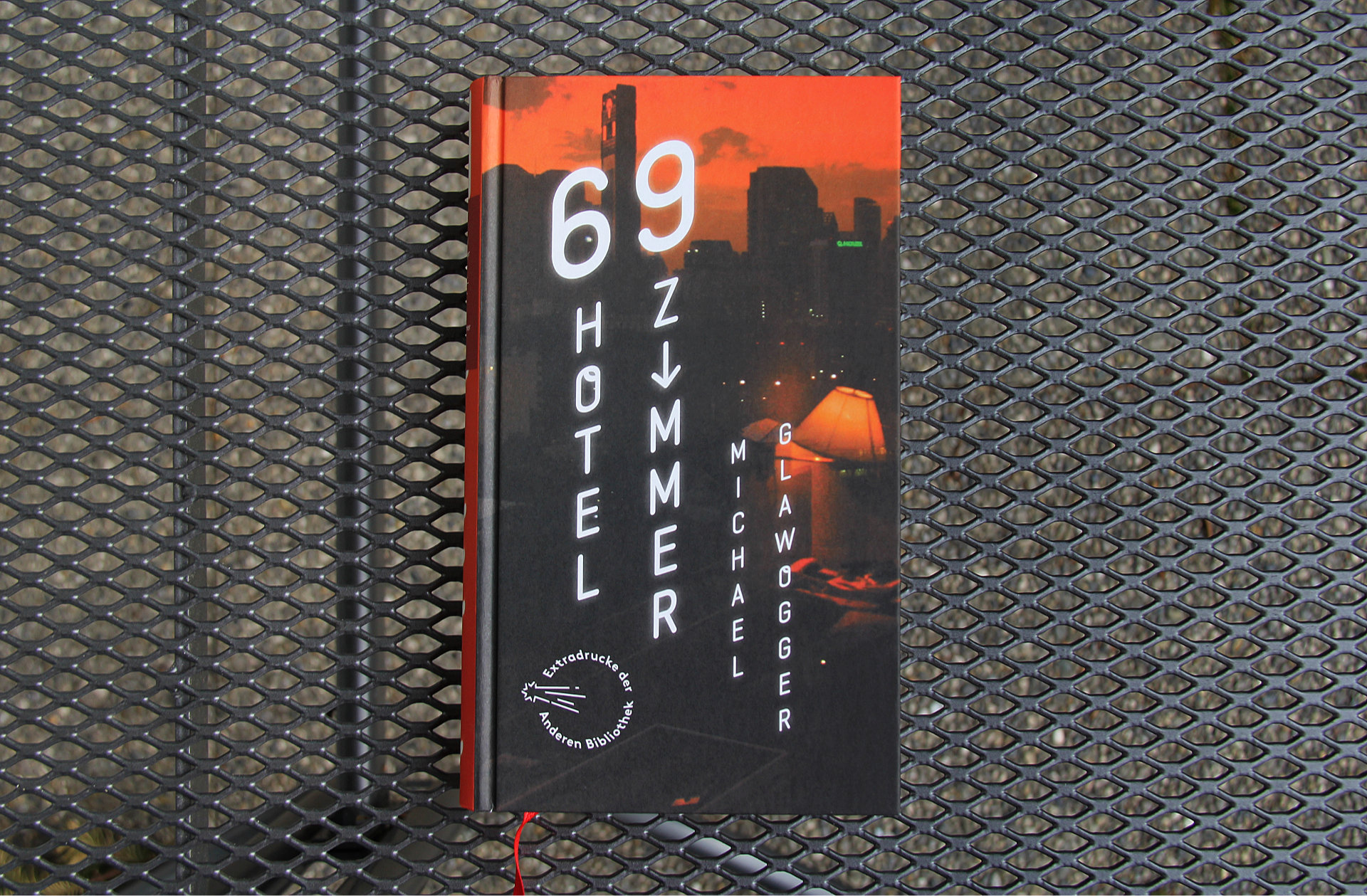
Sometimes it’s a chain of events and, in the end, a whim that makes me pick up a book I wouldn’t otherwise have noticed. 69 Hotelzimmer by Michael Glawogger is such a book, and in hindsight I’m glad I read it. I came across it on the Stiftung Buchkunst website, where this collection of short stories was named one of the most beautiful books of 2015. Months later—still very much in the mood for short fiction after reading Guy de Maupassant’s short stories—I stumbled on this handsome edition and could no longer resist. A stroke of luck, because 69 Hotelzimmer proved outstanding not only visually, and I’d like to write a bit about it today.
The blurb sparked all kinds of associations for me. It’s about 69 hotels, about stories that in some way relate to a hotel and are meant to convey the feeling of traveling, of pausing briefly at a way station in a foreign place. In fact, the book has more to offer. It doesn’t consist of 69 but of 96 stories. And even that isn’t quite right, because story number 13 is omitted—just as hotels often skip room number 13. Each story runs to three to at most five pages—exactly a cigarette’s length, as the foreword puts it. Each short piece plays out in a different place, at a different time. Glawogger chose a wide range of countries and cities—from Nigeria, Mexico, Ukraine, Ethiopia, Paris, Vienna, North Korea, South Korea to Cambodia or Thailand—as his backdrops. The hotels are equally varied: from luxury hotels, hourly hotels, motels, and simple dives to a chic property overlooking a major city and even a dark hole in Nigeria—everything’s here.
This variety—and the sometimes uninviting locations—surprised me at first. But a bit of reading about the author explains why. Michael Glawogger, born in Graz in 1959, was a documentary filmmaker who gained a certain popularity with his films Megacities, Workingman’s Death, and Whores’ Glory. In April 2014, he died from an undiagnosed case of malaria in Liberia while traveling the world in a VW bus to shoot a documentary about it. Glawogger was an adventurer, seemingly quite restless, who crisscrossed the globe to exotic and sometimes dangerous places. According to the afterword, he wasn’t a daredevil, but he was courageous and pursued his documentaries with great persistence. This book was published posthumously.
The content, mood, and orientation of the individual stories are as varied as the places Glawogger visited in his life. Often he gives a snapshot—a brief episode from a traveler’s life—conveying that fleeting moment everyone knows who has arrived somewhere new and is finding their bearings in an unfamiliar hotel, suddenly focusing not on the big picture but on the details. The mood of a grimy courtyard; the aura that furniture and its arrangement can create; and, not least, the encounters one has in foreign places. The range runs from typical hotel situations—city noise blaring through the window, housekeeping sweeping through rooms—right down to questions like whether a mirror belongs above the desk or not.
“For him there were two kinds of hotel rooms: those you automatically claimed through your own presence and restlessness, and those in which you had to win the territory first. In the one he lived out of his suitcase; in the other he moved in as if coming home.” (p. 125)
The brief episodes are highly diverse and often quite profound. Sometimes they deliver clear social critique—directed at the countries visited but also at the familiar Western world. At other times they feel very personal, and you get the impression that some moments and thoughts of the protagonist are Glawogger’s own. You can’t say for sure—and it isn’t really relevant. I found it very entertaining to follow the different trains of thought, his intelligent way of telling, and these very short episodes set in environments that often feel utterly foreign. The protagonists remain in the shadows, limited to the encounters, the moments in the hotel, and the short narrative thread. You can often infer whether it’s a traveling salesman, backpacker, businessman, documentarian, journalist, or tourist—but that’s usually only hinted at.
The feeling of strangeness and being a stranger—and a certain restlessness—rubbed off on me in many places. Some stories have a clear statement; others struck me as odd, often ending in ways that seem utterly nonsensical. Not every meaning revealed itself to me—perhaps because the place was unfamiliar to me, or the situation is so specific it only resonates with a certain kind of travel experience. Others, by contrast, attest to the author’s strong sensitivity and keen power of observation. Some pieces feel arbitrary, sketch-like. Some carry an underlying message, and a big bang is usually absent. There are humorous and ironic scenes here, too.
In one story, for example, a hotel guest tries to leave little things behind for the guests who follow—placed so that housekeeping won’t remove them. In another, rather quirky tale, a man reports how he photographs sleeping people while on the road. Some stories feel more documentary in nature and describe places—Bangkok’s entertainment district (Patpong), for instance—and impressions of the local red-light milieu. I especially liked the stories that look at typical hotel situations. One protagonist is bothered by the breakfast buffet and wonders who really needs that variety, even as other guests pile their plates high. And then, after such a humorous situation, comes a chance encounter in Ukraine, where the protagonist observes a wedding celebration—and everything dissolves into a delightfully bizarre punchline.

In many of the stories you can see Glawogger the documentarian. One highly experimental piece jumps constantly from one person to the next—like a camera that flows onward without settling in one spot. Many stories also hark back to his Austrian homeland, and some situations—say, in Kosovo, Mexico, or Ukraine—are hard to imagine if they weren’t drawn from life. I’m convinced he’s writing from his own experiences.
His vividly imagistic language—the impressions that could just as well come from a documentary—also clearly shows his background.
“He was already standing in the dark again. He went out onto the balcony and smoked a cigarette. Each drag made the ember—and with it his face—glow.” (p. 68)
He writes very pleasantly, and it’s easy to follow his thoughts and sentences. The simple language, the clear images, the emotionally tinged, atmospheric vignettes that so often capture the feel of the hotels, the places, and the people are very successful.
“At that moment a long freight train rattled past. Everything trembled, droned, filled with dust; a warning signal whistled over them. She didn’t react, didn’t bat an eyelid. He wanted to restrain himself and not stare at her fixedly, but still couldn’t stop. Not because she was so beautiful or because he felt drawn to her. It was nothing but the beauty of the moment. The pure surface on which everything was perfect.” (p. 315)
Glawogger is an author who truly has a lot to say—and he does it very well. You sense the person behind the stories, someone full of thoughts who has lived through situations far removed from the everyday routines most people follow.
“But all at once he knew he wanted everyone he knew and loved to share what he felt now: this green, this wind, this radiance of light, this sense of being a stranger. At the same time he knew it would never be possible, because there was no one there to share it with. And if next time he brought someone from home, it would be different again. If he told someone about this feeling, the other would look for it and, of course, not find it—because everything always changes. That’s why every guidebook describes places that don’t exist as such. That’s why guidebooks are always instructions for being disappointed.” (p. 185)

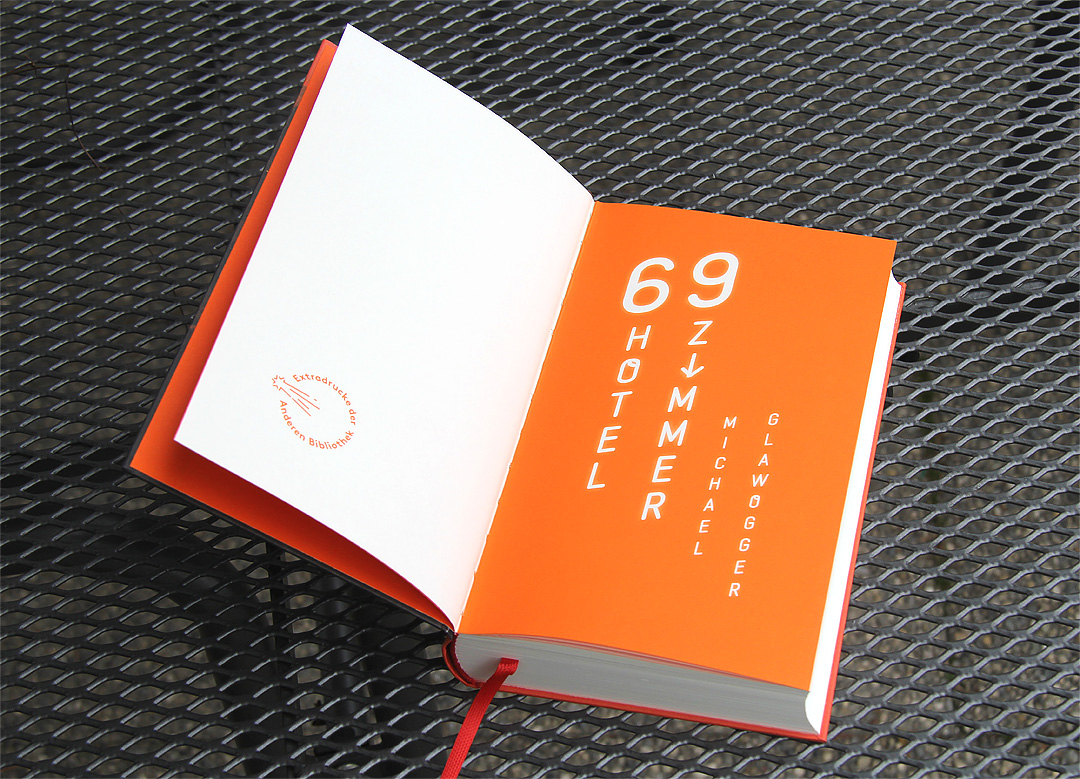
I have to say a few words about the beautiful edition from the publisher Die Andere Bibliothek. The book is visually superb and perfectly mirrors its content. Andreas Töpfer designed and produced the volume. At the start of each new story, a large, centered number—just like on a hotel room—marks the sequence. A color gradient and the small location and time note at the page margin feel like a documentary film where such information fades in and slowly fades out—a very pleasing effect. Even the layout of the title type and the page numbers is well chosen, reinforcing the very mood the content exudes.

I also really liked the color scheme. Unfortunately, my copy is from the newly reissued extra print, which has to make do without the handsome slipcase shown on the Stiftung Buchkunst–honored edition. Still, it’s a very chic, high-quality book—printed on 100 g/m² paper with a fine thread-sewn binding. The award is, in my view, entirely understandable and well deserved.
One question remains: why does a book called 69 Hotelzimmer contain 96 stories (minus number 13, so actually 95)? The answer, of course, is found in one of the stories. Glawogger, for his part, liked film scenes in which someone slammed a hotel door so hard that the attached numbers loosened and fell off.
“But what people are capable of you only ever see in films. Because reality may be furnished—but it isn’t cast. »In the old days,« he almost thought, »films were …« Instead he thought of Mark Twain and how the difference between reality and fiction is today exactly what it was back then: fiction has to make sense.” (p. 339)
Conclusion: With 69 Hotelzimmer, Michael Glawogger has created a versatile collection of short stories that’s very much worth reading. With a documentarian’s skill, he masterfully captures snapshots—the atmosphere of travel, of diverse places and hotels, and of odd, humorous, profound, and adventurous moments. Many stories fascinated me, offering subtle critique while often portraying the otherness of places that are hardly on a vacationer’s radar. I was especially taken with the brief pauses—the quiet contemplation of a room, a courtyard, the many small details. The feeling of foreignness, of being lost or washed ashore, gives this book a distinctly personal resonance. Other stories were, for me, too opaque or quirky—more like drafts. The edition honored by the Stiftung Buchkunst, published by Die Andere Bibliothek, is very handsome, executed with great attention to detail, artfully echoing the content and noticeably enhancing the stories’ atmosphere. A book I can recommend without reservation—both for its content and its design.
Book Information: 69 Hotelzimmer • Michael Glawogger • Die Andere Bibliothek • 408 pages • ISBN 9783847720102
Lieber Tobias,
Deinen Text über die 96 Hotelzimmer von Glawogger habe ich mit großem Interesse und noch größerem Vergnügen gelesen.
Ein wirklich lesenswerter Erzählungsband, ich stimme Dir vollumfänglich zu und erlaube mir als Service für Deine Leser den Link zu meiner Betrachtung zum Buch anzufügen.
Eine Erkundung der Welt als Reise zu sich selbst durch 69 Hotelzimmer
Ich hoffe, Du gestattest mir dies?!
lg_jochen
Lieber Jochen,
ich glaub ich muss deinen Blog nochmal genauer durchforsten. Du hast ja auch einen ziemlich guten Geschmack!
Gerne darfst du hier verlinken. Deine Rezension gefällt mir sehr gut und trifft das Buch wirklich hervorragend. Vielleicht täusche ich mich, aber für mich ist 69 Hotelzimmer ein echter Geheimtipp.
Liebe Grüße
Tobi
Das liest sich aber sehr spannend und das Buch macht einen sehr guten Eindruck!
Ich lese sehr gerne Reiseberichte und schreibe auch gerne eigene Reiseberichte in meinem Blog.
Das Buch werde ich mir kaufen, danke für den Tipp!
LG Volker
Lieber Volker,
so ein richtiger Reisebericht ist das ja nicht. Eher kurze Episoden. Was Reiseberichte angeht, liebe ich ja die Klassiker aus dem mare Verlag. Besonders empfehlenswert ist da “Die Reise mit der Snark”, die erst vor wenigen Tagen erschienen ist. Aber darüber blogge ich in Kürze noch.
Auf jeden Fall klasse, wenn ich deinen Geschmack getroffen habe und Interesse für das wirklich gelungene Buch wecken konnte.
Liebe Grüße
Tobi