
The Hobbit • J. R. R. Tolkien

Who doesn’t know Tolkien’s books? Since the lavishly produced films, even the last non-nerd will have realized that The Lord of the Rings and its prequel, The Hobbit, are very successful and beautiful fantasy stories. I read The Lord of the Rings in my teenage years, though the book has only remained in my memory in broad strokes. That’s primarily because, before reading it, I had already read Tad Williams’s Osten Ard cycle—Memory, Sorrow and Thorn—so the role of the first perfect, epic, and gripping fantasy story was already taken. Since that was some time ago and I’ve pretty much forgotten the films as well, now is a good moment to pick up Tolkien’s books again.
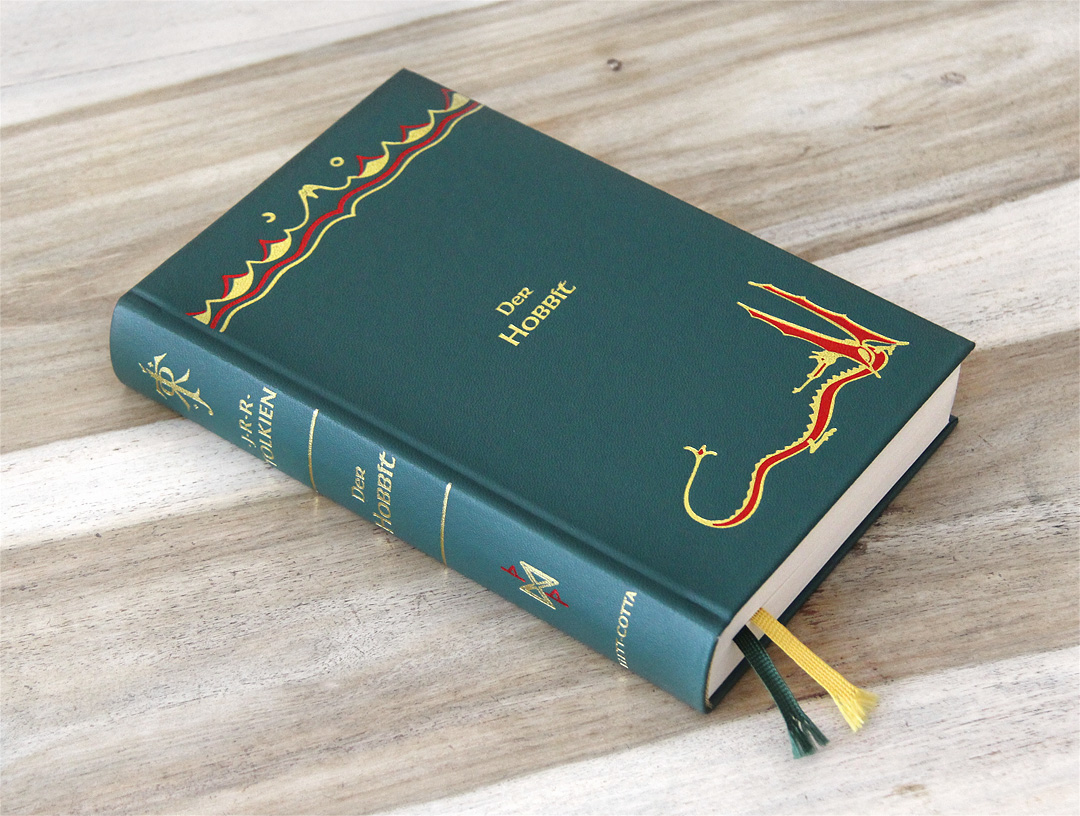
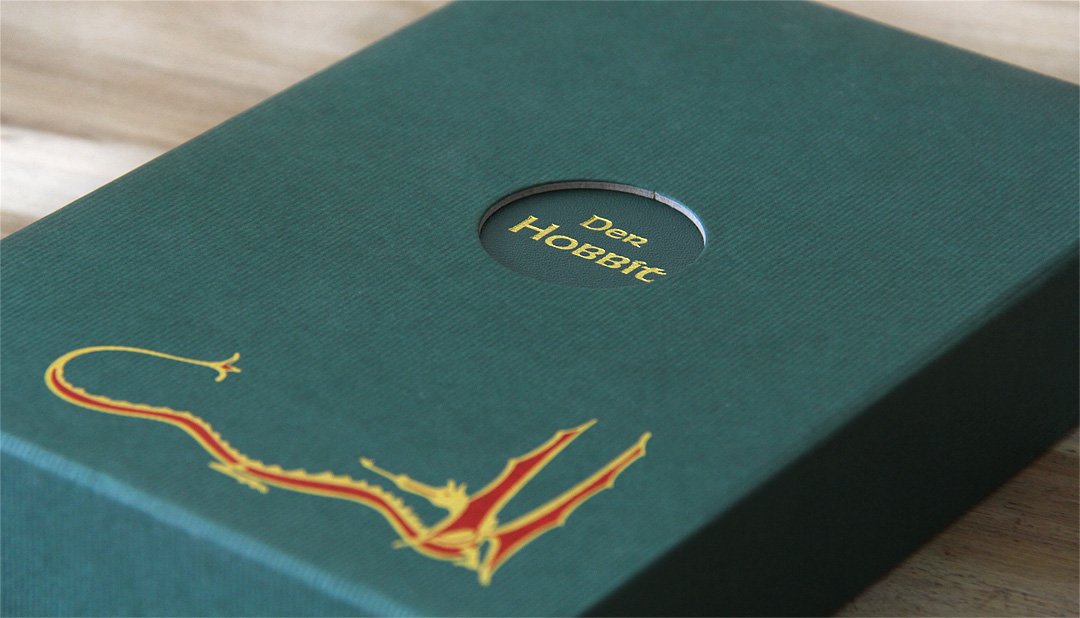
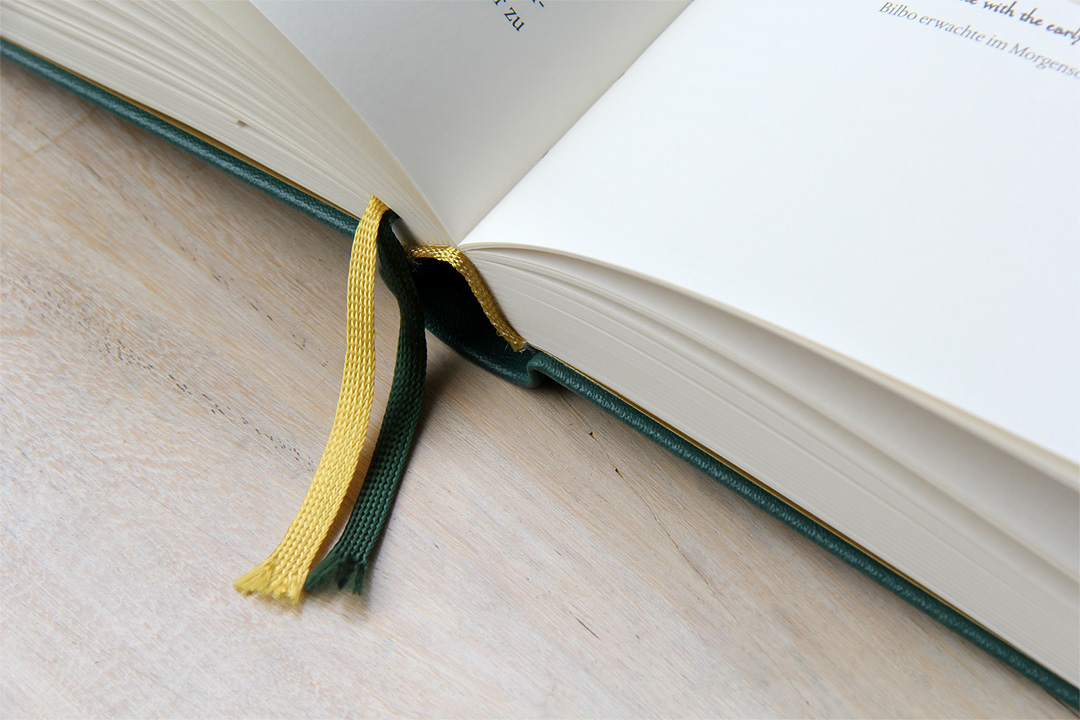
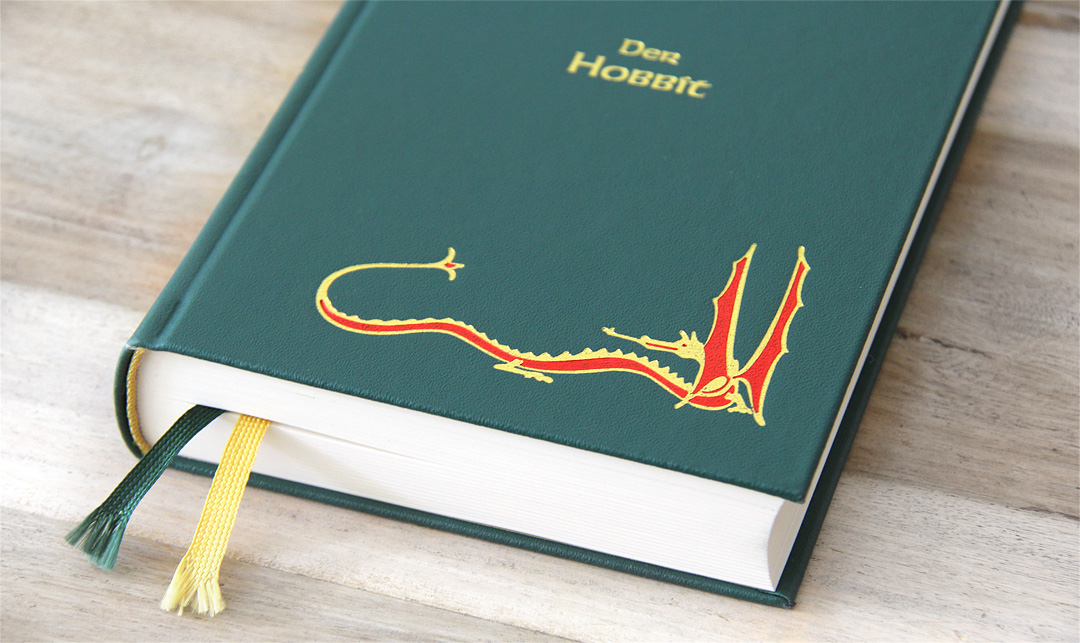
Of course I had little desire for a cheap mass-market edition and naturally treated myself to a sumptuous de luxe version again. As a limited edition, Klett-Cotta—the publisher that has all of Tolkien’s books on its list—offers The Hobbit as a handsome leather-bound edition with slipcase. At €99 it’s not exactly a bargain, but together with the illustrations from the original 1937 edition and a tasteful, very coherent, old-fashioned design, the book is a real gem I just couldn’t pass up. The book exudes something antiquated, and you feel transported back to Tolkien’s time, when there were no glossy covers with elaborately designed fantasy illustrations.
The content of the story is hardly a secret anymore; the commercial success of these books and the accompanying films has seen to that. The hobbit Bilbo sets out with a few dwarves and the wizard Gandalf on a dangerous adventure to wrest from the evil dragon Smaug a lavish treasure—including a kingdom. Along the way he stumbles upon an ornament that just about everyone knows by now: a magic ring that makes its wearer invisible and helps Bilbo out of a tight spot more than once. Beyond that, he experiences numerous adventures and dangers—with Elves, Dwarves, and Orcs—in a very appealing, Nordic-feeling world, and of course there’s a proper battle.
I only remembered the Hobbit films faintly, so the first two parts only limitedly influenced my imagination. For most descriptions, entirely my own images arose in—and from—my imagination. While the film felt rather drawn out, the book’s brisk pace surprised me. Where in the movie battles seem to drag on forever, the situation in the book resolves fairly quickly and sometimes unspectacularly. But of course, if you want to stretch one book into three overlong films, you have to pad things wherever possible, and then the carnage takes a bit longer. Generally I’d say the films’ settings are highly polished. Lake-town, for example, isn’t described and presented in the book with the depth it receives in the films. For me that was always the decisive reason to see the movies in the cinema after all: the landscapes and the nature of New Zealand are simply too beautiful.
I always associate Tolkien’s books with beautiful illustrations as well. Ted Nasmith remains vivid in my mind as a painter. John Howe is another artist who worked as a concept designer on the films and rendered the scenes from the books quite masterfully. (My John Howe, incidentally, was Michael Whelan, who did the illustrations for Tad Williams’s Osten Ard books—Memory, Sorrow and Thorn—and is every bit Howe’s equal.) If you’re interested in the topic, I recommend the documentary “On the Trail of the Hobbits,” which aired on Arte some time ago and can surely be found somewhere online (or someday as a repeat on Arte). The places from The Lord of the Rings are wonderfully atmospheric, and, preloaded with those lovely paintings and the gorgeous shots of New Zealand from the films, I quickly rediscovered these beautiful settings while reading.
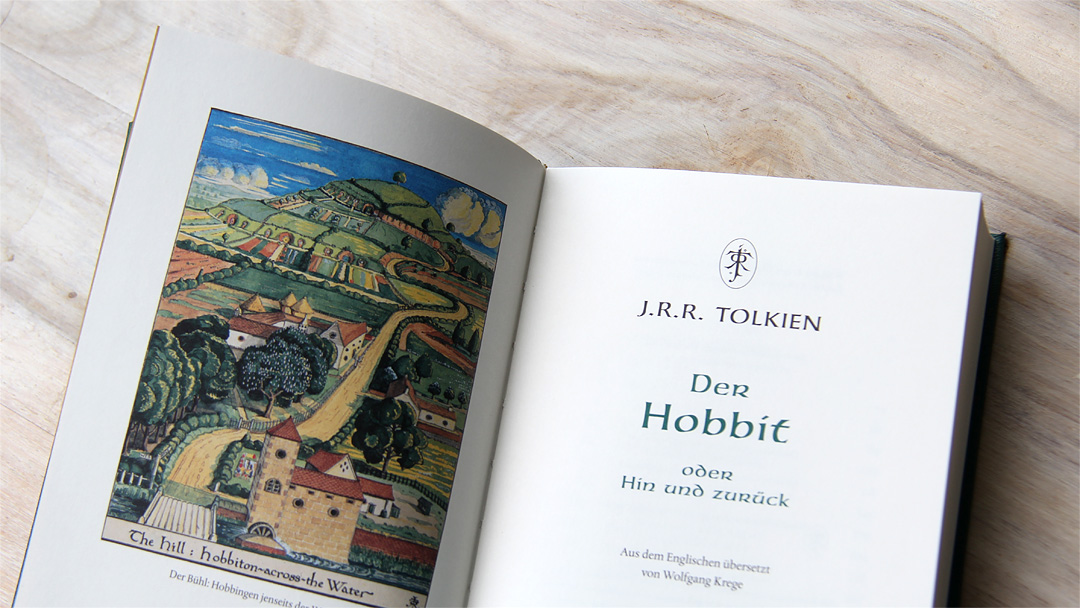
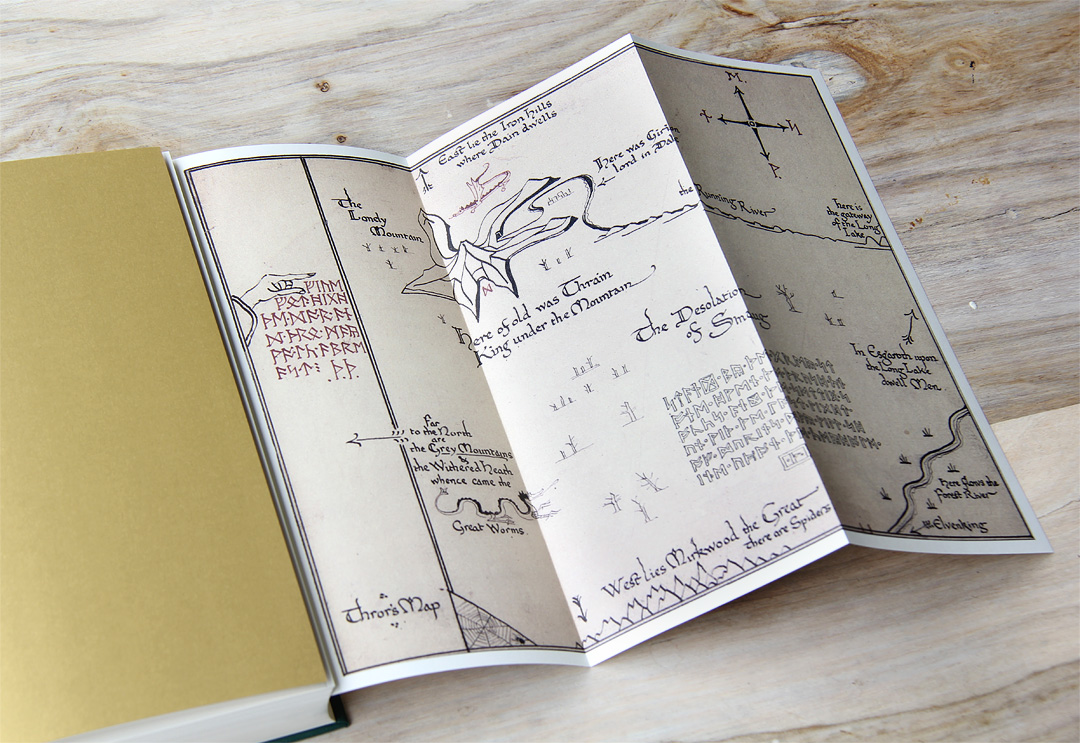
The book features the illustrations from the 1937 first edition, drawn by Tolkien himself and colored by H. E. Riddett in 1976. There are also two maps with English labels worked into the book: on one side Thror’s Map, and on the other the Wilderland, which is the region the companions traverse in this story. As is typical of Tolkien’s books, the sketch-like map with runes is highly atmospheric and serves as a useful guide.
Wolfgang Krege’s translation of The Lord of the Rings has been strongly criticized by some readers. Apparently there was an attempt to modernize the language a bit, which many—at least those who had already read Margaret Carroux’s translation—found off-putting. In this edition I only noticed that at very, very few points (e.g., on page 104: “[…] then some giant will snatch us up and boot us into the clouds like footballs.”). The book is pleasant to read. The language is simple and suits a children’s book that can also be read with enjoyment by adults, without resorting to an overly plain style. The narrator also steps into view quite often, which reinforced the feeling of holding a children’s book—but that, too, is not unpleasant. The prose rhythm and sentence constructions, however, are not of a truly outstanding kind.
I really liked the story’s pace. It’s never boring, and there are no longueurs whatsoever. The descriptions of nature, places, and characters are nicely balanced and vivid, making it very easy to picture the scenes and the landscape. Somehow I kept waiting for it to become long-winded and was then surprised that the individual episodes were over so quickly (for example, when Bilbo and the dwarves encounter the trolls). That must have been my unconscious memory of the films. But of course Tolkien’s books surpass the movies. Especially toward the end, the configuration and the makeup of the opposing sides shift relatively quickly, which gives the book fresh momentum and spice right at the end—something I really liked here. It truly remains exciting until the last page.
The foreword—which I read at the end out of habit—was written by Tolkien’s son, Christopher Tolkien, and offers a few background details on the book’s creation and its illustrations. I found it only mildly informative and had the impression it’s aimed more at Tolkien enthusiasts.
Conclusion: If you’re looking for a fine fantasy adventure, I can only recommend this old yet peerlessly popular tale. Even with a fading memory of the films in the back of your mind, Tolkien manages—through a brisk, entertaining, and pictorial narrative style—to captivate the reader and conjure up a vivid personal vision of places and scenes. Both the translation and the handsome presentation of this de luxe edition, with its antiquated-looking illustrations, are impressive. I truly immersed myself in this beautiful world, in Bilbo’s adventure, and in a thoroughly classic fantasy setting—one that ultimately founded an entire genre and, after all these years, still stands up to contemporary works in every respect. Given the price-to-value ratio, the publisher is likely addressing bibliophiles and Tolkien fans first and foremost with this edition; fortunately there are enough different editions of the book that everyone can choose the style they prefer. A book I can recommend without reservation.
Book information: The Hobbit • J. R. R. Tolkien • Klett-Cotta Verlag • 400 pages • ISBN 9783608938401
Wow, was für eine schöne Ausgabe! Aber der Preis – hui!
Tolkien hat eine wunderbare Welt erschaffen und ich habe natürlich sowohl den Hobbit als auch den Herrn der Ringe gelesen (deutsch und englisch) und gesehen (HdR nur auf Deutsch, den Hobbit nur auf Englisch und leider in 3D). Die Hobbit-Filme fand ich nicht so toll. Das liegt vor allem an der Umsetzung, denn die Landschaft wirkte so künstlich. Wenn man sich im Gegenzug HdR anschaut, ist da ein krasser Unterschied – was sicher vor allem an dem technischen Fortschritt liegt. Dabei hatte ich mich so auf diese schöne Landschaft gefreut, die schon in HdR gezeigt wurde. Hätte ich nicht solche Angst davor, würde ich gerne nach Neuseeland fliegen, um die Landschaft in echt sehen zu können.
Liebe Verena,
cool, dann bist du ja ein richtiger Herr der Ringe Fan. Dann dürfte das Buch ja eigentlich in dein Beuteschema fallen ;) Aber ich gebe dir Recht, die schöne Aufmachung muss einem das schon Wert sein.
Die Herr der Ringe Filme habe ich auch alle im Kino gesehen. Beim Hobbit nur die ersten beiden und so richtig begeistert war ich davon auch nicht. Aber ich bin an sich nicht so der Filme Fan und ziehe immer die Bücher vor.
Die Landschaften haben mir aber in allen Filmen sehr gefallen. Die Stadt auf dem See war schon sehr schön gemacht. Und natürlich die weiten Landschaften mit Gebirgszügen. Mir gehts da aber wie dir. Angst vorm Fliegen hab ich zwar nicht, aber die weite Entfernung ist schon krass. Da gibt es einfach noch zu viele schöne Länder zu entdecken, die wesentlich näher sind. Und wenn ich mir die Fotos und Dokus über Neuseeland so anschaue, dann wird es von Island doch um einiges getoppt. Und das ist praktisch gleich ums Eck, wenn man das mit Neuseeland vergleicht.
Liebe Grüße
Tobi
Hallo Tobi,
eine schön gestaltete Buchausgabe ist das. Für mich ist allerdings die Krege-Übersetzung ein absolutes No-go, wobei mein Urteil da nur auf der Herr der Ringe-Übersetzung beruht. Hatte seinerzeit mal einige Textpassagen verglichen und habe die “Modernisierung” der Sprache durch Krege als extrem unpassend empfunden. So muss ich jetzt mit meiner uralten, abgegriffenen Carroux-Übersetzung leben. Leider habe ich nur die alte grüne Paperback-Ausgabe. So hoffe ich weiterhin auf eine Neuauflage der ledergebundenen Dünndruckausgabe der HdR-Übersetzung und werde mir auch vom Hobbit keine Krege-Übersetzung zulegen.
LIebe Grüße
Thomas
Lieber Thomas,
das die Krege Übersetzung nicht so gut sein soll, hab ich nun schon öfters gelesen. Bei “Der Hobbit” fand ich die Übersetzung nicht auffallend schlecht. Mit Ausnahme von ein paar wenigen Stellen. Aber bei “Herr der Ringe” wollte ich mich nicht auf Versuche einlassen, da habe ich mir die Übersetzung von Carroux geholt. Die gibt es aber durchaus noch als gebundenes Buch zu kaufen: https://www.amazon.de/Herr-Ringe-J-R-R-Tolkien/dp/3608938281/.
Liebe Grüße
Tobi
Wirklich eine wundervolle Ausgabe. Da lohnt sich jeder Euro.
In Leder gebundene Bücher geben einfach ein Gefühl von vollwertigem Leseerlebnis. Haptik, Bindung, das edlere Papier und die Langlebigkeit sind mit einem Taschenbuch eben nicht zu Vergleichen. Taschenbücher haben über kurz oder lang ein Mindesthaltbarkeitsdatum. Doch bei solchen gebundenen Schönheiten hat man das Gefühl, das man mit ihnen alt werden kann.
Da haben wir das gleiche Verständnis und die gleiche Erwartung an Bücher. Ich sehe es ganz genauso wie du. Ein schönes Buch dann einfach nur im Regal zu haben, ist einfach etwas Schönes und ich ertappe mich immer wieder dabei, wie ich sie dann doch immer mal wieder aus dem Regal ziehe, nur um darin etwas zu blättern und an die schönen Lesestunden zurück zu denken.
Ich schon einmal gelesen, dass die ganzen Bücher mit Klebebindung einmal kaputt gehen und nur die Fadenbindung etwas für Jahrhunderte ist. Am Ende bin ich mir sicher, dass meine zerlesenen dtv Taschenbücher mich sicher weit überleben und die Klebebindung gut hält. Aber wenn ich mir beispielsweise meine Mare Bücher im Schuber anschaue, dann sehen die halt noch wie neu aus, während eben die benannten Taschenbücher nach einer Lektüre schon ziemlich durchgelutscht sind. Und das, obwohl ich mit beiden Formaten gleich unachtsam bin.
Liebe Grüße
Tobi
Danke für diese sehr informative und schön gemachte Rezi – inklusive den Hinweisen auf die arte-Doku und Tad Williams, dessen Osten Ard ich vor gar nicht langer Zeit mit großer Lust gelesen habe. Wärmt mir immer wieder das Herz, dass es doch noch einige Bibliophile da draußen gibt :-)
Lieber Simon,
ich glaub so unbekannt ist Tad Williams Osten Ard Zyklus gar nicht. Ich treffe immer wieder auf Buchblogger, die seine Bücher lieben und schätzen. Aber wenn man auch schaut, dass seine Bücher im Rahmen der Hobbit Presse erscheinen, ist auch klar, dass es sich einfach um Premium Literatur handelt. Ich hab noch die Ausgaben aus den 90ern Zuhause und schon ein paar mal darüber nachgedacht mir die neueste Auflage zu holen. Er schreibt ja an einer Fortsetzung und wenn die vollständig raus ist, dann werde ich die gesamte Reihe komplett neu lesen. So hab ich das schon mit Shadowmarch gemacht und das war ein echtes Vergnügen. Alle vier Bücher am Stück zu lesen ist schon genial, weil Tad Williams es einfach versteht einen wunderbaren Spannungsbogen zu erzeugen.
Herzliche Grüße
Tobi
Eine wirklich schöne Ausgabe und sehr schöne Rezension. Bin kein großer Tolkien Fan, aber den Hobbit mochte ich sehr. Habe mein Ausgabe auf diese Schmuckausgabe des Folio Verlages geworfen, da ich gerne im original lese:
http://www.foliosociety.com/book/HOB/hobbit
Liebe Grüße vom bingereader :)
Liebe Sabine,
oh ja, die Schmuckausgabe vom Folio Verlag sieht auch genial aus. Ich hab immer das Gefühl, dass es im englischen Sprachraum wesentlich mehr schöne Ausgaben gibt als in Deutschland. Easton Press hat auch echt geniale Bücher am Start. Sowas fehlt hierzulande einfach noch.
Liebe Grüße
Tobi
Huhu,
wow das Buch ist echt wunderschön! Ich liebe Ledereinband-Ausgaben!! Tolkien ist einfach wunderbar, einer meiner Lieblingsautoren. Ich habe alle Bücher von ihm, manche sogar doppelt. Einmal in Deutsch und einmal in English, ich finde man muss Tolkien einfach im Original lesen, keine Übersetzung kommt da ran. Das so wie bei Shakespeare, den kann man find ich auch nicht überetzen, es ist einfach in English was ganz anderes.
@Sabine Delorme: diese Ausgabe ist ein Traum und der Preis ist human! Echt schön!! 100 Eur würde ich glaub ich für kein Buch zahlen !! Da buch ich lieber ein Ticket und verreise für ein Wochenende ;)
LG
Liebe Tinka,
nach der Lektüre von “Der Hobbit” habe ich eher weniger das Verlangen das Buch im Original zu lesen. Wenn ich an Honore de Balzac, Victor Hugo, Guy de Maupassant oder Gustave Flaubert denke, dann blicke ich schon neidisch auf die Franzosen, die das im Original lesen können. Die haben ja schon als Übersetzung eine Sprache, die mich komplett flashed. Bei “Der Hobbit” hatte ich das nicht. Aber mal sehen, wie das bei Herr der Ringe ist. Das ist nun als nächstes dran und wird hier im Blog natürlich auch noch besprochen.
Der Preis ist so eine Sache. Man muss natürlich schon ein gewisses Budget für Bücher und insbesondere für schöne Ausgaben haben. Wenn es einen nur um den Inhalt geht, gibt es wohl keine Ausgabe, mit der man schlechter fährt als wie mit dieser ;) Mit 100 Euro kommst du halt über ein Wochenende auch nicht sonderlich weit. Wenn du nicht grad des Bayernticket nimmst, dann lutscht dir die Bahn schon die Kohle aus der Tasche ;)
Liebe Grüße
Tobi
ach, da gibts zb von Urlaubsguru.at ganz gute Angebote und Städtetrips für unter 100 Eur mit Hotel :)
Hallo Tobi,
eine wirklich sehr schöne Ausgabe von diesem Klassiker. Aber Kregge als Übersetzer? Nein danke! Ich hatte damals, als die Herr der Ringe – Filme veröffentlicht wurden, die Kregge-Ausgabe geschdnkt bekommen. Schrecklich in der Sprache und trifft überhaupt nicht den Ton der Geschichte. Das mag beim Hobbit vielleicht nicht so auffallen, aber bei HdR nutzte ich vor ein paar Jahren die Gelegenheit und kaufte die Carroux-Übersetzung in einer Neuauflage. Teilweise bekommt man eine andere Geschichte serviert. Ich bin definitiv für Pro- Carroux und kann einer Kregge-Übersetzung nichts mehr abgewinnen.
Gruß
Marc
Hallo Marc,
hm, also das lese ich immer wieder. Bei Herr der Ringe hab ich mich da auf nichts eingelassen und Carroux gewählt. Aber interessant, dass da die Unterschiede so groß sind. Die Übersetzung von Krege wird ja beim Klett Verlag auch ziemlich groß im Programm. Wird wohl mal Zeit für eine weitere, neue Übersetzung.
Herzliche Grüße
Tobi
Hallo Tobi,
danke für den Link zu der Carroux-Übersetzung. Hatte sie schon mehrfach gesehen, wäre allerdings wirklich nur etwas fürs Regal. Zum Lesen ist dieser dicke Wälzer eigentlich nicht geeignet.
Vielen Dank übrigens auch für den Hinweis, dass eine Fortsetzung zum Osten-Ard-Zyklus erscheint, das war mir bisher entgangen. Habe ich vor Jahren gelesen und es konnte mich fast genau so begeistern wie Herr der Ringe. Habe allerdings nicht wirklich viele Vergleichsmöglichkeiten, da ich nicht so viel Fantasy lese. Der Otherland-Zyklus konnte da nicht mithalten, habe ich bei Band 3 abgebrochen und möchte ihm irgendwann noch eine Chance geben.
Gruß
Thomas
Lieber Thomas,
sooo unpraktisch ist das Buch gar nicht. Ich komm mit so dicken Schmöker ganz gut zurecht. Mit einem kleinen Taschenbuch ist es natürlich praktischer, aber ich mag so dicke gebundene Bücher einfach gerne. Und ich hab mich daran gewöhnt sie auch im Stehen zu lesen.
Von Tad Williams letzten Büchern war ich vom Setting nicht so angetan. Aber so klassische Fantasy, die liebe ich bei ihm einfach. Mal sehen, wie lange er brauchen wird. Wenn er erst angefangen hat, müssen wir uns noch gedulden. Kann mich an Shadowmarch erinnern, das hat auch von Ankündigung bis das letzte Buch kam, einige Zeit gedauert (was auch nachvollziehbar ist, bei dem Umfang). Otherland konnte mich auch nicht richtig überzeugen. Habe das recht früh abgebrochen. Aber primär, weil ich Science-Fiction einfach nicht mag.
Liebe Grüße
Tobi