
Das Feuer des Mondes • Christian & Florian Sußner
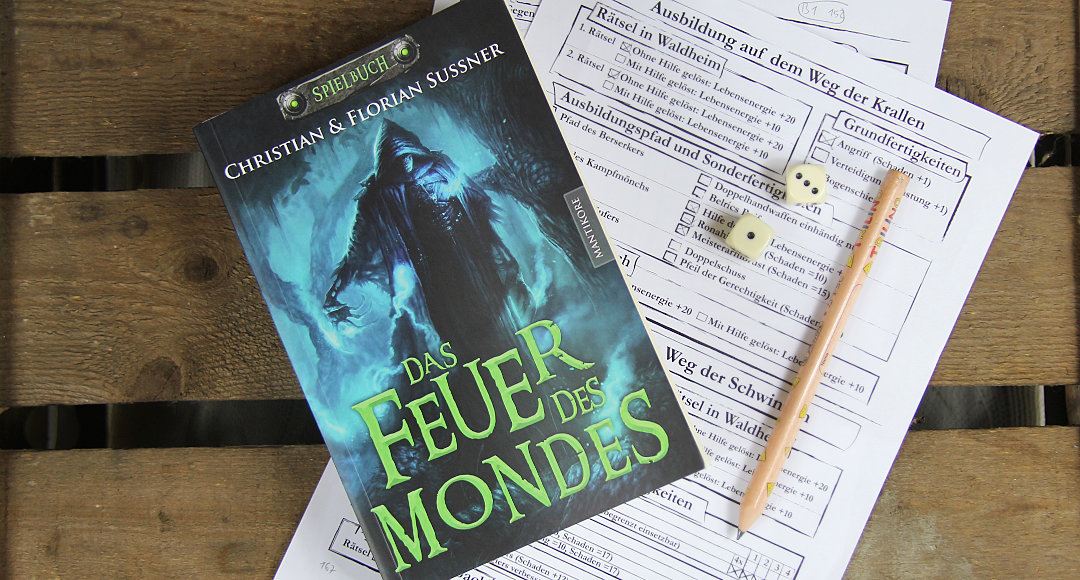
In my last post I mentioned I wanted to introduce a few adventure gamebooks, and with Das Feuer des Mondes I’m starting with a more recent title in the genre—though “recent” might be a stretch, as it already appeared five years ago. Many current gamebooks are reissues of popular titles from the 1980s, so I was curious how a more contemporary work would read. What kind of adventure awaits you here, and whether it’s worth reading—you’ll find out in this post.
I’ve already written in the past about Joe Dever and his wonderful Lone Wolf books. In the 1980s there was a brief boom in adventure gamebooks. These are books that aren’t read straight through but are divided into numbered sections. You step into the role of the protagonist, start at the first section, and then choose how the story should continue and what you, as the main character, will do. That way each reader experiences the book differently and has a uniquely personal adventure, usually under a set of rules: battles are resolved with dice, items are collected, and everything is tracked on an action sheet. As the name suggests, these are books you play—often set in fantasy worlds. It’s a nerdy affair, but I loved these books as a kid and teen, and as I’m finding these days, they’re still great fun and very entertaining to read.
Das Feuer des Mondes is likewise set in a fantasy world, on Anmar. You slip into the role of a night watchman in the city of Waldheim. During a nocturnal patrol you’re attacked and marked by a Shadow Servant; from there things escalate quickly—you’re hunted by dark forces and must find a way to counter the threat. It’s all very classic, but the story is entertaining to read.
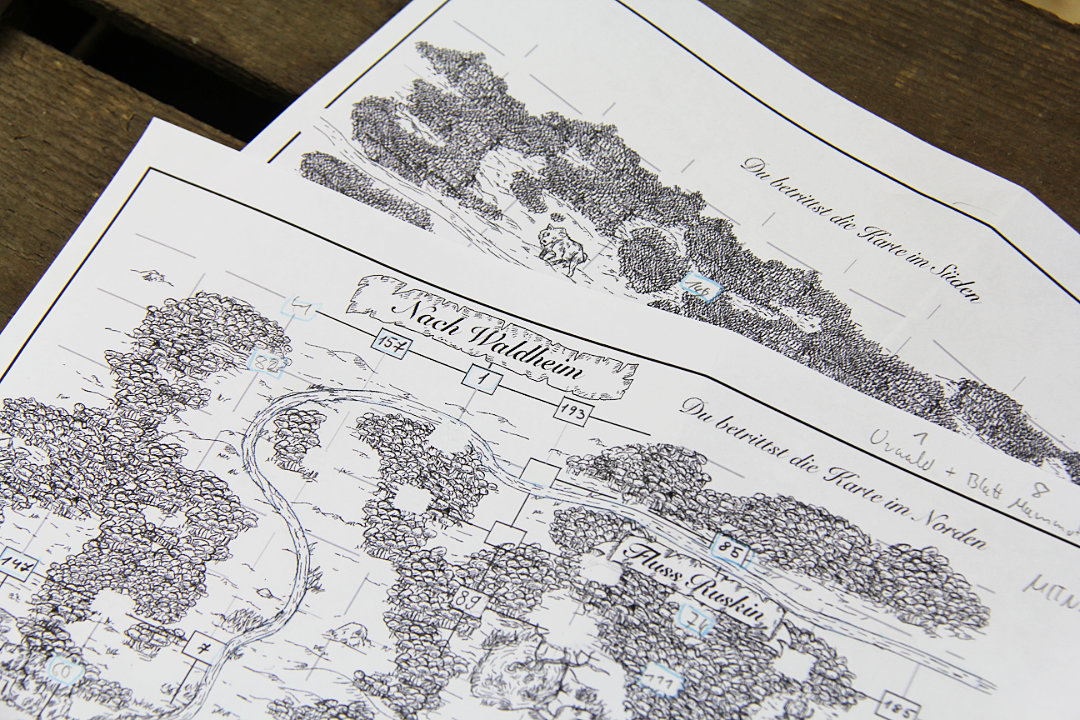
This gamebook also provides a character sheet where you record stats, backpack items, endurance, etc. And there are two maps you reveal as you go. Both the sheet and the maps are available as a download so you can print them and scribble freely.
I really liked the book’s clean structure. Instead of reading the rules first, you dive straight into the story and are prompted, bit by bit, to consult the rule blocks at the back—so you learn on the fly and the reading flow stays smooth. The mechanics are well designed; you can tell the authors learned from older titles and refined the structure. It’s obvious they’re fans of the genre (how could they not be). After the tutorial—which reminded me a bit of video games—the adventure truly begins, and later you can even choose different character progressions, again very much like in computer games. You can pick between a warrior (Path of Claws) and a mage (Path of Wings), with further branches within each. Instead of rolling randomly for starting skills, you earn them through puzzles. These are elements that hook a gamer nerd like me right away. The implementation is excellent, and the balancing is something a few games could learn from. (For insiders: you won’t run into an unwinnable Zakhan Kimah here.)
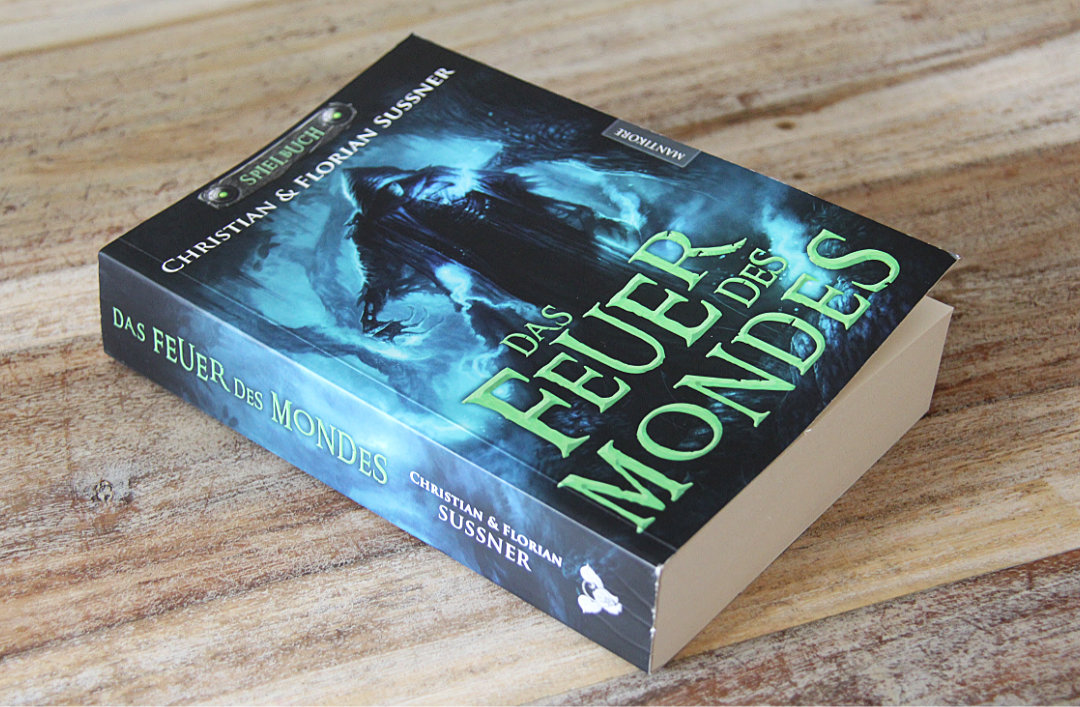
The book is divided into three “books.” Book 1 takes place in the capital, Waldheim, where the story begins and ends. Books 2 and 3 play out in a jungle and a forest, respectively, which you gradually explore. With the help of the maps you navigate and must complete objectives in these regions to push the story forward. Each book contains 200 sections—so three times 200 in total—which is quite a lot; you’ll be occupied for a while. I usually need about one evening for a Lone Wolf book; for Das Feuer des Mondes I took three evenings altogether, taking my time and enjoying it (as I do with Dever’s books, too).
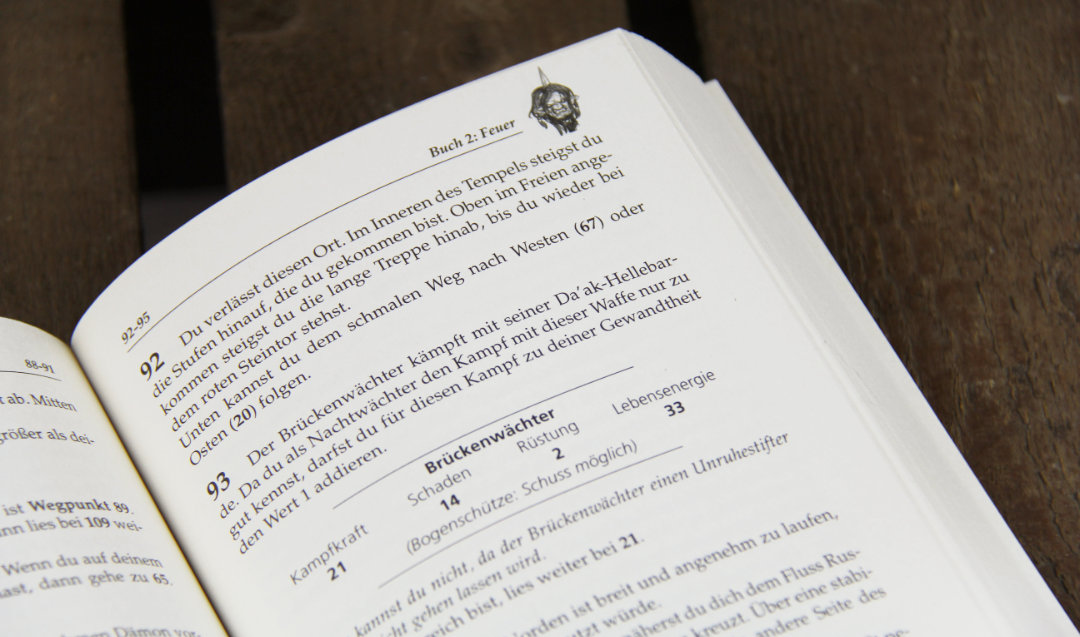
I also enjoyed the sheer variety of mechanics. For example, you might find a ring engraved with a number; to use it in the right place you add that number to your current section number. There are puzzles, random events, explorable maps, teleportation like in video games, trading, tasty item upgrades, and more. The authors really went to town—but everything is well balanced, so your character progression feels good, there are steady side quests to complete, you get to puzzle a bit, and you follow the story step by step. By the way, the narrative often nods to other gamebooks and to games like Diablo, lending a light, humorous note that fits nicely.
As for me, my luck in games—of any kind—is usually lousy. I was perpetually broke and could never afford anything at the merchants, and my Humanity was so low I was on the verge of becoming one of those sinister Shadow Servants myself. But I somehow kept pulling out of the nosedive and finished the book as a Raven Hunter. If you’ve read it too, feel free to comment on how your run went—I’m curious!
Stylistically the writing is on the simple side—typical for the genre. The focus is on staging situations, and in a book like this it’s crucial that scenes are clearly rendered, which they are here. In terms of content and language it’s very suitable for younger readers as well. Had this fallen into my hands back when I first devoured gamebooks, it would have been a big favorite. But even now, as an adult nerd, it’s a pleasant read.
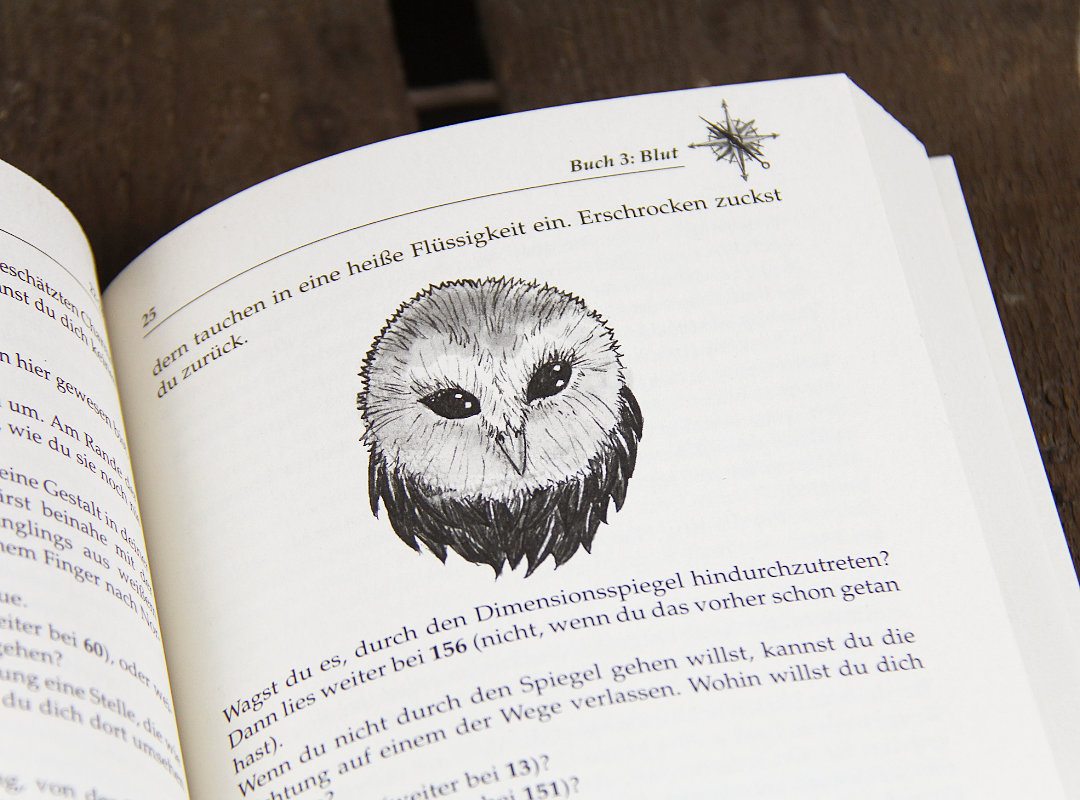
In classic ’80s fashion, the book includes illustrations. The spot illustrations and maps are nicely drawn, and the character sheet looks good. The full-page pieces, however, appealed to me less; the style feels rather amateurish and can’t hold a candle to, say, Gary Chalk’s wonderful art for the Lone Wolf books of the ’80s. The physical book is a standard paperback, which actually suits a gamebook—it’s easy to flip back and forth. Of course I’d always love a de luxe edition, but that would be a niche within a niche.
Conclusion: Das Feuer des Mondes is a well-crafted adventure gamebook with a pleasantly balanced, fair difficulty level, inventive mechanics, and a story that, while not wildly original, is fun to play through. I loved picking it up in the evenings and exploring the world of Anmar. The illustrations could have been more lavish, but taken as a whole this is a rounded, very entertaining gamebook that I can heartily recommend—especially for anyone who’s never tried this format and is curious, or for gifting to a young person who’d enjoy something a bit different.
Book information: Das Feuer des Mondes • Christian and Florian Sußner • Mantikore Verlag • 560 pages • ISBN 9783939212638
Moin,
also das ist nichts für mich. Ich hab das mal vor ewigen Zeiten ausprobiert, das war aber dann recht einfach gemacht. Nach ein paar Absätzen kamen dann imer Fragen der Art “Möchtest du jetzt das tun, dann lies weiter auf 197” “Oder magstdu jenes tun, dann lies weiter auf 79”. Das ständige rumblättern hat mich nur genervt.
Und überhaupt ist sowas prädestiniert fürs Tablet oder den eReader :) Da brauch ich neben dem Buch nicht noch mit Bleistift, Papier und Würfeln hantieren.
//Huebi
Hi Tobi,
in meiner Jugend habe ich die AD&D Bücher in der Bibliothek ausgeliehen und nur so verschlungen. Allerdings konnte man in den Büchern – wenn ich mich richtig erinnere – “sterben”, was manchmal ein wenig frustrierend war, da dann das Suchen nach dem Ausgangspunkt losging um doch noch den “richtigen” Weg zu finden. Wie schaut es denn da mit “Das Feuer des Mondes aus”?
Viele Grüsse,
Huhu Harald,
die AD&D Bücher habe ich auch gelesen und auch noch im Schrank stehen. Die sind ja auch echt alt. Ja die waren echt frustrierend, daran kann ich mich auch noch erinnern, wobei das echt schon lange her ist. Bei diesem Spielbuch hab ich keine Stelle gefunden, wo man plötzlich stirbt. Und auch bei Joe Devers Bücher gibt es das nur ganz selten. Die sind eigentlich schon fair. Aber ich muss gestehen, bei einem plötzlichen Ableben, blättere ich dann auch schnell zurück. Mir fehlt dann einfach die Zeit, dass ich so ein Buch mehrmals durchlese und langweilig wird das dann auch.
Liebe Grüße
Tobi