
All Quiet on the Western Front • Erich Maria Remarque

Today I’m introducing a book that many of you avid readers probably already know and have read. It caught my attention again while looking through the list for my Canon project, where it appears quite high up. Since there’s a beautiful edition from Kiepenheuer & Witsch, I decided to get it. All Quiet on the Western Front is without a doubt a timeless classic that keeps resurfacing. Here you can find out whether it’s worth reading.
I had to read this book once back in school and give a presentation about it. Since that was quite a few years ago, I could hardly remember anything. At least it wasn’t a traumatic experience (like my reading of Büchner’s Woyzeck), and my memory of it was positive — which is rather rare when it comes to school readings. That’s probably because the book wasn’t completely dissected and overanalyzed. So this time, I approached it with an open mind.
The novel tells the story of 19-year-old Paul Bäumer, a simple soldier who, together with several of his former classmates, volunteers for military service. He describes in detail his experiences, his time at the front, what it’s like to lie and fight in the trenches, and all the horrors that come with war. The backdrop is the First World War and the battles between the German troops and the Allies. It’s a novel about war in all its detail.
From the very beginning, the book captivates with its unvarnished storytelling and plain directness. With clear sentences, Remarque paints a shocking and realistic picture of war and of the struggle of ordinary soldiers who face the brutal violence of battle firsthand at the front. Death is a constant threat and companion; comrades fall one after another; the traumatic moments in the trenches, the thunder of shells and artillery, and countless harrowing experiences all find their place in this book. It’s distressing to read what soldiers had to endure back then, and once I started, I couldn’t put the book down. I found it especially fascinating how the fictional soldier Bäumer writes about his emotions and thoughts, how he and his peers were driven by teachers and society to volunteer out of patriotic duty. How the older generation, who should have known better, sent the young men as cannon fodder to the front. He writes about the merciless basic training, especially about the battles at the front and the many traumatic images that forever changed the lives of these young soldiers. Remarque captures Bäumer’s thoughts and feelings in sentences that are sometimes almost poetic and beautifully shows how lost this generation became — how the war uprooted them and destroyed not only their present but also their future.
And with horror one feels at night, waking from a dream, overwhelmed and exposed to the enchantment of approaching visions, how thin the barrier and boundary is that separates us from darkness — we are small flames, poorly sheltered by frail walls against the storm of dissolution and meaninglessness, in which we flicker and sometimes almost drown. (p. 275)
The novel contains numerous episodes interwoven with moments of reflection, as the characters, in the brief pauses between battles, keep questioning what it all means and what could possibly justify this horror. It’s also very much about how war changes people. Particularly striking are the scenes in the field hospital, where the protagonist eventually ends up and witnesses the consequences of war in all their gruesome detail. Again, he poses the universal question: why?
How senseless is everything that has ever been written, done, or thought, if such a thing is possible! It all must be lies and meaningless, if the culture of thousands of years could not even prevent these streams of blood from being shed, these prisons of torture from existing by the hundreds of thousands. Only the hospital shows what war really is. (p. 266)
Erich Maria Remarque was born in 1898 in Osnabrück and can unequivocally be regarded as part of the Lost Generation. After his military training, he was sent to war and spent about a month at the front (if one can even say “only” a month). He was wounded after several deployments and spent the following 16 months in a military hospital in Duisburg. During that time, he heard numerous stories and reports from other soldiers, which he later wove into his novel.

I found the afterword by Thomas F. Schneider quite informative, though a bit over the top in some places. It explains that Remarque had first offered the book to S. Fischer Verlag, who rejected it. The Ullstein publishing group then took it on and went all in on marketing. The book was edited to appear politically more neutral, and much of the anti-war critique was toned down to suit the times. In my opinion, that doesn’t work at all. The afterword highlights several passages questioning the ideological justification of war that Remarque himself later removed. No matter how much one tries to reshape it, it remains an anti-war book. It was marketed as a fictional yet fact-based novel by an inexperienced writer who supposedly wrote down his experiences for therapeutic reasons. That’s nonsense — Remarque had already worked as a journalist, and if you look at the text and how polished it is, it’s obvious that it was carefully crafted for effect. That’s evident already in the choice of narrative form and perspective, which strengthen the bond between narrator and reader. The way anecdotes and experiences are presented makes it clear: this is not the work of a literary novice.
This edition includes a wealth of supplementary material, such as the typescript and preprints that show how the book became less openly critical of war. Schneider interprets things quite liberally and even claims that it’s more a book about the post-war period. Of course, the sense of alienation the protagonist feels and his inability to reintegrate into society are major themes. But the novel is unmistakably about the war itself — its events and experiences are central. There was much debate about the book’s authenticity, and it was immensely successful in its time, until the Nazis eventually banned it. Still, the novel hit its mark and remains one of the most significant anti-war novels of the last century — despite the censorship and criticism of its factual accuracy.
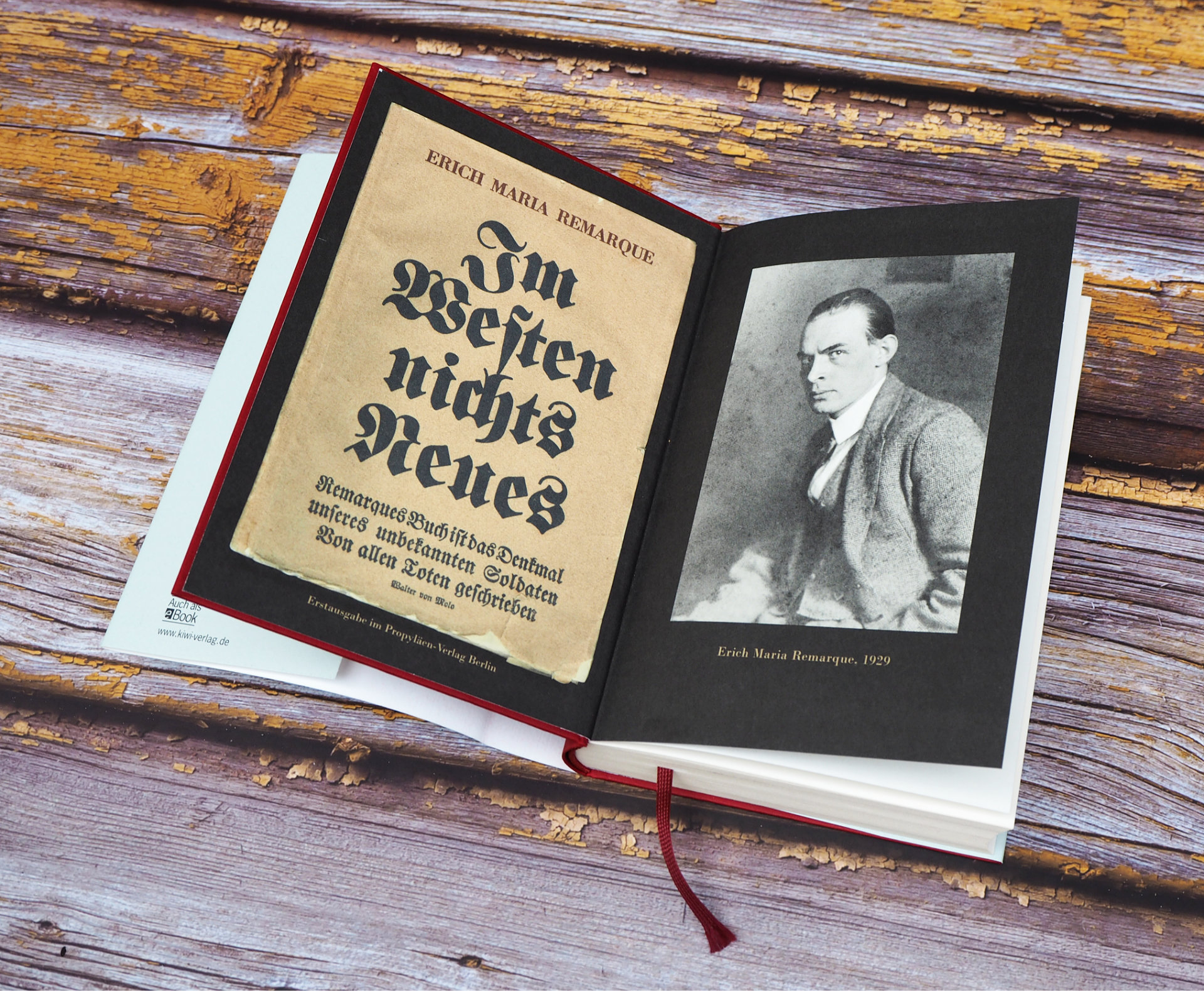
I quite like this edition. The inside cover features the original book cover and a portrait of Remarque. Overall, I find the design very well done, even if it’s just a cardboard binding with standard glue binding. The price is fair, though. There’s also a low-budget paperback edition available.
Conclusion: I found this book incredibly gripping and devoured it. Remarque writes about war with straightforward yet poetic simplicity — how the soldiers experienced it, how brutal life at the front was, and the lasting damage war inflicts on people. It’s harrowing to read these lines, and the protagonist’s thoughts and conclusions are completely relatable. You can’t help but empathize with Paul Bäumer every step of the way. An absolute triple-A book that everyone should read at least once.
Book Information: All Quiet on the Western Front • Erich Maria Remarque • Kiepenheuer & Witsch • 368 pages ISBN 9783462045819
Hallo Tobi,
an dieses Buch kann ich mich zwar inhaltlich nicht mehr im Detail erinnern, dafür aber an das, was du als sehr fesselnd beschreibst und die Situation, als ich es gelesen habe hat sich mir auch eingebrannt, wie bei keinem anderen Buch. Und zwar war das bei der Bundeswehr als ich einmal am Wochenende zur Wache eingeteilt war. Zu diesem Dienst habe ich mir dieses Buch mitgenommen, um in den Pausen ein wenig darin zu lesen. Wenig war es nicht, denn ich habe es mindestens zur Hälfte während des Dienstes und den Rest an demselben Wochenende gelesen.
Ich habe es ebenso wie du als sehr eindrücklich und kriegskritisch in Erinnerung und möchte es schon seit einiger Zeit wieder lesen, zusammen mit In Stahlgewittern und Schlachthof Nr. 5, um ein ganzes Paket an Antikriegsliteratur vergleichend lesen zu können.
Danke jedenfalls für diese Erinnerung, diese Bücher bald mal in die Hände zu nehmen.
Viele Grüße
Marc