
Der gewendete Tag • Marcel Proust
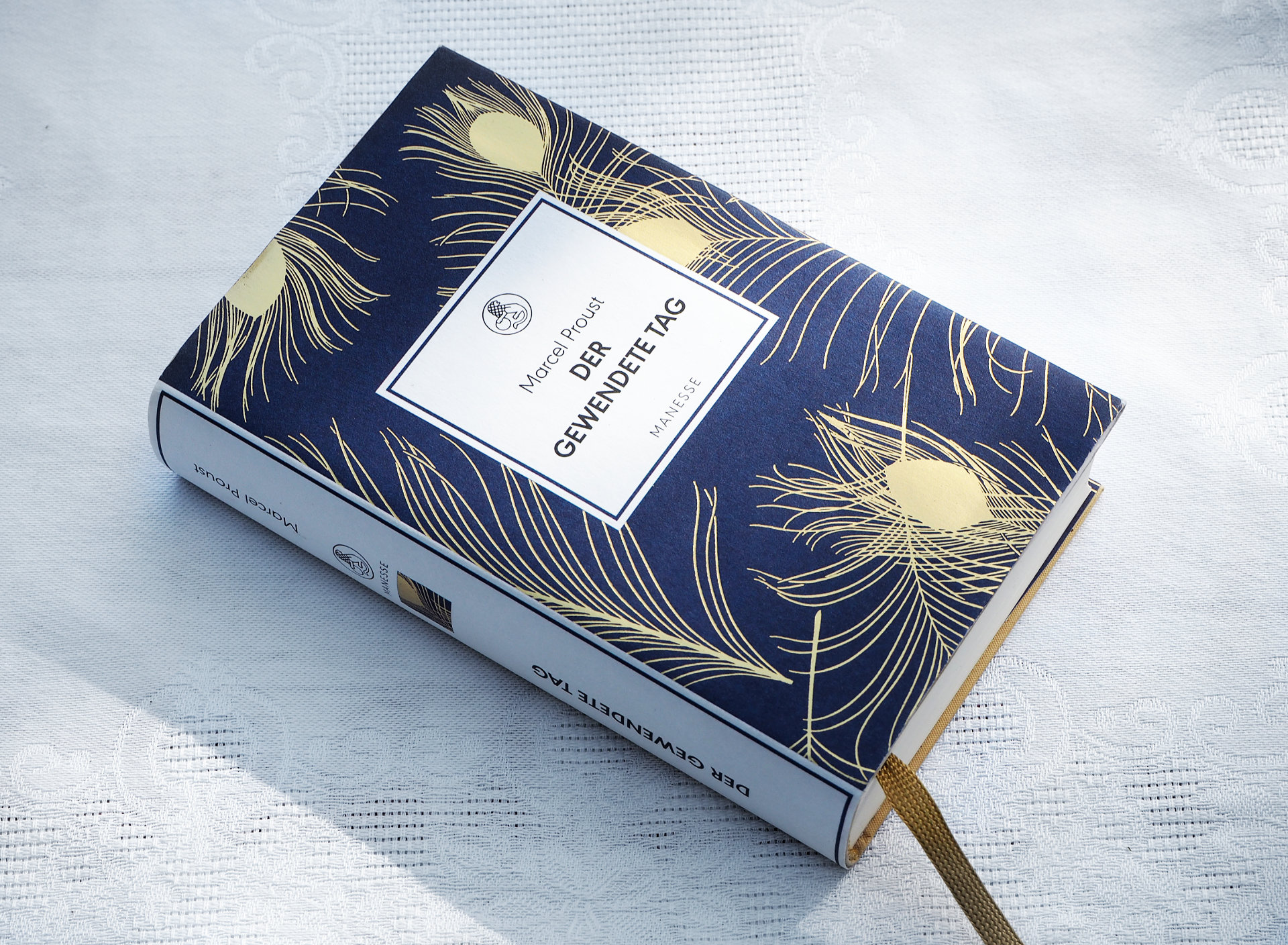
For a long time, I’ve wanted to finally devote myself to Marcel Proust, a very famous French writer who entered literary history above all with his extensive novel cycle In Search of Lost Time. I didn’t want to start right away with the multi-thousand-page cycle, though, and when the Manesse publishing house presented the book Der gewendete Tag in a new guise, I immediately recognized it as a good opportunity to dip a toe into Proust’s cosmos. In this post I want to share my impressions and give anyone who’s also thinking about tackling Proust a sense of what to expect.
Der gewendete Tag comprises, in chronological order, several advance publications that Proust released bit by bit between 1912 and 1923. He later modified and greatly expanded these, and out of them ultimately grew his In Search of Lost Time, which appeared between 1913 and 1927. So readers here are offered texts that in places can also be found in his great cycle; numerous figures from there appear as well, such as Albertine, the Duchess of Guermantes, or Madame Verdurin. One could say that Proust more or less assembled this book in the form in which he successively pre-published these texts.
With his lost time, Proust wanted to sketch a portrait of manners around the era of the Belle Époque, and he does this in the form of a fictional autobiography. The individual chapters are loosely connected chronologically, but each has its own focus, describing places, people, encounters, and events as the protagonist experiences and feels them—sometimes called Marcel—who is, with very high probability, the author’s alter ego.

The first chapter begins with detailed descriptions of how he admires the beautifully flowering hawthorn. In the following chapter Proust describes how sunbeams on the balcony remind him of a first infatuation he felt at the tender age of twelve for a girl. The model for the girl he regularly met on the Champs-Élysées in summer was presumably Proust’s youthful love Marie de Bénardaky. Already in this first chapter it quickly becomes clear that his work is very much about memories—about how present sensory impressions arbitrarily evoke reminiscences in him. Proust’s work is notorious for these involuntary memories. The most famous scene is the taste of a madeleine dipped in tea igniting a fireworks display of memories of his childhood. These numerous recollections crop up again and again throughout the book—at first rather banal, in the form of a village church in a holiday town he often visited as a child with his parents, or his feelings about a planned trip to Florence that was then canceled due to illness.

The chapters are sometimes aimless, capturing the moment, wandering over various details—from an infatuation to an unattainable marquise, to a friend’s relationship with his mistress, all the way to his grandmother’s final days. Always with a very precise eye for particulars, phrased in fine words enlivened by numerous comparisons. The chapters are arranged chronologically and describe different experiences in the protagonist’s life, with later events then referring back to earlier chapters—for example, how he returns to Balbec after his grandmother’s death. As in In Search of Lost Time, the book is thus a string of moments from his life—or rather, a fictional life—though the stories already seem to be of autobiographical origin.
In one chapter he describes the society around Madame Verdurin, a group of elderly professors, doctors, and artists, and he sketches the peculiarities of this circle—their quirks and habits. That reminded me a bit of Balzac’s The Collection of Antiquities (Le Cabinet des Antiques). Especially in his La Comédie humaine, Balzac wonderfully captured a number of eccentric circles. Even though with Proust one already perceives numerous nuances, and through the descriptions one gets more a feeling than a fixed picture of these people, he is far removed here from what Balzac achieved with his expressive, clear, and wonderfully sonorous sentences.

I found one of the later chapters very entertaining, where his love for a woman awakens to whom he had previously shown a certain disdain. I found the cause of this affection very strange, as well as the way he renders his thoughts—yet this was precisely the chapter that captivated me the most. It deals with homosexuality and how his love for a woman is constantly stoked by jealousy, and how he perceives that jealousy—how he wants to possess this woman completely, which he cannot achieve—and Proust describes it very sensitively, making it highly comprehensible.
In another chapter Proust describes how he coped with the grief over his grandmother. It’s about how she concealed her illness from him for as long as possible to spare him, and overall the chapter is simply an episode of self-pity, without my finding much in the sentences themselves. And so it often happened that his thoughts and feelings didn’t quite reach me.
In his texts Proust offers a very detailed look at particulars, at often seemingly banal details and at momentary moods, with the unimportant and the significant mingling, which makes the scenes very slow. It quickly becomes apparent that he was very sensitive and had a very delicate perception of light and feeling. Besides time—which, like remembering, recurs again and again—the precise gaze at emotional subtleties and the portrayal of his rich inner life are especially characteristic. In doing so, Proust uses artful, long, nested sentences with a fine linguistic melody—sometimes distinguished, empathetic, sometimes presenting the banal in long, word-rich sentences.
“The time we have at our disposal every day is elastic; our own passions expand it, the passions others feel for us contract it, and habit fills it up.” (p. 223)
He proves his wonderful ability to portray sublime emotions in a chapter in which he describes his infatuation with a woman, how it remains unfulfilled, and how it slowly dies out. It reminded me very much of Henry James, in how he disentangles his feelings and thoughts in a highly nuanced way and describes—and re-describes—them with much psychological finesse, again in long and nested sentences.
The individual chapters often have no clear line: they describe something—very precisely, very minutely—only to turn to another topic, which is then likewise examined very closely with regard to particular aspects. The episodes have no punchline, no suspenseful plot; the book flows along, Proust loses himself in contemplating details, especially of an emotional nature, and that is sometimes very beautiful to read because it repeatedly reminded me of my own thinking—of how one often perceives one’s surroundings, with impressions of mostly insignificant details. At the same time, I found the book to be rather unfocused; it lacks a tangible narrative thread, which meant it couldn’t build real depth for me. Long, convoluted sentences don’t help there either; they make the reading needlessly complicated and very often add little value.
It is often, of course, masterful—how he formulates his thoughts, how he perceives nuances. For example, he describes his grandmother’s death and focuses on people’s reactions—how they deal with the event. Proust is, then, a very good observer. Nevertheless, I often felt that he remained on the surface: when he considers whether someone is sufficiently distinguished; when he asks himself whether an environment and current circumstances are to his liking; or how his view of a woman changes so that he finds her attractive. Proust comes across as arrogant, conceited, egocentric, and snobbish. Although he writes a lot about feelings, impressions, and very personal thoughts, I felt a certain emotional coldness while reading. Warmth and passion are missing.
Indeed, that was one of the main problems I had with these texts. The protagonist himself is very much at the center, and I simply noticed that there is far too great a distance between Proust the man, with his way of thinking, and me as a reader. Proust is a shrinking violet—very wealthy and privileged—and he makes a highly dependent impression. It was often hard to bear when he writes how he has to cry constantly, or how he complains when he gets a drafty table near the door in a café. Proust is the opposite of Mark Twain or B. Traven. Traven, in particular, worked as a stoker on a ship like a drudge under the harshest conditions and still cracked his shaggy jokes. A single week in Traven’s life would probably have finished Proust off. He is blasé and condescending—such as when he becomes intimate with a young woman and then treats her from above in the rest of the story. Or in another chapter he writes that he takes pleasure in “playing with young girls,” while at the same time airing his disdain for friendships. The way he schemes and deliberately lies to women is likewise unflattering and attests to a very calculating nature.
All the stories take place within Proust’s very wealthy milieu: seaside resorts, his apartment in Paris, or stays in upscale hotels or restaurants. Along the way he repeatedly turns his attention to servants, or describes in detail how the calls of street vendors affect him, while he presumably spent most of his time at home, frequently bedridden and ailing. Apart from writing he didn’t really work, lived in refined spheres, and presumably drifted through his days.
Despite this criticism of him as a person—which may be unfair, since my view is based primarily on his book—I still perceived the texts very much as world literature. You can hear it in those mellifluous sentences, with their extremely nuanced gaze at details; and it was precisely this exaggerated sensitivity in his own life that likely enabled him to write as he did.
“That is why the best part of our memory lies outside us, in a breath of air scented with rain, in the shut-in smell of a room or the smell of a blazing fire—wherever we find again of ourselves what our intelligence has not used and has rejected: the last reserve of the past, the best, which can still make us weep when all our tears seem dried.” (p. 260)
On the one hand, I found the reading incredibly relaxing. Because of the slow pace and the detailed rendering of his thoughts and feelings, it’s pure deceleration. On the other hand, some passages—due to the long and nested sentence constructions—do demand a good deal of concentration and attention.

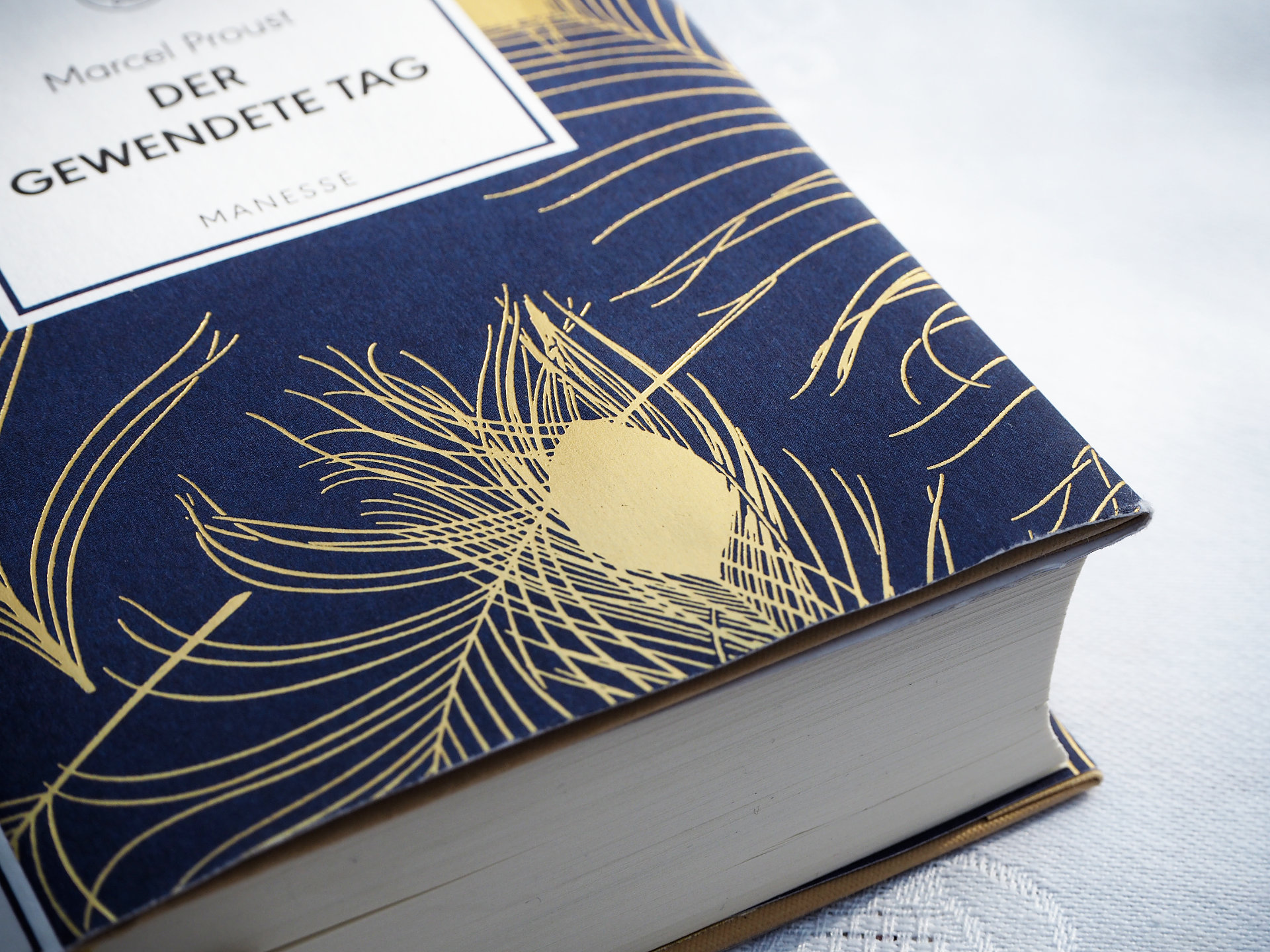
I really like this Manesse edition’s presentation. The binding with shimmering golden peacock feathers looks beautiful and simply suits Proust’s rarefied sphere. The printed endpapers have a gorgeous color, and the matching ribbon bookmark fits perfectly. The book also has blue thread stitching, which looks lovely and rounds everything off wonderfully. The only downside is the missing cloth binding, but that seems to be missing from the new Manesse classics in general. Otherwise there’s nothing to complain about—you get an excellent book for the price.
I found the notes very informative and helpful for understanding the text—for example, the Dreyfus Affair is briefly explained. The afterword, by contrast, was lofty waffle without added value and offers very little information.
I love the combination of book and Arte documentary. In fact, I had that again with this book. A while ago Arte had numerous documentaries on great authors available in its media library, including The World of Marcel Proust, which I saved at the time and wanted to watch after reading this book. In the meantime the doc has been removed from Arte (greetings from the Stone Age that Germany still seems stuck in), but anyone who wants to see it can currently find it on YouTube. I watched it and you learn some really interesting background information, with photographs and film footage from the time. Proust was attracted to both men and women, and I found it fascinating that his character Albertine—who appears both in this book and in In Search of Lost Time—was modeled on a man he had fallen in love with. And you learn that my impression from the book didn’t deceive me: the fictional narrator was indeed very close to Proust himself. The documentary definitely complemented the book wonderfully, and overall I gained an excellent insight into Proust’s literary achievement.
Conclusion: Formally speaking, what Proust writes is of the highest quality. Wonderfully long sentences with a clearly perceptible, pleasant linguistic melody; very subtle nuances; the observation of many small details; a portrait of manners of his time with characterizations that testify to keen powers of observation—just as the great authors all had. And yet this book—and Proust’s way of thinking, perceiving the world, and rendering it—didn’t reach or move me. What his long, sonorous sentences express were, for me, observations; it was more like an image, presented with a certain coolness and distance, grasped with a sense of calculation, and so foreign to me in attitude that it didn’t touch me emotionally at all. The chosen subjects—when he writes about his relationships and feelings toward women; when he writes about his impressions of nature, the sea, the hawthorn, the light; or about aristocratic society—simply call for passion, that typical stirring passion so characteristic of French authors and which has so often gripped and moved me with its intensity. Only with Proust I couldn’t find it. Even so, I found the book very much worth reading, precisely because of those often wonderful sentences and the strangeness and, at the same time, familiarity that his thinking held for me. The book is beautiful; the selection is wonderfully suited to sampling Proust’s work, and I can only recommend that every curious reader pick it up.
Book information: Der gewendete Tag • Marcel Proust • Manesse Verlag • 699 pages • ISBN 9783717525301
Ich habe vor einigen Jahren die Verlorene Zeit gelesen (Neuübersetzung im Reclam-Verlag). Den ersten Band noch im normalen Tempo, ab dem zweiten Band nur noch 20 Seiten pro Tag. Es war wirklich anstrengend. Allerdings für mich auch sehr gewinnend. Proust erklärt seine Erinnerungstechniken nicht, er benutzt sie. Diese hat er einst in einem Sanatorium beigebracht bekommen. Und dadurch, dass Proust diese Erinnerungstechniken benutzt wie er es tut, kamen mir selbst auch kleinste Details aus meinem Leben zurück. Ich habe damals pro Tag ca 45 Minuten gelesen und war anschließend ca ne Stunde damit beschäftigt, meine eigenen Geschichten zu sortieren. Mich hat das voll getriggert. Hintenraus wurmt es mich, dass ich keine eigenen Aufzeichnungen zu meinen Erinnerungen gemacht habe. Da ist wieder vieles verloren gegangen. Ne verlorene Zeit halt.
Das Zimperliche hat mich anfangs auch genervt. Hat sich irgendwann gelöst.
Lieber Oblomow,
das kann ich nur unterstreichen, wie Proust Erinnerungen zurück holt, das war und ist auch für mich ein grosser Gewinn. Das nehme ich für mich auf, nutze es, um eigene Erinnerungen zu triggern und zurück zu holen.
Und diese Erinnerungen tausche ich dann auch gerne mit meinem Freund aus, mit dem Zusammen ich das Buch (die Bücher) lese.
Lieber Tobi,
einfach toll, dass Du Proust zum Thema machst, ein Autor von Weltrang, dessen Lektüre ich lange vor mir hergeschoben habe. Nun lese ich »Auf der Suche nach der verlorenen Zeit gemeinsam mit einem Freund, mit dem ich mich dazu per Videokonferenz austausche. Wir stecken noch im Abschnitt »Unterwegs zu Swann«, knapp 100 Seiten, aber genug für einige Eindrücke.
Ein Buch, das ich aufgrund seiner Komplexität lieber am Schreibtisch lese, und mir Notizen dazu mache, Du hast mit Recht auf die verschachtelten Sätze hingewiesen.
Du schreibst, er wollte ein Sittenbild seiner Zeit wieder geben, ich nehme eher seinen Titel wörtlich: Die Momente des Lebens, in dem man sich fragt, wo die Zeit geblieben ist, wie dazu die Erinnerung an diese Momente aussieht. Wie diese getriggert werden, wie Töne, Bilder, Gerüche sie auslösen können. Wie die Erinnerungen, die offenbar chaotisch im Gehirn liegen, gerne von einer zur anderen springen, immer wieder durch Momente neu getriggert, eine Erinnerungskette auslösen.
Und wo ich sehr gespannt bin, wieweit philosophische Ansätze, die durchblitzen, auch realisiert werden.
Ich finde nicht, dass es bei Proust eine Aneinanderreihung von Momenten in seinem oder einem fiktiven Leben ist, es sind die Ergebnisse seiner Suche, nach der (verlorenen) Zeit, nach Erinnerungen. Wobei ich nicht weiß, wieweit hier eine unterschiedliche Wahrnehmung in den verschiedenen Textgrundlagen liegt.
Ich habe keinen Tiefgang im Text vermisst, der steckt doch in den Texten selbst, in der hyper-sensiblen Wahrnehmung. In der unglaublichen Poesie vieler Sätze, die man auf sich wirken lässt, wie einen ganz alten Armagnac.
Wo hast Du Gefühlskälte bei ihm empfunden, bei einem Autor der schreibt, dass er den Kuss der Mutter ganz vorsichtig in sein Schlafzimmer tragen muss?
Über die Schönheit der Sprache hast Du sehr treffend geschrieben, für mich drückt er damit oft Gefühle aus, die mit meinen eigenen stark übereinstimmen.
Vor zehn Jahren hätte ich Proust nicht lesen können, jetzt bin ich in einer ganz anderen Lebensphase, lese – nicht nur Proust – ganz anders. Vielleicht hängt von der Lebensphase und Situation, in der man selbst ist, viel ab, wie man einen hypersensiblen Text wie den von Proust wahrnimmt.
Nochmal danke, dass Du Proust rezensiert hast.