
The Lover • Marguerite Duras
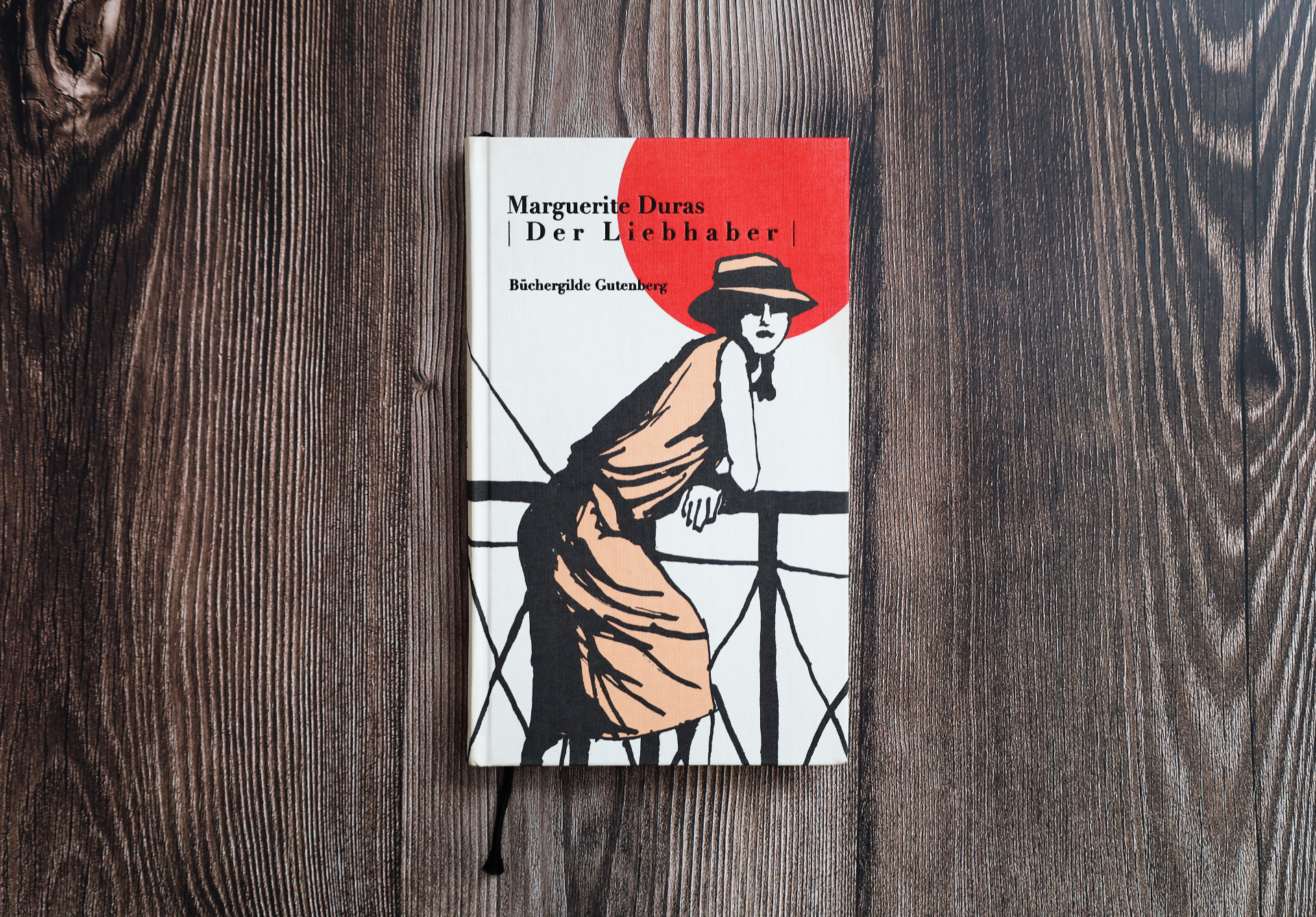
I found this book a long time ago in a public bookcase, without knowing anything about it. It was the edition by the SZ, whose design I simply didn’t like. Without reading it, I gave it away again. Years later, I stumbled upon the title once more, and my curiosity was immediately piqued. I then bought it again in the much prettier edition by the Büchergilde and finally read it. Sometimes we make the wrong decisions. Here you can find out whether it was right or wrong to give the book away—or whether I should have read it after all.
A young white girl in colonial Indochina in the 1930s enters into a love affair with a wealthy young Chinese man. From the narrator’s retrospective perspective, a picture emerges of desire, power, and self-discovery—one that remains both deeply intimate and deliberately fragmentary. Against the backdrop of French-colonized Southeast Asia, the reader gains a moving insight into the life and past of the young woman she once was.

At 132 pages, the book is very short, and since it was highly successful at the time, I expected a deeply moving love story. And I was not disappointed: the book quickly captivates the reader, and after only a short time I couldn’t put it down. Little by little, the reader learns more about the girl, but also about her family—her mother and her two brothers—who shaped her life profoundly and lastingly. Her relationship with her mother is complex, and her brothers, with their devastating life paths, also shaped the personality and emotional world of the young protagonist.

The love affair is therefore not stereotypical but heavily influenced by the colonial society that makes a relationship between a white French girl and a Chinese man nearly impossible. But that is not the only thing that gives the story its appeal. It is the emotions of the young, nameless girl—described with great intensity and detail—that feel authentic and become increasingly comprehensible as the book progresses. The protagonist is only fifteen, and her lover, in his mid-twenties, is significantly older, yet still appears young and insecure. She is in the midst of adolescence, and while reading, it becomes clear how this first experience—her feelings, physical desire, and emotional distance—intertwine to form a fragile backdrop. This is precisely what makes the book so compelling. The tenderness within this intimacy and passion is palpable, yet society and the surrounding environment are always present, creating a sense of dissonance. Not only through external pressures but also through the multilayered emotions, the interactions, every moment between them.

Discovering the origins and expressions of this intimacy step by step is certainly one of the novel’s great strengths—something that is repeatedly very touching. In the end, however, it is also a character study. One that can only be understood within the context of society, and the fact that both are outsiders—one due to economic circumstances, the other due to cultural background—beautifully illustrates how this colonial system fails. Just as the family structures within it fail. To pack all of this into a short and emotional story, to sketch it through a single fate, is quite an achievement. I caught myself thinking about these connections long after finishing the book.
The book is structured in a very fragmentary way. The language is simple to read, yet powerful and consistently melancholic. I found many of the sentences exceptionally beautiful. They often contain lists that build in intensity and read wonderfully from a stylistic perspective, as they perfectly underline the thoughts and emotions. Some sections are very short, others span several pages. Still, the reading flow remains pleasant. Linguistically, Duras varies her style, though the book is primarily told from the first-person perspective, which naturally creates great closeness. At times she shifts into the third person, which creates distance and gives the sense of observing the scenes from the outside.
Below is an example of a sentence that is simply masterful, because it places the love affair in relation to society, to the colonized, unstable, and unjust system, and at the same time loops back to these two individuals who do not love each other and yet do.
I see the war as like him, spreading everywhere, breaking in everywhere, stealing, imprisoning, always there, merged and mingled with everything, present in the body, in the mind, awake and asleep, all the time, a prey to the intoxicating passion of occupying that delightful territory, a child’s body, the bodies of those less strong, of conquered peoples. Because evil is there, at the gates, against the skin.
Page 74 (translation by Barbara Bray)
The Indochina background was new to me. Apparently, the novel contains many autobiographical elements. The author, Marguerite Duras, was born in 1914 in Saigon, Vietnam. She grew up in French Indochina, and beyond that, there are many parallels between her own life and that of the protagonist. She, too, had an impoverished and overwhelmed mother, a violent older brother, and at the age of fifteen, a love affair with an older wealthy man. The book was published in 1984, so the retrospective look back at this early love affair also feels very realistic.

My edition is from the Büchergilde and dates back to 1985. The cover shows the protagonist leaning over the railing, wearing the hat and dress described in detail by Duras in the novel—chosen very deliberately. The little book has thread stitching and a lovely linen binding. The design is not extraordinary, but it shows the excellent quality that well-made books can have. Even after all these years, it still looks new and very beautiful.
Conclusion: The Lover is a moving and multilayered love story. The novel shows in a deeply emotional way how society and family reach far into interpersonal relationships, shaping and influencing them. As a reader, you feel the many moments, notice all the small details, feel the pain and the devotion. Surely this is also because the narrative is autobiographical and largely based on real events. A short novel that I devoured in a single day and could not put down after only a few pages.
Book information: The Lover • Marguerite Duras • Büchergilde Gutenberg • 132 pages • ISBN 9783763254613
Vielen Dank nochmal für diese Erinnerung und Analyse. Das Zitat mit dem Liebhaber, der dem Wesen des Krieges ähnelt, hatte ich schon wieder vergessen. Wirklich große, zeitlose Literatur, auch, wenn der Roman voller Lokalkolorit ist (ich hab’ ihn in Vietnam gelesen)! https://lightning-bug.de/ce-jour-de-la-limousine-noire/