
Eduard von Keyserling
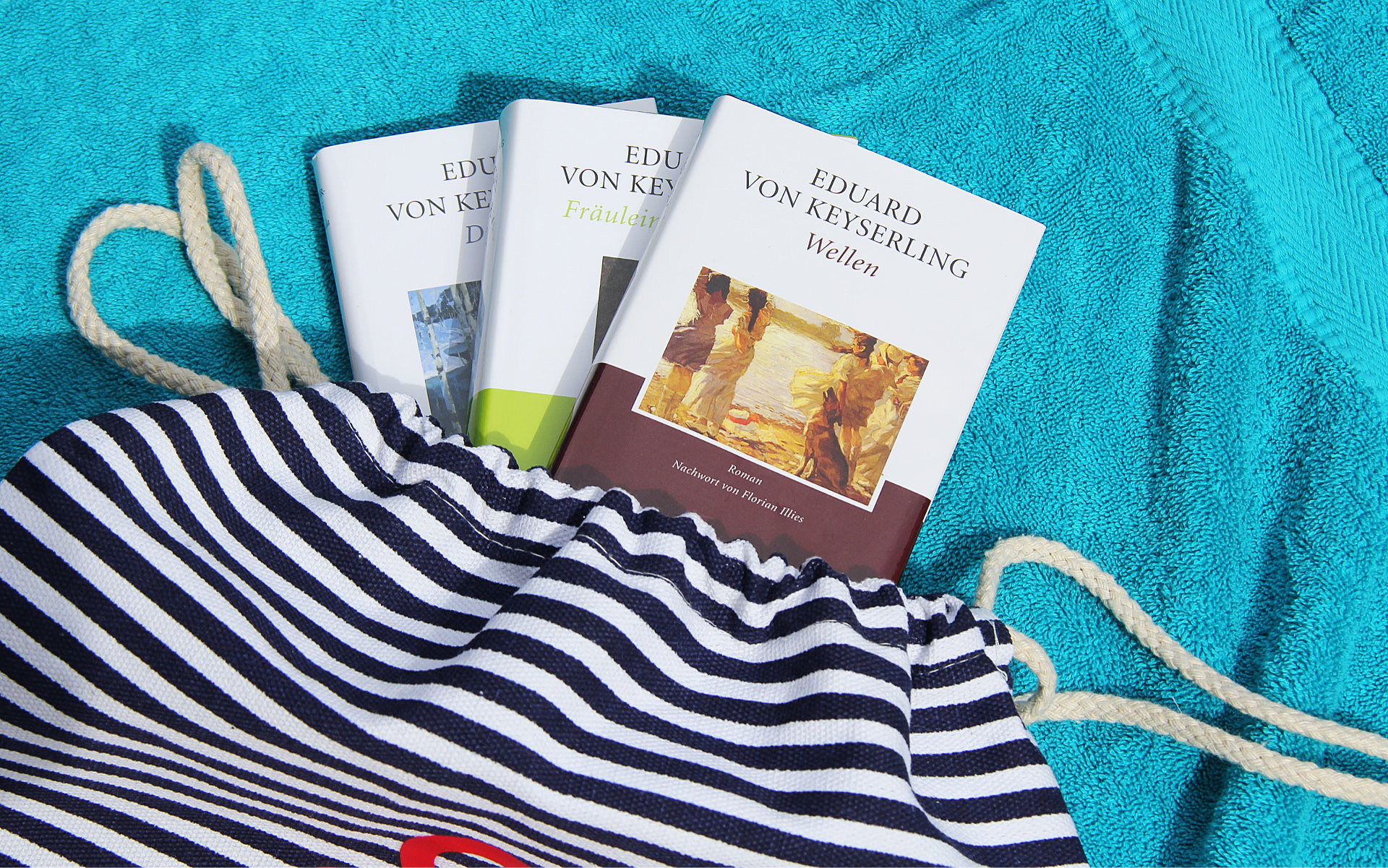
I always choose my vacation reading with great care—and most of the time the list changes several times until I’ve made the perfect selection. That was, of course, the case this year as well. After scrapping my plans more than once, I settled on Eduard von Keyserling. He kept popping up for me, and other book bloggers recommended him again and again, so I packed a small bundle of his books in my suitcase. Manesse Verlag has published a wonderful slipcase with three of Eduard von Keyserling’s novels. Perfect little yet bibliophilic volumes for travel—and thematically a very fitting read for the beach. Whether the choice was good—you’ll find out in this post.
The slipcase includes three of Keyserling’s novels: Waves, Fräulein Rosa Herz, and Dumala. This selection covers his work quite well in terms of time and gives an excellent impression of his style and way of telling stories.

Keyserling isn’t necessarily one of the major household names in world literature. Born in 1855 in what is now Latvia and descended from the rural nobility, he remains in literary memory as an impressionist writer of novels and novellas. He’s known for his female protagonists, who rebel against the conventions of the landed gentry and the society of their time, pushing back against class boundaries and social norms. From 1908 on, blinded by syphilis, he hardly left the house. His last works (including Waves) were dictated to his sisters, who lived with him. From what I’ve read, his works were never properly appreciated; even his grave in Munich’s old Nordfriedhof was only marked again in 2011. In my view, that’s truly a serious oversight, and Manesse Verlag deserves great credit for making such treasures accessible to a wider audience again.
The association with impressionism (in literature roughly 1890–1910) is owed especially to his descriptions of nature. They are indeed outstanding: he masterfully evokes the impressions of nature—the sea, the shifting light, the landscapes. Stylistically, however, I experienced him more as a realist who enriches his narratives with detailed snapshots of impressions. The result is an array of wonderfully atmospheric mood pieces that are a genuine pleasure to read.
Der Himmel wurde jetzt farbig, die Wolken am Horizont bekamen dicke goldene Säume, und eine Welle von Rot übergoss den Himmel. Auch in das Graugrün des Meeres mischten sich blanke Fäden, und die Höhlungen der brechenden Wellen am Strande füllten sich mit Rosenrot, und plötzlich begann das Meer weiter dem Horizonte zu ganz in Rotgold zu brennen. (S. 51, Wellen)
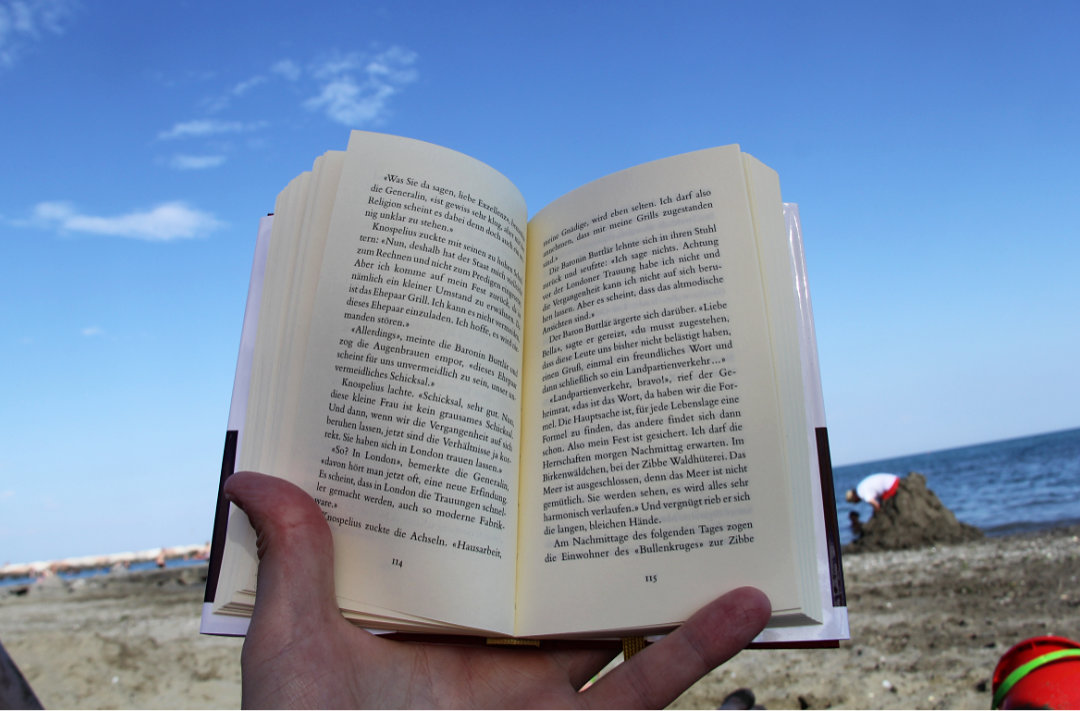
He doesn’t necessarily use these descriptions of nature to heighten his characters’ emotions, as many other authors—for example, Maupassant—often did. Rather, they infuse his stories with a unique atmosphere, and his beautiful depictions consistently conjured very precise images of the scenes in my mind. It’s delightful to read and truly captivated me. Especially in Waves, you feel as though you’re standing on the Baltic shore yourself, listening to the rush of the sea. That might also be because I read the book on the beach in my little beach tent, which really enhanced the reading experience.
What all his works share is a critique of society that usually surfaces in a subtle way. By switching perspectives among the various characters and capturing their thoughts and especially their manner of speaking and communicating, he creates a distinctive kind of irony. The figures remain within expected bounds and represent cross-class petty bourgeois or aristocrats firmly stuck in their old structures, showing zero tolerance for even the slightest deviation from their norms. His books also paint a stark picture of women’s rights at the time, and underscore how valuable the progress in this hemisphere has been in that regard. Considering how powerful the cultural imprint of social structures is and how it operates, one must conclude that Keyserling’s works are more timely than ever.
I also found it interesting that the fate of his characters never fully gripped me emotionally. It’s compelling to follow the course of his narratives; you want to know what happens, but you don’t exactly root for the protagonists. You recognize the tragedy—the inescapability of their situations is always palpable.
Waves
The first book I read was the novella Waves. It’s about Doralice, a former countess who has run away with the painter Hans Grill and turned her back on aristocratic society. The story begins with Doralice living with Hans on the Baltic coast and shows how other figures—primarily from aristocratic circles and the upper classes—encounter the fallen woman. Of course, Doralice’s divorce was utterly unacceptable at the time, yet she’s a very attractive young woman who exerts a strong pull on men and women alike. In the end, she enjoys a certain social respect, but everyone is hot for the beautiful blonde and wants to win her.
The ensemble of characters is excellently chosen—very well done and entertaining. It’s precisely this double standard—narrow-minded thinking versus the forces of nature—that forms the novel’s compelling core. The sea, in particular, is constantly present and depicted masterfully in its different lights. The sea is definitely the center of the novel, and anyone who loves the classics from Mare Verlag will love this book too. The varying weather, the hues of the water, the atmosphere rising among the dunes—everything is full of love for nature and the sea. That stands in sharp contrast to the constrained behavior of the aristocratic bathers, set against the simply living fishermen and locals.
I can recommend Waves without reservation. It’s a magnificent novella that I would count among the great classics of world literature.
Fräulein Rosa Herz
In the late 19th century, penny dreadfuls were all the rage. They often revolved around an attractive young woman of humble origins who, through a love match with Mr. Right from a higher social class—who ignores class boundaries—marries into a perfect life. Keyserling’s first novel is, in a sense, a parody: his protagonist does not experience the happy fate so often and so eagerly read in those popular tales.
Fräulein Rosa Herz is set in a small town whose narrow-minded burghers Keyserling mercilessly exposes: a conservative, blinkered, and backward society, where everyone keeps close watch on everyone else and no deviation from entrenched class thinking is tolerated. Rosa gets involved with a scion of a wealthy family and must live with all the consequences. This novel repeatedly reminded me of Madame Bovary or Effi Briest. Flaubert, in particular, so vividly portrayed the petty-bourgeois way of thinking and acting—and Keyserling’s townspeople are in no way inferior to that depiction.
This novel, too, is sprinkled with descriptions of nature, which are not necessarily mirrors of the characters’ inner states. Rather, they stand in a mutual exchange, and the figures often perceive and are influenced by their surroundings. Here as well, I found the scenes superbly rendered—I could picture them perfectly. It’s truly wonderful to read.
That said, I found the book overall too long. Numerous passages are simply far too detailed or repetitive. The story could have been trimmed substantially without losing substance. By the end, though, it did grip me, and I had to know what would happen to Rosa and how it would all turn out.
Dumala
The third book, Dumala, I read last—and I liked it best. At the center of the novella stands Pastor Werner, who lives in the snowy, wintry province of Dumala and pines for the beautiful young Baroness Karola. As in the other two novels, the story revolves around a fixed ensemble of figures, held together by their inclination toward Karola. The way Keyserling renders the pastor’s thoughts—his marriage, his actions and reactions—is masterful. Once again, I was enthralled by the dialogues, by the confrontations between opponents, and fascinated by the subtle, fine-grained view of this small society. You only find this in great classics—it’s pure enjoyment.
The atmosphere in Dumala again derives from marvelous descriptions of the setting, which here clearly gives the story a firm framework: snowy, remote, and quiet. Dark and dull, yet somehow cozy and tranquil. When the pastor wanders through the snowy forest at night, when Keyserling writes of the red light of the setting sun, or of a thick fog, I could always see the scenes vividly before my mind’s eye. And that matches the aura of the individual figures perfectly. It’s truly outstanding. Considering that this was the first novel Keyserling dictated to his sisters after losing his sight, it’s quite a remarkable achievement.
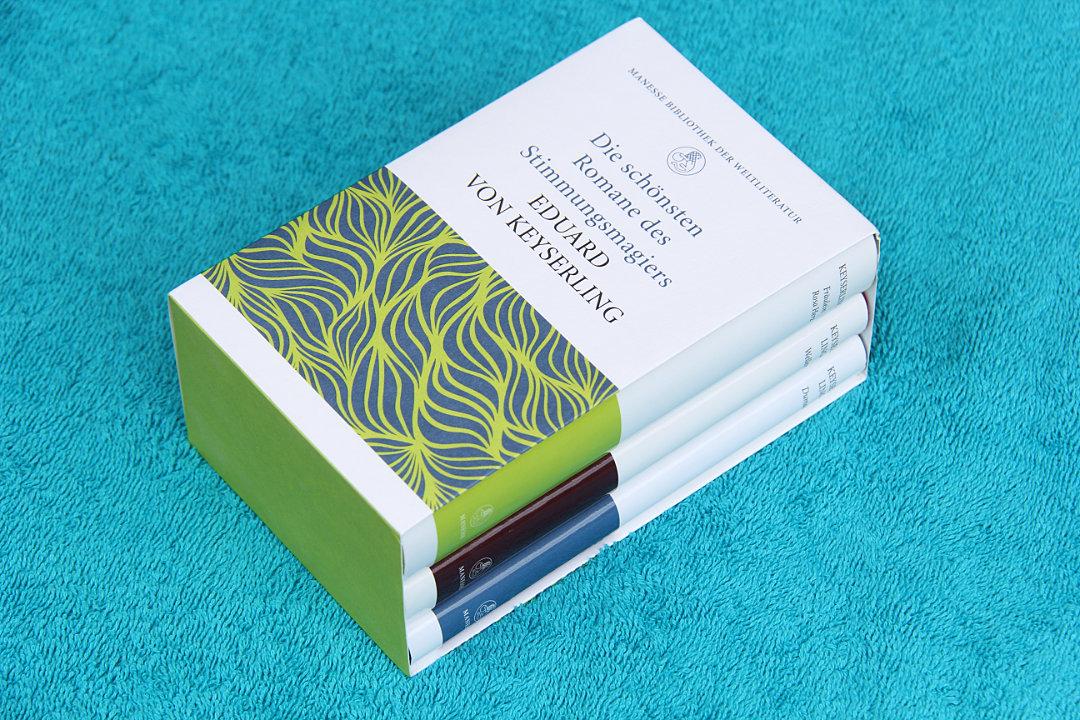
For the edition, I chose the aforementioned slipcase from Manesse Verlag. As a limited edition, there are several of these slipcases, each bundling three of those beautiful Manesse books. I think the idea is excellent, and for bibliophiles it makes a superb gift. For vacations, the small, handy books are ideal—taking up hardly any space, yet offering everything a discerning reader could wish for: high-quality cloth binding, sewn binding, and a ribbon marker. A glance at my bookshelf shows quite a few of these little Manesse volumes by now. For me, like the Hanser classics and the Mare classics, they’ve become a category of their own—you can buy them blind and always get the finest quality.
Conclusion: Keyserling’s three novels thoroughly impressed me. All three narratives shine with wonderful descriptions of nature, for which he is known and appreciated. Beyond that, he also possesses a very subtle mode of social critique and masterfully characterizes relationships in an exquisitely delicate way. You sink into his atmospherically dense landscapes, hover over the individual figures, empathize with them yet remain an observer, shake your head at certain utterances, and feel the social corset closing around the protagonists, enclosing them and making the inevitability of their life paths inescapable. These are fine psychological character studies that encompass society as a whole and, for me, belong right where they are in the Manesse Bibliothek der Weltliteratur, alongside other notable titles. As always, I can only recommend the Manesse edition. These little volumes proved their worth on vacation and offer everything a bibliophile heart desires.
Book information: «Allein wie er das Meer beschreibt!» – Die schönsten Romane des Stimmungsmagiers Eduard von Keyserling: Limitierte Geschenkausgabe im Schuber (3 Bände): «Wellen» (Waves), «Fräulein Rosa Herz» und «Dumala» • Eduard von Keyserling • Manesse Verlag • 1056 Seiten • ISBN 9783717524649
Schöne Rezi, meinen Dank. Langsam aber sicher wird der Keyserling doch wieder populär …
Dann kann ich Dir jetzt nur den neuen Roman von Klaus Modick empfehlen über Keyserling und Corinth. Liebe Grüße!
Ja, genau, lieber Tobi, diesen Roman würde ich dir als frischgebackenem Keyserling-Fan nun auch sehr ans Herz legen! Ich freu mich, dass dir besonders auch die Wellen so gut gefallen haben : ) Liebe Grüße
Petra
Liebe Petra,
von Dir weiß ich, dass du ja schon länger Keyserling empfiehlst und klasse findest. Also war die Wahrscheinlichkeit schon sehr hoch, dass die Bücher echt gut sind ;)
“Keyserlings Geheimnis” hört sich echt interessant an. Aber erstmal werde ich noch ein bisschen was von Keyserling lesen. Ich hab gesehen, dass es sogar vom Manesse Verlag noch ein interessanten Titel gibt.
Liebe Grüße
Tobi
Vielen Dank für diese Vorstellung – mir war der Autor bisher unbeknant – wie es scheint, absolut zu Unrecht!
Liebe Franziska,
ich glaube Keyserling ist doch eher ein Geheimtipp, den kennen nicht so viele. Aber ich kann ihn dir nur empfehlen. Ich bin gefühlt immer wieder über seine Bücher gestolpert ;)
Liebe Grüße
Tobi
Hallo,
ich muss gestehen, von diesem Autor noch nichts gelesen zu haben, aber da scheine ich ja leider keine Ausnahme zu sein… Es klingt so, als sollte ich das mal ändern, auch wenn man mit den Charakteren nicht so mitfiebert. Mich interessiert der gesellschaftskritische Aspekt besonders. Wie ich sehe (ich habe gerade nachgeschaut), kann meine Bibliothek da abhelfen.
“Unterm Strich ist sie zwar gesellschaftlich geachtet, aber alle sind sehr heiß auf die schöne Blondine und wollen sie klar machen.”
Da musste ich lachen, damit hatte ich nicht gerechnet!
Ich denke, ich werde “Dumala” mal auf die Leseliste setzen.
Ich habe diesen Beitrag HIER für meine Kreuzfahrt durchs Meer der Buchblogs verlinkt.
LG,
Mikka
Danke für die interessante Empfehlung. Geboren im heutigen Lettland – war für mich gleich das Stichwort zum Weiterlesen, … habe ich doch selbst das Baltikum/ Lettland intensiv bereist und darüber geschrieben,… um so mehr freut es mich, wenn Autoren mit lettischen Wurzeln wieder mehr Aufmerksamkeit geschenkt wird! Danke, Evelin Brigitte Blauensteiner
Ich hatte vor ca. vier Jahren ein Uni-Seminar zu Keyserling und meine damalige Dozentin hat so sehr von ihm und seinen Büchern geschwärmt, dass man sich dem kaum entziehen konnte. Ab da hat dann meine Liebe zu seinen Werken angefangen. Ich habe dann auch meine Bachelorarbeit über die Frauenfiguren in seinen Büchern geschrieben und freue mich gerade total, dass Keyserling aktuell so viel Aufmerksamkeit bekommt. Mit dem Schuber liebäugele ich in jedem Fall auch – danke, dass du ihn hier vorgestellt hast!