
Modeste Mignon • Honoré de Balzac
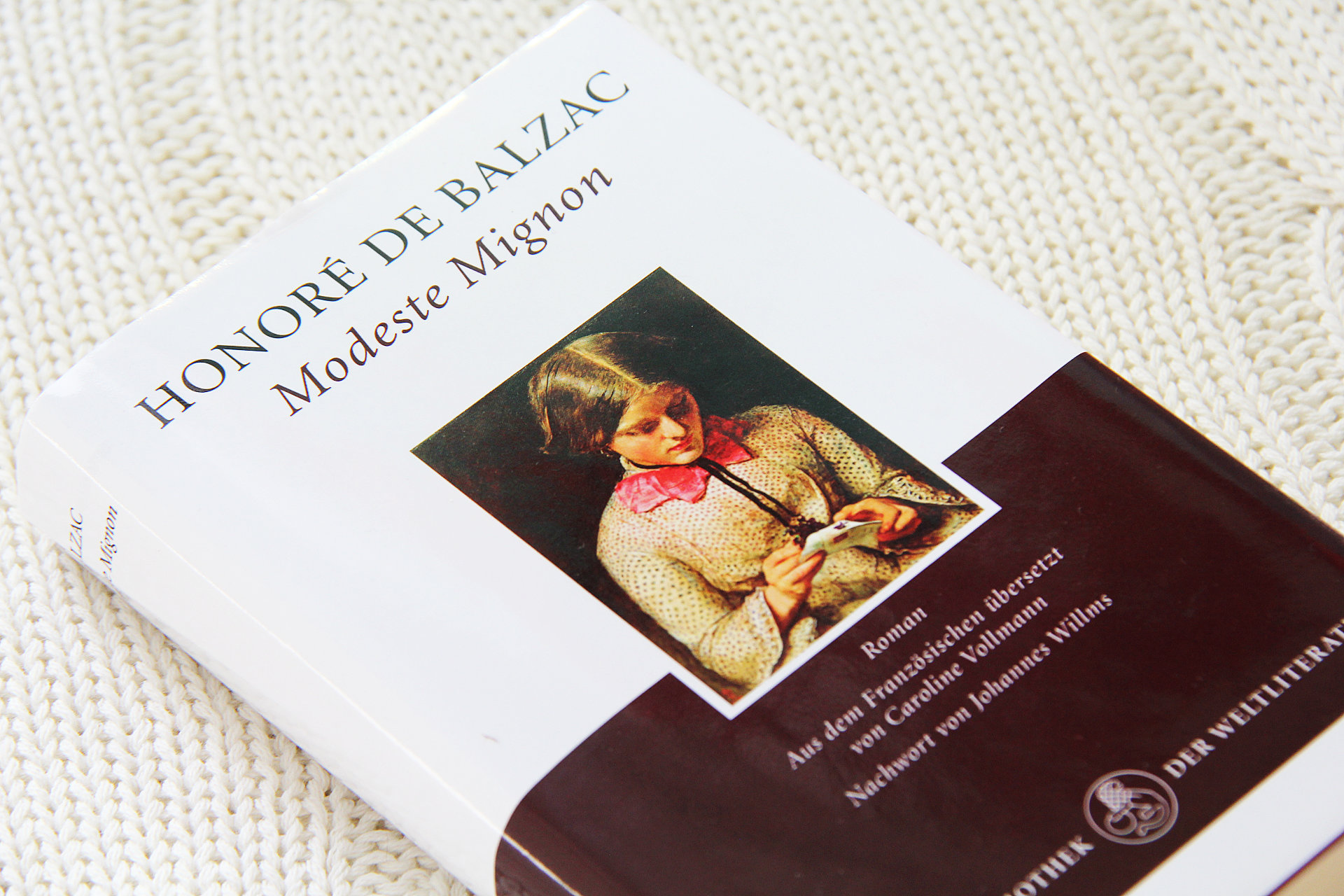
For me, Balzac is one of the real big fish in the literary pond and one of my absolute favorite authors. On Lesestunden I’ve neglected him so far, and I want to make up for that now by presenting one of his books from his Human Comedy. Modeste Mignon immediately appealed to me from the blurb and very quickly shot to the top of my wish list. I’m currently reading my way through Manesse Verlag’s current World Literature Classics program (many of the books are now out of print), and while browsing the publisher’s website it was—alongside Manon Lescaut—one of those books I simply couldn’t pass by.
At the center of the story is the young Modeste, daughter of a bankrupt merchant. Well sheltered, she loses herself in the world of books and especially adores a poet from Paris. She writes to him, and a lively correspondence ensues. Only it’s not with the poet—and suddenly things become interesting rather quickly. The beginning thus recalls an epistolary novel, though this is limited to the first 200 pages and is repeatedly interrupted there by chapters in a narrative mode.
Balzac’s way of writing is very detailed, with many explanations, precise descriptions of what his characters look like, how the settings are arranged, and frequent excursions into and explanations of the social and political situation. I always need the first 30 to 40 pages to get used to this expansive style. But then his books completely absorb me and I dive into his world. He offers truly beautiful prose that reads very smoothly and dazzles with lovely sentences. A very clear picture arises before the mind’s eye, and for me reading Balzac is a bit like watching a film. An example of such a well-turned sentence:
“She drank in long draughts from the cup of the unknown, the impossible, the dream. She admired that blue bird of paradise of young girls, which sings in the distance and can never be touched, which shows itself only fleetingly and which the lead of no gun can reach, whose magic colors and jewels sparkle and bewitch the eyes, and which vanishes the moment reality, that ghastly harpy, […] appears.” (p. 96)
Modeste Mignon is a book from his unfinished cycle of novels which, in allusion to Dante’s The Divine Comedy, he called The Human Comedy (La Comédie humaine). Its focus is the French society of the Restoration, and it is therefore consistently critical, cynical, and often satirical. The entire cycle also includes tales, essays, and in total 91 completed novels—his goal was 137. Lost Illusions is his best-known work, which I can recommend to anyone. In it he paints a very clear picture of the mores of his time, and it is a pleasure to read his books because they are also, from a storytelling perspective, more than exciting and entertaining. What’s special is that his characters reappear across different books—sometimes only in passing, sometimes center stage with a long arc of development. He is said to have created 2,000 different characters, and 573 people appear in at least two works.
When I think of Lost Illusions, the multitude of different figures—sometimes introduced with very little explanation, sometimes with extensive commentary—left me a bit confused, and I often had to flip back and check who was who. That’s not the case in this book: the cast is manageable, and you quickly get a feel for who ticks how and what role each person plays.
Modeste, who is of course duly introduced, struck me as realistic in character and nicely drawn, but I found the aim—the motivation for her actions—a bit contrived. However, there’s a specific reason for that, and what Balzac does with it—the constellation he arranges, how he positions his figures—turns the book into a very special reading pleasure from the middle onward. Even if some figures seem stereotypical, it’s precisely their interplay that gives the book its spice: it makes the plot seem predictable and then repeatedly surprises the reader. Together with numerous bon mots and reflections on society—from Balzac’s critical perspective (you often hear him speak through his characters)—and with never-boring, often brief digressive asides, the book is simply grand entertainment.
“Gobenheim let slip that sentence which nowadays is the sacred unction of genius in the eyes of economists and bankers: >>He’s making a crazy amount of money!<<” (p. 369)
Balzac was a bon vivant, had lovers during his successful years, and was quite the salon lion. You can sense that in the speeches he sometimes puts into his characters’ mouths, and you can see it in the way he describes the subtleties of social encounters. Themes such as high society life, gaining standing in the aristocratic world, and social ascent and decline are again and again at the center. There’s certainly something autobiographical here, for these were central elements of his own life. The son of a peasant family who worked hard for his success, tried numerous ventures and failed just as often, he ultimately managed to position himself in the noble world of his time, maintaining an extravagant lifestyle with numerous countesses and married noble acquaintances. And the afterword indeed reveals that there are very clear parallels between Modeste Mignon and the Polish noblewoman Eveline Hanska, with whom Balzac corresponded for many years, wooed her, and married her after the death of her husband, twenty years her senior. The model for the poet Canalis was probably the pianist Franz Liszt, who also moved in Hanska’s circle. The book thus seems closely interwoven with reality and with Balzac’s striving and courtship of Hanska.
In both biography and style, Balzac reminds me of Alexandre Dumas and Victor Hugo. He knew both well and, together with them, founded the Société de Gens de Lettres, a writers’ association. So it’s no wonder they share a certain stylistic kinship.

The book is compelling because different figures, each in their own way, embody and bring to life the mores of the time: the old nobility, much diminished in significance; the capitalist greed for money; the role of women and of marriage in a society on the cusp of the July Revolution—all these facets surface in the actions and thoughts of the individual protagonists.
Conclusion: Balzac simply knows how to tell a good story and manages to portray the mores of the Restoration through his characters, packing them into a gripping novel. His sometimes expansive yet wonderful style, the little bon mots and side swipes at the society of his time, and the agreeable, beautiful language make the reading a delight. The wooing of Modeste, with its twists, the social carousel, and the lively dialogues, held me spellbound, and I truly regretted finishing the book. It could have gone on forever, and for me it’s clear that Modeste Mignon won’t be the last book from the Human Comedy that I read.
Book information: Modeste Mignon • Honoré de Balzac • Manesse Verlag • 576 pages • ISBN 9783717521808
Hallo Tobi,
unglaublich, aber wahr: Dieses schöne Manesse-Büchlein war (vor “Emma”) mein letzter Neuzugang aus der Bibliohtek der Weltliteratur. Wunderbar, dass du es jetzt hier so schön in Szene gesezt hast. Ich finde es erstaunlich, wie wenig Titel Balzacs derzeit auf deutsch verfügbar sind.
Wieder ein toller Artikel von Dir.
Liebe Grüße
Thomas
Hallo Tobias!
Wie immer eine wundervolle Rezension, die Lust macht zum Klassiker-Regal zu schlendern und endlich wieder einmal einen Blazac-Roman zu lesen.
Schönen Montag,
Nana
Ich habe vor kurzem auch die tollen Büchlein aus dem Manesse Verlag für mich entdeckt. Freue mich auch immer sehr über deine Klassiker-Rezensionen und dass du diese besonderen Bücher einem so “schmackhaft” machst :) Von Balzac habe ich leider noch gar nichts gelesen. Aber er steht definitiv auf der “To Read” Liste – jetzt noch mehr als zuvor.
Liebe Grüße
Britta
Hi Tobias,
das Zitat hat mir schon gezeigt, dass ich wohl auch erstmal eine Weile brauchen würde, um ich an diesen ausschweifenden Stil zu gewöhnen. Danke für die Rezi, du hast mir richtig Lust gemacht, auch endlich wieder einmal zu einem Klassiker zu greifen, obwohl es wohl nicht Balzac sein wird :-D
Liebes Friedelchen,
Balzac liest sich eigentlich sehr angenehm, an seinen Stil gewöhnt man sich recht schnell und dann ist es ein großes Vergnügen seine Bücher zu lesen.
Es freut mich, wenn ich die Lust auf einen Klassiker wecken konnte. Welchen hast du denn ins Auge gefasst?
Liebe Grüße
Tobi
Ich habe grad mal geguckt, ich habe jede Menge Bücher von Balzac hier, von meinem Opa übernommen. Dann werde ich mich wohl doch einmal an ihm versuchen. Gibt es noch andere Bücher von ihm, die du empfehlen kannst (Modeste Mignon ist natürlich nicht dabei)?
Ich dachte bei meinem Ausflug unter die Klassiker eher an deutsche Autoren. Thomas Mann, Kafka etc.
Also das bekannteste und auch ein echt spitzen Buch ist “Verlorene Illusionen”. Der zweite Teil heißt “Glanz und Elend der Kurtisanen”. Beide Bücher hab ich verschlungen, die sind einfach klasse.
Deutsche Klassiker habe ich bisher stark vernachlässigt. Aber das hol ich noch noch nach. Thomas Mann ist auch schon auf meinem SuB.
Liebe Grüße
Tobi
Danke für die Tipps, die beiden werde ich mir einmal genauer anschauen.