
War and Peace • Leo Tolstoy
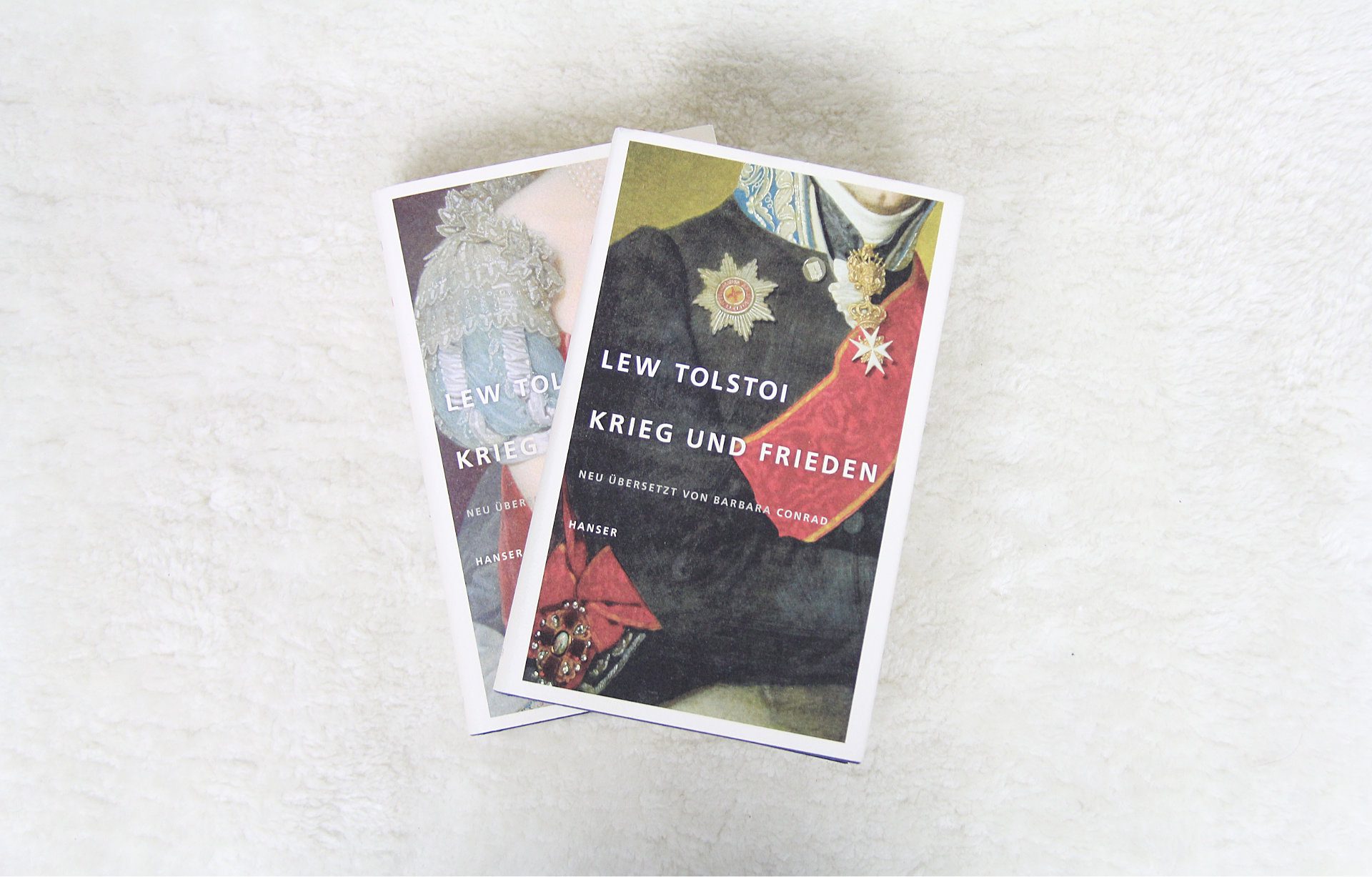
After quite some time, here comes another review of a true heavyweight in the world of literature. In both senses of the word, since War and Peace is not only vast in scope but also offers a great deal of substance. Initially, I hadn’t planned on writing about the book, but the reading experience was simply too delightful, and the book itself so magnificent, that I just had to blog about it. Even though it’s hardly an insider’s tip and is one of the best-known works of world literature, I’ll let my own taste guide me here and write about it anyway. During my rereading of War and Peace, the characters, the descriptions, and the entire setting once again captivated and fascinated me. In this post, you’ll find out what makes this book so special to me.
War and Peace is a historical novel, a monumental work that portrays the lives of several people and families against the backdrop of Napoleon’s campaign against Russia. It vividly brings to life society, individual fates, historical contexts, war, and Russia itself. Many families and figures appear throughout the novel, but at its center are several recurring characters from the Russian aristocracy. There’s Pierre Bezukhov, the illegitimate son of a very wealthy count who eventually becomes his heir; Prince Andrei Bolkonsky, who at the beginning of the novel wishes to escape the boredom of aristocratic life by joining the military; and Nikolai Rostov, a young nobleman eager to join the hussars and win fame and honor in war. Also of great importance are Natasha Rostov, Nikolai’s sister, who reappears throughout the story, and Princess Marya, Andrei’s sister. Through these characters, Tolstoy introduces readers to the upper class of Russian society, depicting their lives and quickly immersing them in the military world to which all feel drawn. Yet the true main character of the book is war itself. Tolstoy keeps returning to it, describing Russia’s conflict with France and Napoleon’s campaign in Russia. The timeline spans from 1805 to 1812, chronicling the developments of the war from Austerlitz to Waterloo from the Russian perspective.
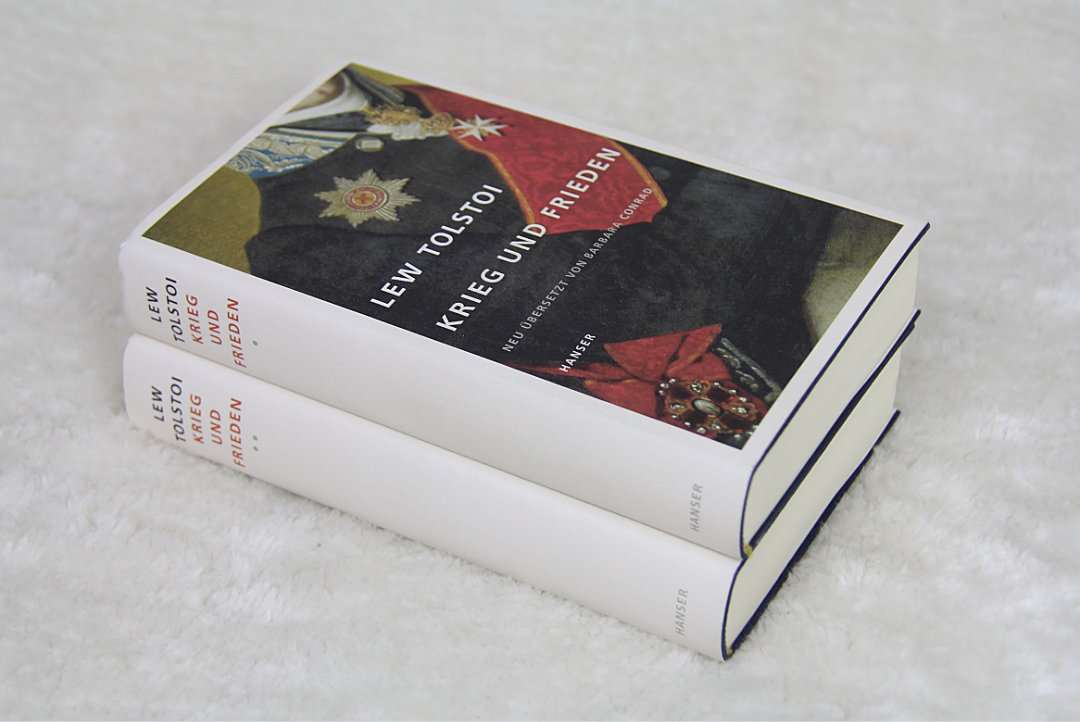
The book is, of course, a massive undertaking, and the Hanser edition spans 2,288 pages. So one must set aside a good deal of time to read it—but the reward is all the greater. The novel completely absorbed me. At first, it takes a little time to get used to the Russian names and to gain an overview of the many characters. Some years ago, I read the original version of War and Peace, published by Fischer Verlag, which is about 1,200 pages long and therefore not quite as extensive. Back then, I already knew that I wanted to read the more complete version. Since then, I had kept these Hanser volumes on my shelf, knowing full well what kind of pleasure awaited me.
Tolstoy revised and rewrote the book many times. The original version is based on the text Tolstoy initially wrote in 1867. Reconstructing it was apparently quite difficult, as Tolstoy had filled both sides of his manuscript pages with numerous corrections, which made it hard to distinguish between the original version and later revisions. In 1918, a staff member of the Tolstoy Museum spent decades reconstructing the original text. In 1983, it was finally published in the USSR, though only with scholarly commentary. It wasn’t until the year 2000 that the text was edited for general readers and translated into other languages.
There are several differences between the original and the “canonized” version of the novel. Among them, the philosophical excursions into history are more extensive. I can confirm this: I had braced myself for lengthy, tedious passages but actually found them engaging and enjoyable to read. The ending also differs, and of course, the length is a significant contrast. Personally, I preferred the original version—it conveys the essence of the story more directly and feels more cohesive—but both versions are of equally high quality. For readers with patience, who already enjoy Tolstoy’s works, I definitely recommend this more extensive edition.
The novel belongs to the realist tradition and combines many elements. On one hand, it is a social novel, beautifully portraying the culture and lifestyle of the upper classes of its time. At the same time, it traces the personal journeys of Pierre, Andrei, and Nikolai. That’s what I liked best about the book: especially Pierre and Andrei’s search for meaning and purpose in life. Tolstoy lets them experience all the highs and lows that come with that search. Their reflections on society, religion, and politics, the conclusions they draw, and their ongoing quest all give the novel great depth. It was fascinating to follow how differently Pierre and Andrei grapple with this central question and how real Tolstoy’s characters feel. One has the sense that these people truly lived (as, in fact, some historical figures did)—just as I always felt while reading Anna Karenina that I was reading a biography. The characters’ storylines are intricately interwoven, primarily through their families and social connections.
There are characters like Andrei’s father, the old prince, or the old Count Rostov—quintessential Russian originals. These many side characters give the book a great deal of authenticity and create a vivid picture that brings old Russia to life. Hélène, for example, perfectly embodies the aloof aristocrat, dazzling in her salon while utterly detached from reality. Natasha Rostov is a true free spirit and offers a glimpse into Russian culture, which at times feels very picturesque—such as during a winter hunt in the countryside followed by a feast with food, drink, and song, or a nighttime sleigh ride at Christmastime. Reading those scenes was a real pleasure.
Of course, the war and Napoleon’s campaign occupy a large part of the book. Tolstoy’s pacifist perspective on the military is both shocking and fascinating. The enthusiasm and admiration once shown toward Tsar Alexander, the high regard for the military—and the grim contrast of reality on the battlefield—are brilliantly portrayed. Tolstoy shows that Napoleon was neither a genius nor a great commander, depicts the disorganized Russian army, and—daring as this may sound—reminds me often of the same sort of dysfunction one finds in modern companies, where people seem primarily motivated by personal accolades. Numerous historical figures appear—Napoleon, Tsar Alexander, and generals such as Kutuzov and Bagration, among others.
Time and again, Tolstoy analyzes and interprets historical developments. In particular, he examines the roles of generals and political leaders, and with excellent reasoning, he downplays their significance—contradicting the historians of his time. There’s real philosophical value in this, since even today political actors—especially in our own media—are vastly overestimated. I found his analogy between historical interpretation and infinitesimal calculus especially brilliant, as well as his reference to the paradox of Achilles and the tortoise. In the end, little remains of the grandeur and supposed strategies of war. For Tolstoy, all the historical events, decisions, and actions of the commanders are the inevitable outcome of the countless individuals and circumstances that together shaped them—just as today’s political, social, and economic events arise from this diffuse, continuous sum. There’s an inherent determinism here, which one might call providence or fate, but ultimately it’s an unavoidable societal expression—much like current political trends in our own time. He convincingly argues that the more power a person wields, the less they act according to their own will, and he repeatedly supports this with strong examples. Especially in the epilogue, he revisits and expands these ideas in great detail.
The impact of war on the protagonists ties everything together. In this unstable political environment, they seek personal fulfillment. I found Andrei especially compelling as a character—both in his nature and in how Tolstoy develops him. His thoughts resonate on a universal level, giving the book something deeply human. It’s fascinating how he explores every possible path to find purpose—from a military career to withdrawal into private life, altruistic projects, or the search for true love. Even his flaws are perfectly believable and add to the realism of his portrayal.
Tolstoy lived from 1828 to 1910, and when the first version appeared in 1867, Napoleon’s campaign in Russia was already more than 50 years past. The extensive notes show how much research Tolstoy did in his attempt to depict actual events. The book feels authentic in its content and, along with its many characters, paints a remarkably realistic picture.
The subject matter might sound heavy, but I found reading the book very relaxing. The style isn’t difficult, and the prose flows smoothly. However, I do think it’s best to read it steadily rather than in small portions—otherwise, you might lose the thread. I had a similar feeling while reading Anna Karenina.
War and Peace has been adapted for film countless times. I got the DVD of the old adaptation starring Audrey Hepburn from the 1950s. There’s also a BBC adaptation from 2016, which tells the story in eight episodes. I watched the first few episodes—they’re beautifully done. For those who want to visualize the world of the book, it’s a nice complement, since while reading, I often wondered what the battles and the characters’ clothing might have really looked like. Still, the series is a bit like War and Peace for beginners—it includes the main storylines but is so condensed that much of the book is lost. That doesn’t surprise me and just proves that the novel can’t truly be filmed. The characters’ inner lives—the very essence of the book—are completely missing. The depictions of warfare and battles are heavily simplified, mostly reduced to scenes of gunfire. The philosophical reflections are entirely omitted. And the biggest disappointment: Princess Bolkonskaya’s sexy upper-lip mustache is missing altogether.
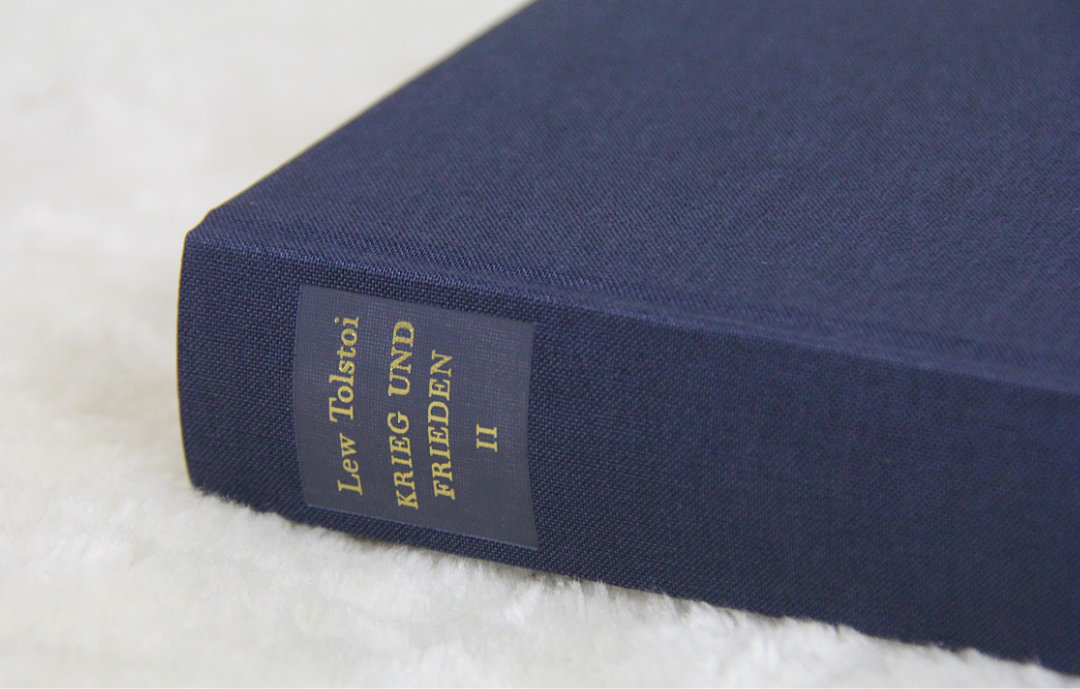
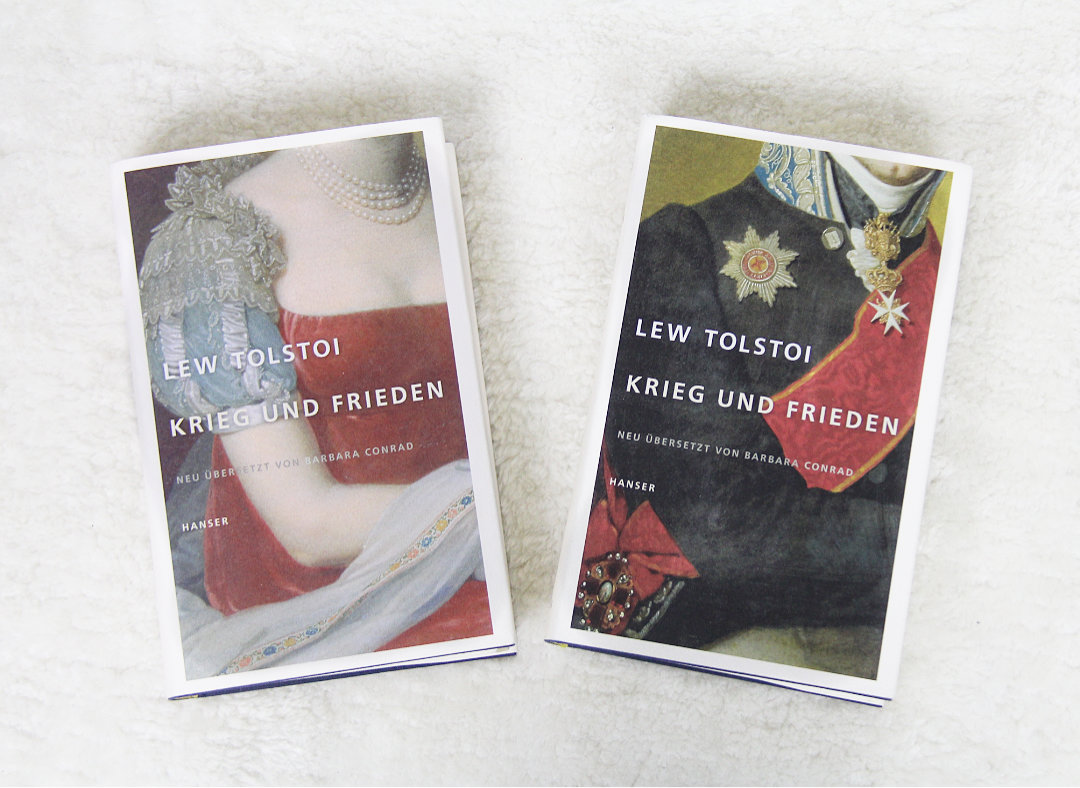
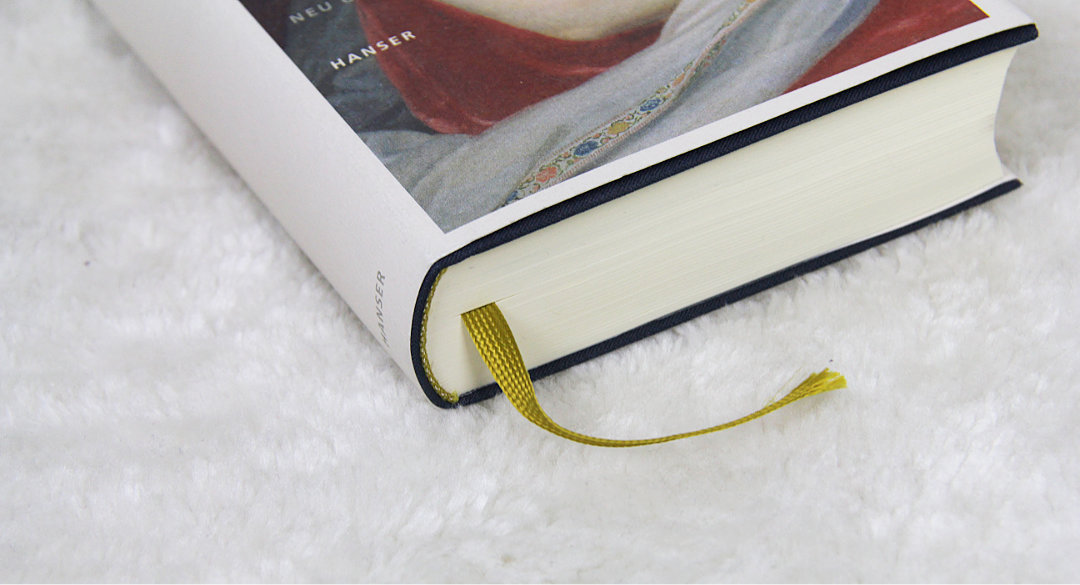
The Hanser edition is once again outstanding. The book is divided into two volumes printed on thin paper, making them compact and easy to handle. You don’t have to lug around a huge tome, yet you still get a beautifully made edition. The notes and afterword reflect a well-researched and high-quality translation. Barbara Conrad received an award for her translation, and she was clearly a top-tier translator at work here. I really like the cover design, and overall, it’s a visually striking edition. A second ribbon bookmark wouldn’t have hurt, but otherwise, the quality is excellent. The two volumes aren’t exactly cheap, but considering the amount of reading time they offer, they’re actually quite a bargain. For those hesitating, I can definitely recommend the original version from Fischer Verlag, which is much cheaper. It still delivers that quintessential War and Peace atmosphere and includes all the key story elements about the protagonists. The pages-per-euro ratio is even better there—but the Hanser deluxe edition certainly holds its own.
I also found the afterword very well done. It provides insight into the background of this book. For example, Tolstoy insisted that it was not a novel and that it had no resolution. You also learn quite a bit about Tolstoy himself—his experiences in the Caucasus War, his admiration for Rousseau, and the influence of Stendhal’s The Charterhouse of Parma (especially the Waterloo scenes). He did extensive research for the historical details, interviewing eyewitnesses and even visiting the battlefield of Borodino to make sketches of the troop formations. The connection to Rousseau doesn’t surprise me, especially when you think of Tolstoy’s descriptions of an ideal agricultural estate at the end—it strongly echoes the ideals Rousseau expresses in Julie, or the New Heloise.
Conclusion: War and Peace is one of the most versatile and fascinating books I have ever read. It is a social novel, a historical novel, a Bildungsroman; it is philosophical yet personal, realistic, and filled with authentic, lifelike people. The historical backdrop of Napoleon’s Russian campaign, as well as the depiction of society at that time, deeply impressed me. I could easily empathize with the protagonists, especially Prince Andrei, whose search for fulfillment and meaning in life is masterfully portrayed. I don’t think one can ever exhaustively describe or analyze this book—you simply have to read it. For me, it’s certain that this won’t be the last time I pick it up. Too fascinating is this intricate web of people, families, society, culture, and the unflinching portrayal of war. Truly, a masterpiece of world literature.
Book information: War and Peace • Leo Tolstoy • Hanser Verlag • 2,288 pages • ISBN 3446235752
ich habe das Buch damals in meiner Jungendzeit gelesen, und es hat mich genauso beeindruckt, wie dich, und es prägte mich, wie kein zweites. Du hast recht, wenn du schreibst, dass man dafür etwas Zeit braucht, einerseits, um sich in die ganzen Figuren hineinzuversetzen, andererseits um die russischen Wörter, die selbst für eine ehemalige DDR_Bürgerin, wie ich eine war, nicht immer einfach zu übersetzen waren.
Klasse rezensiert !
Liebe Britta,
hast du das Buch damals im Original gelesen? Also das muss nochmal ein ganz eigenes Erlebnis sein. Wobei die Übersetzungen vom Hanser Verlag schon klasse sind. Und dass das Buch einen bleibenden Eindruck hinterlässt, dass kann ich nur bestätigen. In Jugendjahren wahrscheinlich noch viel stärker. Es freut mich, dass meine Rezension gefällt!!
Liebe Grüße
Tobi
Ja, solch eine umfangreiche Rezensionen fehlen mir heute bei meinen Büchern, denn ich habe in Anlehnung an Krieg und Frieden meine Biografie ” Eine Frau von Ost nach West” Zeit für Veränderungen geschrieben, und auch mein Kinder-Krimi ” Peter, der kleine Katzen Kommissar befasst sich mit Leben im Frieden und Freiheit ich glaube beide Bücher würden dir gefallen ich möchte hier keine Eigenwerbung betreiben, aber ein Autor ist immer nur so gut, wie er oder sie in den Rezensionen gesehen wird.
Moin,
also meine Fassung wiegt in einem Band unter 500 Gramm und ist in feinem Leder gebunden. Ich kann soviele Lesezeichen setzen wie ich mag und Anmerkungen schreiben, die man Rückstandsfrei wieder entfernen kann. Daneben bietet es Zugang zur aktuellen Ausgabe der Süddeutschen und der Spektrum der Wissenschaft. Und wenn ich schnell mal was nachschlagen möchte ist auch gleich eine Enzyklopädie dabei. :)
Spass beiseite. Mich erinnert Krieg und Frieden immer an den Film “Mr Hobbs macht Ferien”, als er mit dem Buch an den Strand geht, und die blonde Schickse, die er dort trifft, sagt: “Ach DAS Krieg und Frieden. Von diesem Sowieso. Mit den ganzen russischen Namen. Ich habe nie gewusst, wer eine Frau und wer ein Mann ist.” Nun, ist bei mir nicht ganz so schlimm, aber so richtig warm geworden bin ich mit dem Buch nicht. Da hab ich mich über Tage geschleppt und ich bin normalerweise ein ziemlicher Schnellleser. Den Osten Ard Zyklus zB habe ich an einem Wochenende verschlungen, und zumindest die erste Hälfte der´s ersten Bandes zieht sich ja auch ein wenig. Da fällt mir auf, den Fantasybereich hast du in letzter Zeit zumindest nicht verblogt. Da stecke ich zumindest gerade in “Der Fall von Gondolin” von Tolkien. Mit elbischen Namen komm ich besser klar als mit russischen. Obwohl mir Anna Karenina sehr gut gefallen hat. Liegt aber vielleicht auch daran dass dasd Buch mit Effi Briest und Madame Bovary auf einer Wellenlänge, alles Bücher, die mir gut gefallen.
Ich hab die Urfassung gelesen (steht zumindest vorne drauf), habe aber keinerlei Bezüge zu anderen/späteren Versionen gezogen. Dazu hat es mir schlicht zu wenig gefallen, mich damit weiter auseinanderzusetzen. Dafür liegen einfach zu viele Bücher auf dem SuB. Apropos SuB: das ist ein grundlegender Nachteil von elektronischen Büchern. Denn weil der ja keinen realen Platz wegnimmt neigt er nicht nur dazu zu wachsen, sondern exponentiell zu wachsen. Ganz oben auf liegt da jetzt übrigens Ulysses, das ich bestimmt schon Jsahre vor mir schiebe.
//Huebi
Lieber Huebi,
praktisch sind sie schon die Ebook Reader. Immer wieder umkreise ich sie, aber kann mich dann doch nicht durchringen. Besonders Bücher, von denen es keine schöne Ausgabe gibt, wäre das in dem Format auch eine praktische Option. Man bekommt halt für 99 Cent tonnenweise Klassiker, die man manchmal sonst echt schwer als Buchausgabe bekommt. Ich denke da an die Heloise von Rousseau. Und ich würd behaupten, dass ich eine gewisse IT-Affinität habe. Aber irgendwie ist die Vorstellung davon, mit einem Ebook Reader da zu sitzen dann doch immer zu schnöde. So ein durchgelutschtes Buch hat dann doch mehr Charme. Und ich bin selten lange unterwegs, so dass ich ja jeden Tag mir ein neues Buch dann mitnehmen kann. Und für Urlaube sind die Manesse Bücher wiederum perfekt, da kann man schon auch einige einpacken, ohne dass man das so groß merkt. Und um was nachzuschlagen, hab ich mein Smartphone dabei. Nene, eine Buchrolle stichst du mit einem E-Reader noch aus, ein schönes Buch sicher nicht :)
Am Ende ist das natürlich immer auch Geschmackssache und auch die Frage, wann man was liest und in welcher Stimmung man ist. Ich kann mir gut vorstellen, dass Krieg und Frieden für einige Leute nichts ist. Man muss schon Zeit mitbringen, das ist klar und manchmal ist die Story durchaus langsam. Aber so weit weg von Fantasy ist das auch nicht mit seinen Schlachten ;) Wobei die elbischen Namen natürlich wohlklingender sind als die russischen.
Fantasy habe ich in den letzten Monaten gar nicht gelesen, irgendwie zieht das Genre aktuell bei mir nicht. Auch auf das neue Tolkien Buch hab ich nicht so richtig Lust. Aber die Russen haben es mir momentan wieder ganz gut angetan. Mein SuB ist momentan auch ganz schön geschrumpft. Na mal sehen was ich mir so die nächste Zeit hole. Von Balzac habe ich auch noch einige Bände, da wird auch bald wieder was fällig. Immer nach ein paar Monaten merke ich, dass es wieder für eine geschmeidige Balzac-Session Zeit wird ;)
Herzliche Grüße
Tobi
Hallo Tobi,
also den Zahn mit den 99 cent Büchern muss ich dir gleich ziehen :)
Es gibt recht gut gemachte Bücher aus dem Userumfeld für lau, da hab ich zB meinen Shakespeare her. Doch vieles ist oft auch sehr schlecht umgesetzt, mit zig OCR Fehlern, falscher Absatztrennung oder Seitenzahler mitten im Text. Als du den Grafen von Montechristo vorgestellt hast, habe ich nach der langen Version gesucht, und für die lange, gut gemachte Version deutlich mehr hingelegt. Mal so eben einen Klassiker herunterladen ist nicht, jedenfalls nicht wenn man Wert auf gut gemachte ebooks legt :)
Und viele sind dann auch noch in der uralten Rechtschreibung gesetzt, also giebt, Thal oder Thür. Das mag ich so gar nicht, für mich behindert das den Lesefluss.
Ausschlaggebend ist für mich einfach der Platz und das Gewicht. Auch dickste Schmöker sind einfach zu lesen, im Urlaub ist alles dabei (da magh der eine sagen, die Auswahl für den Urlaub gehört zum Urlaub), ich wähle dann halt am Strand. Dauert mal wieder länger irgendwo? Kein Problem, viele Bücher habe ich auch auf dem Handy. Das ist zwar nicht so prall zum drauf lesen, Aber besser als Löcher in die Luft zu starren oder Das goldene Blatt lesen zu müssen ist es allemal. Ich lese halt auf dem Reader, dem Tablet und dem Handy. Als Leseratte wird der Bestand nunmal nicht kleiner.
Wenn für dich der “günstige” Zugang zu Klassikern viel Gewicht hat, solltest du es evtl doch eher lassen. Denn den Hang zu guten und schönen Büchern haben wir beide, und auch bei den ebooks gibt es viel technischen Schund.
//Huebi
Ich las dieses faszinierende Buch mit 14 Jahren und ich konnte es nicht aus der Hand legen. Ich mag diese Art des Schreibens von Tolstoi. Die neue usgabe werde ich mir gleich besorgen, denn das alte Buch in schwarzem Leder gebunden, ist mir bei einem Umzug abhanden gekommen.
Liebe Anneli,
die Ausgabe ist wirklich perfekt, da kann man echt nichts sagen. Ich mag Tolstois Stil auch sehr gerne. Vom Hanser Verlag gibt es ja auch “Anna Karenina” und “Auferstehung”. Die sind beide auch echt super und lesenswert. Und ich hab beide hier im Blog auch rezensiert. Wobei natürlich eine alte Lederausgabe von “Krieg und Frieden” aus der eigenen Kindheit wahrscheinlich schwer zu übertreffen ist ;)
Liebe Grüße
Tobi
Lieber Tobi,
ich bin jedes Mal fasziniert, wie du es schaffst, die Bücher so treffend und einnehmend zu beschreiben. Auch diesmal hat mich direkt die Lust gepackt, das Buch nochmal zu lesen und all die schönen Erinnerungen von damals kamen wieder. Danke dir dafür! Ich habe Krieg und Frieden vor 10 Jahren im Original gelesen und war auch wie du von all den vielschichtigen und realistischen Figuren begeistert. In Andrej habe ich mich direkt verliebt, mit ihm konnte ich mich am meisten identifizieren. Meine Lieblingsstelle ist aber die mit Pierre, als er versucht, aus seinem Namen die Zahl 666 zu erhalten so wie er es bei Napoleon geschafft hat. Sein tollpatschiger und naiver Charakter und der Wunsch, eine wichtige Persönlichkeit fürs Weltgeschehen zu sein, kamen hier auf eine so amüsante Art zur Geltung, dass ich die ganze Zeit schmunzeln musste. :-) Hast du auch eine Lieblingsstelle?
Liebe Grüße,
Lena
Hallo Tobi,
dank deinen Rezensionen wag ich mich ja immer an die “großen Schwarten” der Literatur heran; grad hab ich “Der Graf von Monte Christo” beendet. Auch hier macht deine Rezension wieder Lust, gleich loszustiefeln und sich das Buch zu besorgen. Über 2000 Seiten ist mal definitiv eine Hausmarke, Tolsoi meint es ernst mit seiner Geschichte.
“Krieg und Frieden” kommt definitiv auf meine Liste der Klassiker, die ich bald lesen möchte.
LG
Daniela
Ich denke an deine Worte, nicht zuviel Zeit beim häppchenweise Lesen verstreichen zu lassen um nicht den Faden zu verlieren, wenn ich mir Ende diesen Jahres/Anfang nächsten Jahres Anna Karenina vornehme. Mein erster Tolstoi, für Krieg und Frieden und der stolzen Seitenanzahl habe ich noch zuviel Respekt. Vielen Dank für den Einblick!
Jetzt musste ich doch glatt einmal mein Bücherregal durchsuchen und schauen, welche Fassung ich denn eigentlich habe. Die vom Anaconda-Verlag, 2007 erschienen und 1532 hauchdünne und in Kleinstschrift beschriebene Seiten. Ein Backstein, wie man ihn selten hat und so zerbrechlich, wie dieses ganze gesellschaftliche Gefüge, welches Tolstoi so herrlich zu beschreiben vermag. Das hat mir sehr gut gefallen. Es ist das Buch, für dass ich nach meiner Erinnerung am längsten gebraucht habe, da ich es dummerweise in meinem Abi-Jahr gelesen habe, neben den ganzen Prüfungsstoff. Nicht besonders klug war das von mir, aber immerhin ein sehr kluges Buch. Gibt es irgendwo eine Übersicht über die verschiedenen Fassungen, die erhältlich sind? Nach meinen Erinnerungen musste ich mich die ersten 500 Seiten über durchkämpfen, um die restlichen 1000 zu genießen. Ich würde gerne wissen, ob ich eine gekürzte Version gelesen habe oder ob die Seitenanzahl “nur” an der Kleinstschrift lag. Weiß das jemand?