
The Great Gatsby • F. Scott Fitzgerald
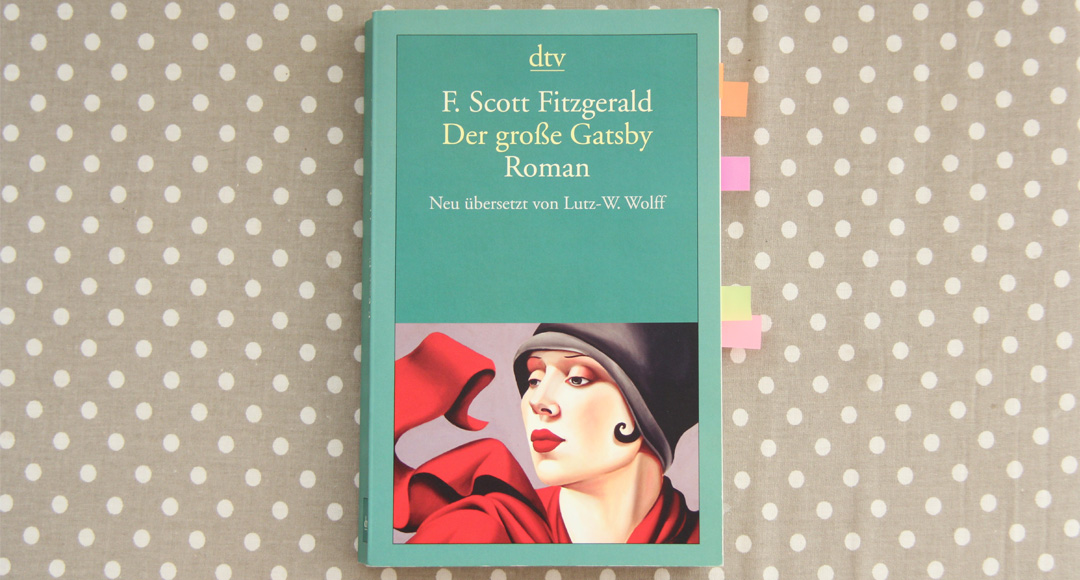
The Great Gatsby is a classic so ubiquitous that it’s hard to get around it. When I put out a small call on Twitter for good classics recommendations, this book was mentioned several times, and since it was already on my TBR pile, it moved straight to the top this time. I love books set in 1920s New York. There’s a kind of strange pseudo-nostalgia there that turns the city—and the legends surrounding it—into an ideal place for adventure, but also into an exciting backdrop for human endeavors. With all the promises the city stood for at that time.
At the center of the story stands Jay Gatsby with his tragic love story. It’s embedded in the decadent life of the 1920s before the great crash—in a society that really indulged itself. Fitzgerald presents this time and its people in a fairly straightforward way: critically, with a sarcastic, sometimes even oddly satirical style. It’s hard to pigeonhole this book. It is multifaceted and not exclusively a depiction of the era’s ills, not only a love story, and not just a portrait of the actions of the wealthy set. It’s a mixture of all these things and much more. Sometimes poetic, sometimes very realistic, somehow autobiographical, yet always a bit off-kilter.
Refraining from critical judgments contains an infinite hope. (p. 10)
If you take a 1,000-page classic and shake the book until about 80% of the sentences fall out, you end up with something like The Great Gatsby. Of course not at random, but through a sieve that retains only the most essential information—with great sensitivity preserving exactly the sentences and passages needed to create an intense impression in the reader. Fitzgerald describes situations, actions, and thoughts with pinpoint precision, and precisely through what he doesn’t write, much of the mood and the characters’ feelings are conveyed. And I think that’s exactly why this book became so famous. Because especially when his protagonists don’t speak, the reader senses instinctively what remains unspoken and how much meaning lies in that. He doesn’t even describe the people fully, leaving much to the reader’s imagination—yet those gaps are filled aptly, since the key cornerstones of his characters nevertheless appear vividly before the mind’s eye, mostly through what happens—what they do, how they react to others.
This book reminded me strongly of Garden by the Sea, which likewise has a distinctly impressionistic style, creates a pastel-like image, and conveys so much through its undertones. Somehow it’s not entirely graspable, diffuse, and yet the mood and feelings are perfectly clear. As readers we learn everything through Nick, who describes his observations. The feelings—the things that move the actual main figures of the love story—remain in the shadows. Here too, the book strongly resembles Garden by the Sea, where everything was relayed by the gardener. In my view, however, this is also the great weakness. Of course the story is artfully composed—with its hints, its bon mots, its stereotypical yet very realistic figures. After only a few pages you feel the melancholy hanging over Gatsby, and the sluggish decadence weighing on Daisy like a dark veil. You also get a sense, in very subtle fashion, of what Tom and Daisy’s marriage looks like and how the spouses feel. All of this comes across very clearly without these impressions being spelled out or shouted. And yet there is always a distance. You see the players, but empathy bumps up against its limits—against the limit of what can be conveyed through observation alone.
Fitzgerald imparts a certain realism in this book. Even when he exaggerates, you still buy the story and the characters. That reminded me of Maupassant, who also always managed to cloak his tales—despite overdrawn elements—in a mantle of authenticity. And in fact, such a story is possible and even likely within its framework. As with Maupassant, I accepted it from him as well, and for me the question of whether the protagonists’ decisions are plausible is answered with a yes.
Looking back at the book now, the nostalgia I mentioned at the beginning didn’t rub off on me. Whether it was the places of this story, the people themselves, or the moods—none of it brought that classic image of New York to life in me. Just as the characters’ feelings didn’t fully reach me, the city’s charm didn’t either—even if Fitzgerald finds some very beautiful words in places.
Over the great bridge, where the sunlight falling between the steel girders creates a constant flicker on the moving cars, while on the other side of the river the city rises as a range of white sugar cubes, all conjured into being by mere wishing, out of completely odorless money. When you see it from the Queensboro Bridge, the city is always as if seen for the first time, the first wild promise of the world’s secrets and all its beauty. (p. 86)
Conclusion: The Great Gatsby is certainly a masterful composition, one that lives off what is left unwritten—one that creates a story out of what is fragmentary. Whether feelings, thoughts, or New York itself—everything is told realistically, impressionistically, unvarnished, and very much in the spirit of its time. But Nick as observer and narrator inserts a distance between the actual main characters that did convey their feelings to me, yet didn’t manage to make me feel them—didn’t allow them to reach me in full. I trust Fitzgerald enough to believe this is intentional, that nothing in this refined composition is left to chance. But the portrait of the people, their fates, and the image of New York did not enthrall me, and so The Great Gatsby and its Daisy will probably rank further back among the great classics for me.
Book information: The Great Gatsby • F. Scott Fitzgerald • Deutscher Taschenbuch Verlag • 256 pages • ISBN 9783423139878
Hach, jetzt möchte ich am liebsten direkt zu dem Buch greifen! Klasse Rezension!
Huhu Saskia,
sehr schön, das ist das beste Lob, was man für eine Rezension bekommen kann ;) Aber wie ich dich kenne, wäre es die zweite Lektüre von dem Buch oder?
Liebe Grüße
Tobi
Hallo Tobias,
eine schöne und differenzierende Rezension. Vielleicht würde Dir “Diesseits vom Paradies“ besser gefallen; es ist umfangreicher und Fitzgerald spricht mehr an.
Ganz anders, aber ein tolles Buch über Amerika ist “Öl“ von Upton Sinclair:
https://notizhefte.wordpress.com/2013/08/16/der-rote-olprinz/
Liebe Grüße
Norman
Lieber Norman,
Fitzgerald ist erstmal auf die hinteren Ränge gewandert. Es gibt einfach zu viele Bücher, die sich einfach sehr verlockend anhören. Auf jeden Fall die großen Franzosen des 19. Jahrhunderts, die ich einfach allesamt liebe ;)
“Öl” hört sich auch echt spannend an. Es passt vor allem sehr gut zu unserer Zeit, immerhin lebt jetzt die ganze Welt den Vollgasraubtierkapitalismus. Aktueller könnte das Buch nicht sein.
Liebe Grüße
Tobi
Hi Tobi :o)
Selten habe ich eine so durchdachte und fast poetische Rezension lesen dürfen. Deinen Leseeindruck zu “Der große Gatsby” lesen zu dürfen bereitet vermutlich mehr Freude als die Lektüre selbst! ♥ Ich habe mir “The Great Gatsby” (allerdings die Anaconda-Ausgabe) damals gekauft, als die Verfilmung mit DiCaprio (schon gesehen?) in die Kinos kam… Leider schlummert er bis heute auf meinem SUB *schandeübermich*
Ich bin sehr gespannt, welchen Klassiker du dir als nächstes vorknöpfst!
Viele liebe Grüße,
Nana
Liebe Nana,
vielen Dank für deine Worte, die mich echt sehr freuen. Die Verfilmung hab ich nicht gesehen und ich muss gestehen, dass ich eigentlich immer das Buch lese und so gar nicht der Filme Typ bin. Wobei ich mir das Buch gut als Film vorstellen kann, denn manche Szene hatte ich so plastisch vor Augen, dass man das echt gut darstellen könnte.
Das Buch ist gar nicht so dick, also ganz gut als Zwischenlektüre geeignet.
Liebe Grüße
Tobi
Liegt vielleicht auch an der neuen Übersetzung, die eher nicht gelungen scheint. Ich hab zwar nur in die Leseprobe reingeschaut, dann mit Original und Standardübersetzung verglichen. Ich bin mit der von Walter Schürenberg und natürlich dem Original “aufgewachsen”.
In dieser Neuübersetzung wird auf Biegen undBrechen anders formuliert, was sicher nicht hilfreich ist, höchstens um ein “neues Produkt” zu verkaufen. Es fängt mit der Widmung und sogar der Schreibweise von “D´Invilliers” an, wo das große D zum kleinen wird. Später werden Aufzählungen in der Reihenfolge verdreht (“Midas, Mäzenas und Morgan” anstelle “Midas and Morgan and Maecenas”). Vielleicht ist diese Übersetzung hier und da werkgetreuer, viel schöner geschrieben ist sicherlich die von Schürenberg. Im Original taucht ein- oder zweimal das Wort “negro” auf, das man sicherlich updaten dürfte.
“It was the kind of voice that the ear follows up and down, as if each speech is
an arrangement of notes that will never be played again.”
“Sie hatte eine jener Stimmen, denen das Ohr so aufmerksam
folgt, als wäre jeder Satz eine Melodie, die nie wieder
gespielt werden wird.”
“Diese Stimme war von der Art, daß man unwillkürlich mit dem Ohr Auf and Ab folgte, als sei jeder Satz
eine Tonfolge, die so nie wieder erklingen würde.” (Schürenberg, 1953)