
Atlas of Remote Islands • Judith Schalansky
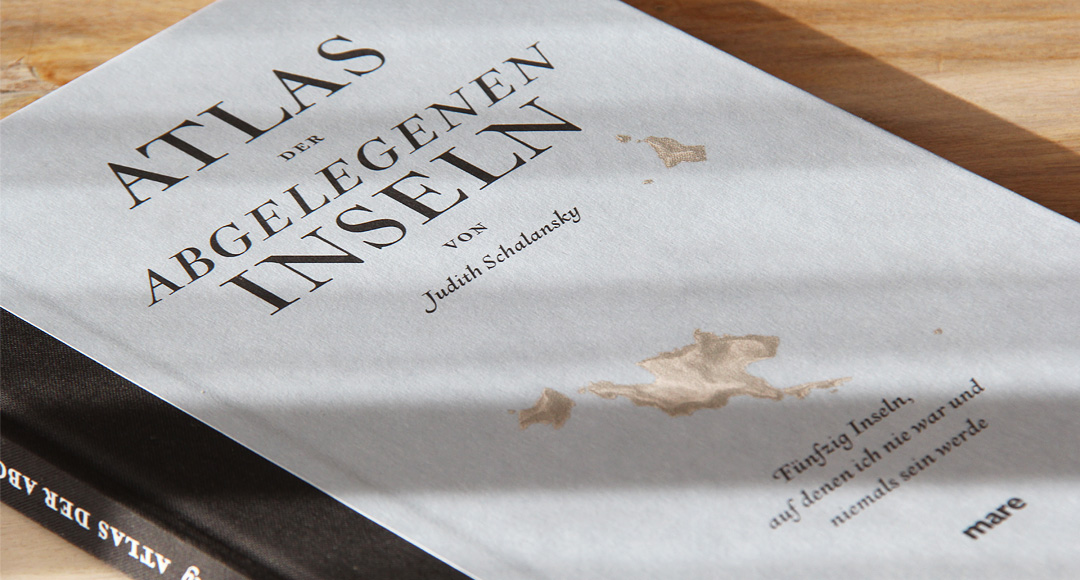
There are books that sit on my wish list for quite a while because they don’t immediately win me over at first glance. I first held this book in Leipzig, and leafing through it I liked it very much. But other books always seemed more interesting and more promising in terms of content, so this little atlas ended up on my Christmas wish list. The Christkind does have a reliable touch, though, and this beautiful piece was under the tree this year. Now I don’t think I’d hesitate long to pick up this little work of art, because after reading it I’m thoroughly delighted.
The sea and islands have always fascinated me, and after numerous reads set on the wide oceans, I still love the scenario of the small, lonely islet. I can’t quite say why. Perhaps because here the beauty and clarity of nature meet the human being and cast a wide shadow on an inner life that’s no less compelling.

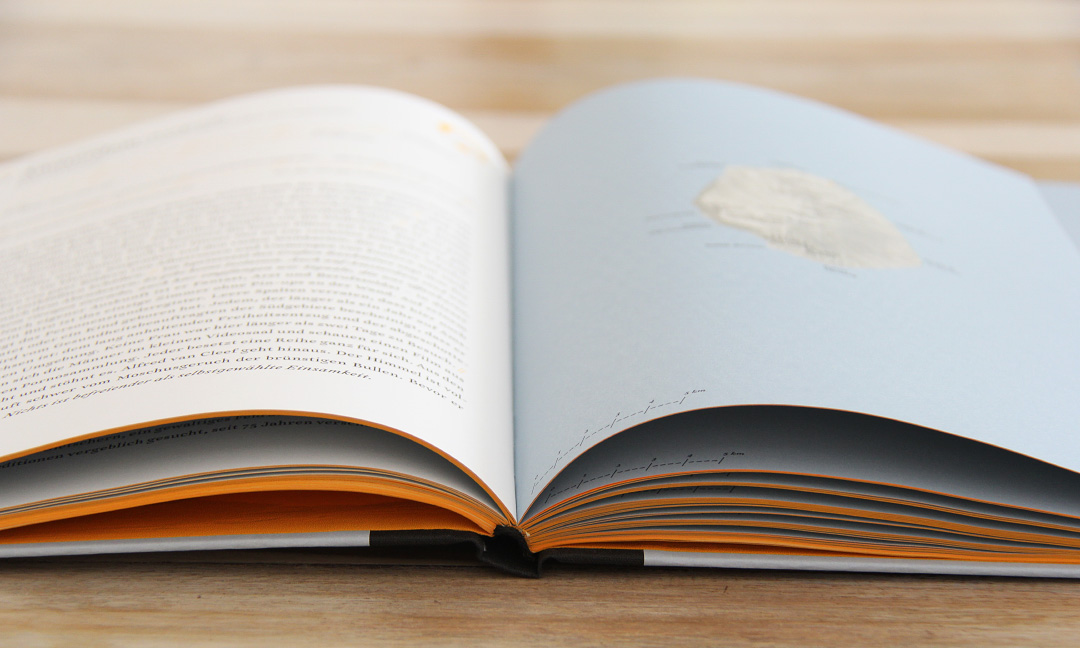
The topic is certainly unusual. Atlas der abgelegenen Inseln (Atlas of Remote Islands) is a title that immediately lures you in. This book presents fifty lonely islands scattered across the world’s oceans and distinguished by their desolate locations. Before I describe what’s inside in more detail, I have to talk about the design, because it’s crucial to the reading experience. This little atlas isn’t really large or extensive like the atlases you know from school. With its 144 pages and a format noticeably smaller than a DIN A4 sheet, it’s nicely compact and sits well in the hand. In terms of color and typography, it really delivers. Yellow and blue tones form the chosen palette, and combined with the typeface the book feels very elegant and harmonious—and a bit old-fashioned, as if you were holding an old primer.

There is a chapter for the Arctic Ocean, the Atlantic Ocean, the Indian Ocean, the Pacific Ocean, and the Southern (Antarctic) Ocean, each introduced by a yellow double-page spread. It presents the region and marks the individual islands that are featured in that chapter.
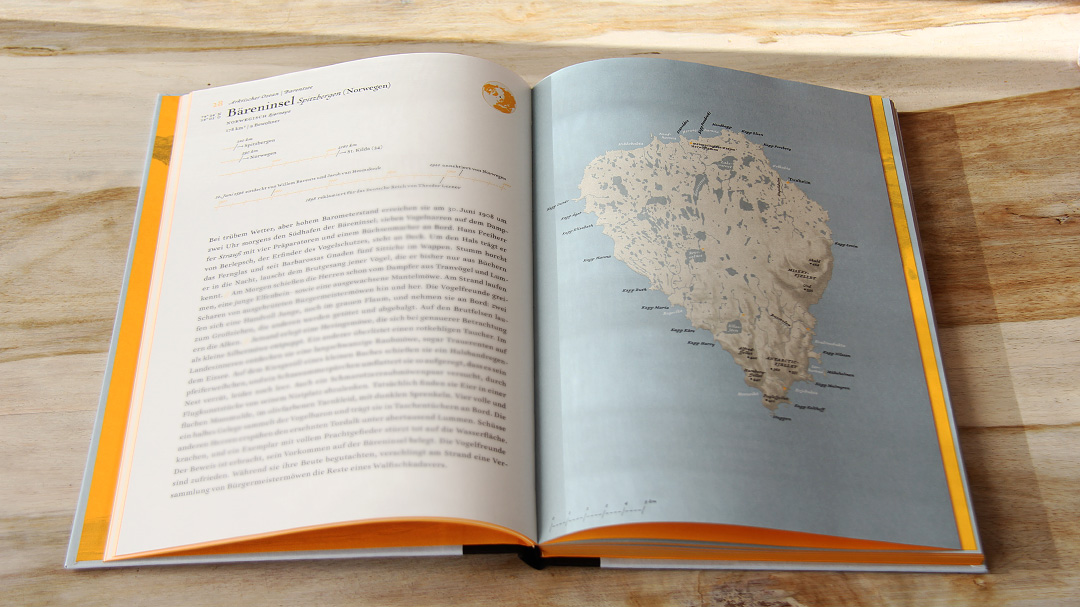
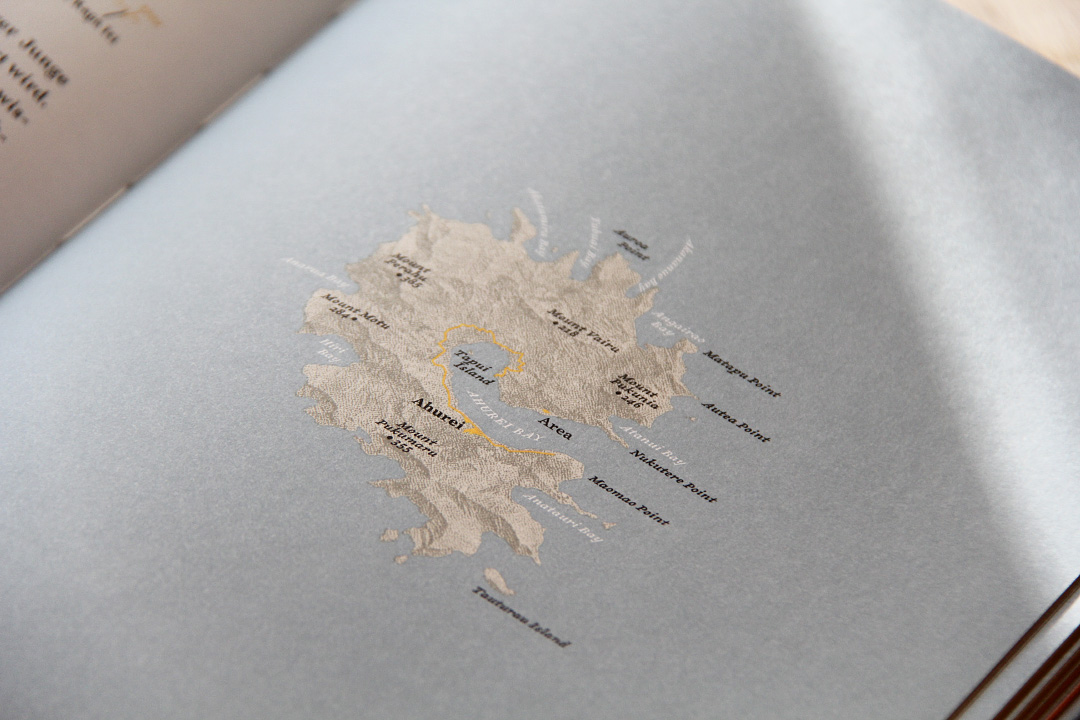
Within the chapters, the individual islands are then presented, with each island getting a double-page spread. The right-hand page shows a map of the island, very much in the manner of an atlas. On the left you first see information about the island—beautifully visualized. I love all kinds of infographics and lovingly designed visualizations, and this book really gets that right. In my view, it’s a template for any communication design textbook.
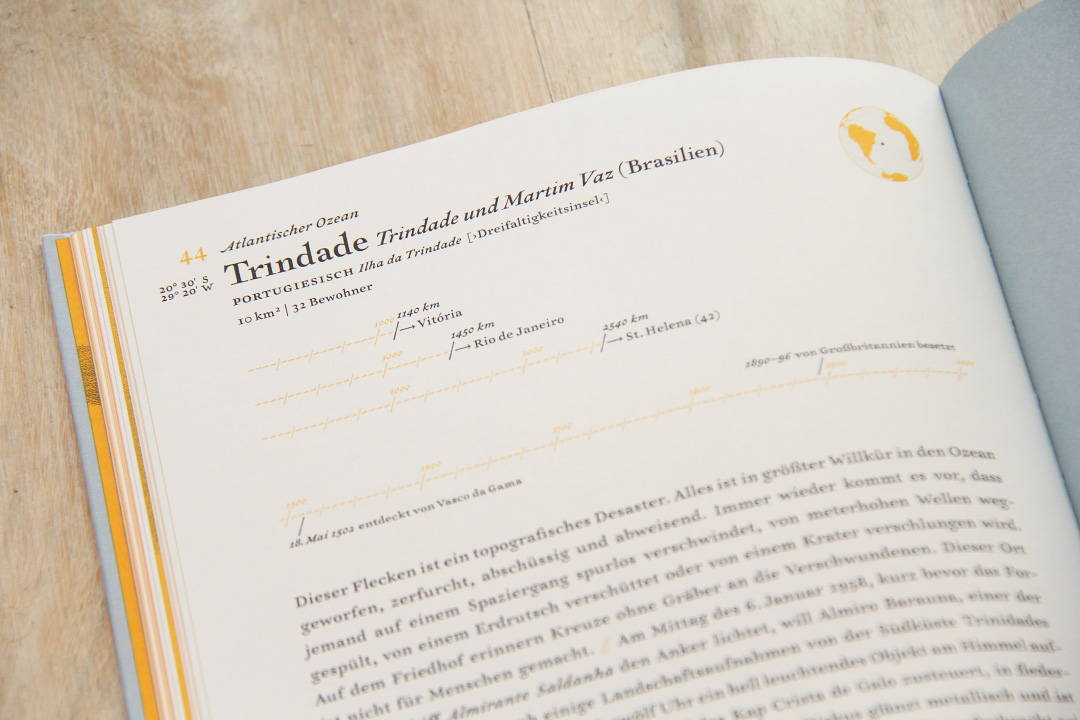
First come the name (also in different languages and variants), the area, and the number of inhabitants. A small globe shows the island’s position. Then the distances to key reference points are displayed on a very stylish measuring scale. Below that there’s a timeline with the decisive milestones in the island’s history. Leafing through, you quickly get your bearings, and browsing the book is genuinely fun.
After that comes a text about the island. At first I was a bit disappointed, because I expected a clear, encyclopedic outline—like in a lexicon, listing vegetation, appearance, and every possible fact in a Wikipedia-like style. But that’s not the case. The text does, of course, often address the island’s characteristics, but it consists of anecdotes and short stories that took place there. And they’re a pleasure to read, because the fates, the events on each island, and what makes each islet unique vary wildly. Naturally it’s about shipwrecks, but also penal colonies; an island where France tested a nuclear bomb; German dropouts founding their own colony and a woman declaring herself a baroness; a tiny population that is color-blind; the mutinous Bounty; Antarctic islands with penguins and whaling; and much, much more. The tales surrounding these small specks—these islands scattered wildly across the globe—are as diverse as humanity itself. It’s pure enjoyment and entertainment to browse the book and read these sometimes quirky, tragic, entertaining, and in any case varied texts.
A foreword by Schalansky briefly introduces the fascination of atlases and sketches what awaits you in this book. All in all, you won’t need more than an evening to read it. That evening, however, will be very entertaining, and you’ll surely pick it up again. The anecdotes are too varied, and this little volume is too beautiful. I often caught myself googling individual islands; it’s fun to look up more information and images. It’s a bit like the Wikipedia effect: you go from one thing to another, leafing through the little atlas and then clicking your way through the internet.
Of course you can’t help thinking about the islands you’ve visited yourself. I’ve been to a few—and surprisingly different ones. They range from Mainau Island, where I barely got an island feeling because I was standing among camera-toting seniors while always keeping the mainland in sight, to a small rocky islet in the Atlantic where the rough sea and sparse surroundings gave a very palpable sense of stranding, solitude, and abandonment.

Verdict: Atlas der abgelegenen Inseln (Atlas of Remote Islands) is an exceptional and very entertaining book that convinces both through its design and its content. The anecdotes about each island are varied, diverse, and always worth reading. The well-prepared island information and the coherent choice of colors, typography, and visualization of key data make the book a real enrichment for relaxed evenings; even though you can easily read it in one sitting, it’s a pleasure to keep browsing it. It rightfully won first prize from the Stiftung Buchkunst and was named the most beautiful book of 2009. Like an old primer, it radiates all the adventures and tragedies that cling to lonely islands: from shipwreck to prison island, from nuclear test site to Arctic whaling station—everything is here.
Book information: Atlas der abgelegenen Inseln (Atlas of Remote Islands: Fifty Islands I Have Not Visited and Never Will) • Judith Schalansky • mare Verlag • 144 pages • ISBN 9783866481176
Ich finde dieses Buch auch wunderschön gestaltet und habe es schon zweimal gelesen, da mir all die Anekdoten so gut gefallen haben. Beide Male hatte ich es nur aus der Bücherei ausgeliehen – beim dritten Mal werde ich es mir dann selbst kaufen. ;-)
Danke für die Empfehlung, Tobi, das klingt auf jeden Fall interessant!
Ich habe den Atlas auch vor kurzem entdeckt und war gleich verliebt! Allerdings habe ich das Taschenbuch mit gelbem Cover – auch sehr schön, passt gut in die Tasche für unterwegs. Der WDR hat es sogar als “musikalisch-poetisches Hörspiel” (nicht meine Worte, sondern deren) umgesetzt.
Liebe Ella,
ich hab gar nicht gesehen, dass es das Buch auch als Taschenbuch gibt. Aber das macht auch Sinn, für kurze Wartezeiten an einer Haltestelle oder ähnliche Situationen, weil die einzelnen Texte zu den Inseln ja nicht lange sind. Unterhaltsamer, als auf dem Smartphone auf die Ladeanimation zu glotzen. Allerdings hätte ich wohl trotzdem in jedem Fall zu der Ausgabe vom mare Verlag gegriffen, da bin ich einfach zu vorbelastet ;)
Die Worte vom WDR hätte ich nun nicht gewählt, aber bisher habe ich auch nur gute Stimmen zu dem Buch gehört. Es scheint wohl jedem gut zu gefallen, was ich ja auch nur bestätigen kann.
Liebe Grüße
Tobi